
BuddhistCatholicContemplativeEvangelicalGeneral ChristianHinduJewishLatter-day SaintMuslimNew VisionsProgressive Christian
Beliefs
- Buddhist
- Catholic
- Contemplative
- Evangelical
- General Christian
- Hindu
- Jewish
- Latter-day Saint
- More Voices
- Muslim
- New Visions
- Pagan
- Progressive Christian
Topics
- Religion News
- Food and Religion
- Sports and Religion
- Religious Art
- Religious Music and Entertainment
- Religious Events
- History and Religion
- Style and Religion
- Politics and Religion
- Women in Religion
- Recreation Outdoors and Religion
- Business Finance and Religion
- Careers Workplace and Religion
- Education and Religion
- Family Parenting and Religion
- Health Fitness and Religion
- Home and Religion
- Relationships and Religion
- Technology and Religion
- Travel and Religion
Columnists
- Buddhist Columnists
- Business Finance and Religion Columnists
- Careers Workplace and Religion Columnists
- Catholic Columnists
- Contemplative Columnists
- Education and Religion Columnists
- Evangelists Columnists
- Family Parenting and Religion Columnists
- General Christian Columnists
- Health Fitness and Religion Columnists
- Hindu Columnists
- History and Religion Columnists
- Home and Religion Columnists
- Jewish Columnists
- More Voices Columnists
- Latter Day Columnists
- Muslim Columnists
- New Visions Columnists
- Nonreligious Columnists
- Pagan Columnists
- Politics and Religion Columnists
- Progressive Columnists
- Recreation Outdoors and Religion Columnists
- Relationships and Religion Columnists
- Religion News Columnists
- Religious Art Columnists
- Religious Events Columnists
- Religious Music and Entertainment Columnists
- Sports and Religion Columnists
- Style and Religion Columnists
- Technology and Religion Columnists
- Travel and Religion Columnists
- Women in Religion Columnists
Resource Library
- 2026 Calendar
- Library of World Religions
- The 100 Most Holy Places on Earth
- Patheos Answers
- Podcasts
- Videos
- Faith Leaders Database
- Anglican Episcopalian
- Bahai
- Baptist
- Buddhism
- Christianity
- Confucianism
- Eastern Orthodoxy
- Hinduism
- Holiness and Pentecostal
- ISKCON
- Islam
- Judaism
- Lutheran
- Methodist
- The Church of Jesus Christ of Latter-day Saints
- New Age
- Paganism
- Presbytarian and Reformed
- Protestantism
- Religion Behind the Scenes
- Roman Catholic
- Scientology
- Shia Islam
- Sikhism
- Sufism
- Sunni Islam
- Taoism
- Zen
- See all religions
Research Tools
 Ad-Free & Subscriber Log-In Subscription Support
Ad-Free & Subscriber Log-In Subscription Support
Follow Patheos 

- Trending:
- Forgiveness
- |
- Marriage
- |
- Consciousness
- |
- Death Penalty
- |
- Election
- |
- Halloween
 Rhetoric Race and Religion
- Home
- Progressive Christian
- #MLK, #BLM and the Rhetoric of Confrontation
#MLK, #BLM and the Rhetoric of Confrontation
Last updated on: February 18, 2018 at 10:46 am by Andre E. Johnson
#MLK, #BLM and the Rhetoric of Confrontation 2018-02-18T10:46:57-05:00 Andre E. Johnson
Patheos Explore the world's faith through different perspectives on religion and spirituality! Patheos has the views of the prevalent religions and spiritualities of the world.
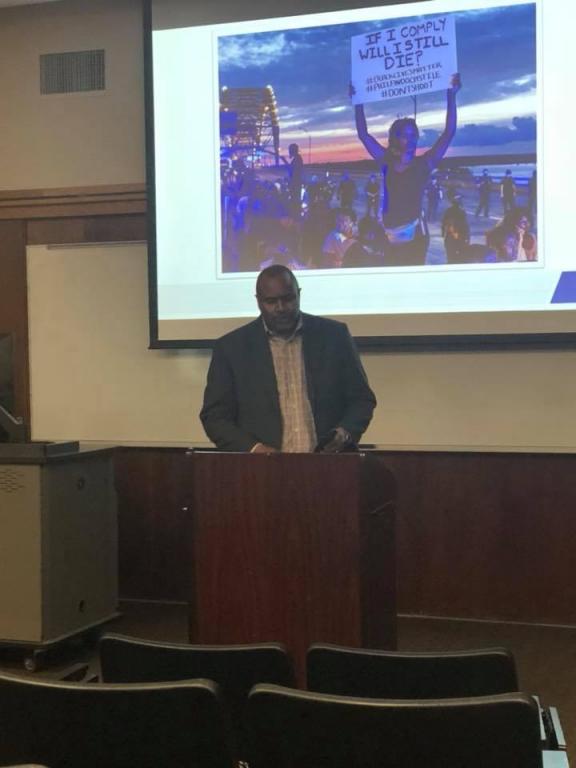 On Friday, February 16, 2018, I gave a talk titled “If We Can’t Get It, Shut It Down:” MLK, BLM and the Rhetoric of Confrontation.” Hosted by the History Department at the University of Memphis, I argued that King, near the end of his life, no longer believed that government officials would “do the right thing,” King called for a campaign of massive civil disobedience that would lead to economic boycotts and shut down entire cities. By doing this, King asked activists to bear witness to their suffering in hopes that the action could convict the government to do the “right thing.” In closing, I argued that BLM whether knowingly or not, have adopted many of the ideas that King argued during the last year of his life thus becoming the natural extension of King’s vision in the last year of his life. Below is a part of that presentation.
On July 10, 2016, more than 1,000 frustrated and fed up American citizens took to the I-40 Bridge connecting Arkansas and Tennessee in an act of mass civil disobedience to disrupt and shut down traffic. These American citizens were protesting the latest videos; the murders of Alton Sterling and Philando Castile that had gone viral causing another round of trauma and pain in the minds and bodies of African Americans. Television stations in Memphis broke away from regularly scheduled programming to cover the protest. The local newspaper provided live updates on its website while other media outlets offered “live” coverage of the event through social media.
People overheard one protester shouting, “We’re trying to get equal rights. We want things to be fair. We want our voices to be heard. Black Lives Matter activist Shahidah Jones called the protest something similar to a family reunion. She remarked, “I saw people I hadn’t seen in years.” Activist Tami Sawyer reminded onlookers and the media that what was going on across the country where people “saying enough is enough,” She continued,
I think about this last year. People all over the city and the Commercial Appeal celebrated the 50th anniversary of the Selma march, where Dr. Martin Luther King and hundreds of African-Americans were hosed by water and attacked by dogs and beaten by police during a peaceful protest for their rights. Fifty years after that, we’re still fighting against the same injustices, and while it is true that blocking traffic could have some dire consequences, the chance of that happening here are still much more slimmer than a black person being faced with systematic racism and injustice.
Labor and wage activist Jayanni Webster, who was one of the last ones off the bridge that night remarked that taking the bridge so openly was the “only opportunity that they would ever have in their life to even talk to a police officer in a way that won’t get them killed. People in Memphis never have the opportunity to confront those in power who represent a failed state of the economy and the politics of this city that continually oppresses people.”
Pastor and University of Memphis Department of Communication graduate student Earle Fisher were one of the ones on the bridge that night. He told independent journalist Wendi Thomas that he was “happy as shit,” about taking the bridge because he “knew it would take a moment like that to change the trajectory of what the movement in Memphis would look like.” Activist Keedran Franklin noted that “A lot of people were crying together, but it was like tears of joy because a lot of people were hurt. That’s the only reason why we were up there,” “Not being heard, not being felt, not enough resources.” While the protest inconvenienced motorists, some that night showed signs of solidarity. One trucker allowed demonstrators to climb on top of his truck to hold up signs and raised fists. Community activist Nour Hantouli, told a reporter that the incident was a “very remarkable sign of solidarity from someone who is caught in the very inconvenient position of that demonstration,” but further added, “of course, that got turned into ‘thugs trashing property,’ you know, the typical racist narrative.”
City officials, on the other hand, had a different view. While claiming that he understood the protester’s frustration, and promising an open dialogue toward effecting change, Interim Police Director at the time of the incident, Mike Rallings remarked that a “bridge shutdown was not the proper way to protest.” Claiming to stand with the protesters, Rallings commented, “I don’t want us to shut down a bridge, I’m with you; I’ll march with you. But we need to do it together; we need to have a dialogue, we need not be shutting down bridges.”
Shelby County Commissioner Terry Roland said that while he was “proud we didn’t have any violence, a lot of those people weren’t even from Memphis, and they should not have blocked the roads, especially a federal highway.” Memphis Mayor Jim Strickland, while appreciating the fact that the protest “remained peaceful,” he cautioned that “citizens must protest in a legal way. Stopping traffic on the interstate is not legal.” A day before the I-40 bridge take over and protest, Atlanta mayor Kasim Reed, after citizens there shut down a major highway infamously proclaimed, “We’re the home of Dr. Martin Luther King. The only thing I ask is that they not take the freeways. Dr. King would never take a freeway.”
Despite, as the Root writer Jeanne Theoharis notes “Reed’s claim is historically absurd,” noting that King “took many a highway—most famously in the Selma-to-Montgomery march,” people continue in speaking of protests, to use the “wrong way”; “right way” dichotomy to silence any activity. Especially when it comes to Black Lives Matter activists, some well-meaning and sympathetic supporters also have been guilty of policing the movement’s strategies. Some like Oprah Winfrey even questioned if BLM had any leaders that could affect “real change.” Others, such as Rev. Barbara Reynolds went even further in her essay published in the Washington Post.
Reynolds, herself active within the Civil Rights struggles of the 60’s, wrote that while the “baby boomers who drove the success of the civil rights movement want to get behind Black Lives Matter, the group’s confrontational and divisive tactics make it difficult.” She remembered that activists in the 1960’s “confronted white mobs and police with dignity and decorum, sometimes dressing in church clothes and kneeling in prayer during protests to make a clear distinction between who was evil and who was good.” She further wrote that activists in her generation were “trained in the tradition of Martin Luther King Jr., we were nonviolent activists who won hearts by conveying respectability and changed laws by delivering a message of love and unity. BLM seems intent on rejecting our proven methods. This movement is ignoring what our history has taught.”
However well-meaning, these historical descriptions just are not accurate. This misremembering not from opponents but supporters of King lead many to believe he was just a utopian dreamer who led a few approved and sanctioned marches. In this presentation, I would like to challenge some of these contemporary embedded narratives by examining the more radical King. Specifically, I examine King’s rhetoric as a synecdoche or as representative of the Civil Rights movement most people profess to understand. Drawing from Robert Cathcart’s notion of managerial and confrontational rhetoric when applied to social movements, King’s earlier rhetoric seeks to be non-confrontational and seeks persuasion—a changing of hearts and minds in accompanying goals and objectives. However, as time went on, I argue that King begins a rhetorical project with the aim not necessarily to persuade but to bear witness through confrontation that would hopefully at best lead to conviction.
During the last year of King’s life, his ability to persuade and to gain a national consensus around issues of war, poverty, economic injustice, and the inequality suffered by blacks and all people of color had waned. Faced with increasing hostility to him and the movement along with the rising white backlash that eventually would give birth to Nixon’s silent majority coalition, King knew that moral suasion would not give him the results that he had hoped. Thus King begins a campaign, grounded in non-violence that aimed to force the government to act on behalf of the movement. No longer believing that government officials would “do the right thing,” King called for a campaign of massive civil disobedience that would lead to economic boycotts and shut down entire cities. By doing this, King asked activists to bear witness to their suffering in hopes that the action could convict the government to do the “right thing.” I conclude by arguing that BLM whether knowingly or not, have adopted many of the ideas that King argued during the last year of his life becoming the natural extension of King’s vision in the last year of his life.
To listen to this and the rest of the lecture, click here.
Donate to the Work of R3
Like the work we do at Rhetoric Race and Religion? Please consider helping us continue to do this work. All donations are tax-deductible through Gifts of Life Ministries/G’Life Outreach, a 501 (3) tax-exempt organization, and our fiscal sponsor. Any donation helps. Just click here to support our work.
Previous Post

February 2, 2018
Silence and Sexual Assault: Toward a Better Response from the Church
Next Post
February 19, 2018 Race, Shrinking Whiteness, and Four Qualities of the Moral Imagination
Browse Our Archives
Select a Category Amy Steele Andre E. Johnson Book Reviews/Series Brian Foulks Call for Chapters Carol Howard Merritt Classes Conferences Contributors Crystal St.Marie Lewis Daniel White Hodge Earle Fisher Eulogy Fredrick Robinson Guest Contributions Henry McNeal Turner Institutes Interviews Joseph Boston Katherine Whitfield Kimberly Peeler-Ringer Lectures/Roundtables Natalie Bullock Brown R3 Book Series R3 Contributor Rashad Grove Readers Reflections Symposiums Teaching Traci Ellis Travis Harris Uncategorized Video
Select a Month June 2020 February 2020 December 2019 November 2019 July 2019 June 2019 May 2019 October 2018 June 2018 May 2018 April 2018 March 2018 February 2018 January 2018 December 2017 November 2017 October 2017 September 2017 August 2017 July 2017 June 2017 May 2017 April 2017 March 2017 February 2017 January 2017 December 2016 November 2016 October 2016 September 2016 August 2016 July 2016 June 2016 May 2016 April 2016 March 2016 February 2016 January 2016 December 2015 November 2015 October 2015 September 2015 August 2015 July 2015 June 2015 May 2015 April 2015 March 2015 February 2015 January 2015 December 2014 November 2014 October 2014 September 2014 August 2014 July 2014 June 2014 May 2014 April 2014 March 2014 February 2014 January 2014 December 2013 November 2013 October 2013 September 2013 August 2013 July 2013 June 2013 May 2013 April 2013 March 2013 February 2013 January 2013 December 2012 November 2012 October 2012 September 2012 August 2012 July 2012 June 2012 May 2012 April 2012 March 2012 February 2012 January 2012 December 2011 November 2011 October 2011
Follow Us!
TAKE THE
Religious Wisdom Quiz
What did Hannah bring annually for Samuel when he lived at the Tabernacle?
Select your answer to see how you score.
A staff A candle A robe A crown
Related posts from Rhetoric Race and Religion


New Book in R3 Book Series on #BLM...

Dislocations and Shutdowns: #MLK, #BLM and the Rhetoric...

From the Mountain Top and Beyond: The Rhetoric...
TRENDING AT PATHEOS Progressive Christian

What Being a Modern-Day Apostle Means to Me
In my last column, I discussed the ins and outs of modern-day...

Did Ancient China Once Worship the God of...
Across human history, a common thread weaves through the origins of the...

Love Your Neighbor – Including Earth-Kin: Lev. 19,...
God’s command to love your neighbor means acting in an ethical and...

Lead a Church Study of “Jesus and Lao...
Guest writer Jack Thomas (The Irreverent Reverend) reflects on leading his church...

Pastoral Wisdom for Responding to Sermon Pushback
Getting sermon pushback on your social justice sermon? Learn practical, Proverbs-based strategies...

Principles for Understanding the Apostolic Ministry Today
Whenever people discover that my formal ministry title is "apostle," as in...
view all Progressive Christian blogs
Ad-Free & Subscriber Log-In Subscription Support
- About Us
- 2026 Calendar
- Videos
- Podcasts
- Library of World Religions
- Faith In Media Tracker
- Advertise With Us
- Write for Us
- Privacy Policy
- Terms of Service
- Do Not Sell My Data
- Contact Us
- Radiant Digital
- Manage Newsletter Subscriptions
- Unsubscribe From Notifications
- Sitemap
Copyright 2008-2026, Patheos. All rights reserved.
Subscription Support Ad-Free & Subscriber Log-In
Follow Patheos