
BuddhistCatholicContemplativeEvangelicalGeneral ChristianHinduJewishLatter-day SaintMuslimNew VisionsProgressive Christian
Beliefs
- Buddhist
- Catholic
- Contemplative
- Evangelical
- General Christian
- Hindu
- Jewish
- Latter-day Saint
- More Voices
- Muslim
- New Visions
- Pagan
- Progressive Christian
Topics
- Religion News
- Food and Religion
- Sports and Religion
- Religious Art
- Religious Music and Entertainment
- Religious Events
- History and Religion
- Style and Religion
- Politics and Religion
- Women in Religion
- Recreation Outdoors and Religion
- Business Finance and Religion
- Careers Workplace and Religion
- Education and Religion
- Family Parenting and Religion
- Health Fitness and Religion
- Home and Religion
- Relationships and Religion
- Technology and Religion
- Travel and Religion
Columnists
- Buddhist Columnists
- Business Finance and Religion Columnists
- Careers Workplace and Religion Columnists
- Catholic Columnists
- Contemplative Columnists
- Education and Religion Columnists
- Evangelists Columnists
- Family Parenting and Religion Columnists
- General Christian Columnists
- Health Fitness and Religion Columnists
- Hindu Columnists
- History and Religion Columnists
- Home and Religion Columnists
- Jewish Columnists
- More Voices Columnists
- Latter Day Columnists
- Muslim Columnists
- New Visions Columnists
- Nonreligious Columnists
- Pagan Columnists
- Politics and Religion Columnists
- Progressive Columnists
- Recreation Outdoors and Religion Columnists
- Relationships and Religion Columnists
- Religion News Columnists
- Religious Art Columnists
- Religious Events Columnists
- Religious Music and Entertainment Columnists
- Sports and Religion Columnists
- Style and Religion Columnists
- Technology and Religion Columnists
- Travel and Religion Columnists
- Women in Religion Columnists
Resource Library
- 2026 Calendar
- Library of World Religions
- The 100 Most Holy Places on Earth
- Patheos Answers
- Podcasts
- Videos
- Faith Leaders Database
- Anglican Episcopalian
- Bahai
- Baptist
- Buddhism
- Christianity
- Confucianism
- Eastern Orthodoxy
- Hinduism
- Holiness and Pentecostal
- ISKCON
- Islam
- Judaism
- Lutheran
- Methodist
- The Church of Jesus Christ of Latter-day Saints
- New Age
- Paganism
- Presbytarian and Reformed
- Protestantism
- Religion Behind the Scenes
- Roman Catholic
- Scientology
- Shia Islam
- Sikhism
- Sufism
- Sunni Islam
- Taoism
- Zen
- See all religions
Research Tools
 Ad-Free & Subscriber Log-In Subscription Support
Ad-Free & Subscriber Log-In Subscription Support
Follow Patheos 

- Trending:
- Forgiveness
- |
- Marriage
- |
- Consciousness
- |
- Death Penalty
- |
- Election
- |
- Halloween
 Rhetoric Race and Religion
- Home
- Progressive Christian
- Proposal for the Eight Hour Work Day
Proposal for the Eight Hour Work Day
Last updated on: September 4, 2017 at 12:48 pm by Andre E. Johnson
Proposal for the Eight Hour Work Day 2017-09-04T12:48:57-05:00 Andre E. Johnson
Patheos Explore the world's faith through different perspectives on religion and spirituality! Patheos has the views of the prevalent religions and spiritualities of the world.
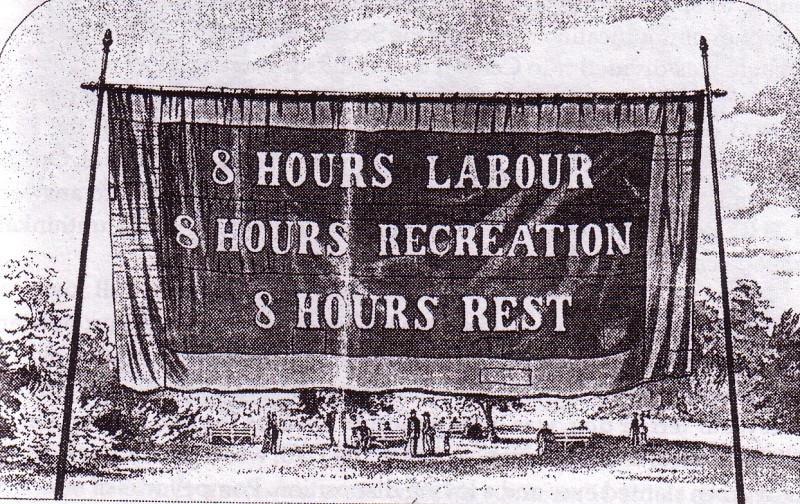 On September 9, 1868, the Atlanta Constitution published a portion of a speech that Henry McNeal Turner was to deliver on the floor of the Georgia House of Representatives. In the speech, Turner was to advocate for the “eight hour bill” pending before the House. In submitting the speech for publication, Turner noted that the speech itself was not completed and several of his strongest points “had not been made.” However when he learned that the House intended to vote him and other African American members ineligible to serve in the legislature because of their beliefs that blacks could not govern, he stopped writing it expecting not to deliver the speech or believing the House or Senate was not “far enough advanced to consider this matter as it should be, and act upon it intelligently.” He was right on both counts. Below is the speech as printed in the Atlanta Constitution.
Mr. Speaker: The bill before this House, which I had the honor of introducing a few days ago, may, from slight attention, appear to some gentlemen on this floor quite amusing, if not ridiculous. But I desire, in paving my way to a practical consideration of the subject, to state an already familiar fact, that this is an age of progress, an age of improvement, an age of great moral and political ideas; yes, may I not in candor say, the vanguard age of the world. For since the day when the umbrageous curtain of moral depravity…..to the appalment of earth and the astonishment of Heaven, man’s dimless intellectual faculties down to the present, no brighter day has ever dawned upon the world’s great drama than the one in which we live. The resources of the mind are contending with the blind fetters of stupidity and human genius clamors in the articulutive notes of all languages and tongues for releasement from the chains of ignorance. Thus, the crooked is being made straight and the hitherto rough is being made smooth, the wrongs of ages is being righted, and false notions though hoary with years, are hourly crashing to the ground, and vanishing like vapor before the rising sun.
The question under consideration may be considered a novel one in this State, if not in most of the Southern States, and yet, I assume that there is not a question now engrossing the attention of our public men of both, or either party, that embraces more truth, more facts, and more good solid reason why it should meet with universal sanction, than this seemingly trite and simple question, viz: “Shall a man work himself to death to live?”
I feel a confidence in the ultimate triumph of the measure incorporated in the bill now pending for discussion. Why? Because it is no new question, no utopian dream, no fanciful idea to lull the energies of the toiling masses. It is to-day, a grand national fact, embodied in the statute laws of our present enlightened Congress. In the first place, the passage of this bill is asked for as an experiment in our legislation. It ought, at least, to have a trial. It can do no harm, but may accomplish much good. The working men of the State ask for its passage, not so much as a peremptory rule, as the recognition of a principle. They feel as I know, that the labor of one-third part of a day, (or twenty-four hours, if you chose) ought to be sufficient to give daily bread, and keep the world industrially moving. They believe, fully that the experiment will not only result in their advantage, morally, socially, and intellectually…….but that the interest of capital, as represented by employers will be benefited in the end.
A very potent reason for the passage of this bill, is, that there may be a uniform standard through the State governing manual labor, and manufacturing employees. In most of the States, ten hours is regarded as a days work. But I find by consulting Irwin’s Code, that there is no ten-hour rule to apply even to our public works. Section 1873 most positively declares the hours of labor shall be “from sun rise to sunset,” except the time allowed for meals, with the boss may limit to his own discretion. And without impugning the honesty of the motives of the framers of the law, I am forced by every philosophic consideration to pronounce such a statute as brutal and as inimical to freedom and happiness of the laborer, as the worse forms of slavery ever were. Custom, however, in several districts of our State has, by common consent, fixed the hours of a day’s work, ranging respectfully from eleven to twelve, and from sunrise to sunset, and in the winter season from day dawn to night dawn. So adverse are these customs that in cases where a man has been engaged to work for another by the day, without a contract specifying the precise number of hours, he is obliged in the event of a controversy, to place experts on the stand to prove what is the usual practice in the locality where he has been employed. – This bill obviates the most onerous difficulty.
The law regulating the interest on money in cases where no specific rate has been agreed upon is in many respects analogous. The term of eight hours has been fixed upon, because while it is the national tenure of laboring hours, it is also the healthful or hygienic limitation of a day’s labor, wherever this rule is habitually violated or exceeded, the man’s life is shortened, and he suffers mentally and morally as well as physically. The demand for the laborer and mechanic not to be required to work more than eight hours each day, is supported by unerring instinct and by the weightiest consideration of expediency, justice and the hitherto premature decadency of humanity. I furthermore find myself sustained by a number of able writers and philosophers of unquestionable ability in this proposition. Cresy’s Encyclopedia of Civil Engineering, chap. ix. “ on Mechanical agents,” page 1087, has the following declaration, to-wit: “ By the term daily labor, is meant the work performed during twenty-four hours, the effective duration of which is only a portion of that time, the remainder being employed in rest and taking meals. Animals of all kinds require that their work should be moderate and regular, and the machine which the drive or put to motion should never call forth more exertion than is natural for them. The limit of this action is indicated by the lassitude which the mover evinces, and which may term the DAILY FATIGUE.”
Daniel Bernoulli imagined that the degree of fatigue was always proportioned to the action which produced it so that whether the man was employed in walking, carrying a load, drawing or pushing, working at a windglass, or raising a weight, he always produced with the same degree of fatigue, the same quantity of action, and consequently, the same effect, and that the daily labor of a man estimated as raising 1, 72(6/8), 000 pounds one-foot high. This estimate would be equal to 60 pounds raised that height every second when his daily labor was eight hours only.
William J. Rankin McQuorne, Professor of Civil Engineering in the University of Glasco, in an able article contributed by him to the Encyclopedia Britannica, volume 14, page 417, says: “The mechanical daily duty of a man or beast is the product of three quantities – the effort, the velocity, the number of units of time per day during which work is continued. It is well known that for each individual man or animal, there is a certain set of valves of these three quantities, which make the product of a daily duty, a maximum, and that any departure from these valves diminishes the daily duty.” The article from which I am quoting, concludes thus: “The past time of working per day for man and all animals, is one third part of a day, or eight hours, a conclusion in accordance with tested experience.” This view is also adopted by a contributor to Appleton’s American Encyclopedia, Article Mechanic’s, vol. II, page 327. “A Man acting by muscular power or weight, and quadrupeds, are animate motors moving powers. The best continued practical working effect of animate motors is obtained when the working hours do not exceed one-third of the twenty-four.”
When…..performed by working men of mechanics, the average term of day labor is but eight hours. In demonstration of this assertion I will state that iron moulders in the State of New York, whose work is of this description, make eight hours the rule. In the mines of the Pacific coast, and the Sierras of that region, the mines far distant from physicians, and forced to adopt the best precautionary means for maintaining health, have, by common consent, agreed upon the eight-hour rule.
This fact, is warranted by the severest experience, led by the General Assembly of California in February, 1866, to pass the bill defining eight hours to be the period of a legal day’s work. In Australia, also, universal experience has led to the establishment of the same rule. But let us adduce a few examples: Elisha Burritt, the learned blacksmith of Worcester, Mass., assigned for himself the same time for labor, and around who brow clusters grander results for a measure or a habit pursued though a triumphant life. Chevaller Brunsen, of Germany, has also said that eight hours were sufficient for a day’s work.
The marching time for armies is also thus limited, from 12 to 17 miles being the distance made day by day; whenever forced marches are had, straining out by a most vigorous effort 40 or 50 miles a day. Long periods for rest and recuperation must ensue, or a large part of the army will be disabled by sickness. The Encyclopedia Britannica makes a similar declaration in respect to the progress made by caravans. It says, (see articles on caravans) from seven to eight hours a day seems to have become a usual day’s journey for caravans, so that, estimating the slow and unwieldy gait of a camel at two and half miles an hour, the average rate of travel would be from 17 to 20 miles a day. Tradition, if I may not call it reliable history, informs us that Solomon, when he was building the Temple of the Most High God, promulgated a decree for the men employed upon that great work to observe, as follows: “Eight hours shall be dedicated to labor, eight hours to rest, recreation, refreshment, and the worship of Jehovah, and eight hours for sleep.”
Let us next notice some of the customs in several of the European and Asiatic countries, which I will do as concisely and as pointedly as time will allow me. But before proceeding to this historical review, allow me to state that the framer of our beings never intended that man, under any circumstance, should wear and toil out every moment of his existence for a little bread to eat, and a few garments to cover his nudeness. This is a false idea handed down from one generation to another, by men who chief pride and ambition is to acquire wealth, though it be at the sacrifice of health and of life. If men would think more and work less, he would be bettered in all respects ten times more rapidly than it is. The trouble is, we absorbed the intellectual in the physical, instead of the physical in the intellectual.
Donate to the Work of R3
Like the work we do at Rhetoric Race and Religion? Please consider helping us continue to do this work. All donations are tax-deductible through Gifts of Life Ministries/G’Life Outreach, a 501(c)(3) tax exempt organization, and our fiscal sponsor. Any donation helps. Just click here to support our work.
Previous Post
August 24, 2017
New Book in R3 Book Series on African American Preaching
Next Post

September 6, 2017 Call for Papers: From the Mountain Top and Beyond
Browse Our Archives
Select a Category Amy Steele Andre E. Johnson Book Reviews/Series Brian Foulks Call for Chapters Carol Howard Merritt Classes Conferences Contributors Crystal St.Marie Lewis Daniel White Hodge Earle Fisher Eulogy Fredrick Robinson Guest Contributions Henry McNeal Turner Institutes Interviews Joseph Boston Katherine Whitfield Kimberly Peeler-Ringer Lectures/Roundtables Natalie Bullock Brown R3 Book Series R3 Contributor Rashad Grove Readers Reflections Symposiums Teaching Traci Ellis Travis Harris Uncategorized Video
Select a Month June 2020 February 2020 December 2019 November 2019 July 2019 June 2019 May 2019 October 2018 June 2018 May 2018 April 2018 March 2018 February 2018 January 2018 December 2017 November 2017 October 2017 September 2017 August 2017 July 2017 June 2017 May 2017 April 2017 March 2017 February 2017 January 2017 December 2016 November 2016 October 2016 September 2016 August 2016 July 2016 June 2016 May 2016 April 2016 March 2016 February 2016 January 2016 December 2015 November 2015 October 2015 September 2015 August 2015 July 2015 June 2015 May 2015 April 2015 March 2015 February 2015 January 2015 December 2014 November 2014 October 2014 September 2014 August 2014 July 2014 June 2014 May 2014 April 2014 March 2014 February 2014 January 2014 December 2013 November 2013 October 2013 September 2013 August 2013 July 2013 June 2013 May 2013 April 2013 March 2013 February 2013 January 2013 December 2012 November 2012 October 2012 September 2012 August 2012 July 2012 June 2012 May 2012 April 2012 March 2012 February 2012 January 2012 December 2011 November 2011 October 2011
Follow Us!
TAKE THE
Religious Wisdom Quiz
What Christian denomination is known for circuit riders and revival meetings in America?
Select your answer to see how you score.
Catholic Presbyterian Episcopalian Methodist
Related posts from Rhetoric Race and Religion


Dislocations and Shutdowns: #MLK, #BLM and the Rhetoric...

From the Mountain Top and Beyond: The Rhetoric...

Special Issue: Communication, Religion, and Race in America
TRENDING AT PATHEOS Progressive Christian

What Being a Modern-Day Apostle Means to Me
In my last column, I discussed the ins and outs of modern-day...

Did Ancient China Once Worship the God of...
Across human history, a common thread weaves through the origins of the...

Love Your Neighbor – Including Earth-Kin: Lev. 19,...
God’s command to love your neighbor means acting in an ethical and...

Lead a Church Study of “Jesus and Lao...
Guest writer Jack Thomas (The Irreverent Reverend) reflects on leading his church...

Pastoral Wisdom for Responding to Sermon Pushback
Getting sermon pushback on your social justice sermon? Learn practical, Proverbs-based strategies...

Principles for Understanding the Apostolic Ministry Today
Whenever people discover that my formal ministry title is "apostle," as in...
view all Progressive Christian blogs
Ad-Free & Subscriber Log-In Subscription Support
- About Us
- 2026 Calendar
- Videos
- Podcasts
- Library of World Religions
- Faith In Media Tracker
- Advertise With Us
- Write for Us
- Privacy Policy
- Terms of Service
- Do Not Sell My Data
- Contact Us
- Radiant Digital
- Manage Newsletter Subscriptions
- Unsubscribe From Notifications
- Sitemap
Copyright 2008-2026, Patheos. All rights reserved.
Subscription Support Ad-Free & Subscriber Log-In
Follow Patheos