
BuddhistCatholicContemplativeEvangelicalGeneral ChristianHinduJewishLatter-day SaintMuslimNew VisionsProgressive Christian
Beliefs
- Buddhist
- Catholic
- Contemplative
- Evangelical
- General Christian
- Hindu
- Jewish
- Latter-day Saint
- More Voices
- Muslim
- New Visions
- Pagan
- Progressive Christian
Topics
- Religion News
- Food and Religion
- Sports and Religion
- Religious Art
- Religious Music and Entertainment
- Religious Events
- History and Religion
- Style and Religion
- Politics and Religion
- Women in Religion
- Recreation Outdoors and Religion
- Business Finance and Religion
- Careers Workplace and Religion
- Education and Religion
- Family Parenting and Religion
- Health Fitness and Religion
- Home and Religion
- Relationships and Religion
- Technology and Religion
- Travel and Religion
Columnists
- Buddhist Columnists
- Business Finance and Religion Columnists
- Careers Workplace and Religion Columnists
- Catholic Columnists
- Contemplative Columnists
- Education and Religion Columnists
- Evangelists Columnists
- Family Parenting and Religion Columnists
- General Christian Columnists
- Health Fitness and Religion Columnists
- Hindu Columnists
- History and Religion Columnists
- Home and Religion Columnists
- Jewish Columnists
- More Voices Columnists
- Latter Day Columnists
- Muslim Columnists
- New Visions Columnists
- Nonreligious Columnists
- Pagan Columnists
- Politics and Religion Columnists
- Progressive Columnists
- Recreation Outdoors and Religion Columnists
- Relationships and Religion Columnists
- Religion News Columnists
- Religious Art Columnists
- Religious Events Columnists
- Religious Music and Entertainment Columnists
- Sports and Religion Columnists
- Style and Religion Columnists
- Technology and Religion Columnists
- Travel and Religion Columnists
- Women in Religion Columnists
Resource Library
- 2026 Calendar
- Library of World Religions
- The 100 Most Holy Places on Earth
- Patheos Answers
- Podcasts
- Videos
- Faith Leaders Database
- Anglican Episcopalian
- Bahai
- Baptist
- Buddhism
- Christianity
- Confucianism
- Eastern Orthodoxy
- Hinduism
- Holiness and Pentecostal
- ISKCON
- Islam
- Judaism
- Lutheran
- Methodist
- The Church of Jesus Christ of Latter-day Saints
- New Age
- Paganism
- Presbytarian and Reformed
- Protestantism
- Religion Behind the Scenes
- Roman Catholic
- Scientology
- Shia Islam
- Sikhism
- Sufism
- Sunni Islam
- Taoism
- Zen
- See all religions
Research Tools
 Ad-Free & Subscriber Log-In Subscription Support
Ad-Free & Subscriber Log-In Subscription Support
Follow Patheos 

- Trending:
- Forgiveness
- |
- Marriage
- |
- Consciousness
- |
- Death Penalty
- |
- Election
- |
- Halloween
 Rhetoric Race and Religion
- Home
- Progressive Christian
- Introducing the #HMTProject
Introducing the #HMTProject
Last updated on: August 10, 2017 at 12:09 pm by Andre E. Johnson
Introducing the #HMTProject 2017-08-10T12:09:06-05:00 Andre E. Johnson
Patheos Explore the world's faith through different perspectives on religion and spirituality! Patheos has the views of the prevalent religions and spiritualities of the world.
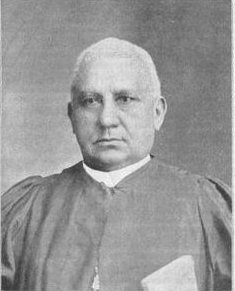
I discovered Henry McNeal Turner (1834-1915) by accident. While starting a seminar class in rhetorical criticism and trying to hone in on a dissertation topic, I ran across a speech delivered by Turner. He delivered the speech on the floor of the Georgia House of Representatives as the House debated whether African Americans could hold office in the state of Georgia. I remember reading the speech and wondering if anyone had studied Turner’s rhetoric. However, there was a problem. Since Turner lived during the nineteenth and early twentieth centuries, it was my belief that texts would be difficult to find. Turner, like many of his contemporaries during this time, spoke extemporaneously—not from notes or prepared texts. Moreover, unlike many other speakers during this time, Turner did not travel with a stenographer—or someone who could have written what Turner said for later publication. Going into my project, I only hoped there were enough texts to do a solid dissertation.
Imagine my surprise when I found that Turner was not only one of the most prolific writers and speakers during his time but also was one of America’s earliest black activists and social reformers, and, as such, made an indelible mark in history and left an enduring social influence. He published a copious amount of articles, essays, and editorials for the Christian Recorder and the AME Church Review. During his time as a chaplain in the Union Army, his weekly reports published in the Christian Recorder from the battlefield became a necessary read for blacks. He published several pamphlets and wrote the introductions to several books. Turner also published several of his speeches as well as a book of letters chronicling one of his trips to Africa. He published a hymnal as well as a church manual for the denomination. However, despite the thick corpus of material to study, scholars have not paid as much attention to Turner as to some of his contemporaries. One of the reasons for this oversight is that Turner’s corpus has not been available for study. Therefore, I made a promise to myself as I was completing my dissertation. I would collect, curate, reclaim and reintroduce Turner not only to academics, but also to the larger public. This lead to the launching of the Henry McNeal Turner Project.
I think the significance of this project is three fold. First, Turner’s public career lasted over sixty years. This archival project will preserve Turner’s writings during that entire critical era. Starting in the antebellum period during the days of slavery to the earlier years of the twentieth century, Turner’s writings give us insight not only on (African) American history, but also Black Church history and the fight for Civil Rights. During his life Turner lived through slavery, Reconstruction, Post-Reconstruction and the beginning of official state sanctioned Jim Crow. As these writings show, Turner presented himself both as a public intellectual and public theologian. Moreover, through his writings and speeches, we not only meet someone who lived through these times, but also a man who participated in shaping the times in which he lived.
Second, there is no “traditional archive” of Turner’s writings. The Spingarn-Mooreland Research Library at Howard University offers two small boxes of “papers” on Turner, but it is not a full collection. As far as I know, this will be the first “place” dedicated to the writings of Turner. In addition, as with any digital archive, this will be a “living archive” meaning that if we discover any other writings or papers from Turner, we can easily upload them as part of the collection.
Finally, while Turner’s writings will make up the centerpiece of the project, we will also add other important artifacts, pictures and writings significant to Turner’s career. This will include other texts that Turner mentions in his writings, newspaper accounts and editorials on or about Turner, and general stories about Turner. Additionally, this will also be a place where readers will learn of current scholarship of Turner. I already started a page with links to previous scholarship on Turner and plans are to invite others to research, write, and present their own findings on the Bishop. It is my hope that this site will lead scholars from many different disciplines to publish works on Turner and continue to share the story of this forgotten leader of the nineteenth and twentieth century.
There are two primary audiences for this project. The first is a scholarly audience. This includes academics using the site as an avenue for primary research. In examining Turner’s life and legacy, students and scholars of Communication/Rhetoric, History, English, African American (Black) Studies, Journalism, Media, Political Science, Religion, and the Black Church will find the site helpful. The second audience consists of non-academics. This includes community leaders, activists, faith-based organizers, and members of the Black Church, especially members of the AME church. By highlighting these two audiences, it is my aim to practice an engaged scholarship that will lead not only to online conversations between the two, but also to begin bridging the gap between “town” and “gown” that stubbornly still exist.
As part of the plan to reach out to these intended audiences, I will actively engage in social media. I have already developed Facebook page and group and a Twitter account along with a hashtag; #HMTProject. In my attempt to make history connect to the present, throughout the school year, I will host live Facebook and Twitter chats on contemporary issues that were also germane during Turner’s time. In addition, we plan on promoting the site as a “required text” for classes and assisting teachers (at all levels) with lesson plans. This is why this site exists. It is our intent to recover a lost voice within American and African American history. Henry McNeal Turner deserves recognition and it is our fervent hope that this site begins to serve that purpose.
If you would like to help with the #HMTProject, email Andre E. Johnson at [email protected].
Donate to the Work of R3
Like the work we do at Rhetoric Race and Religion? Please consider helping us continue to do this work. All donations are tax-deductible through Gifts of Life Ministries/G’Life Outreach, a 501(c)(3) tax exempt organization, and our fiscal sponsor. Any donation helps. Just click here to support our work.
Previous Post

August 6, 2017
What Is Womanist Preaching?
Next Post

August 13, 2017 Reflections on #Charlottesville-Part 1
Browse Our Archives
Select a Category Amy Steele Andre E. Johnson Book Reviews/Series Brian Foulks Call for Chapters Carol Howard Merritt Classes Conferences Contributors Crystal St.Marie Lewis Daniel White Hodge Earle Fisher Eulogy Fredrick Robinson Guest Contributions Henry McNeal Turner Institutes Interviews Joseph Boston Katherine Whitfield Kimberly Peeler-Ringer Lectures/Roundtables Natalie Bullock Brown R3 Book Series R3 Contributor Rashad Grove Readers Reflections Symposiums Teaching Traci Ellis Travis Harris Uncategorized Video
Select a Month June 2020 February 2020 December 2019 November 2019 July 2019 June 2019 May 2019 October 2018 June 2018 May 2018 April 2018 March 2018 February 2018 January 2018 December 2017 November 2017 October 2017 September 2017 August 2017 July 2017 June 2017 May 2017 April 2017 March 2017 February 2017 January 2017 December 2016 November 2016 October 2016 September 2016 August 2016 July 2016 June 2016 May 2016 April 2016 March 2016 February 2016 January 2016 December 2015 November 2015 October 2015 September 2015 August 2015 July 2015 June 2015 May 2015 April 2015 March 2015 February 2015 January 2015 December 2014 November 2014 October 2014 September 2014 August 2014 July 2014 June 2014 May 2014 April 2014 March 2014 February 2014 January 2014 December 2013 November 2013 October 2013 September 2013 August 2013 July 2013 June 2013 May 2013 April 2013 March 2013 February 2013 January 2013 December 2012 November 2012 October 2012 September 2012 August 2012 July 2012 June 2012 May 2012 April 2012 March 2012 February 2012 January 2012 December 2011 November 2011 October 2011
Follow Us!
TAKE THE
Religious Wisdom Quiz
Who said: "If we confess our sins, he is faithful and just and will forgive us our sins"?
Select your answer to see how you score.
John Paul Peter Jesus
Related posts from Rhetoric Race and Religion


Dislocations and Shutdowns: #MLK, #BLM and the Rhetoric...

From the Mountain Top and Beyond: The Rhetoric...

Special Issue: Communication, Religion, and Race in America
TRENDING AT PATHEOS Progressive Christian

What Being a Modern-Day Apostle Means to Me
In my last column, I discussed the ins and outs of modern-day...

Did Ancient China Once Worship the God of...
Across human history, a common thread weaves through the origins of the...

Love Your Neighbor – Including Earth-Kin: Lev. 19,...
God’s command to love your neighbor means acting in an ethical and...

Lead a Church Study of “Jesus and Lao...
Guest writer Jack Thomas (The Irreverent Reverend) reflects on leading his church...

Pastoral Wisdom for Responding to Sermon Pushback
Getting sermon pushback on your social justice sermon? Learn practical, Proverbs-based strategies...

Principles for Understanding the Apostolic Ministry Today
Whenever people discover that my formal ministry title is "apostle," as in...
view all Progressive Christian blogs
Ad-Free & Subscriber Log-In Subscription Support
- About Us
- 2026 Calendar
- Videos
- Podcasts
- Library of World Religions
- Faith In Media Tracker
- Advertise With Us
- Write for Us
- Privacy Policy
- Terms of Service
- Do Not Sell My Data
- Contact Us
- Radiant Digital
- Manage Newsletter Subscriptions
- Unsubscribe From Notifications
- Sitemap
Copyright 2008-2026, Patheos. All rights reserved.
Subscription Support Ad-Free & Subscriber Log-In
Follow Patheos