
BuddhistCatholicContemplativeEvangelicalGeneral ChristianHinduJewishLatter-day SaintMuslimNew VisionsProgressive Christian
Beliefs
- Buddhist
- Catholic
- Contemplative
- Evangelical
- General Christian
- Hindu
- Jewish
- Latter-day Saint
- More Voices
- Muslim
- New Visions
- Pagan
- Progressive Christian
Topics
- Religion News
- Food and Religion
- Sports and Religion
- Religious Art
- Religious Music and Entertainment
- Religious Events
- History and Religion
- Style and Religion
- Politics and Religion
- Women in Religion
- Recreation Outdoors and Religion
- Business Finance and Religion
- Careers Workplace and Religion
- Education and Religion
- Family Parenting and Religion
- Health Fitness and Religion
- Home and Religion
- Relationships and Religion
- Technology and Religion
- Travel and Religion
Columnists
- Buddhist Columnists
- Business Finance and Religion Columnists
- Careers Workplace and Religion Columnists
- Catholic Columnists
- Contemplative Columnists
- Education and Religion Columnists
- Evangelists Columnists
- Family Parenting and Religion Columnists
- General Christian Columnists
- Health Fitness and Religion Columnists
- Hindu Columnists
- History and Religion Columnists
- Home and Religion Columnists
- Jewish Columnists
- More Voices Columnists
- Latter Day Columnists
- Muslim Columnists
- New Visions Columnists
- Nonreligious Columnists
- Pagan Columnists
- Politics and Religion Columnists
- Progressive Columnists
- Recreation Outdoors and Religion Columnists
- Relationships and Religion Columnists
- Religion News Columnists
- Religious Art Columnists
- Religious Events Columnists
- Religious Music and Entertainment Columnists
- Sports and Religion Columnists
- Style and Religion Columnists
- Technology and Religion Columnists
- Travel and Religion Columnists
- Women in Religion Columnists
Resource Library
- 2026 Calendar
- Library of World Religions
- The 100 Most Holy Places on Earth
- Patheos Answers
- Podcasts
- Videos
- Faith Leaders Database
- Anglican Episcopalian
- Bahai
- Baptist
- Buddhism
- Christianity
- Confucianism
- Eastern Orthodoxy
- Hinduism
- Holiness and Pentecostal
- ISKCON
- Islam
- Judaism
- Lutheran
- Methodist
- The Church of Jesus Christ of Latter-day Saints
- New Age
- Paganism
- Presbytarian and Reformed
- Protestantism
- Religion Behind the Scenes
- Roman Catholic
- Scientology
- Shia Islam
- Sikhism
- Sufism
- Sunni Islam
- Taoism
- Zen
- See all religions
Research Tools
 Ad-Free & Subscriber Log-In Subscription Support
Ad-Free & Subscriber Log-In Subscription Support
Follow Patheos 

- Trending:
- Forgiveness
- |
- Marriage
- |
- Consciousness
- |
- Death Penalty
- |
- Election
- |
- Halloween
 Rhetoric Race and Religion
- Home
- Progressive Christian
- The Fourth of July is a Day to #Resist
The Fourth of July is a Day to #Resist
Last updated on: July 4, 2017 at 8:32 am by Guest Contributor
The Fourth of July is a Day to #Resist 2017-07-04T08:32:01-05:00 Guest Contributor
Patheos Explore the world's faith through different perspectives on religion and spirituality! Patheos has the views of the prevalent religions and spiritualities of the world.
First posted on Citizen Critics.
Once again, stores are stocked with miniature flags and coal for grilling. Americans are breaking out picnic blankets and American flag-themed apparel. At the same time, many Americans are buying poster-board and writing up calls to “Resist.” In a year marked by the largest protests in American history, a number of groups are planning demonstrations and marches on the Independence Day holiday. For a country where refusing to stand for the national anthem can be widely renounced as unpatriotic, using the Fourth to picket and shout into megaphones will surely draw some criticism.
Protest anyway. Independence Day has always been a day of resistance. Signing the Declaration of Independence was, itself, an act of profound protest, a call to reject an entire system of government. In the centuries since, the holiday has been used as a foil for disgruntled citizens to express their problems with society and the government. The causes have ranged from pacifism to abolitionism to women’s suffrage and beyond. Across these agendas, Americans have consistently found that the Fourth of July provides what the Greeks called kairos: an opportune moment to advance an argument.
A History of Dissent
The first Fourth of July protest happened just a year after the Declaration was signed. As citizens of Philadelphia gathered in 1777 to enjoy fireworks and banners, a group of pacifists — the Society of Friends — resisted the festivities and the glorification of violence. While much of the city lit their windows with candlelight to show support for the war effort, the Friends left their houses dark to condemn the ongoing Revolutionary War. An angry mob of pro-war Philadelphians shattered their windows. Then, as now, pushing back against a patriotic holiday carried a risk.
For the first few decades of the Republic, few people took that risk. In a young nation trying to build a sense of national identity, speakers tried not to dissent. Typically, they spoke in a way that was so ornate, so specific, and so image-driven that nothing was left to the audience’s imagination. For hours, they would vividly describe battles of the Revolutionary War, with sentences like, “CORNWALLIS droops his crest. This petrified colossus that would bestride our land, crumbles into dust.” It was eloquent stuff, but not meant to challenge how audiences thought.
As Fourth of July speeches became formulaic, speakers started trying to use their platform more subversively. In 1826, for instance, the idiosyncratic orator Robert Owen declared private property, “irrational systems of religion,” and marriage to be a “Trinity of the most monstrous evils.” As might be expected, listeners were outraged. Another example came from Boston, where each year the city carefully selected a well-known citizen to deliver an official Fourth of July speech. Bucking expectations, the young politician Charles Sumner challenged the way the Fourth of July celebration glamorized warfare and violence. He even had the gall to claim that George Washington should not be honored for any of his activity in war, but only as president. Blasphemy! City authorities were not pleased.
In time, Independence Day protests emerged as a powerful way for the disenfranchised to advance their arguments. Among abolitionists and former slaves, for example, critical gatherings were held on the fifth of July to draw a stark distinction from the celebrations on the Fourth. Across the 19th and 20th centuries, the holiday became a time for civil rights activists, antiwar demonstrators, and suffragists to pursue expanded political rights. As James R. Heintze chronicles in his Fourth of July Encyclopedia, these protestors form an important part of the tapestry of the holiday’s history.
An Opportune Time to Resist
Why is the Fourth of July such an appealing time to protest? In large part, it stems from the document the holiday commemorates. Written by a slaveholder to herald the “self-evident” nature of human equality, the Declaration of Independence has always captured the obvious contradictions between American ideals and an imperfect reality. As Abraham Lincoln put it, the Declaration was written to be “constantly labored for, and even though never perfectly attained… constantly spreading and deepening its influence.” Every time the Fourth of July comes around, it provides a chance to highlight that distance between the Declaration’s vision and its execution.
But there’s another, perhaps more obvious, reason why the Declaration provides such an effective basis for protest. People typically remember the first few lines of the Declaration of Independence, but most of the document is not an eloquent enumeration of natural rights. It’s a list of complaints. King George III had obstructed justice, denied the rule of law, granted too much power to the military, cut off trade, imposed taxes, quartered troops — the list went on. What better template for protest than a list of political grievances?
Thanks to its format, the Declaration offers an excellent model for those aiming to express their discontent. Take, for instance, the Declaration of Sentiments written by women’s suffragists at the Seneca Falls Convention in 1848. Rewriting Thomas Jefferson’s text to declare that “all men and women are created equal,” the authors adapted the list of grievances against King George to show how men oppressed women. Similarly, on the Fourth of July in 1915, suffragist Carrie Chapman Catt invoked the Declaration and followed a similar structure for her argument. Repeating the phrase “we protest” to start several sentences, she challenged women’s unequal treatment by government.
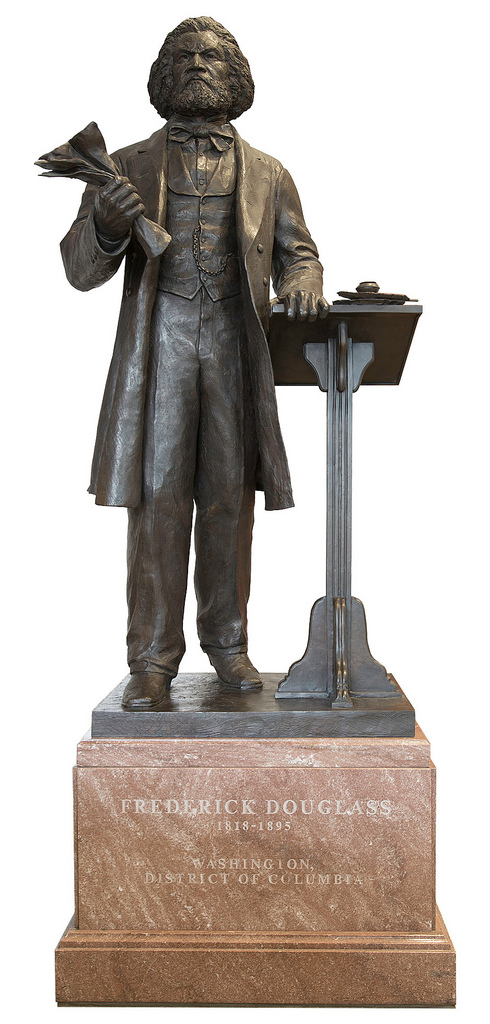
Protesting on the Fourth also creates an opportunity to highlight contrasts between those celebrating and those who, due to injustices, cannot. This is the rhetorical power of juxtaposition: setting two images side-by-side and letting them speak for themselves. Frederick Douglass was well aware of this technique when he delivered his famous Fourth of July speech. From the outset, he made it clear that he was weary of arguing the immorality of slavery. Instead, he used juxtaposition. To the slave, he said, “your celebration is a sham; your boasted liberty, an unholy license; your national greatness, swelling vanity.” Set beside horrific scenes of slave auctions, it was utterly perverse to hear men speaking about “liberty and equality.” Where argument would not work, Douglass made his audience feel dissonance.
And so, this Fourth of July, create that dissonance. While others down hotdogs and watch fireworks, take to the streets to challenge police brutality, threats to health care, underfunded veterans’ benefits, or efforts to suppress voting rights. List your grievances. Declare self-evident truths. Whatever your cause, this is the day to pronounce it loudly.
Michael J. Steudeman is a Visiting Assistant Professor of Rhetoric at the University of Memphis.
Donate to the Work of R3
Like the work we do at Rhetoric Race and Religion? Please consider helping us continue to do this work. All donations are tax-deductible through Gifts of Life Ministries/G’Life Outreach, a 501(c)(3) tax exempt organization, and our fiscal sponsor. Any donation helps. Just click here to support our work.
Previous Post

June 27, 2017
When Demons Are Not Discussed
Next Post

July 16, 2017 Two Years Later: Remembering Sandra Bland
Browse Our Archives
Select a Category Amy Steele Andre E. Johnson Book Reviews/Series Brian Foulks Call for Chapters Carol Howard Merritt Classes Conferences Contributors Crystal St.Marie Lewis Daniel White Hodge Earle Fisher Eulogy Fredrick Robinson Guest Contributions Henry McNeal Turner Institutes Interviews Joseph Boston Katherine Whitfield Kimberly Peeler-Ringer Lectures/Roundtables Natalie Bullock Brown R3 Book Series R3 Contributor Rashad Grove Readers Reflections Symposiums Teaching Traci Ellis Travis Harris Uncategorized Video
Select a Month June 2020 February 2020 December 2019 November 2019 July 2019 June 2019 May 2019 October 2018 June 2018 May 2018 April 2018 March 2018 February 2018 January 2018 December 2017 November 2017 October 2017 September 2017 August 2017 July 2017 June 2017 May 2017 April 2017 March 2017 February 2017 January 2017 December 2016 November 2016 October 2016 September 2016 August 2016 July 2016 June 2016 May 2016 April 2016 March 2016 February 2016 January 2016 December 2015 November 2015 October 2015 September 2015 August 2015 July 2015 June 2015 May 2015 April 2015 March 2015 February 2015 January 2015 December 2014 November 2014 October 2014 September 2014 August 2014 July 2014 June 2014 May 2014 April 2014 March 2014 February 2014 January 2014 December 2013 November 2013 October 2013 September 2013 August 2013 July 2013 June 2013 May 2013 April 2013 March 2013 February 2013 January 2013 December 2012 November 2012 October 2012 September 2012 August 2012 July 2012 June 2012 May 2012 April 2012 March 2012 February 2012 January 2012 December 2011 November 2011 October 2011
Follow Us!
TAKE THE
Religious Wisdom Quiz
What continent was the birthplace of Christianity?
Select your answer to see how you score.
Asia Europe Australia Africa
Related posts from Rhetoric Race and Religion

Are We Just Dancing for the King?

White Policing of Black Protest


"We Are Outchea!": Just Do the Work!
TRENDING AT PATHEOS Progressive Christian

What Being a Modern-Day Apostle Means to Me
In my last column, I discussed the ins and outs of modern-day...

Did Ancient China Once Worship the God of...
Across human history, a common thread weaves through the origins of the...

Love Your Neighbor – Including Earth-Kin: Lev. 19,...
God’s command to love your neighbor means acting in an ethical and...

Lead a Church Study of “Jesus and Lao...
Guest writer Jack Thomas (The Irreverent Reverend) reflects on leading his church...

Pastoral Wisdom for Responding to Sermon Pushback
Getting sermon pushback on your social justice sermon? Learn practical, Proverbs-based strategies...

Principles for Understanding the Apostolic Ministry Today
Whenever people discover that my formal ministry title is "apostle," as in...
view all Progressive Christian blogs
Ad-Free & Subscriber Log-In Subscription Support
- About Us
- 2026 Calendar
- Videos
- Podcasts
- Library of World Religions
- Faith In Media Tracker
- Advertise With Us
- Write for Us
- Privacy Policy
- Terms of Service
- Do Not Sell My Data
- Contact Us
- Radiant Digital
- Manage Newsletter Subscriptions
- Unsubscribe From Notifications
- Sitemap
Copyright 2008-2026, Patheos. All rights reserved.
Subscription Support Ad-Free & Subscriber Log-In
Follow Patheos