
BuddhistCatholicContemplativeEvangelicalGeneral ChristianHinduJewishLatter-day SaintMuslimNew VisionsProgressive Christian
Beliefs
- Buddhist
- Catholic
- Contemplative
- Evangelical
- General Christian
- Hindu
- Jewish
- Latter-day Saint
- More Voices
- Muslim
- New Visions
- Pagan
- Progressive Christian
Topics
- Religion News
- Food and Religion
- Sports and Religion
- Religious Art
- Religious Music and Entertainment
- Religious Events
- History and Religion
- Style and Religion
- Politics and Religion
- Women in Religion
- Recreation Outdoors and Religion
- Business Finance and Religion
- Careers Workplace and Religion
- Education and Religion
- Family Parenting and Religion
- Health Fitness and Religion
- Home and Religion
- Relationships and Religion
- Technology and Religion
- Travel and Religion
Columnists
- Buddhist Columnists
- Business Finance and Religion Columnists
- Careers Workplace and Religion Columnists
- Catholic Columnists
- Contemplative Columnists
- Education and Religion Columnists
- Evangelists Columnists
- Family Parenting and Religion Columnists
- General Christian Columnists
- Health Fitness and Religion Columnists
- Hindu Columnists
- History and Religion Columnists
- Home and Religion Columnists
- Jewish Columnists
- More Voices Columnists
- Latter Day Columnists
- Muslim Columnists
- New Visions Columnists
- Nonreligious Columnists
- Pagan Columnists
- Politics and Religion Columnists
- Progressive Columnists
- Recreation Outdoors and Religion Columnists
- Relationships and Religion Columnists
- Religion News Columnists
- Religious Art Columnists
- Religious Events Columnists
- Religious Music and Entertainment Columnists
- Sports and Religion Columnists
- Style and Religion Columnists
- Technology and Religion Columnists
- Travel and Religion Columnists
- Women in Religion Columnists
Resource Library
- 2026 Calendar
- Library of World Religions
- The 100 Most Holy Places on Earth
- Patheos Answers
- Podcasts
- Videos
- Faith Leaders Database
- Anglican Episcopalian
- Bahai
- Baptist
- Buddhism
- Christianity
- Confucianism
- Eastern Orthodoxy
- Hinduism
- Holiness and Pentecostal
- ISKCON
- Islam
- Judaism
- Lutheran
- Methodist
- The Church of Jesus Christ of Latter-day Saints
- New Age
- Paganism
- Presbytarian and Reformed
- Protestantism
- Religion Behind the Scenes
- Roman Catholic
- Scientology
- Shia Islam
- Sikhism
- Sufism
- Sunni Islam
- Taoism
- Zen
- See all religions
Research Tools
 Ad-Free & Subscriber Log-In Subscription Support
Ad-Free & Subscriber Log-In Subscription Support
Follow Patheos 

- Trending:
- Forgiveness
- |
- Marriage
- |
- Consciousness
- |
- Death Penalty
- |
- Election
- |
- Halloween
 Rhetoric Race and Religion
- Home
- Progressive Christian
- “There They Come; They Will Kill Me for Sure!”: The Victims of the Massacre
“There They Come; They Will Kill Me for Sure!”: The Victims of the Massacre
Last updated on: May 17, 2016 at 2:43 pm by Andre E. Johnson
“There They Come; They Will Kill Me for Sure!”: The Victims of the Massacre 2016-05-17T14:43:48-05:00 Andre E. Johnson
Patheos Explore the world's faith through different perspectives on religion and spirituality! Patheos has the views of the prevalent religions and spiritualities of the world.
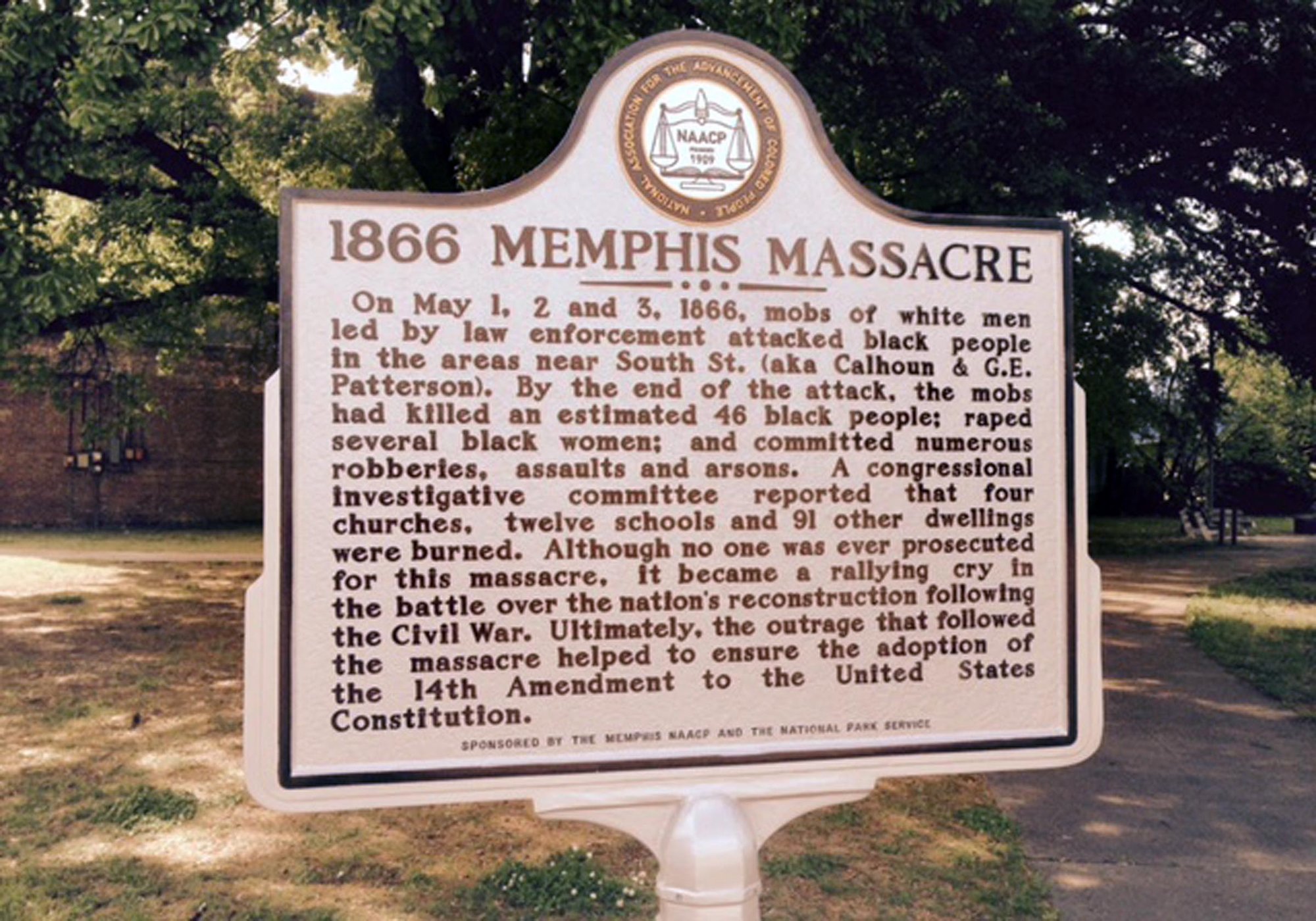
This post is part of the Memories of a Massacre Project: Memphis in 1866. This project is designed to bring to public attention the massacre that rattled Reconstruction-era Memphis in May 1866.
On May 20-21, 2016, the University of Memphis will host “Memories of a Massacre: Memphis in 1866, a Symposium Exploring Slavery, Emancipation, and Reconstruction.” The culmination of a semester-long series of lectures, workshops, discussions, and book talks, this symposium will feature historians and scholars from across the country, including Robert K. Sutton, Chief Historian of the National Park Service. Together, their presentations and the ensuing discussions will pry open what has for 150-years been the carefully concealed history of Reconstruction, its legacies, and the significant role that Memphis played in both. As both a scholar and Communication Director of the project I am thrilled to be a part.
In my researching of the ways media helped shaped the narrative of the Massacre (one sadly we are still living in today), I ran across a story that I found quite interesting. On May 12, 1866, the Memphis Public Ledger reported a story about a German man from Cincinnati who was in Memphis during the Massacre. The report said that the man was “so terrified by the excitement that he became partly deranged.” Further the report stated that this man continue to give evidences of the terror of the riots (massacre) and always finishing with
Due to his “derangement” a friend watched and guarded him when traveling. However, one Saturday evening as the two were traveling by ship and after the German retired for the evening, his friend decided to get up and leave the cabin. When the friend came back to the room he found the door locked and after trying to get in, his friend found the “occurrence” funny. However, suddenly, the German man rushed from the room, passing by the guards on the ship and he jumped overboard and drowns.
When I read this, I could not help but to think about the horror of the Memphis Massacre. It really must have been intense. So intense that a man who just witnessed the carnage was so distraught that he committed suicide. But then my mind began to think about the black people who also witnessed and survived the massacre. What about the women who survived the rape and abuse? What about the men who were beaten and left for dead? What about the one woman who held the head of her tortured husband in her lap as he slowly died? And what about the children who witness the carnage? How did they survived? How did they make it? Did any of them “lose it” or become “deranged?”
These questions many times are not reflected upon because we are busy producing and promoting a narrative that highlights the strength and vitality of the Memphis black community or what I call the “how we bounced back” narrative. While we may discuss the Memphis Massacre as a tragic and troubling event, we are also quick to promote how black Memphians rebuilt their community. While hopeful and optimistic, we sometimes forget that the Memphis Massacre (May 1-3, 1866) was a police inspired and carried out event that systematically and without regard to black humanity destroyed not only schools, churches, and homes, but also killed 46 people and injured many more. And the truth is that while some “bounced back,” many others did not. What happened to them? Where are their stories? We hope this symposium is the beginning of that conversation and one that will produce fruitful results.
If you cannot attend the symposium, please follow us on Twitter @MemphisMassacre. We will also live tweet the event using #MemphisMassacre1866. You can also like us on Facebook.
Andre E. Johnson is the Managing Editor and Founder of R3
Donate to the Work of R3
Like the work we do at Rhetoric Race and Religion? Please consider helping us continue to do this work. All donations are tax-deductible through Gifts of Life Ministries/G’Life Outreach, a 501(c)(3) tax exempt organization, and our fiscal sponsor. Any donation helps. Just click here to support our work.
Previous Post

May 4, 2016
Can I Carry A Gun on Campus and Live?
Next Post

May 24, 2016 Day One: Memories of a Massacre: Memphis in 1866 Symposium
Browse Our Archives
Select a Category Amy Steele Andre E. Johnson Book Reviews/Series Brian Foulks Call for Chapters Carol Howard Merritt Classes Conferences Contributors Crystal St.Marie Lewis Daniel White Hodge Earle Fisher Eulogy Fredrick Robinson Guest Contributions Henry McNeal Turner Institutes Interviews Joseph Boston Katherine Whitfield Kimberly Peeler-Ringer Lectures/Roundtables Natalie Bullock Brown R3 Book Series R3 Contributor Rashad Grove Readers Reflections Symposiums Teaching Traci Ellis Travis Harris Uncategorized Video
Select a Month June 2020 February 2020 December 2019 November 2019 July 2019 June 2019 May 2019 October 2018 June 2018 May 2018 April 2018 March 2018 February 2018 January 2018 December 2017 November 2017 October 2017 September 2017 August 2017 July 2017 June 2017 May 2017 April 2017 March 2017 February 2017 January 2017 December 2016 November 2016 October 2016 September 2016 August 2016 July 2016 June 2016 May 2016 April 2016 March 2016 February 2016 January 2016 December 2015 November 2015 October 2015 September 2015 August 2015 July 2015 June 2015 May 2015 April 2015 March 2015 February 2015 January 2015 December 2014 November 2014 October 2014 September 2014 August 2014 July 2014 June 2014 May 2014 April 2014 March 2014 February 2014 January 2014 December 2013 November 2013 October 2013 September 2013 August 2013 July 2013 June 2013 May 2013 April 2013 March 2013 February 2013 January 2013 December 2012 November 2012 October 2012 September 2012 August 2012 July 2012 June 2012 May 2012 April 2012 March 2012 February 2012 January 2012 December 2011 November 2011 October 2011
Follow Us!
TAKE THE
Religious Wisdom Quiz
What does "Gideon" mean in Hebrew?
Select your answer to see how you score.
God is my Strength Warrior Hewer Redeemer
Related posts from Rhetoric Race and Religion


Dislocations and Shutdowns: #MLK, #BLM and the Rhetoric...

From the Mountain Top and Beyond: The Rhetoric...
New Book in R3 Book Series on Desegregation...
TRENDING AT PATHEOS Progressive Christian

What Being a Modern-Day Apostle Means to Me
In my last column, I discussed the ins and outs of modern-day...

Did Ancient China Once Worship the God of...
Across human history, a common thread weaves through the origins of the...

Love Your Neighbor – Including Earth-Kin: Lev. 19,...
God’s command to love your neighbor means acting in an ethical and...

Lead a Church Study of “Jesus and Lao...
Guest writer Jack Thomas (The Irreverent Reverend) reflects on leading his church...

Pastoral Wisdom for Responding to Sermon Pushback
Getting sermon pushback on your social justice sermon? Learn practical, Proverbs-based strategies...

Principles for Understanding the Apostolic Ministry Today
Whenever people discover that my formal ministry title is "apostle," as in...
view all Progressive Christian blogs
Ad-Free & Subscriber Log-In Subscription Support
- About Us
- 2026 Calendar
- Videos
- Podcasts
- Library of World Religions
- Faith In Media Tracker
- Advertise With Us
- Write for Us
- Privacy Policy
- Terms of Service
- Do Not Sell My Data
- Contact Us
- Radiant Digital
- Manage Newsletter Subscriptions
- Unsubscribe From Notifications
- Sitemap
Copyright 2008-2026, Patheos. All rights reserved.
Subscription Support Ad-Free & Subscriber Log-In
Follow Patheos