
BuddhistCatholicContemplativeEvangelicalGeneral ChristianHinduJewishLatter-day SaintMuslimNew VisionsProgressive Christian
Beliefs
- Buddhist
- Catholic
- Contemplative
- Evangelical
- General Christian
- Hindu
- Jewish
- Latter-day Saint
- More Voices
- Muslim
- New Visions
- Pagan
- Progressive Christian
Topics
- Religion News
- Food and Religion
- Sports and Religion
- Religious Art
- Religious Music and Entertainment
- Religious Events
- History and Religion
- Style and Religion
- Politics and Religion
- Women in Religion
- Recreation Outdoors and Religion
- Business Finance and Religion
- Careers Workplace and Religion
- Education and Religion
- Family Parenting and Religion
- Health Fitness and Religion
- Home and Religion
- Relationships and Religion
- Technology and Religion
- Travel and Religion
Columnists
- Buddhist Columnists
- Business Finance and Religion Columnists
- Careers Workplace and Religion Columnists
- Catholic Columnists
- Contemplative Columnists
- Education and Religion Columnists
- Evangelists Columnists
- Family Parenting and Religion Columnists
- General Christian Columnists
- Health Fitness and Religion Columnists
- Hindu Columnists
- History and Religion Columnists
- Home and Religion Columnists
- Jewish Columnists
- More Voices Columnists
- Latter Day Columnists
- Muslim Columnists
- New Visions Columnists
- Nonreligious Columnists
- Pagan Columnists
- Politics and Religion Columnists
- Progressive Columnists
- Recreation Outdoors and Religion Columnists
- Relationships and Religion Columnists
- Religion News Columnists
- Religious Art Columnists
- Religious Events Columnists
- Religious Music and Entertainment Columnists
- Sports and Religion Columnists
- Style and Religion Columnists
- Technology and Religion Columnists
- Travel and Religion Columnists
- Women in Religion Columnists
Resource Library
- 2026 Calendar
- Library of World Religions
- The 100 Most Holy Places on Earth
- Patheos Answers
- Podcasts
- Videos
- Faith Leaders Database
- Anglican Episcopalian
- Bahai
- Baptist
- Buddhism
- Christianity
- Confucianism
- Eastern Orthodoxy
- Hinduism
- Holiness and Pentecostal
- ISKCON
- Islam
- Judaism
- Lutheran
- Methodist
- The Church of Jesus Christ of Latter-day Saints
- New Age
- Paganism
- Presbytarian and Reformed
- Protestantism
- Religion Behind the Scenes
- Roman Catholic
- Scientology
- Shia Islam
- Sikhism
- Sufism
- Sunni Islam
- Taoism
- Zen
- See all religions
Research Tools
 Ad-Free & Subscriber Log-In Subscription Support
Ad-Free & Subscriber Log-In Subscription Support
Follow Patheos 

- Trending:
- Forgiveness
- |
- Marriage
- |
- Consciousness
- |
- Death Penalty
- |
- Election
- |
- Halloween
 Rhetoric Race and Religion
- Home
- Progressive Christian
- On the Necessary Tension between Rhetoric and Journalism
On the Necessary Tension between Rhetoric and Journalism
Last updated on: November 16, 2015 at 8:36 am by Guest Contributor
On the Necessary Tension between Rhetoric and Journalism 2015-11-16T08:36:36-05:00 Guest Contributor
Patheos Explore the world's faith through different perspectives on religion and spirituality! Patheos has the views of the prevalent religions and spiritualities of the world.
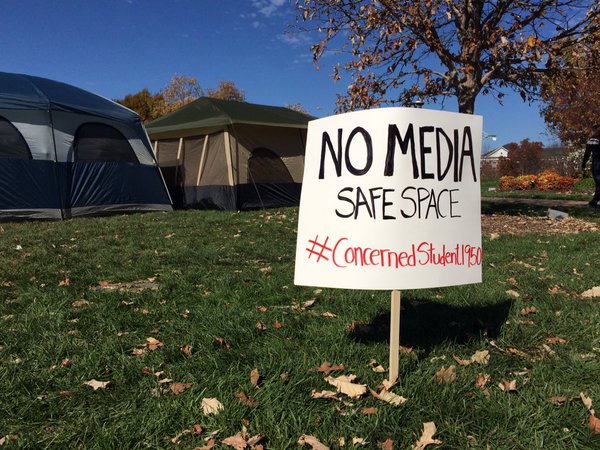
The situation at the University of the Missouri is complicated, full of twists and turns and what feels like a constant stream of new information and misinformation. My own feeling of being overwhelmed by all of this information has been underscored by the near constant *ding* … *ding* … *ding* of iPhones and Facebook messages, as friends reach out to update me on the situation and check in to make sure I’m doing okay. While I feel a thousand miles removed from the situation and powerless to help, I’m very close to the events at Mizzou. Until six months ago, a saggy old house in downtown Columbia was my home and Switzler Hall, on the University of Missouri campus, was where I studied and worked. Dr. Melissa Click was my advisor, and throughout the exhausting process of completing my PhD, she offered not only an impressive level of knowledge and connectedness to the media studies field, but also support, guidance, empathy, and a spirit of generosity (of time, ideas, opportunities, emotional fortitude) that I will never be able to repay.
With my alma mater in crisis and my advisor the object of the internet rage machine, I have struggled to find words to describe the overwhelmingly complex systems of oppression, power, love, and hate at work in the stories that have flooded my mobile devices. As a scholar trained in words — both through my critical/cultural media studies doctoral work and my earlier background in rhetorical theory — I believe words are some of the most important parts of our world, not only in how they are used as rhetoric, but also in the way we can use them to find stronger, more nuanced perspectives on issues that may, on first glance, feel monolithic. The First Amendment is one of these issues, as is the divide our culture draws between public and private space. More obviously complex issues are at work here too, but even these only make sense through the words we choose. Is a professor’s responsibility to facilitate journalists’ unfettered access to a space, or is it to support and protect students who have called out for help both in that moment and for years before? In this moment, that depends upon whom you ask, but even that disagreement owes itself to the flood of words that have framed this issue in this (limited and often misinterpreted) context at this time.
In this discussion (though the rage and self-righteous dismissal that has permeated so many exchanges makes “discussion” a debatably inapplicable term), one word that has catapulted itself to prominence is “journalism.” Of course the word journalism often finds a happy traveling companion in the First Amendment, but many may not have realized prior to this incident the link between journalism and Mizzou. And many still do not realize that a faulty connection has been made between journalism and media studies, with so many, many misinformed statements of the irony of Dr. Click’s involvement in this issue, especially given her position as a media professor. “Hypocrisy!” they cry. But words have meanings, and in this case, they are being used to stir up the very worst of humanity. Indeed, this is precisely the kind of incident that all media studies and rhetorical scholars must involve ourselves with, because any time blanket assumptions are made and unchallenged, our job is to remind others that words are powerful, flexible, and rarely simple.
Dr. Click is not a journalism professor. She is a professor of critical/cultural media studies. Media Studies scholars — like Rhetorical scholars — have a very different investment in teaching and research about the role of the media in a democracy. Rather than teaching students how to collect and document stories for the media, we teach students to bring a critical eye to the stories others have produced. We interrogate structures of media not as a monolithic public good — though, at least in my class, we do discuss the role of media as public interest — but as a complex system of narratives layered over technologies, ideologies, economic interests, and cultural politics. We connect contemporary news media stories with the histories that bubble underneath the apparent objectivity of journalism, and we bring to light the ways different backgrounds and experiences seep into each of our narratives shattering the concept of neutrality. My classes examine the progressive role of alternative presses in labor movements alongside the racist media structures that paint Black men and boys as criminals, erase Black women victims of state violence, and somehow find more positive descriptions for White mass murders than for unarmed Black victims. My students discuss the fact that news media — like all institutions — is situated within a particular cultural context that does not particularly value the intellectual contributions of marginalized groups, and the ways marginalization is exaggerated by structures of advertising revenue that constrict both media’s stories and journalists themselves. And we talk about the ways limited numbers of Black characters narrow the possibilities for representation as part of a media system that can implicate individual journalists and media producers, but that is also much, much larger than any lone reporter.
I don’t teach journalism. I teach students to find a healthy position of media skepticism, not because I don’t respect the abstract and noble concept of journalism, but because I do. I believe media could serve the public interest, a concept that is not itself monolithic or easily defined, but I don’t believe it is doing so right now. It is the role of the scholar trained in words and symbols both to call attention to the snags in the fabric of media and cultural politics and to search for ways of improving these institutions. Our job is to find a place of productive opposition within the larger context of a media-infused culture. That necessarily means supporting some aspects of media practice and pushing back, challenging, and, yes, sometimes even protecting our students from the violence that words can do. As others have written, there were very good reasons Mizzou’s student protesters didn’t want to talk to the media at that moment. There are also very good reasons we might consider the use of public space to be more nuanced in cases of protest occupation, not that we don’t regularly place implicit restrictions on journalists in public spaces every single day. Offering context, challenging word choices, and interrogating cultural assumptions as these counter arguments do are not antithetical to understanding media institutions. These processes of media and rhetorical analysis go hand in hand with supporting media for the purpose of improving its service to the public interest.
Over the course of these events, many well-meaning people have proudly declared to me that they would never have asked journalists to leave, because they “know how media works.” I want to suggest that knowing how media works is an excellent reason to refuse participation in our current, economically-driven system of corporate and conglomerate media.
Amanda Nell Edgar is a Visiting Assistant Professor of Communication at the University of Memphis
Previous Post
November 15, 2015
The Power of Love
Next Post

November 17, 2015 An Open Letter of Love to Black Students: #BlackLivesMatter
Browse Our Archives
Select a Category Amy Steele Andre E. Johnson Book Reviews/Series Brian Foulks Call for Chapters Carol Howard Merritt Classes Conferences Contributors Crystal St.Marie Lewis Daniel White Hodge Earle Fisher Eulogy Fredrick Robinson Guest Contributions Henry McNeal Turner Institutes Interviews Joseph Boston Katherine Whitfield Kimberly Peeler-Ringer Lectures/Roundtables Natalie Bullock Brown R3 Book Series R3 Contributor Rashad Grove Readers Reflections Symposiums Teaching Traci Ellis Travis Harris Uncategorized Video
Select a Month June 2020 February 2020 December 2019 November 2019 July 2019 June 2019 May 2019 October 2018 June 2018 May 2018 April 2018 March 2018 February 2018 January 2018 December 2017 November 2017 October 2017 September 2017 August 2017 July 2017 June 2017 May 2017 April 2017 March 2017 February 2017 January 2017 December 2016 November 2016 October 2016 September 2016 August 2016 July 2016 June 2016 May 2016 April 2016 March 2016 February 2016 January 2016 December 2015 November 2015 October 2015 September 2015 August 2015 July 2015 June 2015 May 2015 April 2015 March 2015 February 2015 January 2015 December 2014 November 2014 October 2014 September 2014 August 2014 July 2014 June 2014 May 2014 April 2014 March 2014 February 2014 January 2014 December 2013 November 2013 October 2013 September 2013 August 2013 July 2013 June 2013 May 2013 April 2013 March 2013 February 2013 January 2013 December 2012 November 2012 October 2012 September 2012 August 2012 July 2012 June 2012 May 2012 April 2012 March 2012 February 2012 January 2012 December 2011 November 2011 October 2011
Follow Us!
TAKE THE
Religious Wisdom Quiz
What does "apostle" literally mean in Greek?
Select your answer to see how you score.
Friend Sent one Leader Writer
Related posts from Rhetoric Race and Religion

Why Christian Nationalism Betrays the Gospel

Dislocations and Shutdowns: #MLK, #BLM and the Rhetoric...

From the Mountain Top and Beyond: The Rhetoric...
New Book in R3 Book Series on Desegregation...
TRENDING AT PATHEOS Progressive Christian

Why Christians Have a Sacred Duty to Vote:...
The Bible offers strong support for the sacred duty to vote. Here...

What Being a Modern-Day Apostle Means to Me
In my last column, I discussed the ins and outs of modern-day...

Did Ancient China Once Worship the God of...
Across human history, a common thread weaves through the origins of the...

Love Your Neighbor – Including Earth-Kin: Lev. 19,...
God’s command to love your neighbor means acting in an ethical and...

Lead a Church Study of “Jesus and Lao...
Guest writer Jack Thomas (The Irreverent Reverend) reflects on leading his church...

Principles for Understanding the Apostolic Ministry Today
Whenever people discover that my formal ministry title is "apostle," as in...
view all Progressive Christian blogs
Ad-Free & Subscriber Log-In Subscription Support
- About Us
- 2026 Calendar
- Videos
- Podcasts
- Library of World Religions
- Faith In Media Tracker
- Advertise With Us
- Write for Us
- Privacy Policy
- Terms of Service
- Do Not Sell My Data
- Contact Us
- Radiant Digital
- Manage Newsletter Subscriptions
- Unsubscribe From Notifications
- Sitemap
Copyright 2008-2026, Patheos. All rights reserved.
Subscription Support Ad-Free & Subscriber Log-In
Follow Patheos