
BuddhistCatholicContemplativeEvangelicalGeneral ChristianHinduJewishLatter-day SaintMuslimNew VisionsProgressive Christian
Beliefs
- Buddhist
- Catholic
- Contemplative
- Evangelical
- General Christian
- Hindu
- Jewish
- Latter-day Saint
- More Voices
- Muslim
- New Visions
- Pagan
- Progressive Christian
Topics
- Religion News
- Food and Religion
- Sports and Religion
- Religious Art
- Religious Music and Entertainment
- Religious Events
- History and Religion
- Style and Religion
- Politics and Religion
- Women in Religion
- Recreation Outdoors and Religion
- Business Finance and Religion
- Careers Workplace and Religion
- Education and Religion
- Family Parenting and Religion
- Health Fitness and Religion
- Home and Religion
- Relationships and Religion
- Technology and Religion
- Travel and Religion
Columnists
- Buddhist Columnists
- Business Finance and Religion Columnists
- Careers Workplace and Religion Columnists
- Catholic Columnists
- Contemplative Columnists
- Education and Religion Columnists
- Evangelists Columnists
- Family Parenting and Religion Columnists
- General Christian Columnists
- Health Fitness and Religion Columnists
- Hindu Columnists
- History and Religion Columnists
- Home and Religion Columnists
- Jewish Columnists
- More Voices Columnists
- Latter Day Columnists
- Muslim Columnists
- New Visions Columnists
- Nonreligious Columnists
- Pagan Columnists
- Politics and Religion Columnists
- Progressive Columnists
- Recreation Outdoors and Religion Columnists
- Relationships and Religion Columnists
- Religion News Columnists
- Religious Art Columnists
- Religious Events Columnists
- Religious Music and Entertainment Columnists
- Sports and Religion Columnists
- Style and Religion Columnists
- Technology and Religion Columnists
- Travel and Religion Columnists
- Women in Religion Columnists
Resource Library
- 2026 Calendar
- Library of World Religions
- The 100 Most Holy Places on Earth
- Patheos Answers
- Podcasts
- Videos
- Faith Leaders Database
- Anglican Episcopalian
- Bahai
- Baptist
- Buddhism
- Christianity
- Confucianism
- Eastern Orthodoxy
- Hinduism
- Holiness and Pentecostal
- ISKCON
- Islam
- Judaism
- Lutheran
- Methodist
- The Church of Jesus Christ of Latter-day Saints
- New Age
- Paganism
- Presbytarian and Reformed
- Protestantism
- Religion Behind the Scenes
- Roman Catholic
- Scientology
- Shia Islam
- Sikhism
- Sufism
- Sunni Islam
- Taoism
- Zen
- See all religions
Research Tools
 Ad-Free & Subscriber Log-In Subscription Support
Ad-Free & Subscriber Log-In Subscription Support
Follow Patheos 

- Trending:
- Forgiveness
- |
- Marriage
- |
- Consciousness
- |
- Death Penalty
- |
- Election
- |
- Halloween
 Rhetoric Race and Religion
- Home
- Progressive Christian
- #Ferguson Reflections: #MichaelBrown: Our Shining Black Prince
#Ferguson Reflections: #MichaelBrown: Our Shining Black Prince
Last updated on: September 6, 2015 at 10:22 am by Guest Contributor
#Ferguson Reflections: #MichaelBrown: Our Shining Black Prince 2015-09-06T10:22:40-05:00 Guest Contributor
Patheos Explore the world's faith through different perspectives on religion and spirituality! Patheos has the views of the prevalent religions and spiritualities of the world.
 This post is part of the Ferguson Reflection: One Year Later series. If you have a reflection on Ferguson, please share it with us at [email protected]
While he has never been far from my mind, this weekend’s trip to Ferguson vividly brought Michael Brown Jr. to my consciousness in a different way. Oddly, princes and icons also came to my mind.
Generally, in the feudal system the primary place for a prince is to remind the people, the aristocracy, and other monarchs that this dynasty has a future. A future in which this kingdom, this people will not be cut off from the earth. Consequently, to kill the Prince was to seal the future against any hope which the people might have. This idea extends beyond the feudal world to the doings of common men. I think that the early gambit by Satan to kill Job’s children in his ongoing wager with God may well have been predicated on this notion. Without his children Job understood he had no future and his name would be cut off from the earth. This despair beyond all the others rent his soul and left him a heap of suffering and despair; seeming proof that perhaps God had misread the table.
As noted in an earlier piece Orthodox theologies center the importance of the Incarnation in the Passion and Resurrection of Christ. In them something true is revealed about us. While we are familiar with the idea that the truth they reveal is that the power of Sin is broken and our bondage to Death is likewise put asunder, a dimension rarely noticed is that these dark powers of dominion are broken because Death simply could not contain the power of Life which was manifest in the Incarnation. According to Origen (one of those African guys in the Early Church), this was a case of the Devil overplaying his hand. In Origen’s thought, God had baited the Devil with this man who shone forth the power of Life. Satan knew full well that this was no ordinary flesh bearer and that it was indeed the Prince of the kingdom, but he thought so little of the flesh which the Prince bore that he saw this as his moment. Thinking he would consume the Prince, made insignificant by the flesh he bore, and therefore break the future of kingdom which Christ heralded Satan, as he had done with Job, orchestrated things such that Jesus was killed.
While fully expecting this bold stroke of using the power of Death would leave God a heap of suffering and despair and the vision of a New Jerusalem in ruins, he found otherwise. Satan discovered that not only was the power of Life so great in this One that it broke every bond of Death but, it also communicated itself to the quick and the dead. Far from being made weak and insignificant by the particular flesh he bore, Christ was enabled by it to gather a community of witnesses that would herald Life’s victory through time and through which this power might be communicated to all. On the account of Orthodox traditions icons (pictures of the Christ and the saints) have the power to communicate this victory of Life and to give us a glimpse into the reign of God in which that victory is complete. By gazing into their eyes what we learn of ourselves is that this flesh that we bear is destined for eternity with God. Beyond teaching, their gaze envelops us in that power of Life which is the resurrection; a power never defeated by death.
On my return from Ferguson I have been struck by the way that pictures of Michael Brown Jr. feel as if they are drawing me into a gaze which communicates some power beyond the photos. Having been in the midst of the community gathered by his death I fully expected that my theological inclinations would lead me to see pictures of Michael Brown Jr. as a martyr to the evil of white supremacy in a more powerful way. What I was not expecting was that his eyes would draw me into an encounter with my own Black flesh that would invite me to experience it in a salvific way which I had not before.
As with Christ, the flesh of Michael Brown Jr. was both invitation to violation and mitigation of the power of Life which shone forth from him. His Black flesh made him imminently killable in the eyes of many and mitigated any claim of empathy on the hearts of too many others. In my own living it was this invitation to violation which was most real to me but, when I experienced the community called into being by the Spirit which was gathered precisely around Mike Mike’s Black flesh, our Black flesh, I knew that God had used his death to communicate something to us all. That communication? Simply put, in the unfolding of God’s salvific plan for all of creation Black Lives Matter.
Michael Brown Jr. is and will be our shining Black Prince for from his death God has brought Life to us all and in his gaze we are enveloped its power.
Rev. Dr. Stephen G. Ray, Jr., serves as the Neal F. and Ila A. Fisher professor of systematic theology at Garrett-Evangelical Theological Seminary. He is also the author of Do No Harm: Social Sin and Christian Responsibility.
Previous Post

August 12, 2015
#Ferguson Reflections: "He Don't Mean Sh*T To Us!"
Next Post

August 14, 2015 #Ferguson Reflections: Privilege, Protest, and Place
Browse Our Archives
Select a Category Amy Steele Andre E. Johnson Book Reviews/Series Brian Foulks Call for Chapters Carol Howard Merritt Classes Conferences Contributors Crystal St.Marie Lewis Daniel White Hodge Earle Fisher Eulogy Fredrick Robinson Guest Contributions Henry McNeal Turner Institutes Interviews Joseph Boston Katherine Whitfield Kimberly Peeler-Ringer Lectures/Roundtables Natalie Bullock Brown R3 Book Series R3 Contributor Rashad Grove Readers Reflections Symposiums Teaching Traci Ellis Travis Harris Uncategorized Video
Select a Month June 2020 February 2020 December 2019 November 2019 July 2019 June 2019 May 2019 October 2018 June 2018 May 2018 April 2018 March 2018 February 2018 January 2018 December 2017 November 2017 October 2017 September 2017 August 2017 July 2017 June 2017 May 2017 April 2017 March 2017 February 2017 January 2017 December 2016 November 2016 October 2016 September 2016 August 2016 July 2016 June 2016 May 2016 April 2016 March 2016 February 2016 January 2016 December 2015 November 2015 October 2015 September 2015 August 2015 July 2015 June 2015 May 2015 April 2015 March 2015 February 2015 January 2015 December 2014 November 2014 October 2014 September 2014 August 2014 July 2014 June 2014 May 2014 April 2014 March 2014 February 2014 January 2014 December 2013 November 2013 October 2013 September 2013 August 2013 July 2013 June 2013 May 2013 April 2013 March 2013 February 2013 January 2013 December 2012 November 2012 October 2012 September 2012 August 2012 July 2012 June 2012 May 2012 April 2012 March 2012 February 2012 January 2012 December 2011 November 2011 October 2011
Follow Us!
TAKE THE
Religious Wisdom Quiz
What is the correct order of 'these three' that remain, as mentioned in 1 Corinthians 13?
Select your answer to see how you score.
Faith, hope, love Love, faith, hope Hope, faith, love Faith, love, hope
Related posts from Rhetoric Race and Religion

New Book in R3 Book Series on #BLM...

Dislocations and Shutdowns: #MLK, #BLM and the Rhetoric...
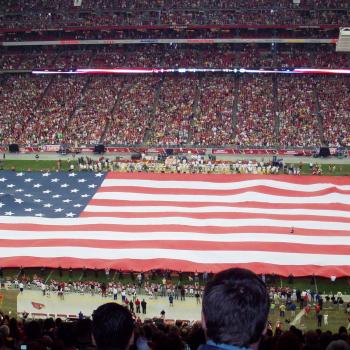
When #TakeAKnee Takes the Streets

TRENDING AT PATHEOS Progressive Christian

Why Christians Have a Sacred Duty to Vote:...
The Bible offers strong support for the sacred duty to vote. Here...

What Being a Modern-Day Apostle Means to Me
In my last column, I discussed the ins and outs of modern-day...

Did Ancient China Once Worship the God of...
Across human history, a common thread weaves through the origins of the...

Love Your Neighbor – Including Earth-Kin: Lev. 19,...
God’s command to love your neighbor means acting in an ethical and...

Lead a Church Study of “Jesus and Lao...
Guest writer Jack Thomas (The Irreverent Reverend) reflects on leading his church...

Principles for Understanding the Apostolic Ministry Today
Whenever people discover that my formal ministry title is "apostle," as in...
view all Progressive Christian blogs
Ad-Free & Subscriber Log-In Subscription Support
- About Us
- 2026 Calendar
- Videos
- Podcasts
- Library of World Religions
- Faith In Media Tracker
- Advertise With Us
- Write for Us
- Privacy Policy
- Terms of Service
- Do Not Sell My Data
- Contact Us
- Radiant Digital
- Manage Newsletter Subscriptions
- Unsubscribe From Notifications
- Sitemap
Copyright 2008-2026, Patheos. All rights reserved.
Subscription Support Ad-Free & Subscriber Log-In
Follow Patheos