
BuddhistCatholicContemplativeEvangelicalGeneral ChristianHinduJewishLatter-day SaintMuslimNew VisionsProgressive Christian
Beliefs
- Buddhist
- Catholic
- Contemplative
- Evangelical
- General Christian
- Hindu
- Jewish
- Latter-day Saint
- More Voices
- Muslim
- New Visions
- Pagan
- Progressive Christian
Topics
- Religion News
- Food and Religion
- Sports and Religion
- Religious Art
- Religious Music and Entertainment
- Religious Events
- History and Religion
- Style and Religion
- Politics and Religion
- Women in Religion
- Recreation Outdoors and Religion
- Business Finance and Religion
- Careers Workplace and Religion
- Education and Religion
- Family Parenting and Religion
- Health Fitness and Religion
- Home and Religion
- Relationships and Religion
- Technology and Religion
- Travel and Religion
Columnists
- Buddhist Columnists
- Business Finance and Religion Columnists
- Careers Workplace and Religion Columnists
- Catholic Columnists
- Contemplative Columnists
- Education and Religion Columnists
- Evangelists Columnists
- Family Parenting and Religion Columnists
- General Christian Columnists
- Health Fitness and Religion Columnists
- Hindu Columnists
- History and Religion Columnists
- Home and Religion Columnists
- Jewish Columnists
- More Voices Columnists
- Latter Day Columnists
- Muslim Columnists
- New Visions Columnists
- Nonreligious Columnists
- Pagan Columnists
- Politics and Religion Columnists
- Progressive Columnists
- Recreation Outdoors and Religion Columnists
- Relationships and Religion Columnists
- Religion News Columnists
- Religious Art Columnists
- Religious Events Columnists
- Religious Music and Entertainment Columnists
- Sports and Religion Columnists
- Style and Religion Columnists
- Technology and Religion Columnists
- Travel and Religion Columnists
- Women in Religion Columnists
Resource Library
- 2026 Calendar
- Library of World Religions
- The 100 Most Holy Places on Earth
- Patheos Answers
- Podcasts
- Videos
- Faith Leaders Database
- Anglican Episcopalian
- Bahai
- Baptist
- Buddhism
- Christianity
- Confucianism
- Eastern Orthodoxy
- Hinduism
- Holiness and Pentecostal
- ISKCON
- Islam
- Judaism
- Lutheran
- Methodist
- The Church of Jesus Christ of Latter-day Saints
- New Age
- Paganism
- Presbytarian and Reformed
- Protestantism
- Religion Behind the Scenes
- Roman Catholic
- Scientology
- Shia Islam
- Sikhism
- Sufism
- Sunni Islam
- Taoism
- Zen
- See all religions
Research Tools
 Ad-Free & Subscriber Log-In Subscription Support
Ad-Free & Subscriber Log-In Subscription Support
Follow Patheos 

- Trending:
- Forgiveness
- |
- Marriage
- |
- Consciousness
- |
- Death Penalty
- |
- Election
- |
- Halloween
 Rhetoric Race and Religion
- Home
- Progressive Christian
- The Church and the #BlackLivesMatter Movement-Pt. 1
The Church and the #BlackLivesMatter Movement-Pt. 1
Last updated on: May 30, 2015 at 8:59 am by Katherine Whitfield
The Church and the #BlackLivesMatter Movement-Pt. 1 2015-05-30T08:59:23-05:00 Katherine Whitfield
Patheos Explore the world's faith through different perspectives on religion and spirituality! Patheos has the views of the prevalent religions and spiritualities of the world.
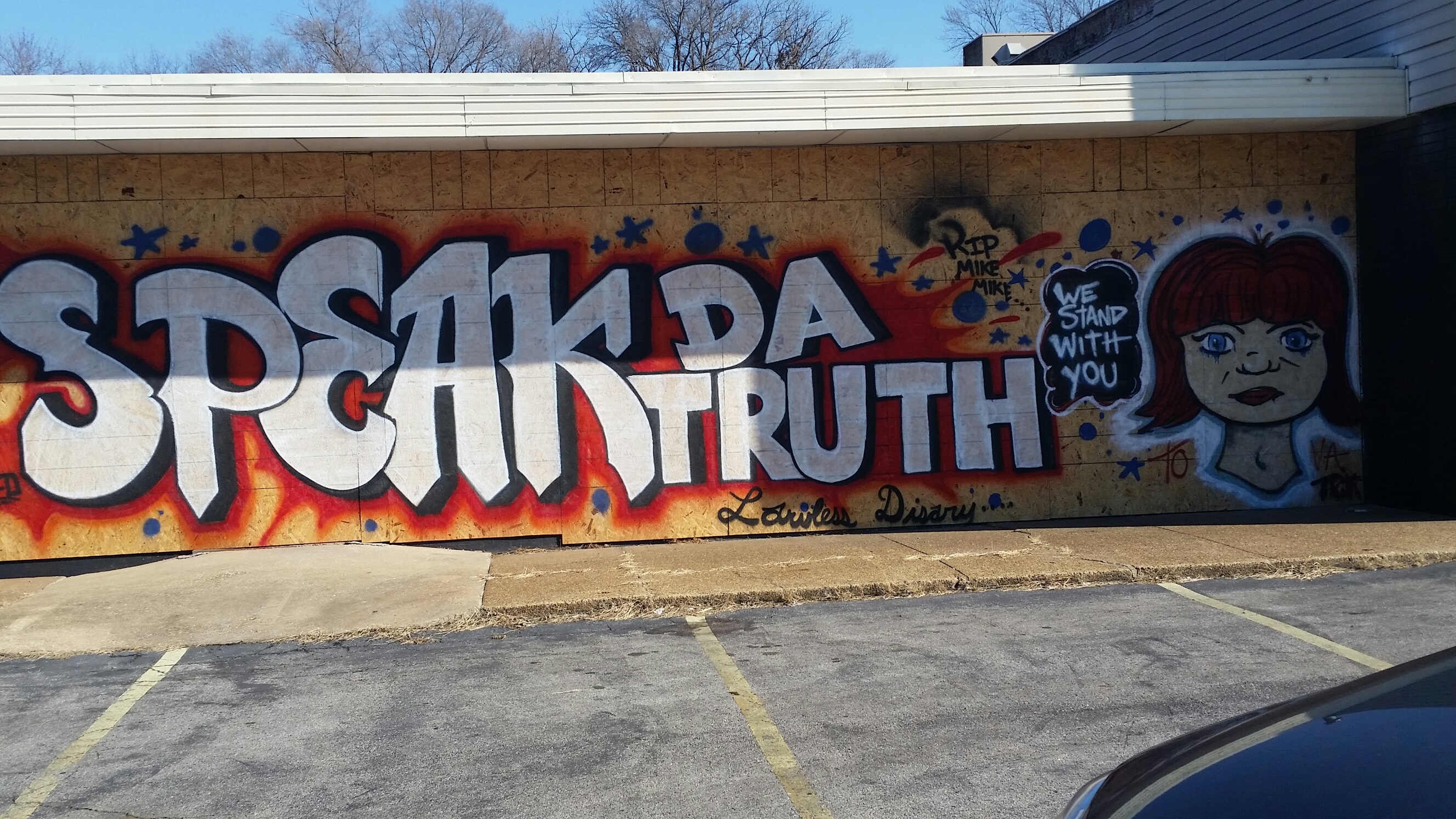
Picture by Andre E. Johnson
“Here is the church, here is the steeple, open the doors and see all the people.”
– Old English nursery rhyme
“If there is a God who is worthy of my adoration, He has a tattoo on His face.”
– Rev. Osagyefo Sekou
I left the church when I was 19 years old. Born and raised in the Episcopal tradition, I was quite the involved churchgoer from an early age. I was baptized as an infant, confirmed as an adolescent, served as an acolyte, was a regular fixture in Sunday School in the mornings and at youth group every Sunday evening, went on mission trips and attended church camp in the summertime. I could recite the liturgy for an entire worship service by heart before I entered high school. During my teenage years, I led the preschool choir, sang in the youth choir, taught Vacation Bible School and even preached from the pulpit on Youth Sunday. Church was as integral a part of my life as school, homework, spending time with friends and eating dinner every night with my family around the kitchen table. But somewhere along the way, something about the notion of “church” changed for me.
I enjoyed the fellowship with my friends, the chance to sing songs of praise in a community of faith, the activities and the intellectual discourse that (sometimes) comprised the content of our Sunday School and youth group gatherings. The liturgy, though, and the rituals of the service had become rote and mechanical for me. The words I spoke in unison with my fellow congregants week after week welled forth not from a place of fire and entrenched belief, but from the banks of memory and familiar incantation. Sermons left me daydreaming and uninspired. My attendance at church and my personal relationship with God began to seem more and more like two disconnected, and even unrelated, entities. Church had begun to feel at best like a checklist item and at worst like a chore; some weeks, I exited the service feeling completely overwhelmed and inundated with noise and empty rhetoric.
American Catholic writer, monk and mystic Thomas Merton once wrote in his reflective volume The Springs of Contemplation, “People don’t want to hear any more words. In our mechanical age, all words have become alike…they’ve all been reduced to the level of the commercial. To say ‘God is love’ is like saying ‘Eat Wheaties.’ Silence, on the other hand, really does speak to people” (Norris 381). As a high school senior, I wasn’t sure that I was craving silence, exactly, but I was in search of a spiritual atmosphere that would allow me to deepen my faith in a community of engaged believers.
At seventeen years old, I joined the Pentecostal Church. Immediately, I felt at home. The fervor, the passion, the absence of liturgy, the vibrant music, the illuminating sermons – in this environment, I felt the presence of God, and I experienced a new connection both with words, and with the Word. I was baptized again, by immersion and by choice. The Bible became meaningful for me in a way that had previously been elusive, and the pervasive sense of communitas – of sharing, intimacy and collaborative search for enlightenment – enveloped me.
For two years, I worshiped and served as a member of this congregation, enjoying fellowship with a similar sister church while I was away during my first year of college. But again, something along the way began to change “church” for me once more. Members of the church leadership frequently espoused very conservative opinions about the fate in store for people they deemed “less than,” including homosexuals, and sometimes the messages preached bore strong overtones of prosperity gospel – an understanding that God richly blesses the faithful with material comforts, and the “unblessed” are lacking in faith.
Questions were discouraged in the church setting, and I was eventually told that those who did not agree with the mind of the “church” were not one with the church. As a 19-year-old college sophomore embarking on a theological journey against the backdrop of a liberal arts institution, I could not abide by the decree that questions were not allowed; for the first time in my life, I was being encouraged and challenged in the academic setting to question and explore nuances of the religion whose tenets I had tacitly accepted as a child. I struggled with the doctrines of exclusivity and “earned” blessing that cloaked the church. I loved the vibrancy, passion and constantly changing energy of the worship service, but I struggled with the conservative and unwelcoming mantra of the Pentecostal Church against my own burgeoning understanding of the Gospel teachings. In the liberal and liturgical arms of the Episcopal Church, I found inclusion and open-minded thinking, but I felt that my spiritual growth was stymied by the repetitive and predictable nature of the worship service. So, without fanfare or consultation, I quietly took my leave from the church, determined to go the road of spiritual growth and fellowship alone.
I have since learned that I was far from alone, both on my journey and in my decision to flee from the institutions of organized religion. Religious writers draw attention to the “missing millennials” as a phenomenon confronting the contemporary church, and young women, particularly, are making a group exodus from the church now that societal expectations have expanded to include home, family, education and success in the workplace. Leah Rampy observes, “All the same forces that would move men toward the ‘none’ category (away from brand-name religion) are present for women, too, now that whatever fence was around women is removed.”
The mantra that one is spiritual, but not religious, seems commonplace in conversations around the water cooler these days. And thanks to ever-evolving advancements in technology, our ability to create and engage meaningfully with a community of like-minded individuals throughout the globe lessens the impetus for young adults to join a church in the hopes of belonging to a community. Ours is the generation of extreme individualization, and the manner in which we approach our relationship with God is no exception. According to a recent article about drawing millennials back to the church, studies show that “in the United States, 59 percent of people ages 18 to 29 with a Christian background have, at some point, dropped out [of church]. According to the Pew Forum on Religion & Public Life, among those…who came of age around the year 2000, a solid quarter claim no religious affiliation at all” (R. Evans). Rampy adds, “Young people want their spirituality to be very personal, not corporate. It might be yoga or mindfulness or chanting but it has to be authentic and it has to work for them” (Grossman).
And yet, the notion of personalized spirituality does not preclude that of a spiritual community. On the contrary, many of the spiritually-enriching activities in which I and other friends who hold similar beliefs participate are often communal in nature. The 21st century often leaves us starved for authentic interpersonal interaction, and the modern church has fallen behind the times. Many contemporary churches – both the hip and trendy, and the classically traditional – offer a dated model of communitas that neither speaks in a language understood by contemporary youth nor responds to the brokenness that permeates our modern context. Although Thomas Merton touched upon something raw and real in his supposition about our cultural proclivity to rob words of their meaning, I found on my own journey that what I was craving was not silence, but a spiritual community centered on meaningful content – relevant, relatable and accessible to our contemporary context and in keeping with the radically subversive teachings of the gangster Jesus portrayed in the Gospels. Beyond relevant content, I was in search of a community geared toward action and effecting real change, focused on drawing people in rather than shutting people out.
Thirteen years after walking out of the church, I walked in to the seminary, drawn to the promise of deep theological exploration in an environment where questions were encouraged and individuals from all backgrounds, belief systems and walks of life were welcomed. I came to the seminary not in the hopes of finding answers, but with the hope of learning to ask better questions. In my inaugural year, I had the opportunity to conduct an intensive study of African American theology.
Foundational readings ranged from the 19th century writings of African Methodist Episcopal minister Henry McNeal Turner and theologian Howard Thurman to the era of James Cone, J. Deotis Roberts, Albert Cleage, William Jones and other men positioned at the vanguard of the “official” black theology movement. Continuing on to the academy of womanism, readings spanned the scholarship of first-generation womanists such as Jacquelyn Grant, Delores Williams and Katie Cannon to the still-evolving immediate works constituting third wave womanism, queer theology and other burgeoning fields of thought. In black liberation theology, and in womanism, specifically, I found the intersection of intellect and inclusion, of ritual and rhetoric, of passion and praxis that my soul had long been seeking. Moreover, I found a straight line between the formation of the earliest Christian church in biblical studies; the emergence and vital function of the Invisible Institution in slave culture; the evolution and social niche of the contemporary African American church; and the Black Lives Matter protests, demonstrations, communion and conversations in which I took part during a journey to Ferguson, Missouri, earlier this year.
In my next post, I will explore the connection between these three variations of the black church (assuming the “non-white” context of the early Christian church) and the Black Lives Matter movement, discussing the theological and practical aspects of the movement as a possible extension of the black, or womanist, church in the 21st century.
Previous Post

May 12, 2015
R3 Contributor: Kimberly Peeler-Ringer
Next Post
May 12, 2015 R3 Contributor: Daniel White Hodge
Browse Our Archives
Select a Category Amy Steele Andre E. Johnson Book Reviews/Series Brian Foulks Call for Chapters Carol Howard Merritt Classes Conferences Contributors Crystal St.Marie Lewis Daniel White Hodge Earle Fisher Eulogy Fredrick Robinson Guest Contributions Henry McNeal Turner Institutes Interviews Joseph Boston Katherine Whitfield Kimberly Peeler-Ringer Lectures/Roundtables Natalie Bullock Brown R3 Book Series R3 Contributor Rashad Grove Readers Reflections Symposiums Teaching Traci Ellis Travis Harris Uncategorized Video
Select a Month June 2020 February 2020 December 2019 November 2019 July 2019 June 2019 May 2019 October 2018 June 2018 May 2018 April 2018 March 2018 February 2018 January 2018 December 2017 November 2017 October 2017 September 2017 August 2017 July 2017 June 2017 May 2017 April 2017 March 2017 February 2017 January 2017 December 2016 November 2016 October 2016 September 2016 August 2016 July 2016 June 2016 May 2016 April 2016 March 2016 February 2016 January 2016 December 2015 November 2015 October 2015 September 2015 August 2015 July 2015 June 2015 May 2015 April 2015 March 2015 February 2015 January 2015 December 2014 November 2014 October 2014 September 2014 August 2014 July 2014 June 2014 May 2014 April 2014 March 2014 February 2014 January 2014 December 2013 November 2013 October 2013 September 2013 August 2013 July 2013 June 2013 May 2013 April 2013 March 2013 February 2013 January 2013 December 2012 November 2012 October 2012 September 2012 August 2012 July 2012 June 2012 May 2012 April 2012 March 2012 February 2012 January 2012 December 2011 November 2011 October 2011
Follow Us!
TAKE THE
Religious Wisdom Quiz
True or False: The parable of the Good Samaritan is found in all four Gospels.
Select your answer to see how you score.
TRUE FALSE
Related posts from Rhetoric Race and Religion

New Book in R3 Book Series on #BLM...

Dislocations and Shutdowns: #MLK, #BLM and the Rhetoric...

A Critique of #MLK's Theory of Non-Violence

The Fallacy of Racial Reconciliation
TRENDING AT PATHEOS Progressive Christian

Why Christians Have a Sacred Duty to Vote:...
The Bible offers strong support for the sacred duty to vote. Here...

What Being a Modern-Day Apostle Means to Me
In my last column, I discussed the ins and outs of modern-day...

Did Ancient China Once Worship the God of...
Across human history, a common thread weaves through the origins of the...

Love Your Neighbor – Including Earth-Kin: Lev. 19,...
God’s command to love your neighbor means acting in an ethical and...

Lead a Church Study of “Jesus and Lao...
Guest writer Jack Thomas (The Irreverent Reverend) reflects on leading his church...

Principles for Understanding the Apostolic Ministry Today
Whenever people discover that my formal ministry title is "apostle," as in...
view all Progressive Christian blogs
Ad-Free & Subscriber Log-In Subscription Support
- About Us
- 2026 Calendar
- Videos
- Podcasts
- Library of World Religions
- Faith In Media Tracker
- Advertise With Us
- Write for Us
- Privacy Policy
- Terms of Service
- Do Not Sell My Data
- Contact Us
- Radiant Digital
- Manage Newsletter Subscriptions
- Unsubscribe From Notifications
- Sitemap
Copyright 2008-2026, Patheos. All rights reserved.
Subscription Support Ad-Free & Subscriber Log-In
Follow Patheos