
BuddhistCatholicContemplativeEvangelicalGeneral ChristianHinduJewishLatter-day SaintMuslimNew VisionsProgressive Christian
Beliefs
- Buddhist
- Catholic
- Contemplative
- Evangelical
- General Christian
- Hindu
- Jewish
- Latter-day Saint
- More Voices
- Muslim
- New Visions
- Pagan
- Progressive Christian
Topics
- Religion News
- Food and Religion
- Sports and Religion
- Religious Art
- Religious Music and Entertainment
- Religious Events
- History and Religion
- Style and Religion
- Politics and Religion
- Women in Religion
- Recreation Outdoors and Religion
- Business Finance and Religion
- Careers Workplace and Religion
- Education and Religion
- Family Parenting and Religion
- Health Fitness and Religion
- Home and Religion
- Relationships and Religion
- Technology and Religion
- Travel and Religion
Columnists
- Buddhist Columnists
- Business Finance and Religion Columnists
- Careers Workplace and Religion Columnists
- Catholic Columnists
- Contemplative Columnists
- Education and Religion Columnists
- Evangelists Columnists
- Family Parenting and Religion Columnists
- General Christian Columnists
- Health Fitness and Religion Columnists
- Hindu Columnists
- History and Religion Columnists
- Home and Religion Columnists
- Jewish Columnists
- More Voices Columnists
- Latter Day Columnists
- Muslim Columnists
- New Visions Columnists
- Nonreligious Columnists
- Pagan Columnists
- Politics and Religion Columnists
- Progressive Columnists
- Recreation Outdoors and Religion Columnists
- Relationships and Religion Columnists
- Religion News Columnists
- Religious Art Columnists
- Religious Events Columnists
- Religious Music and Entertainment Columnists
- Sports and Religion Columnists
- Style and Religion Columnists
- Technology and Religion Columnists
- Travel and Religion Columnists
- Women in Religion Columnists
Resource Library
- 2026 Calendar
- Library of World Religions
- The 100 Most Holy Places on Earth
- Patheos Answers
- Podcasts
- Videos
- Faith Leaders Database
- Anglican Episcopalian
- Bahai
- Baptist
- Buddhism
- Christianity
- Confucianism
- Eastern Orthodoxy
- Hinduism
- Holiness and Pentecostal
- ISKCON
- Islam
- Judaism
- Lutheran
- Methodist
- The Church of Jesus Christ of Latter-day Saints
- New Age
- Paganism
- Presbytarian and Reformed
- Protestantism
- Religion Behind the Scenes
- Roman Catholic
- Scientology
- Shia Islam
- Sikhism
- Sufism
- Sunni Islam
- Taoism
- Zen
- See all religions
Research Tools
 Ad-Free & Subscriber Log-In Subscription Support
Ad-Free & Subscriber Log-In Subscription Support
Follow Patheos 

- Trending:
- Forgiveness
- |
- Marriage
- |
- Consciousness
- |
- Death Penalty
- |
- Election
- |
- Halloween
 Rhetoric Race and Religion
- Home
- Progressive Christian
- Blacks, Latinos, and the Right to Vote
Blacks, Latinos, and the Right to Vote
Last updated on: May 21, 2015 at 5:58 am by Andre E. Johnson
Blacks, Latinos, and the Right to Vote 2015-05-21T05:58:08-05:00 Andre E. Johnson
Patheos Explore the world's faith through different perspectives on religion and spirituality! Patheos has the views of the prevalent religions and spiritualities of the world.
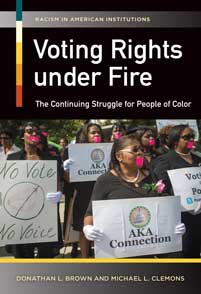
Recently, R3 had an opportunity to interview Donathan Brown, co-author (with Michael L. Clemons) of the new book Voting Rights Under Fire: The Continuing Struggle for People of Color (Praeger, 2015).
R3: What lead you and your to write this book?
DB: We felt that the continual onslaught of states passing voter identification laws, the continual court challenges, along with the overall controversy these measures created was reason enough to dig deeper. Claims over the widespread existence and influence of in-person voter fraud continued to fuel much debate throughout the country. GOP lawmakers in states like Colorado, Florida, Arizona, Iowa, Nevada and Texas, among others, claimed that voter fraud was alive and well and have gone to great mediated lengths to saturate the headlines with this dubious message.
Therefore, intrigued by the timing of these laws, especially against the grander backdrop and growth of majority-minority cities, we were in agreement that there is more here than what meets the eye. To further solidify our thoughts, once the video footage of Pennsylvania Republican Representative Mike Turzai was released that showed him stating, ” Voter ID, which is going to allow Governor Romney to win the state of Pennsylvania, done,” we knew we had to act.
R3: Why do you both feel that the book is important now?
DB: First, with more than thirty states now requiring some form of voter identification, this book articulates the curiosity and ultimately the findings of multiple legal and political inquiries that sought to go beyond the press releases, the television interviews and the campaign speeches. Chief among the goals of this book is to highlight not only the past and present underpinning racial dimensions involved throughout the political legacy of voting rights, but more importantly, to illustrate how such past actions continue to guide current controversies pertaining to African American and Latino voting rights.
Second, as the once “solid south” finds itself on the verge of becoming purple, political dynasties now find their influence in danger. Combined with shifting racial demographics along with the 50th anniversary of Selma, this book presents both the timely and timeless political and legal battles over representation. The importance of this book exists not only within its diachronic approach toward understanding past and present struggles over voting rights, but how voter identification laws are thinly veiled racially retrogressive measures.
Finally, while much of the political rhetoric surrounding changes to voter identification laws employ arguments in defense of so-called “voter fraud” as their justification, there are considerable reasons to believe that race exists as a significant, albeit downplayed, placeholder within this debate. For instance, since Latinos overtook African Americans in 2004 to become the nation’s largest and fastest growing “minority” group, and have already displaced whites as the majority in various parts of the county, it would be shortsighted of us not to consider this variable. Our focus, therefore, is the centrality of race as a factor in the political behavior and rhetoric associated with the ongoing debate over voting rights in the United States.
R3: What were the biggest surprises in your findings?
DB: We were quite surprised, when upon reviewing court documents, to discover the flimsy nature of evidence that some courts allowed and accepted as fact. In one case, a lower court judge noted the serious demeanor and concerned facial expressions of one government official, whereas a result, and without actual evidence to rejoin the plaintiffs claim of retrogression, sided with the defendant. Another example is, of course, the infinitesimal statistical findings of actual in-person voter fraud. Here, in places like Arizona, for instance, we found state-provided court data that contradicted claims made by former Attorney General Tom Horne. Specifically, we found and noted that it is one thing to be charged with voter fraud, but another for those charges to be dismissed due to lack of evidence.
R3: Any closing remarks?
DB: As the investigative reports continue to culminate and the evidence pertaining to voter fraud continues to illustrate that such fraud remains minuscule, only a few arguments have remained accurate over time. Chief among these claims is the belief that voter identification laws, whether acknowledged or not, exist to diminish voter participation among groups who typically sway Democratic. These groups, whether they be African American, Latino, the elderly, those on the lower end of the socioeconomic ladder, or those who are mobility impaired, are all retrogressively impacted by these laws. If the data supported the claims made by GOP lawmakers who are calling for voter identification laws, then this book would approach the topic differently.
As it is however, these supporters have failed to “show their work”; they have failed to satisfy any rhetorical burden of proof to prove to dissenters that these efforts are not politically motivated. At no point throughout the lifespan of this book did we uncover any evidence by any political group or lawmaker that states (1): voter fraud is a widespread problem downplayed by the media; (2) that these reform efforts are actually for the better and not for the worst; and (3) race plays no part in the deliberation and implementation of these laws.
Following exhaustive legal research, obtaining and analyzing state level data sets, reviewing past Congressional hearings, records, court decisions along with current political trends and debates, I am extremely confident when saying, “widespread voter fraud is a myth,” and indeed retrogressive. The simple truth is that enacting harsh voter identification laws for the sake of “securing” the ballot box remains to be a solution to a nonexistent problem.
Donathan L. Brown, PhD, is associate professor and editor of the Journal of Race and Policy in the Department of Communication Studies at Ithaca College. He is the lead author of Praeger’s When Race and Policy Collide: Contemporary Immigration Debates. His published works on race and public policy have appeared in numerous outlets, including Harvard Journal of Hispanic Policy, Journal of Latino-Latin American Studies, International Journal of Discrimination and the Law, and Communication Law Review, among others.
Michael L. Clemons, PhD, is associate professor and founding editor of the Journal of Race and Policy in the Department of Political Science and Geography at Old Dominion University, Norfolk, VA. His published works have appeared in numerous media outlets and his edited volume African Americans and Global Affairs: Contemporary Perspectives was recognized by Choice as one of its Outstanding Academic Titles.
Previous Post

May 18, 2015
On Hearing Call and Respecting Your Path
Next Post

May 22, 2015 Death Dying and the Definite Article
Browse Our Archives
Select a Category Amy Steele Andre E. Johnson Book Reviews/Series Brian Foulks Call for Chapters Carol Howard Merritt Classes Conferences Contributors Crystal St.Marie Lewis Daniel White Hodge Earle Fisher Eulogy Fredrick Robinson Guest Contributions Henry McNeal Turner Institutes Interviews Joseph Boston Katherine Whitfield Kimberly Peeler-Ringer Lectures/Roundtables Natalie Bullock Brown R3 Book Series R3 Contributor Rashad Grove Readers Reflections Symposiums Teaching Traci Ellis Travis Harris Uncategorized Video
Select a Month June 2020 February 2020 December 2019 November 2019 July 2019 June 2019 May 2019 October 2018 June 2018 May 2018 April 2018 March 2018 February 2018 January 2018 December 2017 November 2017 October 2017 September 2017 August 2017 July 2017 June 2017 May 2017 April 2017 March 2017 February 2017 January 2017 December 2016 November 2016 October 2016 September 2016 August 2016 July 2016 June 2016 May 2016 April 2016 March 2016 February 2016 January 2016 December 2015 November 2015 October 2015 September 2015 August 2015 July 2015 June 2015 May 2015 April 2015 March 2015 February 2015 January 2015 December 2014 November 2014 October 2014 September 2014 August 2014 July 2014 June 2014 May 2014 April 2014 March 2014 February 2014 January 2014 December 2013 November 2013 October 2013 September 2013 August 2013 July 2013 June 2013 May 2013 April 2013 March 2013 February 2013 January 2013 December 2012 November 2012 October 2012 September 2012 August 2012 July 2012 June 2012 May 2012 April 2012 March 2012 February 2012 January 2012 December 2011 November 2011 October 2011
Follow Us!
TAKE THE
Religious Wisdom Quiz
Which branch of Christianity believes in the doctrine of transubstantiation?
Select your answer to see how you score.
Evangelicals Orthodox Catholics Protestants
Related posts from Rhetoric Race and Religion

Talking Politics: Russia, Religion, and Race
#WhiteChurchQuiet and the Silence That's Killing Us All

Race and the Movies: An Interview with Dr....

#MemphisMassacre1866: The Time That Memphis Burned
TRENDING AT PATHEOS Progressive Christian

What Being a Modern-Day Apostle Means to Me
In my last column, I discussed the ins and outs of modern-day...

Did Ancient China Once Worship the God of...
Across human history, a common thread weaves through the origins of the...

Love Your Neighbor – Including Earth-Kin: Lev. 19,...
God’s command to love your neighbor means acting in an ethical and...

Lead a Church Study of “Jesus and Lao...
Guest writer Jack Thomas (The Irreverent Reverend) reflects on leading his church...

Pastoral Wisdom for Responding to Sermon Pushback
Getting sermon pushback on your social justice sermon? Learn practical, Proverbs-based strategies...

Principles for Understanding the Apostolic Ministry Today
Whenever people discover that my formal ministry title is "apostle," as in...
view all Progressive Christian blogs
Ad-Free & Subscriber Log-In Subscription Support
- About Us
- 2026 Calendar
- Videos
- Podcasts
- Library of World Religions
- Faith In Media Tracker
- Advertise With Us
- Write for Us
- Privacy Policy
- Terms of Service
- Do Not Sell My Data
- Contact Us
- Radiant Digital
- Manage Newsletter Subscriptions
- Unsubscribe From Notifications
- Sitemap
Copyright 2008-2026, Patheos. All rights reserved.
Subscription Support Ad-Free & Subscriber Log-In
Follow Patheos