
BuddhistCatholicContemplativeEvangelicalGeneral ChristianHinduJewishLatter-day SaintMuslimNew VisionsProgressive Christian
Beliefs
- Buddhist
- Catholic
- Contemplative
- Evangelical
- General Christian
- Hindu
- Jewish
- Latter-day Saint
- More Voices
- Muslim
- New Visions
- Pagan
- Progressive Christian
Topics
- Religion News
- Food and Religion
- Sports and Religion
- Religious Art
- Religious Music and Entertainment
- Religious Events
- History and Religion
- Style and Religion
- Politics and Religion
- Women in Religion
- Recreation Outdoors and Religion
- Business Finance and Religion
- Careers Workplace and Religion
- Education and Religion
- Family Parenting and Religion
- Health Fitness and Religion
- Home and Religion
- Relationships and Religion
- Technology and Religion
- Travel and Religion
Columnists
- Buddhist Columnists
- Business Finance and Religion Columnists
- Careers Workplace and Religion Columnists
- Catholic Columnists
- Contemplative Columnists
- Education and Religion Columnists
- Evangelists Columnists
- Family Parenting and Religion Columnists
- General Christian Columnists
- Health Fitness and Religion Columnists
- Hindu Columnists
- History and Religion Columnists
- Home and Religion Columnists
- Jewish Columnists
- More Voices Columnists
- Latter Day Columnists
- Muslim Columnists
- New Visions Columnists
- Nonreligious Columnists
- Pagan Columnists
- Politics and Religion Columnists
- Progressive Columnists
- Recreation Outdoors and Religion Columnists
- Relationships and Religion Columnists
- Religion News Columnists
- Religious Art Columnists
- Religious Events Columnists
- Religious Music and Entertainment Columnists
- Sports and Religion Columnists
- Style and Religion Columnists
- Technology and Religion Columnists
- Travel and Religion Columnists
- Women in Religion Columnists
Resource Library
- 2026 Calendar
- Library of World Religions
- The 100 Most Holy Places on Earth
- Patheos Answers
- Podcasts
- Videos
- Faith Leaders Database
- Anglican Episcopalian
- Bahai
- Baptist
- Buddhism
- Christianity
- Confucianism
- Eastern Orthodoxy
- Hinduism
- Holiness and Pentecostal
- ISKCON
- Islam
- Judaism
- Lutheran
- Methodist
- The Church of Jesus Christ of Latter-day Saints
- New Age
- Paganism
- Presbytarian and Reformed
- Protestantism
- Religion Behind the Scenes
- Roman Catholic
- Scientology
- Shia Islam
- Sikhism
- Sufism
- Sunni Islam
- Taoism
- Zen
- See all religions
Research Tools
 Ad-Free & Subscriber Log-In Subscription Support
Ad-Free & Subscriber Log-In Subscription Support
Follow Patheos 

- Trending:
- Forgiveness
- |
- Marriage
- |
- Consciousness
- |
- Death Penalty
- |
- Election
- |
- Halloween
 Rhetoric Race and Religion
- Home
- Progressive Christian
- Reflections on #Ferguson: “This Here is Sacred Space.”-Part 3
Reflections on #Ferguson: “This Here is Sacred Space.”-Part 3
Last updated on: April 29, 2015 at 7:27 pm by Guest Contributor
Reflections on #Ferguson: “This Here is Sacred Space.”-Part 3 2015-04-29T19:27:27-05:00 Guest Contributor
Patheos Explore the world's faith through different perspectives on religion and spirituality! Patheos has the views of the prevalent religions and spiritualities of the world.
R3 Editor
The week of January 11-16, 2015, I taught an immersion class in Ferguson, Missouri. These are some of my reflections of that week. Read Part 1 here. Read Part 2 here
When we got up Monday morning, we headed to class to start the “classroom portion” of our time together. After a rundown of the syllabus and an explanation of the class and assignments, our host, Deb Krause shared her involvement with the movement. She started by telling us how the movement has shaped and influenced her actions—offering a powerful testimony of how this movement connected with her work as an academic and New Testament scholar. In addition, Deb also offered us a concrete corrective to a pervasive narrative that clergy were not present during the early days of the movement. To the contrary, clergy were not only present but also present afterwards creating space and place for activists to share their experiences. While it is true that the majority of clergy did not respond to the early events in Ferguson by standing with protesters in the street, some did and continue to do so.
What Deb also did for us was to help us to see how churches COULD get and stay involved. She spoke of not only the prayers that clergy offered in the streets and in some cases becoming human shields between grief-stricken and angry protesters and overzealous law enforcement, but also the follow-up meetings, workshops, and continued dialogue. One such meeting that she and other clergy were apart of was the Teach In and Preach In Tent Revival for Social Justice. She and other clergy also drafted one of the earlier statements on the events in Ferguson along with contributing to worship resources centered on the events in Ferguson. She continues to participate in discussions centered on race and discerning other ways for clergy and churches to get and stay involved. What inspired and captured student’s attention is that despite all of this and despite her work as academic dean at Eden Theological Seminary and as well as a host of other duties (wife, mom, etc.); she also found time to engage her body in the streets of protest. For Deb, the bible in not some ancient text, but more of a “popup book” that when one opens it and one is in tuned with the Spirit, things in it just pop up at the right time (and many times in inopportune times), leading, pushing, and calling us to live authentic and whole lives.
 Mike Brown’s Memorial
After our classroom time and after lunch, we headed towards what I knew would be a powerful moment for us—to the place where Darren Wilson killed Michael Brown. I knew we had to see the site for two reasons. First, I had been before and found the site—the sacred space so moving and powerful and I believed that others would as well. I can only imagine what the community must have felt as they saw someone lay dead on the pavement for four and a half hours. As I reflected again on seeing the memorial, I also noted that if I had known someone in Mike Brown’s family, they could have called me in Memphis, telling me that Mike Mike was shot, I could have gotten in my car, drove four hours to Ferguson and the body would have been still there. The people in this community felt disrespected in the highest order.
Second, and more importantly for the class, the site offered an opportunity for theological reflection. Since a major emphasis of the class was theological reflection, I wanted students to offer reflection at this site. Therefore, when approaching the sacred space, many students immediately became quiet, stood still, or just got away for a moment to gather themselves. I remember as I quietly reflected on my time there, I said to myself, “This here is sacred space.”
I suggest that these “roadside,” “urban” or “street memorials,” are sites for theological reflection because, as I shared with the class, it gives insight on how people constructed ideas of the sacred in the aftermath of a tragic and sometimes senseless death. It is the way people attempted (and continue to attempt) to make sense out of a messed up situation. I wanted to know what students saw and/or heard. To probe a little further, I then asked how the readings shaped students’ reflections. I sometimes asked students to offer one or two words that describe their experience or just simply ask
, “Where did you see God/Spirit today?”
 Mike Brown’s Memorial
The roadside memorials and the art that people attach to them do three things. First, they remind people that death happened here. In a society that does not like to talk about death or wants to move away from death as quickly as possible, memorials force us to remember that a death happened here. Second, these memorials remind us that the community does not forget the person who has died. They proclaim that the community not only remembers the deceased, but that the community also loved the person. This may help with the grieving process.
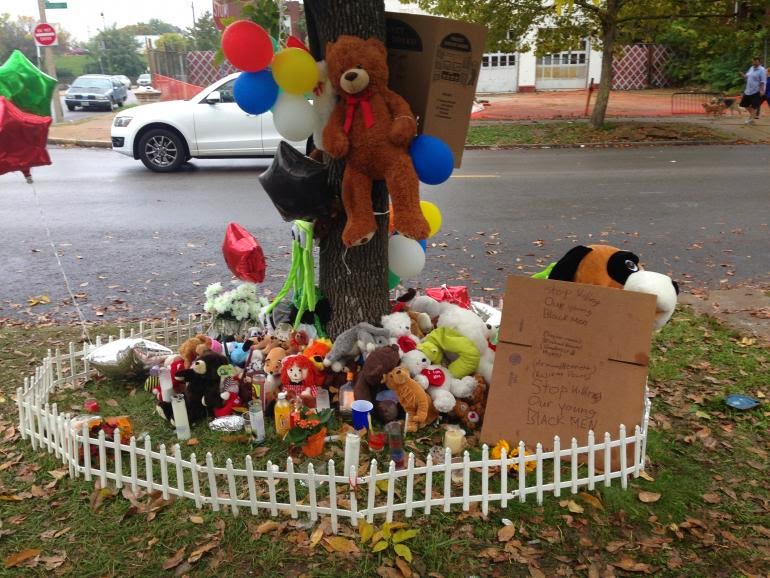 Vonderitt Myers’ Memorial
Finally, I suggest that these memorials offer for church leaders creative ways to do liturgy and other worship activities within their own congregations. For example, this may lead some to offer “services” on the street while people are creating memorials or to offer prayer services and reflections on not only death, but also life as healing continues—for both individuals and the community.
The site of the Michael Brown memorial—as well as the Vonderitt Myers memorial, and the art associated with them had a profound impact on the students. First, some discovered the “Divine” in what they typically do not think of as “art.” With this discovery, students can see, expand, or construct the Divine in much bigger and deeper ways. Second, seeing the Divine in these memorials forms, students, if they did not realize before, now understand that we do not “bring” the Divine to anyone—but if we are still enough, with ears to hear and eyes to see, we can discover that the Divine is already there.
After leaving the memorial sites, we headed to MoKaBe’s—a coffee house that has been very instrumental in the movement. Leading up to the Grand Jury announcement, MoKaBe’s opened its doors to protesters and activists providing a safe space for “activists to stay warm, use the bathroom, charge their phones, and get something to eat and drink.” In return, some on the message board St. Louis CopTalk branded MoKaBe’s as supporters of “cop killers” while others simply vowed to take their business elsewhere. The night after the Grand Jury decided not to indict Darren Wilson for the killing of Mike Brown; law enforcement officials fired tear gas on protesters assembled at MoKaBe’s. We wanted to come here to process and reflect on our day. We felt as if we had a good day and now, coming to this “safe and sacred” place, we could unpack what we heard and saw on that day. We briefly met the owner of MoKaBe’s, Mo Costello, who thanked us for coming and learning more about the movement. After our gathering at MoKaBe’s, the plan was to head to dinner and to prepare for the next day’s class.
However, while waiting in line for my order, someone walked in and stood directly behind me. When I noticed who it was, I introduced myself and told him why I was in the area. I asked him if he would not mind coming just to say hello to the class since they had already heard of him and some even had seen him on YouTube giving lectures or interviews. He readily agreed to come to our table after ordering his food to say hello to the class. We he came over to our table, the “hello” turned into a 90-minute session—complete with a question and answer section that succinctly tied together many of the issues of the movement. Little did I know that things were about to be turned up real quick. We were about to have an impromptu evening with the Rev. Osagyefo Sekou.
To be Continued……….
Follow Andre on Twitter @aejohnsonphd
Previous Post

February 13, 2015
Where’s the Religion in Meditation?
Next Post
February 18, 2015 Call for Papers: African American Communication & Culture Division
Browse Our Archives
Select a Category Amy Steele Andre E. Johnson Book Reviews/Series Brian Foulks Call for Chapters Carol Howard Merritt Classes Conferences Contributors Crystal St.Marie Lewis Daniel White Hodge Earle Fisher Eulogy Fredrick Robinson Guest Contributions Henry McNeal Turner Institutes Interviews Joseph Boston Katherine Whitfield Kimberly Peeler-Ringer Lectures/Roundtables Natalie Bullock Brown R3 Book Series R3 Contributor Rashad Grove Readers Reflections Symposiums Teaching Traci Ellis Travis Harris Uncategorized Video
Select a Month June 2020 February 2020 December 2019 November 2019 July 2019 June 2019 May 2019 October 2018 June 2018 May 2018 April 2018 March 2018 February 2018 January 2018 December 2017 November 2017 October 2017 September 2017 August 2017 July 2017 June 2017 May 2017 April 2017 March 2017 February 2017 January 2017 December 2016 November 2016 October 2016 September 2016 August 2016 July 2016 June 2016 May 2016 April 2016 March 2016 February 2016 January 2016 December 2015 November 2015 October 2015 September 2015 August 2015 July 2015 June 2015 May 2015 April 2015 March 2015 February 2015 January 2015 December 2014 November 2014 October 2014 September 2014 August 2014 July 2014 June 2014 May 2014 April 2014 March 2014 February 2014 January 2014 December 2013 November 2013 October 2013 September 2013 August 2013 July 2013 June 2013 May 2013 April 2013 March 2013 February 2013 January 2013 December 2012 November 2012 October 2012 September 2012 August 2012 July 2012 June 2012 May 2012 April 2012 March 2012 February 2012 January 2012 December 2011 November 2011 October 2011
Follow Us!
TAKE THE
Religious Wisdom Quiz
What color is the first horse in Revelation 6?
Select your answer to see how you score.
White Black Pale Red
Related posts from Rhetoric Race and Religion

Why Christian Nationalism Betrays the Gospel

White People of Faith Who Affirm #BLM: How...

Deferred Dreams: The Consequence of Misaligned Personhood in...

TRENDING AT PATHEOS Progressive Christian

Why Christians Have a Sacred Duty to Vote:...
The Bible offers strong support for the sacred duty to vote. Here...

What Being a Modern-Day Apostle Means to Me
In my last column, I discussed the ins and outs of modern-day...

Did Ancient China Once Worship the God of...
Across human history, a common thread weaves through the origins of the...

Love Your Neighbor – Including Earth-Kin: Lev. 19,...
God’s command to love your neighbor means acting in an ethical and...

Lead a Church Study of “Jesus and Lao...
Guest writer Jack Thomas (The Irreverent Reverend) reflects on leading his church...

Principles for Understanding the Apostolic Ministry Today
Whenever people discover that my formal ministry title is "apostle," as in...
view all Progressive Christian blogs
Ad-Free & Subscriber Log-In Subscription Support
- About Us
- 2026 Calendar
- Videos
- Podcasts
- Library of World Religions
- Faith In Media Tracker
- Advertise With Us
- Write for Us
- Privacy Policy
- Terms of Service
- Do Not Sell My Data
- Contact Us
- Radiant Digital
- Manage Newsletter Subscriptions
- Unsubscribe From Notifications
- Sitemap
Copyright 2008-2026, Patheos. All rights reserved.
Subscription Support Ad-Free & Subscriber Log-In
Follow Patheos