
BuddhistCatholicContemplativeEvangelicalGeneral ChristianHinduJewishLatter-day SaintMuslimNew VisionsProgressive Christian
Beliefs
- Buddhist
- Catholic
- Contemplative
- Evangelical
- General Christian
- Hindu
- Jewish
- Latter-day Saint
- More Voices
- Muslim
- New Visions
- Pagan
- Progressive Christian
Topics
- Religion News
- Food and Religion
- Sports and Religion
- Religious Art
- Religious Music and Entertainment
- Religious Events
- History and Religion
- Style and Religion
- Politics and Religion
- Women in Religion
- Recreation Outdoors and Religion
- Business Finance and Religion
- Careers Workplace and Religion
- Education and Religion
- Family Parenting and Religion
- Health Fitness and Religion
- Home and Religion
- Relationships and Religion
- Technology and Religion
- Travel and Religion
Columnists
- Buddhist Columnists
- Business Finance and Religion Columnists
- Careers Workplace and Religion Columnists
- Catholic Columnists
- Contemplative Columnists
- Education and Religion Columnists
- Evangelists Columnists
- Family Parenting and Religion Columnists
- General Christian Columnists
- Health Fitness and Religion Columnists
- Hindu Columnists
- History and Religion Columnists
- Home and Religion Columnists
- Jewish Columnists
- More Voices Columnists
- Latter Day Columnists
- Muslim Columnists
- New Visions Columnists
- Nonreligious Columnists
- Pagan Columnists
- Politics and Religion Columnists
- Progressive Columnists
- Recreation Outdoors and Religion Columnists
- Relationships and Religion Columnists
- Religion News Columnists
- Religious Art Columnists
- Religious Events Columnists
- Religious Music and Entertainment Columnists
- Sports and Religion Columnists
- Style and Religion Columnists
- Technology and Religion Columnists
- Travel and Religion Columnists
- Women in Religion Columnists
Resource Library
- 2026 Calendar
- Library of World Religions
- The 100 Most Holy Places on Earth
- Patheos Answers
- Podcasts
- Videos
- Faith Leaders Database
- Anglican Episcopalian
- Bahai
- Baptist
- Buddhism
- Christianity
- Confucianism
- Eastern Orthodoxy
- Hinduism
- Holiness and Pentecostal
- ISKCON
- Islam
- Judaism
- Lutheran
- Methodist
- The Church of Jesus Christ of Latter-day Saints
- New Age
- Paganism
- Presbytarian and Reformed
- Protestantism
- Religion Behind the Scenes
- Roman Catholic
- Scientology
- Shia Islam
- Sikhism
- Sufism
- Sunni Islam
- Taoism
- Zen
- See all religions
Research Tools
 Ad-Free & Subscriber Log-In Subscription Support
Ad-Free & Subscriber Log-In Subscription Support
Follow Patheos 

- Trending:
- Forgiveness
- |
- Marriage
- |
- Consciousness
- |
- Death Penalty
- |
- Election
- |
- Halloween
 Rhetoric Race and Religion
- Home
- Progressive Christian
- Was God Around for Michael Brown? A Humanist Perspective on Ferguson
Was God Around for Michael Brown? A Humanist Perspective on Ferguson
Last updated on: November 6, 2014 at 3:11 pm by Guest Contributor
Was God Around for Michael Brown? A Humanist Perspective on Ferguson 2014-11-06T15:11:00-05:00 Guest Contributor
Patheos Explore the world's faith through different perspectives on religion and spirituality! Patheos has the views of the prevalent religions and spiritualities of the world.
by Katherine Whitfield
R3 Contributor
Follow Katherine on Twitter @curlyheff
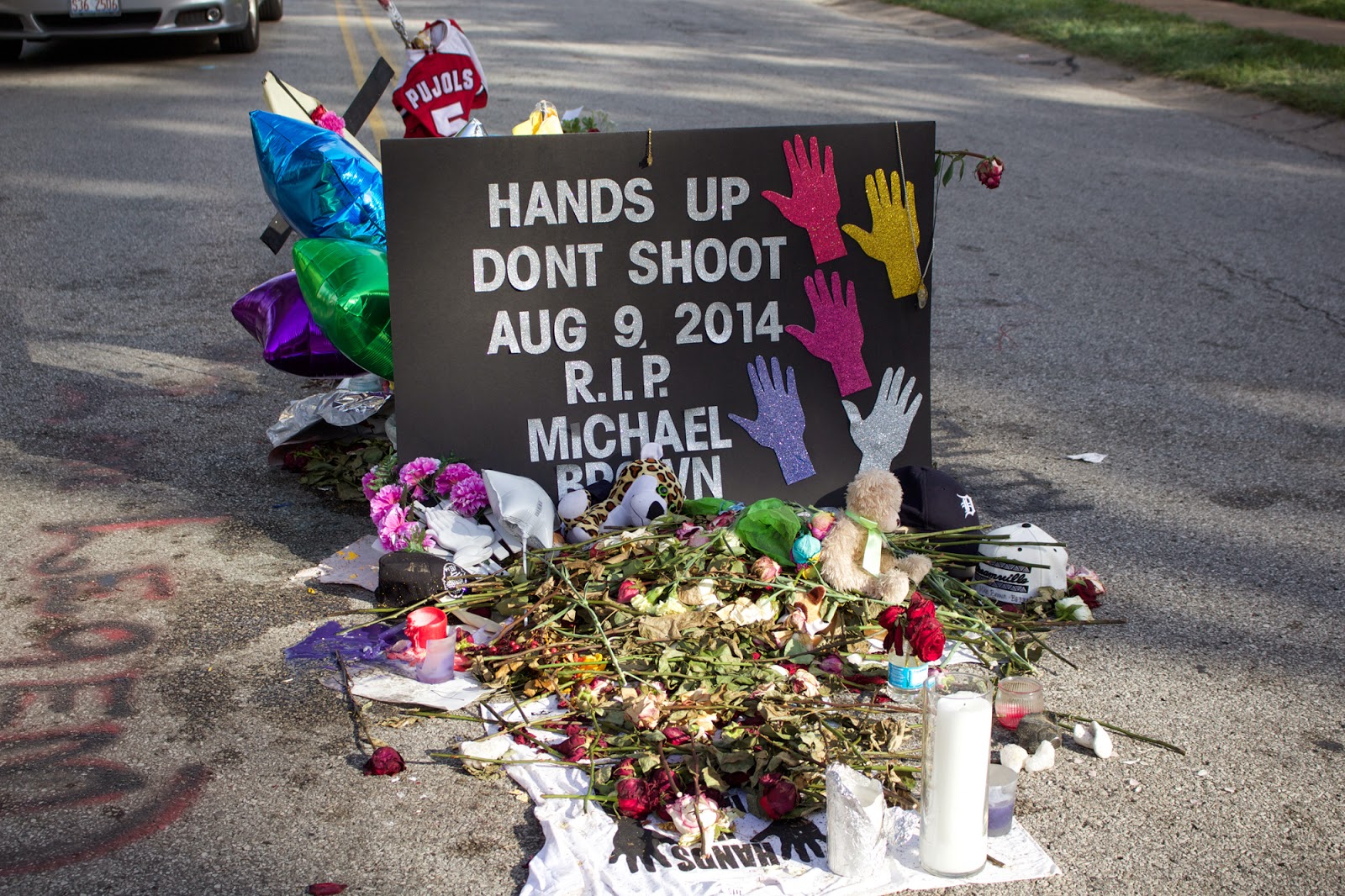
Humanism is roughly defined as a belief system that assigns primary importance to human, rather than divine or supernatural, matters. Tenets of humanism emphasize the inherent potential for human good, the common ground shared among all human beings and the need for solutions to human problems based solely on rational possibilities, not divine interventions. In his chapter titled
“Humanism in African American Theology,” religious studies professor and formative humanist Anthony B. Pinn spends less time explaining the function of humanism within a theological context than on establishing a foundation for what humanism is not. Namely, humanism is not, at its core, an extension of the black church tradition nor of the Christ Event, despite its overlap with African American theology’s emphasis on liberation from racism and oppression (“Humanism” 280). Pinn posits African American humanist theology as promoting a study of people “grounded not in imago Dei but rather in science and culture” (“Humanism” 288). Essentially, Pinn advocates for a “slice of life” theology, suggesting that everything we do and feel, as humans, is source material in our search to infuse our lives with purpose. Put simply, God-centric religion does not have the market cornered on meaningful existence.
Creating a connection between humanism, as an overarching concept, and the events in Ferguson, Mo., since the shooting of Michael Brown did not prove difficult. To quote Pinn’s thoughts about the functional ultimacy, or radical autonomy, of humans, “people act in the world, and these actions have ongoing meaning and consequence that is not overridden by divine maneuvers” (“Humanism” 285). Most certainly, the actions that transpired on Aug. 9 on Canfield Drive were not overridden by divine maneuvers. Mike Brown and his friend, Dorian Johnson, were not urged on to the sidewalk by an unseen guiding force. Officer Darren Wilson did not act upon an inexplicable sense to drive a different route that afternoon. Brown and Wilson collided and Mike Brown died, and the pair’s encounter has far-reaching meaning and consequence that is firmly rooted outside the religious world in the social and political contexts. If there are those who might argue that Brown’s death was divinely ordained, or even orchestrated – a necessary evil to serve as the tipping point to usher in the next movement for human rights – then I find myself tightly aligned with both the humanist and womanist schools of thought, seeking distance from any theology that currently requires the death of one for the life of many.
For most womanist theologians, that price was effectively paid by way of the Christ Event; injustice and suffering hold no place in God’s divine plan. Founding womanist theologian Delores Williams argues that “there is nothing divine in the blood of the Cross” (167). According to Williams, the death of Christ is not an endorsement of surrogacy, but rather a demonstration of the human capacity for wrongdoing. From the humanist perspective, Pinn maintains that the resolution of evil requires “an appeal to human accountability. Humans have created the problems presently encountered and humans are responsible for changing those conditions” (Murphy 219). Brown’s death, viewed through a humanist lens, is a harsh reality effected at the hands of manmade and flawed power structures. A humanist response to Ferguson focuses not on prayer and restoration through divine grace and healing, but on an appeal to the broken social systems whose faulty infrastructure allows for the permissive and fairly routine killing of black citizens. Pinn speaks at greater length about these disproportionate power structures in his book African American Humanist Principles, highlighting racial profiling as a particular threat to black citizenship. He writes, “An understanding of power as the ability to fix another’s identity should include an awareness of racial profiling as another mode of power through which black Americans have been overdetermined and fixed” (Humanist Principles 80). Statistics overwhelmingly suggest that if all circumstances in the Michael Brown shooting had been identical, save for the color of Brown’s skin, a white Michael Brown would still be alive today. Humans, not the divine, appear to be writing the rules and holding the keys to the kingdom these days, and so it is a change within humans that is necessary.
As such, Pinn calls for a radical paradigm shift, challenging the academic community to envision a theology devoid of God at its core – one that asserts humanism as its own form of religion and allows for the positioning of its theology “as the description and interrogation of human stories of meaning making” (“Humanism” 288). While the concept of a nontheistic theology seems to teeter on the brink of a semantical breakdown, I appreciate Pinn’s assertion that labeling humanism in this manner might “push beyond narrow understandings that seek to privilege theology as a mode of discourse and to disassociate it from other methodologies for studying human experience” (“Humanism” 288). Indeed, Pinn’s desire to strip certain belief structures down to their roots and reexamine what is necessary and just to create the ultimate lived black experience aligns with the call, in the wake of Ferguson, for a paradigm shift in how young black men are viewed in our society as compared to their white counterparts. Immediately following the shooting by cop of an unarmed black teen, ensuing debates about Brown’s potential gang affiliations, alleged wrongdoing prior to his shooting and other efforts to defame his personal character emerged as thinly-veiled attempts to plant seeds of justification for the shooting in the court of public opinion. “Arguing whether Brown was a good kid or not is functionally arguing over whether he specifically deserved to die, a way of acknowledging that some black men ought to be executed,” writes Deadspin staff writer Greg Howard. “To even acknowledge this line of debate is to start a larger argument about the worth, the very personhood, of a black man in America.” Howard’s assertion serves to emphasize the inherent worth of all human beings – a truth that stands in stark contrast to the reception and treatment of black citizens, particularly men, throughout the country.
In contrast to Howard’s humanistic acknowledgments, St. Louis minister and professor Christopher Grundy, in a recent open letter to the Ferguson police force, says, “The conflict itself, day after day, can cause us – can cause you – to lose sight of the flame of the holy in each of [the African American youth who are leading this movement].” The problem with Grundy’s statement is its theologically based assumption that all members of the white infrastructure
share his belief that the flame of the holy is even present in the black body. Grundy operates from the perspective of one who believes Christian principles can serve as a unifying force to offset the dehumanization of both the black youth and the hyper-militarized officers. However, his notion that one human being should treat another well because the flame of God exists in each of us detracts from the more basic truth that one human should treat another human well simply because it is the right thing to do. In this case, religion serves almost as a distraction from the real matter at hand.
Pinn does not believe that African American humanism is a rejection of the commonly held African American tradition. Rather, he upholds that humanism “is an underappreciated but nonetheless vital dimension of this tradition” (“Humanism” 282-3). Considering the legacy of the African American tradition, I find myself wondering, how often (if ever) has the placement of God and Christ at the center stood in the way of true social progress or blinded African Americans to the real dangers – and opportunities – at hand? Drawing a biblical comparison, one could question whether, when the Babylonians destroyed the temple, razed Jerusalem and exiled nearly 5,000 Judeans to a foreign land, the Judeans’ expressed beliefs as God’s chosen people – that God had punished them and God would save them – stood in the way of their ability to formulate more creative or empowered solutions toward their own liberation? Perhaps the profound emphasis on God’s all-consuming power has fostered a “wait and hope” or “will of God” theology that is depriving those who are oppressed of immediate and deserved access to freedom and a better life. In a contemporary setting, one could argue that an overdependence on divine agency is helping to sustain isolating and misguided notions that breast cancer is a stigma or a punishment from God; that severely disproportionate distribution of wealth aligns with approved biblical social structures; or that the shooting of an unarmed teenager by a figure of authority is an acceptable, or at least unavoidable, part of the divine status quo.
Religion professor Kelly Brown Douglas seems to ask the ultimate question: “What is it about Christianity that has allowed it to be both a bane and a blessing for black people?” (Pinn, “Humanism” 285). Black theology’s extreme dependence on a “hermeneutic of revelation” (Pinn, “Humanism” 286) is not only overshadowing humanism’s contribution to the field, but may potentially serve as a stumbling block for African Americans whose faith in God’s divine agency is depriving them of their own. For African Americans who find the deck continually stacked against them, faith in God cannot be perpetually leaned upon as the only source of solace. Such a one-way faith conversation borders on the verge of an antihuman theology – one that favors divine dealings at the expense of the human experience with regard to suffering and evil. Current realities of the black experience in America suggest that the onus is now on the human, not solely the divine, to effect and sustain just and liberative change.
Works Cited
Grundy, Christopher. “A Pastoral Letter to Members of the Ferguson, Missouri Police Force.” A More Peaceful Table 15 Oct. 2014: n. pag. Web. 26 Oct. 2014.
Howard, Greg. “America is Not for Black People.” The Concourse: Deadspin 12 Aug. 2014: n. pag. Web. 3 Sept. 2014.
Murphy, Larry G. “Evil and Sin in African American Theology.” The Oxford Handbook of African American Theology. Ed. Katie G. Cannon and Anthony B. Pinn. New York: Oxford UP, 2014. 212-227. Print.
Pinn, Anthony B. African American Humanist Principles: Living and Thinking Like the Children of Nimrod. New York: Palgrave Macmillan, 2004. Print.
—. “Humanism in African American Theology.” The Oxford Handbook of African American Theology. Ed. Katie G. Cannon and Anthony B. Pinn. New York: Oxford UP, 2014. 280-291. Print.
Williams, Delores S. Sisters in the Wilderness: The Challenge of Womanist God-Talk. New York: Orbis Books, 1993. Print.
Previous Post

November 6, 2014
Who Has the Authority to Write Theology?
Next Post
November 6, 2014 Engaging the City: Urban Theology After #Ferguson
Browse Our Archives
Select a Category Amy Steele Andre E. Johnson Book Reviews/Series Brian Foulks Call for Chapters Carol Howard Merritt Classes Conferences Contributors Crystal St.Marie Lewis Daniel White Hodge Earle Fisher Eulogy Fredrick Robinson Guest Contributions Henry McNeal Turner Institutes Interviews Joseph Boston Katherine Whitfield Kimberly Peeler-Ringer Lectures/Roundtables Natalie Bullock Brown R3 Book Series R3 Contributor Rashad Grove Readers Reflections Symposiums Teaching Traci Ellis Travis Harris Uncategorized Video
Select a Month June 2020 February 2020 December 2019 November 2019 July 2019 June 2019 May 2019 October 2018 June 2018 May 2018 April 2018 March 2018 February 2018 January 2018 December 2017 November 2017 October 2017 September 2017 August 2017 July 2017 June 2017 May 2017 April 2017 March 2017 February 2017 January 2017 December 2016 November 2016 October 2016 September 2016 August 2016 July 2016 June 2016 May 2016 April 2016 March 2016 February 2016 January 2016 December 2015 November 2015 October 2015 September 2015 August 2015 July 2015 June 2015 May 2015 April 2015 March 2015 February 2015 January 2015 December 2014 November 2014 October 2014 September 2014 August 2014 July 2014 June 2014 May 2014 April 2014 March 2014 February 2014 January 2014 December 2013 November 2013 October 2013 September 2013 August 2013 July 2013 June 2013 May 2013 April 2013 March 2013 February 2013 January 2013 December 2012 November 2012 October 2012 September 2012 August 2012 July 2012 June 2012 May 2012 April 2012 March 2012 February 2012 January 2012 December 2011 November 2011 October 2011
Follow Us!
TAKE THE
Religious Wisdom Quiz
What does "Tabernacle" mean?
Select your answer to see how you score.
Holy altar Cupboard Dwelling place Sacrifice
Related posts from Rhetoric Race and Religion

Why Christian Nationalism Betrays the Gospel

White People of Faith Who Affirm #BLM: How...

Deferred Dreams: The Consequence of Misaligned Personhood in...

TRENDING AT PATHEOS Progressive Christian

Why Christians Have a Sacred Duty to Vote:...
The Bible offers strong support for the sacred duty to vote. Here...

What Being a Modern-Day Apostle Means to Me
In my last column, I discussed the ins and outs of modern-day...

Did Ancient China Once Worship the God of...
Across human history, a common thread weaves through the origins of the...

Love Your Neighbor – Including Earth-Kin: Lev. 19,...
God’s command to love your neighbor means acting in an ethical and...

Lead a Church Study of “Jesus and Lao...
Guest writer Jack Thomas (The Irreverent Reverend) reflects on leading his church...

Principles for Understanding the Apostolic Ministry Today
Whenever people discover that my formal ministry title is "apostle," as in...
view all Progressive Christian blogs
Ad-Free & Subscriber Log-In Subscription Support
- About Us
- 2026 Calendar
- Videos
- Podcasts
- Library of World Religions
- Faith In Media Tracker
- Advertise With Us
- Write for Us
- Privacy Policy
- Terms of Service
- Do Not Sell My Data
- Contact Us
- Radiant Digital
- Manage Newsletter Subscriptions
- Unsubscribe From Notifications
- Sitemap
Copyright 2008-2026, Patheos. All rights reserved.
Subscription Support Ad-Free & Subscriber Log-In
Follow Patheos