
BuddhistCatholicContemplativeEvangelicalGeneral ChristianHinduJewishLatter-day SaintMuslimNew VisionsProgressive Christian
Beliefs
- Buddhist
- Catholic
- Contemplative
- Evangelical
- General Christian
- Hindu
- Jewish
- Latter-day Saint
- More Voices
- Muslim
- New Visions
- Pagan
- Progressive Christian
Topics
- Religion News
- Food and Religion
- Sports and Religion
- Religious Art
- Religious Music and Entertainment
- Religious Events
- History and Religion
- Style and Religion
- Politics and Religion
- Women in Religion
- Recreation Outdoors and Religion
- Business Finance and Religion
- Careers Workplace and Religion
- Education and Religion
- Family Parenting and Religion
- Health Fitness and Religion
- Home and Religion
- Relationships and Religion
- Technology and Religion
- Travel and Religion
Columnists
- Buddhist Columnists
- Business Finance and Religion Columnists
- Careers Workplace and Religion Columnists
- Catholic Columnists
- Contemplative Columnists
- Education and Religion Columnists
- Evangelists Columnists
- Family Parenting and Religion Columnists
- General Christian Columnists
- Health Fitness and Religion Columnists
- Hindu Columnists
- History and Religion Columnists
- Home and Religion Columnists
- Jewish Columnists
- More Voices Columnists
- Latter Day Columnists
- Muslim Columnists
- New Visions Columnists
- Nonreligious Columnists
- Pagan Columnists
- Politics and Religion Columnists
- Progressive Columnists
- Recreation Outdoors and Religion Columnists
- Relationships and Religion Columnists
- Religion News Columnists
- Religious Art Columnists
- Religious Events Columnists
- Religious Music and Entertainment Columnists
- Sports and Religion Columnists
- Style and Religion Columnists
- Technology and Religion Columnists
- Travel and Religion Columnists
- Women in Religion Columnists
Resource Library
- 2026 Calendar
- Library of World Religions
- The 100 Most Holy Places on Earth
- Patheos Answers
- Podcasts
- Videos
- Faith Leaders Database
- Anglican Episcopalian
- Bahai
- Baptist
- Buddhism
- Christianity
- Confucianism
- Eastern Orthodoxy
- Hinduism
- Holiness and Pentecostal
- ISKCON
- Islam
- Judaism
- Lutheran
- Methodist
- The Church of Jesus Christ of Latter-day Saints
- New Age
- Paganism
- Presbytarian and Reformed
- Protestantism
- Religion Behind the Scenes
- Roman Catholic
- Scientology
- Shia Islam
- Sikhism
- Sufism
- Sunni Islam
- Taoism
- Zen
- See all religions
Research Tools
 Ad-Free & Subscriber Log-In Subscription Support
Ad-Free & Subscriber Log-In Subscription Support
Follow Patheos 

- Trending:
- Forgiveness
- |
- Marriage
- |
- Consciousness
- |
- Death Penalty
- |
- Election
- |
- Halloween
 Nomad
Nomad
- Home
- Progressive Christian
- Religion News
- How A Theology of Inclusion Can Enrich Your Faith
How A Theology of Inclusion Can Enrich Your Faith
Last updated on: April 25, 2019 at 1:51 pm by Brandan Robertson
How A Theology of Inclusion Can Enrich Your Faith 2019-04-25T13:51:22-04:00 Brandan Robertson
Patheos Explore the world's faith through different perspectives on religion and spirituality! Patheos has the views of the prevalent religions and spiritualities of the world.
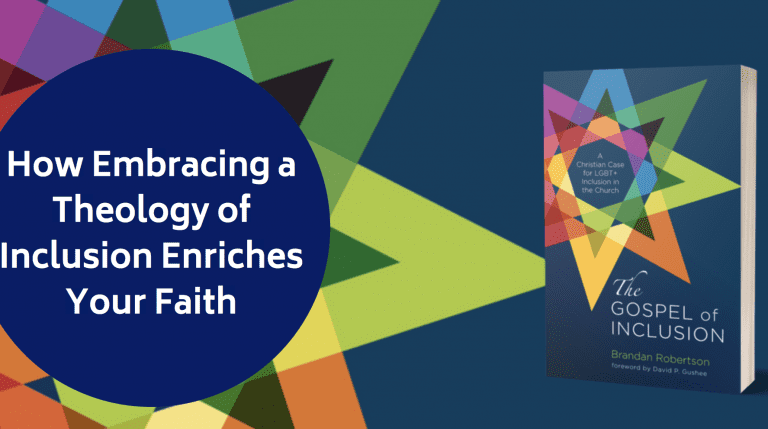
The following is an excerpt from my new book The Gospel of Inclusion, released today. Get your copy here.
When we begin to understand that the entire trajectory of scripture points to God’s radically inclusive love for all of Creation, we will be compelled to rethink our entire theological framework. Since patriarchy and exclusion are embedded in the worldview of the writers of Scripture, we will be brought into conflict with various exclusive texts and the doctrines that have formed around them.
But this is perhaps the most faithful posture to engage scripture with- it is the posture of Jesus as he seeks to amend and raise the ethical standards of the Hebrew Bible time and time again in the Gospel accounts, it’s the way that the ancient Jewish rabbis engaged scripture as they wrote out the Talmud, and it’s the way that Peter and the early Apostles engaged their long-held beliefs- asking hard questions, observing the work of the Spirit around them in their contemporary context, and shifting their beliefs and perspectives to align with reality and the direction that the Spirit seemed to be nudging them. The call away from an exclusive understanding of the Bible invites us to rethink how we view God, how we understand salvation, and how we interact in the world as disciples of Christ.
One of the primary ways that leaning into an inclusive understanding of Christianity leads to spiritual reformation in an individual’s life is by calling us out of a dualistic way of interacting in the world, towards what my mentor and renowned philosopher Ken Wilber calls an “integral” approach to the world.
In Acts 10, when God speaks to Peter, telling him to stop thinking through the lens of “clean” and “unclean”, he’s actually being called out of a dualistic binary towards an integral way of viewing the world. Instead of seeing one group, kind, or class of people as the “in” group and another as the out, the Voice in Peter’s vision reveals God’s true heart: All things can and will be declared “clean”. There is no longer a separation between the Jewish people and the Gentiles, but in Christ, all are integrated into one new humanity. God’s plan of redemption is deeply and radically inclusive: God seeks to bring everyone into redemption and reconciliation, leaving no one out.
If this is how we begin to understand God- the inclusive Creator of all who seeks to redeem all- then every aspect of our faith is transformed. We no longer cling to theological purity or doctrinal certainty as a means of knowing that we’re truly “saved”- instead, we see that God’s plan has always been to “save” everyone, in the midst of all of our diversity. We no longer view the world as those who are children of God and those who are not- for we know that God’s heart is for all to be reconciled to their Father. We no longer look at the world as black and white, but as a beautiful rainbow of color, where absolutely everyone has a place. When our faith moves outside of a dualistic system and into the contours, textures, and tensions that exist in reality, it becomes a more versatile, credible, and sustainable faith to build our lives around.
Another way that embracing the Gospel of radical inclusion fundamentally transforms us is in our own life and relationships. In my book True Inclusion, I spend 100 pages exploring the implications of the Gospel of Inclusion on our faith, so I won’t reiterate all of those ways here, however, when we understand that the plan that the Spirit of God has been unravelling throughout the ages is to include and redeem absolutely everyone, then we are forced to confront and challenge our own prejudice and bias. It is a sad reality that perhaps the most exclusive and damaging body of people in human history has been the Church of Jesus Christ. Our failure to see what God has been up to throughout Scripture has led us to reinforce binary way of engaging the world, creating communities that exclude and marginalize the very people who God delights in.
The Church, at various times and places, has discriminated en masse against people of certain races, genders, cultures, theologies, political positions, disabilities, sexualities, and just about every other aspect of identity, and done so in the name and under the authority of Jesus Christ. In our individual lives, many of us have digested this exclusive faith and incarnated it into our existence- distancing ourselves from people who are different than we are. But if we are to learn anything from the example of the life of Jesus, we should take away the fact that true growth and transformation comes from being in proximity with our “others”. It is easy to demonize and exclude from a distance, but it’s incredibly difficult to continue to marginalize people that we enter into relationship with.
It’s easy to fail to see how God may be working through those who look and live differently than us when we only know them by their social media profile or caricature, but when you’re walking through life in close proximity to those who are different, we will often see God moving and speaking in the most unexpected places. If we take the imperative of the Gospel seriously- to “go into the world proclaiming the good news”- then we must be willing to move out of our comfort zones in our own lives and purposely seek out relationships with those who are fundamentally different than we are.
We must confront the dualism and prejudices in our own hearts that we have justified with our exclusionary theology, and seek to follow in the example of Jesus who, as Eugene Peterson wrote, “…became flesh and blood and moved into the neighborhood.”[1]Fr. Richard Rohr expands upon the inclusive incarnationality of Jesus, saying:
“The point of the Christian life is not to distinguish oneself from the ungodly, but to stand in radical solidarity with everyone and everything else. This is the full, final, and intended effect of the Incarnation.”[2]
Are you willing to move into the neighborhood with those who may even perceive you as an enemy? Are you up to the challenge of overcoming your misconceptions and biases against others? Are you willing to do the hard work to see the light of Christ in “everyone and everything”? The process isn’t easy, and if Jesus life teaches us anything it’s that such a posture may even come with great pain and our own exclusion, but if we’re going to claim to follow Jesus, it seems to me that we have no other choice but to be such radical ambassadors of reconciliation in our world.
Embracing the Gospel of Inclusion is what it means to follow Jesus Christ. In my understanding, there is simply no other way to be faithful to the life and teachings of Jesus if we aren’t willing to cross all of the culturally defined boundaries and borders that separate us and seek to see that the same Spirit that is within us is actually in and through everybody else. In this sense, we’re not special. God does not play favorites, and therefore, neither should we.
Each of us, in all of our diversity and disagreement, is invited to step into our identity as children of God and work to heal the world through the good news of reconciliation and redemption in Christ. This is and has always been the heart of the Christian faith, though it has often been buried underneath the false gospel of exclusivity, and until we’re ready and willing to deconstruct our own faith and indeed, our own lives and rebuild our lives around Spirit-driven faith of Christ, we will remain preaching and believing a gospel that is deficient to save our own souls, let alone the entire world.
The good news is great joy for all people, without exception, inviting us to recreate the world as God has always intended it to be, where all people, in all of our difference, stand united as a multicolored glass mosaic through which the Light of God shines through bringing beauty and hope to our lives and to our world. I don’t know about you, but for me, that sounds like a faith worth believing.
[1]John 1:14 The Message
[2]Rohr, The Universal Christ, Covergence Books 2019, p. 33
Previous Post

April 8, 2019
Why Democrats Must Embrace Faith
Next Post
April 26, 2019 Who Is Franklin Graham To Hinder God?
Browse Our Archives
Select a Category Breaking News Contributor Post Current Events Devotional Devotional Ideas For A Better Tomorrow General Posts Guest Post Interview Missiology Nomad Rants Recalibrate Reflections Response Review The Other Side Theology Uncategorized
Select a Month May 2020 April 2020 March 2020 February 2020 January 2020 December 2019 September 2019 August 2019 July 2019 June 2019 May 2019 April 2019 March 2019 December 2018 November 2018 October 2018 September 2018 August 2018 July 2018 June 2018 May 2018 April 2018 August 2017 July 2017 May 2017 February 2017 January 2017 December 2016 September 2016 August 2016 July 2016 June 2016 May 2016 April 2016 March 2016 February 2016 January 2016 December 2015 November 2015 October 2015 September 2015 August 2015 July 2015 June 2015 May 2015 April 2015 March 2015 February 2015 January 2015 December 2014 November 2014 October 2014 September 2014 August 2014 July 2014 June 2014 May 2014 June 2013
Follow Us!
TAKE THE
Religious Wisdom Quiz
I am a large sheet that came down from heaven, filled with animals both clean and unclean. I changed Peter's understanding forever. What am I?
Select your answer to see how you score.
Peter's vision A dream A heavenly message A sign from God
Related posts from Nomad
Continue The Fight: My (Potential) Experience with COVID-19
If We Want To See America’s Resurrection, Churches...
Why Progressives & Moderates Need Each Other
TRENDING AT PATHEOS Progressive Christian

Why Christians Have a Sacred Duty to Vote:...
The Bible offers strong support for the sacred duty to vote. Here...

What Being a Modern-Day Apostle Means to Me
In my last column, I discussed the ins and outs of modern-day...

Did Ancient China Once Worship the God of...
Across human history, a common thread weaves through the origins of the...

Love Your Neighbor – Including Earth-Kin: Lev. 19,...
God’s command to love your neighbor means acting in an ethical and...

Lead a Church Study of “Jesus and Lao...
Guest writer Jack Thomas (The Irreverent Reverend) reflects on leading his church...

Principles for Understanding the Apostolic Ministry Today
Whenever people discover that my formal ministry title is "apostle," as in...
view all Progressive Christian blogs
Ad-Free & Subscriber Log-In Subscription Support
- About Us
- 2026 Calendar
- Videos
- Podcasts
- Library of World Religions
- Faith In Media Tracker
- Advertise With Us
- Write for Us
- Privacy Policy
- Terms of Service
- Do Not Sell My Data
- Contact Us
- Radiant Digital
- Manage Newsletter Subscriptions
- Unsubscribe From Notifications
- Sitemap
Copyright 2008-2026, Patheos. All rights reserved.
Subscription Support Ad-Free & Subscriber Log-In
Follow Patheos