
BuddhistCatholicContemplativeEvangelicalGeneral ChristianHinduJewishLatter-day SaintMuslimNew VisionsProgressive Christian
Beliefs
- Buddhist
- Catholic
- Contemplative
- Evangelical
- General Christian
- Hindu
- Jewish
- Latter-day Saint
- More Voices
- Muslim
- New Visions
- Pagan
- Progressive Christian
Topics
- Religion News
- Food and Religion
- Sports and Religion
- Religious Art
- Religious Music and Entertainment
- Religious Events
- History and Religion
- Style and Religion
- Politics and Religion
- Women in Religion
- Recreation Outdoors and Religion
- Business Finance and Religion
- Careers Workplace and Religion
- Education and Religion
- Family Parenting and Religion
- Health Fitness and Religion
- Home and Religion
- Relationships and Religion
- Technology and Religion
- Travel and Religion
Columnists
- Buddhist Columnists
- Business Finance and Religion Columnists
- Careers Workplace and Religion Columnists
- Catholic Columnists
- Contemplative Columnists
- Education and Religion Columnists
- Evangelists Columnists
- Family Parenting and Religion Columnists
- General Christian Columnists
- Health Fitness and Religion Columnists
- Hindu Columnists
- History and Religion Columnists
- Home and Religion Columnists
- Jewish Columnists
- More Voices Columnists
- Latter Day Columnists
- Muslim Columnists
- New Visions Columnists
- Nonreligious Columnists
- Pagan Columnists
- Politics and Religion Columnists
- Progressive Columnists
- Recreation Outdoors and Religion Columnists
- Relationships and Religion Columnists
- Religion News Columnists
- Religious Art Columnists
- Religious Events Columnists
- Religious Music and Entertainment Columnists
- Sports and Religion Columnists
- Style and Religion Columnists
- Technology and Religion Columnists
- Travel and Religion Columnists
- Women in Religion Columnists
Resource Library
- 2026 Calendar
- Library of World Religions
- The 100 Most Holy Places on Earth
- Patheos Answers
- Podcasts
- Videos
- Faith Leaders Database
- Anglican Episcopalian
- Bahai
- Baptist
- Buddhism
- Christianity
- Confucianism
- Eastern Orthodoxy
- Hinduism
- Holiness and Pentecostal
- ISKCON
- Islam
- Judaism
- Lutheran
- Methodist
- The Church of Jesus Christ of Latter-day Saints
- New Age
- Paganism
- Presbytarian and Reformed
- Protestantism
- Religion Behind the Scenes
- Roman Catholic
- Scientology
- Shia Islam
- Sikhism
- Sufism
- Sunni Islam
- Taoism
- Zen
- See all religions
Research Tools
 Ad-Free & Subscriber Log-In Subscription Support
Ad-Free & Subscriber Log-In Subscription Support
Follow Patheos 

- Trending:
- Forgiveness
- |
- Marriage
- |
- Consciousness
- |
- Death Penalty
- |
- Election
- |
- Halloween
 Nomad
Nomad
- Home
- Progressive Christian
- Religion News
- Why Your Rainbow Flag Isn’t Enough?
Why Your Rainbow Flag Isn’t Enough?
Last updated on: August 16, 2018 at 6:22 pm by Brandan Robertson
Why Your Rainbow Flag Isn’t Enough? 2018-08-16T18:22:21-04:00 Brandan Robertson
Patheos Explore the world's faith through different perspectives on religion and spirituality! Patheos has the views of the prevalent religions and spiritualities of the world.
A few years ago, I was invited to preach at a self-proclaimed LGBT+ inclusive church. It was one of the first times I had been invited into a pulpit since I had come out as an openly gay Christian, and I was deeply honored to find a place that would welcome me and my calling regardless of my sexuality. As I approached the church, I spotted a large rainbow flag hanging above the door- this sight was healing and exhilarating for me, a sign that I wouldn’t have to be ashamed of who God made me to be as I entered into this space. As I approached the door, there was a sign outside that read “We celebrate diversity!”, another indicator that this church was leaning into the Gospel’s call to radical inclusion. When it came time for me to preach, I walked up to the pulpit and looked out at the congregation for the first time, and a stunning realization hit me like a wall of bricks: nearly everyone gathered in the space was a white, cisgender, gay, man.
So much for diversity.
Since this experience years ago, I have noticed that so many progressive, inclusive churches find themselves in a similar place: They work hard to be inclusive of the LGBT+ community, which usually actually means the L & G community (lesbian and gay), and once they pass a resolution or appoint a gay leader, their commitment to inclusivity stops. While I would never want to minimize the importance of LGBT+ inclusive communities, the question inclusive faith communities must grapple with is whether or not we have truly understood the full implications of our claim to inclusion. If your community is dedicated to including only one marginalized group of people at the expense of others, can you truly claim to be inclusive?
Over the past five years, I have had the honor of working with churches and denominations around the world as they have journeyed towards LGBT+ inclusion, and as I have engaged in this hard work, it has become clear to me that the general understanding of inclusivity in Christian circles is severely deficient. We have failed to understand how systemic oppression actually works in our churches and society, and have failed to grasp the reality of intersectionality- that all oppression and marginalization is fundamentally tied together, and therefore, unless we are seeking the liberation and inclusion of all marginalized groups, we are actually failing to fully include any marginalized groups.
What I mean is this- the LGBT+ community is incredibly diverse. A large number of LGBT+ people who face marginalization for their sexuality or gender identity also face exclusion and discrimination because of their race, socio-economic status, or disability (to name a few areas) and if we are not intentionally working on dismantling our communities discriminatory and priveleged posture towards these categories at the same timeas we fight for inclusion of sexual and gender minorities, then we are not truly inclusive of the full LGBT+ community. In reality, we’re actually only including a small, privileged portion of the LGBT+ community, and therefore are actually participating in the furthering of the oppression of other minority groups.
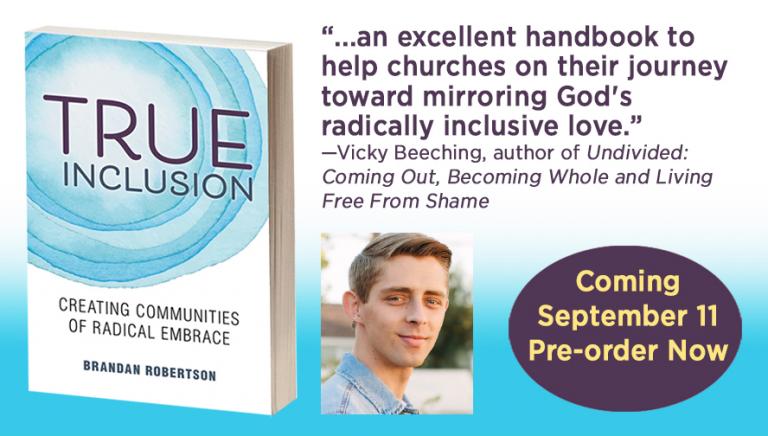
In my new book True Inclusion, I tackle the topic of how churches and communities can intentionally engage in the hard work of true inclusion, with practical stories and actionable steps that I have seen work in inclusive faith communities around the world. Towards the end of the book, I challenge faith leaders and community members to consider what the goal of the church is: is it to become large numerically or is it to reflect the full diversity of God’s creativity, and be a powerful beacon of healing and justice for the good of the world? The reality is that when a community commits to embracing a posture of radical inclusion, they are often making a decision to sacrifice numerical growth for the good of justice and liberation of the marginalized. But this is the call of Christ and is the cost of walking the path of liberation.
I conclude a chapter with the following words:
I believe inclusive churches are in fact called to have revolving doors—continually welcoming new people in to discover what it means to be a part of a faith that promotes justice, and then sending them on their way with our blessings. In this way, we prevent our community from becoming diluted by trying to offer everything to everyone, we encourage people to become the fully formed humans that God created them to be, and we continually have space and resources to help new people who are seeking a community of healing and restoration.
It’s far easier for us to seek liberation and inclusion of one group of people- it’s comfortable, easy to manage, and easy to market to a singular group. But the call of Christ and the commitment that inclusion demands is that we sacrifice egoic desire for larger communities and lean into the need for communites that are truly healing and transforming lives through the power of the gospel. If we are going to be faithful to the way of Jesus and lean into the full posture of inclusion, we must be engaged in intersectional inclusivity, always seeking to lift up and learn from diverse voices who will challenge and transform our communities into the powerful beacon of justice they’re called to be. We must fight our desire to be comfortable, and lean in to the journey of liberation for ourselves and all people, which demands that we rethink our way of doing church and life together as a community.
The path to inclusion isn’t easy. This is why many communities stop short of this high calling. A rainbow flag and a pride float isn’t enough. We must always be working to transform our perspectives and ask “Who else isn’t being embraced in our community?” and work to ensure that they have equal access to their rightful place at the table of God’s grace. This is what true inclusion demands, and this is what it looks like to truly follow in the path of Jesus.
To find out more, check out my new book “True Inclusion” from Chalice Press. You can pre-order it here.
Previous Post

August 3, 2018
Whole Lives: The Spiritual Good of Being Healthy
Next Post
August 27, 2018 The Church's Greatest Sin: Exclusion
Browse Our Archives
Select a Category Breaking News Contributor Post Current Events Devotional Devotional Ideas For A Better Tomorrow General Posts Guest Post Interview Missiology Nomad Rants Recalibrate Reflections Response Review The Other Side Theology Uncategorized
Select a Month May 2020 April 2020 March 2020 February 2020 January 2020 December 2019 September 2019 August 2019 July 2019 June 2019 May 2019 April 2019 March 2019 December 2018 November 2018 October 2018 September 2018 August 2018 July 2018 June 2018 May 2018 April 2018 August 2017 July 2017 May 2017 February 2017 January 2017 December 2016 September 2016 August 2016 July 2016 June 2016 May 2016 April 2016 March 2016 February 2016 January 2016 December 2015 November 2015 October 2015 September 2015 August 2015 July 2015 June 2015 May 2015 April 2015 March 2015 February 2015 January 2015 December 2014 November 2014 October 2014 September 2014 August 2014 July 2014 June 2014 May 2014 June 2013
Follow Us!
TAKE THE
Religious Wisdom Quiz
What does "Abraham" mean?
Select your answer to see how you score.
Chosen One Man of Wisdom King of Peace Father of Many
Related posts from Nomad
Continue The Fight: My (Potential) Experience with COVID-19
If We Want To See America’s Resurrection, Churches...
Why Progressives & Moderates Need Each Other
TRENDING AT PATHEOS Progressive Christian

What Being a Modern-Day Apostle Means to Me
In my last column, I discussed the ins and outs of modern-day...

Did Ancient China Once Worship the God of...
Across human history, a common thread weaves through the origins of the...

Love Your Neighbor – Including Earth-Kin: Lev. 19,...
God’s command to love your neighbor means acting in an ethical and...

Lead a Church Study of “Jesus and Lao...
Guest writer Jack Thomas (The Irreverent Reverend) reflects on leading his church...

Pastoral Wisdom for Responding to Sermon Pushback
Getting sermon pushback on your social justice sermon? Learn practical, Proverbs-based strategies...

Principles for Understanding the Apostolic Ministry Today
Whenever people discover that my formal ministry title is "apostle," as in...
view all Progressive Christian blogs
Ad-Free & Subscriber Log-In Subscription Support
- About Us
- 2026 Calendar
- Videos
- Podcasts
- Library of World Religions
- Faith In Media Tracker
- Advertise With Us
- Write for Us
- Privacy Policy
- Terms of Service
- Do Not Sell My Data
- Contact Us
- Radiant Digital
- Manage Newsletter Subscriptions
- Unsubscribe From Notifications
- Sitemap
Copyright 2008-2026, Patheos. All rights reserved.
Subscription Support Ad-Free & Subscriber Log-In
Follow Patheos