
BuddhistCatholicContemplativeEvangelicalGeneral ChristianHinduJewishLatter-day SaintMuslimNew VisionsProgressive Christian
Beliefs
- Buddhist
- Catholic
- Contemplative
- Evangelical
- General Christian
- Hindu
- Jewish
- Latter-day Saint
- More Voices
- Muslim
- New Visions
- Pagan
- Progressive Christian
Topics
- Religion News
- Food and Religion
- Sports and Religion
- Religious Art
- Religious Music and Entertainment
- Religious Events
- History and Religion
- Style and Religion
- Politics and Religion
- Women in Religion
- Recreation Outdoors and Religion
- Business Finance and Religion
- Careers Workplace and Religion
- Education and Religion
- Family Parenting and Religion
- Health Fitness and Religion
- Home and Religion
- Relationships and Religion
- Technology and Religion
- Travel and Religion
Columnists
- Buddhist Columnists
- Business Finance and Religion Columnists
- Careers Workplace and Religion Columnists
- Catholic Columnists
- Contemplative Columnists
- Education and Religion Columnists
- Evangelists Columnists
- Family Parenting and Religion Columnists
- General Christian Columnists
- Health Fitness and Religion Columnists
- Hindu Columnists
- History and Religion Columnists
- Home and Religion Columnists
- Jewish Columnists
- More Voices Columnists
- Latter Day Columnists
- Muslim Columnists
- New Visions Columnists
- Nonreligious Columnists
- Pagan Columnists
- Politics and Religion Columnists
- Progressive Columnists
- Recreation Outdoors and Religion Columnists
- Relationships and Religion Columnists
- Religion News Columnists
- Religious Art Columnists
- Religious Events Columnists
- Religious Music and Entertainment Columnists
- Sports and Religion Columnists
- Style and Religion Columnists
- Technology and Religion Columnists
- Travel and Religion Columnists
- Women in Religion Columnists
Resource Library
- 2026 Calendar
- Library of World Religions
- The 100 Most Holy Places on Earth
- Patheos Answers
- Podcasts
- Videos
- Faith Leaders Database
- Anglican Episcopalian
- Bahai
- Baptist
- Buddhism
- Christianity
- Confucianism
- Eastern Orthodoxy
- Hinduism
- Holiness and Pentecostal
- ISKCON
- Islam
- Judaism
- Lutheran
- Methodist
- The Church of Jesus Christ of Latter-day Saints
- New Age
- Paganism
- Presbytarian and Reformed
- Protestantism
- Religion Behind the Scenes
- Roman Catholic
- Scientology
- Shia Islam
- Sikhism
- Sufism
- Sunni Islam
- Taoism
- Zen
- See all religions
Research Tools
 Ad-Free & Subscriber Log-In Subscription Support
Ad-Free & Subscriber Log-In Subscription Support
Follow Patheos 

- Trending:
- Forgiveness
- |
- Marriage
- |
- Consciousness
- |
- Death Penalty
- |
- Election
- |
- Halloween
 Nomad
Nomad
- Home
- Progressive Christian
- Religion News
- Tear Down That Wall: A Sermon for Inauguration Week
Tear Down That Wall: A Sermon for Inauguration Week
Last updated on: January 15, 2017 at 8:28 pm by Brandan Robertson
Tear Down That Wall: A Sermon for Inauguration Week 2017-01-15T20:28:03-04:00 Brandan Robertson
Patheos Explore the world's faith through different perspectives on religion and spirituality! Patheos has the views of the prevalent religions and spiritualities of the world.
Originally delivered at First Baptist Church, Denver, Colorado on January 15, 2017.
Good morning, First Baptist!
Before I get in to my message this morning, I’d like to reread my paraphrase of our New Testament text from this morning. This comes from Paul’s Letter to the Ephesians. Paul writes:
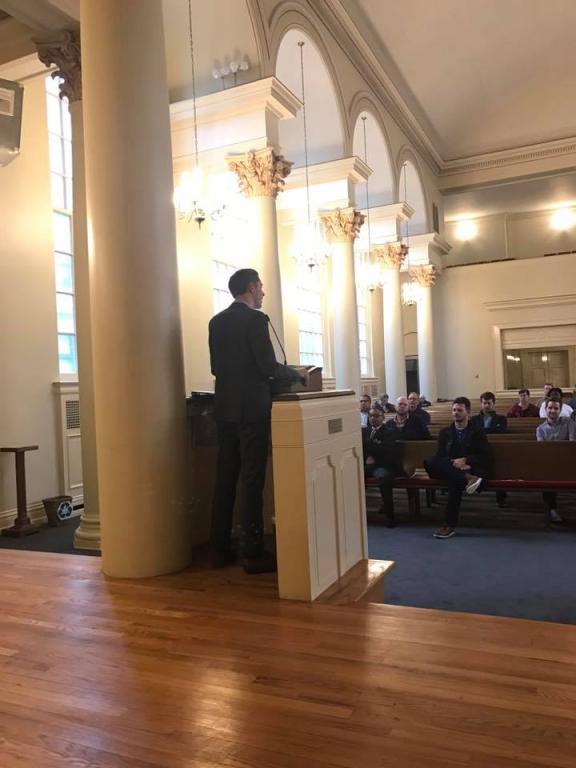
Preaching at FBC Denver
“Jesus embodies for us what true peace looks like, for he was sent once and for all to take down the great wall of hatred and hostility that has divided us, so that we can be one.
He gave up his life to bring an end to all of the self-imposed and meaningless ideologies and laws that separated one people group from the people they consider outsiders. His desire was to create one new humanity from the two opposing groups, thus creating peace.
Effectively the cross becomes God’s means to put to death the hostility we create between ourselves once and for all so that we all may be reconciled together to God in this one new humanity.
The Great Preacher of peace and love came for you, and His message reached those of you who were near and those who were far away. His message revealed to us that all people have access to God in one Spirit. And so you are no longer called outcasts, others, heretics, deplorable, overrated, unclean, or illegal immigrants but are full citizens with God’s people, members of God’s holy family, and residents of His household.”**
You see, First Baptist, I’ve come to you this morning to share with you some breaking news.
Our nation is divided.
Can you believe that?
Our nation is really, really divided.
Some would say it is more divided than ever before, but I think such statements are largely unhelpful.
All that I know is that we are divided.
White versus people of color. Rich versus poor. LGBT versus Traditionalists. Trump Supporters versus Clinton versus Sanders versus McMullin versus whomever.
And no matter where you stand after this tumultuous election season, no matter what direction you believe our nation is heading in, I believe all of us at some level are feeling a collective tension, a fear that something deeply distressing has been exposed in our world and we are all wondering what exactly we can do about it.
For so many of us, especially those with privilege, we have believed that our deepest divisions were actually healed. That we had solved racism in the 1960’s. That LGBT rights found its culmination in June 2015. That despite differences in worldviews, that we were pretty much on the same page.
Now, we know that nothing could be further from the truth.
Families have been divided against themselves. Sections of the nations. Churches. Denominations. Countries. Cities. Division is all around us, every single day.
Many of us are also divided internally.
When the veil is pulled back on reality and we are abruptly shaken out of our dream state, fear rises to the surface. And when fear emerges in our bodies, we get stupid.
Literally.
When fear is present, an area of our brain called the amygdala fires, and we lose the capacity to think rationally. We revert to our animalistic impulses, and we prepare to fight or to flee.
When the amygdala fires, we begin to do some highly irrational and crazy things.
We begin to build walls. We begin to segregate. We begin to demonize those who think, look, love, believe, vote, or act differently than us. We begin searching for a scapegoat, someone we can place the blame on for all of our problems and fears, and begin to seek to exile them from our families, our communities, and our world.
Fear causes us to do some dangerous, terrible things.
This is why the Scriptures says that fear and love are incompatible. That love expels fear.
Because it’s impossible to love, at least in the Biblical sense, while we’re acting like animals.
When we’re making out decisions out of fear and impulse.
Love requires higher levels of consciousness. It requires intentionality and hard work. It requires us to see our common humanity in all people and our interconnectedness to all of life.
Love simply cannot manifest when we’re reacting in fear.
As we’re all well aware, in this moment of division and fear, many in our nation are acting irrationally. We’re making choices and decisions, not out of love, not even out of rationality, but out of impulsive, unjustifiable, fear.
Fear is what causes us to seek to build a wall to “keep out” those who we see as the sole cause of the drug problems and rape cases in our nation.
Fear causes us to seek to ban and expel everyone who worships a different god or holds to a different worldview than we do.
Fear is what causes us to posture ourselves for attack, ready to marginalize anyone who sees things differently than we do- and that goes for all of us, regardless of what side of the aisle we’re on.
Fear is what separates us, and love is the only thing that can bring us together.
In our scripture this morning, the Apostle Paul tells us that Jesus is the embodiment of what true peace looks like, because he was sent once and for all to tear down the wall of hostility that divided us so that we might be one.
That sounds like a nice theological idea, but what does it actually mean?
Paul was writing to a racially divided people. The Jews believed that they were superior to the Gentiles, that there religion and customs made them more pure and more sophisticated. Likewise, the Gentiles saw the Jewish people as strange religious elitists who didn’t deserve to be fully integrated into society.
Needless to say, they were an incredibly divided culture.
So when the early Christian evangelists felt called to bring the Gospel message of Jesus beyond the Jewish people to the rest of the world, they were faced with the need to confront their own prejudice and discriminatory attitudes.
If they were going to be effective in spreading this message about Jesus, they knew they needed to go beyond just themselves, but in order to do so required confronting their fears about Gentiles and expanding their understanding of love- God’s love- that it could and did extend beyond the Jewish people and indeed was available and present to all people.
This was a radical notion then, and it still is today.
They were compelled to reach beyond themselves because they saw their Rabbi, Jesus, constantly demonstrating this behavior.
Jesus not only spoke to, but also befriended, ate with, and put his reputation on the line for all of the people that the Jewish elites would never have touched with a ten-foot pole.
Do you remember the time that Jesus invited himself over to Simeon, the tax collectors house for a meal? Or when a promiscuous woman meets Jesus at a well? Or when Jesus is found having drinks in the home of a Gentile?
The religious leaders, and in fact, his own disciples were beside themselves.
“You can’t just hang around those kinds of people!” They snarled among themselves.
Yet Jesus insisted on breaking all of the rules. Jesus insisted on tearing down the imaginary walls that separated him from everyone else.
Because you know, most of the walls that separate us are imaginary, right?
Tell me; really, what is the actual, tangible difference between a Democrat and a Republican?
The differences are small and often menial. But the similarities, namely, our common humanity far outweigh any difference.
So Jesus, in one fell swoop, destroys the imaginary walls that divide us. He shows us that all of the prejudices and misconceptions that we continually use to make ourselves superior to others are all in our head.
Because when Jesus is sitting at that table with Simeon, or at that well with the adulterous woman, or in the home of a Gentile, he’s not experiencing them as tax collectors, adulterers, or Gentiles, but as humans, as siblings, and manifestations of the same life and light that he himself partakes in.
The same life and light that we all partake in.
We are all already one. It’s an inescapable reality. We are all made of the same substance and partake in the same nature. We live and move and have our being in the same Universe. We’re all already one.
Any separation is self-constructed and imaginary.
We’re people. We’re one. In the midst of our great cultural diversity. Worldview diversity. Religious diversity. We’re all already one.
But when you begin to mess with the walls, borders, and boundaries of separation that we create out of our fear, you’re likely going to get some major blowback.
Because fear not only drives us to create walls, it also drives us to defend our security at all costs.
See, fear gets us to believe the lie that we live in a world where everyone and everything is out to get us. That anyone who doesn’t look like, believe like, or act like us, is our actual enemy who has the desire to harm us.
Even if 99% of the time, nothing could be further from the truth.
See, Paul tells us that Jesus ends up giving up his life because of his work to tear down our walls. The Jewish elites of his day, along with the Roman government officials, didn’t like his constant subverting of cultural norms.
They didn’t like his message of love, unity, and forgiveness for all people. Because his message was beginning to dissolve the false systmes and structures that had been created to keep society running smoothly. To keep the Jewish people in their system, the Gentiles in theirs.
Anyone who comes with a message that calls out our irrational fears and begins to chip away at our walls is bound to be faced with the threat of violence. Because they become the scapegoat.
Not the enemy on the other side of the wall, but the one seeking to tear down the wall.
And they must be removed. Imprisoned. Or killed.
This is what happens to Jesus. It’s what happened to Dr. Martin Luther King Jr. It’s what happened to Nelson Mandela. It’s what happened to the Dalai Lama.
Anyone who pulls back the veil and reveals the absurdity of our divisions, they are seen as incredibly dangerous.
Jesus called the people of his day to become one new humanity.
Did you hear that? One new humanity?
That kind of radical vision is still needed today, isn’t it?
This is what Jesus was all about, by the way.
Not preaching about heaven and hell. Not even about social justice. But about creating one new humanity and thereby bringing justice and heaven to earth.
It’s a far off vision, for sure, but it’s one that’s definitely needed in our world today. But notice what Paul says is necessary for that to become a reality.
“He gave up his life to bring an end to all of the self-imposed and meaningless ideologies and laws that separated one people group from the people they consider outsiders.”
Jesus sought to reveal that all of the things that divided us where rooted in “self imposed and meaningless laws and ideologies”.
Stuff that religious and political people thought up in their ivory towers of power and privilege but have absolutely nothing to do with the real things of life- justice, equality, peace, and love.
In this moment of our nation and worlds history, we are being called by the Spirit to stop and consider the example of Jesus. The example that led him to subvert cultural norms. To tear down the walls of self-imposed standards that divide us. To literally give up his own life to show us just how futile and dangerous we can become when we act out of fear.
It’s easy for us to sit here and listen to this message and think that I am preaching about some other group of people. Surely, I couldn’t be talking to the beautiful, progressive people of First Baptist, Denver!
But this message is probably more important for us than anyone else.
See, in this moment, we too can easily fall into the trap of fear leading to demonization. We might not be the ones calling for a wall between the U.S. and Mexico, but we are building walls, often much more dangerous walls than a physical one.
Many of us have fallen into the trap of demonization where we see anyone who thinks, looks, acts, and believes differently than us is the problem for our society. We see them as archaic, bigoted hindrances to progress.
We see them as out of touch and dangerous. And we demonize them. We make them our “others”, and tell ourselves the lie that if we just got rid of those people- the pro-lifers, the Trump supporters, the racists- then our country would finally be a place of progress.
But we know, deep down, that that’s not the case. And we know, deep down, that by demonizing entire groups of people, painting them with one brush, and blaming them for all of our problems, that we’re only exacerbating the problems we face.
Because our fear drives them to fear. We fall into their worst stereotypes about the “Left”. And they respond out of fear. And we crucify each other. We make poor choices. We act out of our reptilian brains. And we bring more destruction instead of peace.
Today, the Spirit calls all of us to examine our own prejudice. Our own propensity to demonize. Our own failure to love. The walls of our own building.
And the Spirit calls us to do something bold- to tear them down. To refuse to perpetuate stereotypes or act out of impulsive, polarized spaces in our own mind. And instead to see each person as a partaker in the Divine nature with us. Each person as a unique combination of experiences, backgrounds, beliefs, and fears. Each person as worthy of our time, our consideration, and our love.
What would happen if instead of demonizing those who differ from us, we did what Jesus did? We took them for lunch? We went out for a drink? We made a point to get to know those who voted differently than us. To understand their perspective. To see them as beloved siblings.
This doesn’t mean that we must agree. It doesn’t mean we sugarcoat our disagreements. It doesn’t mean we condone immoral behaviors. It just means that connect as humans, rather than demonize as ideologues.
Perhaps this would lead our communities, our nation, and our world in a different direction. Perhaps, we would begin to experience that one new humanity that Jesus sought to create. Beyond our meaningless divisions. Beyond our fears.
Perhaps, at last, we’d experience that more beautiful world our hearts know is possible.
Paul concludes our passage this morning by writing these words:
“The Great Preacher of peace and love came for you, and His message reached those of you who were near and those who were far away. His message revealed to us that all people have access to God in one Spirit. And so you are no longer called outcasts, others, heretics, deplorable, overrated, unclean, or illegal immigrants but are full citizens with God’s people, members of God’s holy family, and residents of His household.”**
Jesus, our great preacher of peace and love has brought to us a message and example that calls us to move beyond of impulsive fears, our propensity to judge, our addiction to scapegoat, and instead, to look at everyone as equal members of God’s family, which is the human family.
All of us, in all of our diversity, share one common humanity. One common light. One common spirit. No human is truly an enemy. No human is truly an other.
When we take the risky, unpopular, uncomfortable path of Jesus and get to see the humanity in even our most despised enemies, we break open the floodgates of empathy, light, and love, and allow for the possibility of true and lasting progress.
We are doing something different, something radical, that has the potential to actually change the way things are.
Will you follow in the Spirit’s steps?
As we head into this inauguration week, the tensions will be high. Our fears will be on display. And we will be tempted to demonize those who stand on the other side of the aisle from us.
Are you willing to let go of your fear and judgments to make room for love in your day-to-day life? Are you willing to make space in your life for those who see things differently than you? More than that, are you willing to have a meal with them? Coffee with them?
Will you take time to get to know people? Real people. Not just their caricature.
That’s the path for change. That’s the spirits call.
The call is hard. But it seems, according to Jesus, to be our only hope.
May we all heed the call of the Spirit to us this day.
Amen.
Previous Post

December 20, 2016
We Are What We've Been Waiting For
Next Post

January 31, 2017 Welcome To The Revolution
Browse Our Archives
Select a Category Breaking News Contributor Post Current Events Devotional Devotional Ideas For A Better Tomorrow General Posts Guest Post Interview Missiology Nomad Rants Recalibrate Reflections Response Review The Other Side Theology Uncategorized
Select a Month May 2020 April 2020 March 2020 February 2020 January 2020 December 2019 September 2019 August 2019 July 2019 June 2019 May 2019 April 2019 March 2019 December 2018 November 2018 October 2018 September 2018 August 2018 July 2018 June 2018 May 2018 April 2018 August 2017 July 2017 May 2017 February 2017 January 2017 December 2016 September 2016 August 2016 July 2016 June 2016 May 2016 April 2016 March 2016 February 2016 January 2016 December 2015 November 2015 October 2015 September 2015 August 2015 July 2015 June 2015 May 2015 April 2015 March 2015 February 2015 January 2015 December 2014 November 2014 October 2014 September 2014 August 2014 July 2014 June 2014 May 2014 June 2013
Follow Us!
TAKE THE
Religious Wisdom Quiz
What was Cornelius' profession?
Select your answer to see how you score.
Roman centurion Fisherman Carpenter Shepherd
Related posts from Nomad

Continue The Fight: My (Potential) Experience with COVID-19
If We Want To See America’s Resurrection, Churches...
Why Progressives & Moderates Need Each Other
TRENDING AT PATHEOS Progressive Christian

What Being a Modern-Day Apostle Means to Me
In my last column, I discussed the ins and outs of modern-day...

Did Ancient China Once Worship the God of...
Across human history, a common thread weaves through the origins of the...

Love Your Neighbor – Including Earth-Kin: Lev. 19,...
God’s command to love your neighbor means acting in an ethical and...

Lead a Church Study of “Jesus and Lao...
Guest writer Jack Thomas (The Irreverent Reverend) reflects on leading his church...

Pastoral Wisdom for Responding to Sermon Pushback
Getting sermon pushback on your social justice sermon? Learn practical, Proverbs-based strategies...

Principles for Understanding the Apostolic Ministry Today
Whenever people discover that my formal ministry title is "apostle," as in...
view all Progressive Christian blogs
Ad-Free & Subscriber Log-In Subscription Support
- About Us
- 2026 Calendar
- Videos
- Podcasts
- Library of World Religions
- Faith In Media Tracker
- Advertise With Us
- Write for Us
- Privacy Policy
- Terms of Service
- Do Not Sell My Data
- Contact Us
- Radiant Digital
- Manage Newsletter Subscriptions
- Unsubscribe From Notifications
- Sitemap
Copyright 2008-2026, Patheos. All rights reserved.
Subscription Support Ad-Free & Subscriber Log-In
Follow Patheos