
BuddhistCatholicContemplativeEvangelicalGeneral ChristianHinduJewishLatter-day SaintMuslimNew VisionsProgressive Christian
Beliefs
- Buddhist
- Catholic
- Contemplative
- Evangelical
- General Christian
- Hindu
- Jewish
- Latter-day Saint
- More Voices
- Muslim
- New Visions
- Pagan
- Progressive Christian
Topics
- Religion News
- Food and Religion
- Sports and Religion
- Religious Art
- Religious Music and Entertainment
- Religious Events
- History and Religion
- Style and Religion
- Politics and Religion
- Women in Religion
- Recreation Outdoors and Religion
- Business Finance and Religion
- Careers Workplace and Religion
- Education and Religion
- Family Parenting and Religion
- Health Fitness and Religion
- Home and Religion
- Relationships and Religion
- Technology and Religion
- Travel and Religion
Columnists
- Buddhist Columnists
- Business Finance and Religion Columnists
- Careers Workplace and Religion Columnists
- Catholic Columnists
- Contemplative Columnists
- Education and Religion Columnists
- Evangelists Columnists
- Family Parenting and Religion Columnists
- General Christian Columnists
- Health Fitness and Religion Columnists
- Hindu Columnists
- History and Religion Columnists
- Home and Religion Columnists
- Jewish Columnists
- More Voices Columnists
- Latter Day Columnists
- Muslim Columnists
- New Visions Columnists
- Nonreligious Columnists
- Pagan Columnists
- Politics and Religion Columnists
- Progressive Columnists
- Recreation Outdoors and Religion Columnists
- Relationships and Religion Columnists
- Religion News Columnists
- Religious Art Columnists
- Religious Events Columnists
- Religious Music and Entertainment Columnists
- Sports and Religion Columnists
- Style and Religion Columnists
- Technology and Religion Columnists
- Travel and Religion Columnists
- Women in Religion Columnists
Resource Library
- 2026 Calendar
- Library of World Religions
- The 100 Most Holy Places on Earth
- Patheos Answers
- Podcasts
- Videos
- Faith Leaders Database
- Anglican Episcopalian
- Bahai
- Baptist
- Buddhism
- Christianity
- Confucianism
- Eastern Orthodoxy
- Hinduism
- Holiness and Pentecostal
- ISKCON
- Islam
- Judaism
- Lutheran
- Methodist
- The Church of Jesus Christ of Latter-day Saints
- New Age
- Paganism
- Presbytarian and Reformed
- Protestantism
- Religion Behind the Scenes
- Roman Catholic
- Scientology
- Shia Islam
- Sikhism
- Sufism
- Sunni Islam
- Taoism
- Zen
- See all religions
Research Tools
 Ad-Free & Subscriber Log-In Subscription Support
Ad-Free & Subscriber Log-In Subscription Support
Follow Patheos 

- Trending:
- Forgiveness
- |
- Marriage
- |
- Consciousness
- |
- Death Penalty
- |
- Election
- |
- Halloween
 Nomad
Nomad
- Home
- Progressive Christian
- Religion News
- Women of Wisdom : Conversations with Iyanla Vanzant, Elizabeth Gilbert, and Marianne Williamson
Women of Wisdom : Conversations with Iyanla Vanzant, Elizabeth Gilbert, and Marianne Williamson
Last updated on: October 29, 2015 at 5:34 pm by Brandan Robertson
Women of Wisdom : Conversations with Iyanla Vanzant, Elizabeth Gilbert, and Marianne Williamson 2015-10-29T17:34:03-04:00 Brandan Robertson
Patheos Explore the world's faith through different perspectives on religion and spirituality! Patheos has the views of the prevalent religions and spiritualities of the world.
For centuries, many of the worlds religious traditions have sought to silence the voices of women, insisting that their place is domestic and not in the public sphere, teaching, leading, and shaping culture. Yet in the midst of these oppressive institutions, women have been resilient, working hard to find ways to subvert societal norms and assert themselves as leaders, visionaries, and creatives, shaping our world in monumental ways. While much of this oppression still remains in cultures and religious systems around our world, the sun is beginning to break on a new day where women are being recognized as some of the most prominent and powerful spiritual leaders in our world.
In my journeys around the country over the past few months, I have had the unique privilege of getting to sit down and talk with a few prominent women in the world of spirituality. As I have sat and listened to them, I have been profoundly blessed by their wisdom and direction and its implications for my own life. So on this weeks post, I wanted to take some time to share with you a few snipets of the conversations that I have had with these spiritual leaders, in hope that you too would find inspiration and encouragement as you walk along your path.
IYANLA VANZANT:
The first person that I sat down to talk with was Iyanla Vanzant, a prominent voice within the New Thought movement and the television personality 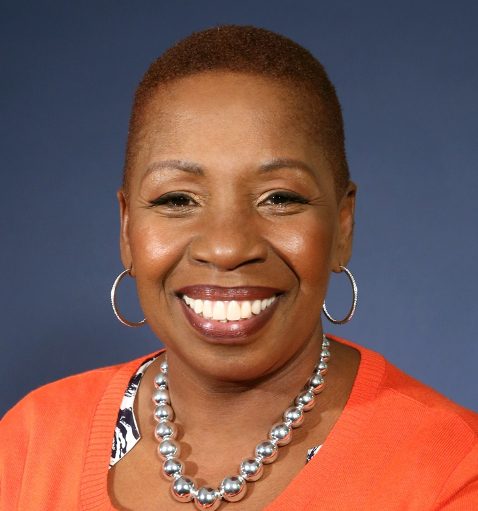 on her popular Oprah Winfrey Network show, “Iyanla, Fix My Life.” I was invited to catch up with Iyanla, along with my friend Bridgette Jackson-Buckley of The Spirituality Examiner and others writers, in Los Angeles, California where she was filming a television special with Oprah.
BRANDAN: “You say you come from “crazy as hell circumstances.” So many of us have that story. I personally grew up with an abusive, alcoholic father and felt like those circumstances could have really weighed me down on my journey. What has helped you to be able to get out of that rut, where so many people get stuck?”
IYANLA: “I think two things helped me. One, I did my masters degree in spiritual psychology at the University of Santa Monica, and one of the things that I learned in that course was about the power of judgments. That very often its not what happens to us, its not what they did or didn’t do, its our judgment about the person or the experience that keeps us locked.
The way to move out of judgments is my favorite subject in life, forgiveness. As soon as you can forgive the thought, forgive the judgment about the thing or the person, it opens up a new avenue of energy for you. But as long as your stuck in judgment- right, wrong, good, bad, should, shouldn’t, fair, unfair- you’re locked into it. So you’ve got to identify the judgment and then forgive it so that you can open up new energy.”
BRIDGITTE JACKSON-BUCKLEY (Spirituality Examiner): “Of all the questions that you’ve been asked, what are we not talking about that is integral to the spiritual conversation?”
IYANLA: “We’re not talking about the role of the indigenous cultures in the spiritual movement. We don’t talk about the role of Native American spiritual philosophies, spiritual traditions, spiritual cultures, in the spiritual movement. We have divorced spirituality and culture…and many cultures have a very specific, engrained spiritual philosophy. But you’ve got to bring it to the table. You cant white wash it. You’ve got to bring it with the culture. You’ve got to bring the dance. You’ve got to bring the music. You’ve got to bring the sound. And we do the same thing with indigenous African spiritual cultures and philosophy… We have not honored, respected, and invited the culture and tradition of indigenous people to the spiritual conversation, and until we do that, we are bereft of a wealth of human presence and understanding. We’ve got to talk about it.”
ELIZABETH GLIBERT:
After chatting with Iyanla at UCLA, Elizabeth Gilbert, the best-selling author of Eat, Pray, Love, and renowned spiritual guru sat down to have a 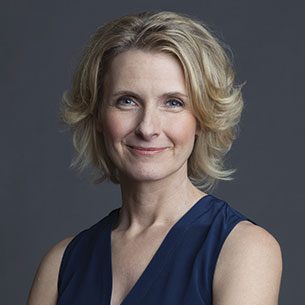 brief conversation with us.
BRANDAN: “I write for a lot of conservative religious folks who are transitioning to a more progressive faith. You talk about the importance of examining our central truths, but for so many people that very process of examination of something so fundamental is clouded with fear. What would you say to a person who is afraid to take a second look at their core truths?”
ELIZABETH: “I would say, if God didn’t want you to be so inquisitive, then why did he give you so much curiosity? Can you trust the Map-Maker a little more? Because I feel like the fear that comes from not wanting to examine your beliefs looks an awful lot like a lack of faith. Which is weird because it plays out as extraordinary faith. “My faith is so strong and so unshakable.” Well, if your faith is so strong, then it should be a problem to, you know, think about it. Look at it. Talk to other people who think differently than you.
So I think that it shows an absence of trust in your Creator who created you exactly as you are, you know? If God wanted you to be narrow minded and uninterested, you wouldn’t even be asking questions to begin with. So trust the One who made you and behave as you were made.”
BRIDGITTE JACKSON-BUCKLEY (Spirituality Examiner): “Can you speak to us a little bit about the greatest lesson you’ve had to learn throughout the creative process. I think with the creative process that there is an illusion that if you just keep doing it that it will be nice a pretty and you’re going to get the calls and the emails, but what about when it’s not. That day to day lesson…not seeing the results that you want…How do you keep going?”
ELIZABETH: “Two things…The first is that vie learned that I mistakenly thought that to be a bold, creative person, I had to be fearless. What I’ve learned instead is that I have to walk next to my fear, holding its hand. Because creativity asks you to enter into realms with unknown outcomes, and your fear hates nothing more than a realm of unknown outcome. Your fear is programmed to stop you from doing that, because its like a security guard all hopped up on Red Bull. Your fear believes that any unknown outcome ends in your death. So…I actually just walk side by side with it, holding its hand, saying “Thank you so much for trying to protect me, but all’s I am trying to do here is write a poem, no one is going to die. And I know this scares you, but I am going to do this thing, and your going to come with me, and were going to do this together.” So if we can develop this loving relationship with fear, rather than a denial or eradication of fear. The only fearless people I’ve ever met are sociopaths and I don’t wanna be fearless, I wanna be someone who can be afraid and be emotional.
The other thing I wanted to say is that the day to day, the belief I have is that were not alone. I think that the struggle that creative people often have is that your sitting in the studio and its not working and you’re all alone… Its so lonely and its such a sense of despair. But in those moments, if I can remind myself of my central belief which is that, this idea, Liz, came to you and asked you to work with it. This idea chose you… because it thought that you could do it. And right now, its sitting next to you, trying with everything that it has from beyond, to help you. So collaborate with it, make something that the idea couldn’t make because it doesn’t have a body, its just an idea, but that you cant make without the help of the idea. So I will literally turn to my left and say, “Show me how I can help you. Help me.” And I believe that I am not alone in this work and that always relaxes me out of that block. You know? “You must have come to me for a reason. You know I’m here, I know you’re there. Let’s work together.”
MARIANNE WILLIAMSON:
A few months later, while presenting at the Parliament of the Worlds Religions in Salt Lake City, my friend Isaac 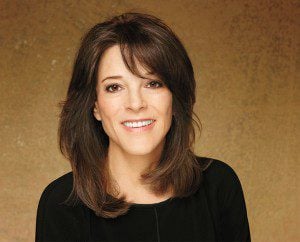 Archuleta and I had the privilege of sitting down for a conversation with Marianne Williamson. Marianne is a best-selling author of A Return to Love and a spiritual teacher in the tradition of A Course In Miracles.
BRANDAN: “So, Marianne, we are here at the Parliament of the Worlds Religions, and walking around LGBT people here, its been interesting to see the expressions of people who see us, of so many different religious backgrounds. Religion at its core is meant to lead us towards Love and Union. What makes it so hard for people of deep, devout, religious faith, to not be able to accept forms of Love that may be they haven’t experienced before, like when they see an LGBT couple together?”
MARIANNE: “The fact that something calls itself a religion doesn’t mean that it is of God. So, I think that were living at a time where we are not so quick to call people “religious”, just because they say that they believe in a religion. Nor are we so quick to dismiss the religiocity of people who say that they are agnostic. In A Course in Miracles it says, some people conspire with God who do not yet believe in him. And also it says that clearly some religions have nothing to do with God. There are people who kill in the name of God. So why should we be surprised that there are people who judge in the name of God?
But were living at a time of spiritual revolution. A renewal of spiritual and religious consciousness and a great consensus, I think, is forming, among the peoples of the world that it’s a universality of the themes at the heart of all the great religious truths that really matter. And that, at its core, is that we love one another. Not that we judge one another, but that we love one another. You said that you’re evangelical Christians, Jesus did not say “Go judge each other”, he said, “Judge not lest ye be judged.” He said the highest law is that we love one another. Now what others say in his name should not be as important to us as what he says himself. So who’s the true Christian there?”
ISAAC: “I’m the son of two conservative pastors, and I grew up knowing that I would come out some day…But by the time I was a seminary student, it was incredibly painful for me… What I see is a lot of millennials leaving the church. I find it very odd that some of us can be very comfortable and staying in the church. But many of us feel compelled to leave religion and spirituality. What is it that millennials find so difficult or off-putting about spirituality?”
MARIANNE: “Well, the larger phenomenon is not that millennials are leaving institutionalized religion, its that everyone is leaving institutionalized religion. And people are leaving it behind because in too many cases we find that institutionalized religious doctrine and dogma actually goes against what we find to be deeply true in our hearts and goes against what we feel to be deeply true about God.
Having said that, I think that there are also a lot of people who having left traditional religions then come to feel that they have thrown away the baby with the bathwater, and that’s where spiritual, congregational experiences led by people such as myself come in, where we do not pussyfoot around God and we do not pussyfoot around the question of “who does God want us to be on this earth?” and “how do we do Gods will?” But from a non-doctrinal, non-dogmatic place. As a student of A Course In Miracles, there are still basic principles, but they are based on universal themes of the heart of all the great religious teachings of the world.
Some people, it sounds like possibly you two, are guided to stay within the religious context in order to revolutionize what is happening within that segment, and I believe that God directs individuals according to his will for us and how we can be best of use…I believe that its important to honor our incarnation. I believe that we are all stewards of the lineage, so, as Americans, we are stewards of American democracy, as gay people, you are stewards, and you are to live in honor of the people of Stonewall, you want to live in honor of the sacrifices that have been made and in honor of generations coming after you so that you continue to forge a greater space.
You also have an amazing incarnational drama, and I’m sure that at times it has been extremely painful. Because not only did you incarnate as a gay person, but you also incarnated to evangelical parents. I really acknowledge both of you for having survived the worst part of it and obviously turning it into something beautiful. But you can see where God would need that to. It’s like Isaiah, “God, send me.” “
BRANDAN: “Absolutely beautiful. So, the last question I try to ask every spiritual leader I interview. In Christianity, we believe that the core truth of our faith is called “the Gospel”, the message that leads humanity to salvation and awakening. What do you understand the Gospel to be?”
MARIANNE: “You know, in the Book of Thomas, Jesus says to his disciples, “Go out into the countryside and teach the Gospel.” Now, from the metaphysical perspective, the question is not just “what is the Gospel?” but also, “what is it to teach?” So, in A Course In Miracles it says “to teach is to demonstrate” and “the Gospel is Love.” So to teach the Gospel is to demonstrate Love. That is the good news. Because in the presence of that Love, things harmonize, in the presence of that Love, miracles happen naturally, in the presence of that Love, God will do his will. You do not serve him by thinking you know what that is for other people. You serve him by being that field of Love through which he can operate. That’s the real meaning behind, “vengeance is mine saith the Lord”, meaning “it’s not yours.”
So, in the Book of Thomas, when the disciples then say to Jesus after he says “Go out into the countryside and teach the Gospel”, they said to him, “What will we say?” And his response to them was, “I’ll tell you when you get there.”
So, you follow the internal direction you get through prayer or however we connect with that still small voice within, and from a Christian perspective, the truth is that the Holy Spirit will guide you. But from all the great spiritual traditions the perspective is that the Spirit will guide you by whatever. And you can see it in everyone you talk to. You’re assigned to a particular area, I’m assigned to a particular area. And if all of us just say, “Dear God, use me. How would you have me go?” In A Course In Miracles, there’s a daily prayer, “Where would you have me go, what would you have me do, what would you have me say, and to whom?”
Three conversations with three of the leading women in religion and spirituality today. So much wisdom is contained in these short snippets of our conversations, and it is my hope that you would hear the voice of God speaking to you through the words of these powerful women. May many more women be empowered to stand with boldness in their power and strength as spiritual leaders and guides and may we all remain open to receive the fresh word that God is speaking to us, through them.
Previous Post

October 26, 2015
We Need Reformation (A Sermon for Reformation Day)
Next Post
November 1, 2015 The Flow of Love
Browse Our Archives
Select a Category Breaking News Contributor Post Current Events Devotional Devotional Ideas For A Better Tomorrow General Posts Guest Post Interview Missiology Nomad Rants Recalibrate Reflections Response Review The Other Side Theology Uncategorized
Select a Month May 2020 April 2020 March 2020 February 2020 January 2020 December 2019 September 2019 August 2019 July 2019 June 2019 May 2019 April 2019 March 2019 December 2018 November 2018 October 2018 September 2018 August 2018 July 2018 June 2018 May 2018 April 2018 August 2017 July 2017 May 2017 February 2017 January 2017 December 2016 September 2016 August 2016 July 2016 June 2016 May 2016 April 2016 March 2016 February 2016 January 2016 December 2015 November 2015 October 2015 September 2015 August 2015 July 2015 June 2015 May 2015 April 2015 March 2015 February 2015 January 2015 December 2014 November 2014 October 2014 September 2014 August 2014 July 2014 June 2014 May 2014 June 2013
Follow Us!
TAKE THE
Religious Wisdom Quiz
What did Moses' staff turn into before Pharaoh?
Select your answer to see how you score.
A serpent A pillar of fire A bird A stone
Related posts from Nomad
Why Progressives & Moderates Need Each Other

Hope for the Future of America with Gov....
Unite & Lead: A Plea for Civility this...
How "Love Thy Neighbor" Can Heal Our Divides
TRENDING AT PATHEOS Progressive Christian

What Being a Modern-Day Apostle Means to Me
In my last column, I discussed the ins and outs of modern-day...

Did Ancient China Once Worship the God of...
Across human history, a common thread weaves through the origins of the...

Love Your Neighbor – Including Earth-Kin: Lev. 19,...
God’s command to love your neighbor means acting in an ethical and...

Lead a Church Study of “Jesus and Lao...
Guest writer Jack Thomas (The Irreverent Reverend) reflects on leading his church...

Pastoral Wisdom for Responding to Sermon Pushback
Getting sermon pushback on your social justice sermon? Learn practical, Proverbs-based strategies...

Principles for Understanding the Apostolic Ministry Today
Whenever people discover that my formal ministry title is "apostle," as in...
view all Progressive Christian blogs
Ad-Free & Subscriber Log-In Subscription Support
- About Us
- 2026 Calendar
- Videos
- Podcasts
- Library of World Religions
- Faith In Media Tracker
- Advertise With Us
- Write for Us
- Privacy Policy
- Terms of Service
- Do Not Sell My Data
- Contact Us
- Radiant Digital
- Manage Newsletter Subscriptions
- Unsubscribe From Notifications
- Sitemap
Copyright 2008-2026, Patheos. All rights reserved.
Subscription Support Ad-Free & Subscriber Log-In
Follow Patheos