
BuddhistCatholicContemplativeEvangelicalGeneral ChristianHinduJewishLatter-day SaintMuslimNew VisionsProgressive Christian
Beliefs
- Buddhist
- Catholic
- Contemplative
- Evangelical
- General Christian
- Hindu
- Jewish
- Latter-day Saint
- More Voices
- Muslim
- New Visions
- Pagan
- Progressive Christian
Topics
- Religion News
- Food and Religion
- Sports and Religion
- Religious Art
- Religious Music and Entertainment
- Religious Events
- History and Religion
- Style and Religion
- Politics and Religion
- Women in Religion
- Recreation Outdoors and Religion
- Business Finance and Religion
- Careers Workplace and Religion
- Education and Religion
- Family Parenting and Religion
- Health Fitness and Religion
- Home and Religion
- Relationships and Religion
- Technology and Religion
- Travel and Religion
Columnists
- Buddhist Columnists
- Business Finance and Religion Columnists
- Careers Workplace and Religion Columnists
- Catholic Columnists
- Contemplative Columnists
- Education and Religion Columnists
- Evangelists Columnists
- Family Parenting and Religion Columnists
- General Christian Columnists
- Health Fitness and Religion Columnists
- Hindu Columnists
- History and Religion Columnists
- Home and Religion Columnists
- Jewish Columnists
- More Voices Columnists
- Latter Day Columnists
- Muslim Columnists
- New Visions Columnists
- Nonreligious Columnists
- Pagan Columnists
- Politics and Religion Columnists
- Progressive Columnists
- Recreation Outdoors and Religion Columnists
- Relationships and Religion Columnists
- Religion News Columnists
- Religious Art Columnists
- Religious Events Columnists
- Religious Music and Entertainment Columnists
- Sports and Religion Columnists
- Style and Religion Columnists
- Technology and Religion Columnists
- Travel and Religion Columnists
- Women in Religion Columnists
Resource Library
- 2026 Calendar
- Library of World Religions
- The 100 Most Holy Places on Earth
- Patheos Answers
- Podcasts
- Videos
- Faith Leaders Database
- Anglican Episcopalian
- Bahai
- Baptist
- Buddhism
- Christianity
- Confucianism
- Eastern Orthodoxy
- Hinduism
- Holiness and Pentecostal
- ISKCON
- Islam
- Judaism
- Lutheran
- Methodist
- The Church of Jesus Christ of Latter-day Saints
- New Age
- Paganism
- Presbytarian and Reformed
- Protestantism
- Religion Behind the Scenes
- Roman Catholic
- Scientology
- Shia Islam
- Sikhism
- Sufism
- Sunni Islam
- Taoism
- Zen
- See all religions
Research Tools
 Ad-Free & Subscriber Log-In Subscription Support
Ad-Free & Subscriber Log-In Subscription Support
Follow Patheos 

- Trending:
- Forgiveness
- |
- Marriage
- |
- Consciousness
- |
- Death Penalty
- |
- Election
- |
- Halloween
 Nomad
Nomad
- Home
- Progressive Christian
- Religion News
- To The Point: The Facts About Indiana’s RFRA
To The Point: The Facts About Indiana’s RFRA
Last updated on: March 30, 2015 at 4:46 pm by Brandan Robertson
To The Point: The Facts About Indiana’s RFRA 2015-03-30T16:46:31-04:00 Brandan Robertson
Patheos Explore the world's faith through different perspectives on religion and spirituality! Patheos has the views of the prevalent religions and spiritualities of the world.
The national debate surrounding Indiana’s Religious Freedom Restoration Act is enough to disorient even the most 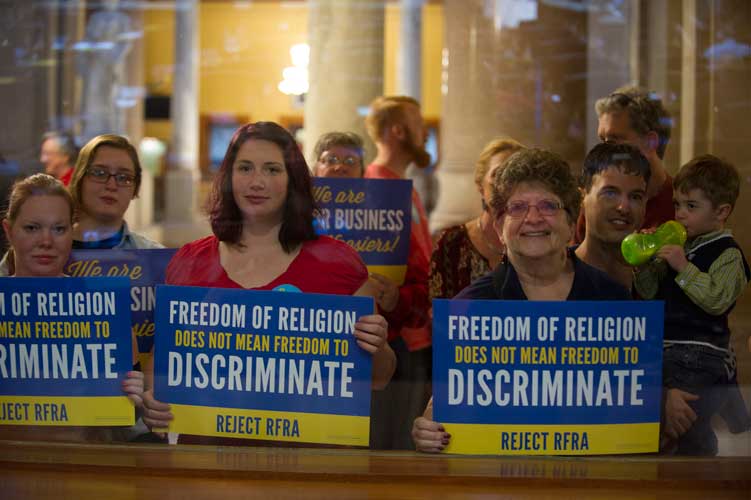 experienced political analyst. There is a constant back and forth between opponents and proponents of the bill claiming that the RFRA in Indiana will/will not open the door for anyone to discriminate against LGBTQ people on the basis of their “religious convictions”.
If you were to read the actual bill that was passed in Indiana, you’d probably walk away with even more confusion. But when it comes down to the bear basics, what’s the truth here.
What does Indiana’s RFRA actually do?
I’ll do my best to distill all of the information and opinions floating around out there into a few, clear points.
To start off, we should ask: does Indiana’s RFRA actually legislate discrimination of LGBTQ people?
No, it doesn’t. At least, not explicitly in the bill itself. Indiana’s RFRA does however provide a legal defense for individuals and businesses (which are defined as “persons” in the RFRA) to deny service (i.e. discriminate) to any LGBTQ person based on “substantial burden” on their “religious convictions.” Here’s what the RFRA actually says:
On businesses being defined as “Persons”:
“As used in this chapter, “person” includes the following: (1) An individual. (2) An organization, a religious society, a church, a body of communicants, or a group organized and operated primarily for religious purposes. (3) A partnership, a limited liability company, a corporation, a company, a firm, a society, a joint-stock company, an unincorporated association, or another entity that: (A) may sue and be sued; and (B) exercises practices that are compelled or limited by a system of religious belief held by: (i) an individual; or (ii) the individuals; who have control and substantial ownership of the entity, regardless of whether the entity is organized and operated for profit or nonprofit purposes.”
In other words, a business is able to defend itself against discrimination charges by appealing to “religious beliefs”, whether or not the business is a “religious” organization.
On being substantially burdened:
“A person whose exercise of religion has been substantially burdened, or is likely to be substantially burdened, by a violation of this chapter may assert the violation or impending violation as a claim or defense in a judicial or administrative proceeding”
In other words, if any business owner feels that providing a for-profit service to any person that they disagree with is a “substantial burden” to their “religious beliefs”, they may appeal to and be protected by RFRA.
Now, defenders of RFRA are quick to point out that in the other 19 states, RFRA has never successfully been used in defense of discrimination of LGBTQ people.
And they would be right.
The difference here is that in Indiana, there are no statewide laws that defend LGBTQ people as a “protected class”.
Now, that language is likely to be confusing to some.
A protected class is simply an identifying characteristic of a person that is protected from being grounds for discrimination. Our Federal law protects race, color, religion, gender, national origin and many other aspects of an individual as protected classes, and many states have added sexual orientation to ensure that no one can be discriminated based on their sexuality.
But in Indiana, this is not the case.
In fact, Indiana Governor Mike Pence has explicitly stated that he will not make sexuality a protected class. In an interview with the Indianapolis Star, Gov. Pence said making sexual orientation a protected class was “not on his agenda.”
Interesting, isn’t it, that the Governor who swears that RFRA is not going to be used to discriminate against LGBTQ people won’t take the one step that’s needed to ensure that RFRA won’t be used to discriminate against LGBTQ people in Indiana.
If sexual orientation and gender identity were listed as protected classes, this would ultimately mean that anyone appealing RFRA to justify not serving an LGBTQ person would face an uphill battle. It would make it increasingly difficult to appeal to religious beliefs as a credible basis for denying service to someone based on their sexual orientation.
In essence, it’d put to bed all of the accusations that the real intention behind RFRA is discrimination.
But the Governor doesn’t seem interested in doing that.
So, in light of these facts, let me again state that though the text of RFRA itself does not talk about LGBTQ people, it seems clear that the agenda of Gov. Pence is to make room for business owners to refuse service to LGBTQ people based on their religious convictions.
If that were not the case, then Gov. Pence would make sexual orientation a protected class.
But he’s made it clear that protecting LGBTQ Hoosiers from discrimination is “not on his agenda” right now.
Then what is on his agenda, we might ask?
The answer seems simple.
Discrimination.
Previous Post

March 26, 2015
Be Not Deceived: RFRA Is Not About Religious Liberty
Next Post
March 31, 2015 Why A Christian Can't Support The Death Penalty
Browse Our Archives
Select a Category Breaking News Contributor Post Current Events Devotional Devotional Ideas For A Better Tomorrow General Posts Guest Post Interview Missiology Nomad Rants Recalibrate Reflections Response Review The Other Side Theology Uncategorized
Select a Month May 2020 April 2020 March 2020 February 2020 January 2020 December 2019 September 2019 August 2019 July 2019 June 2019 May 2019 April 2019 March 2019 December 2018 November 2018 October 2018 September 2018 August 2018 July 2018 June 2018 May 2018 April 2018 August 2017 July 2017 May 2017 February 2017 January 2017 December 2016 September 2016 August 2016 July 2016 June 2016 May 2016 April 2016 March 2016 February 2016 January 2016 December 2015 November 2015 October 2015 September 2015 August 2015 July 2015 June 2015 May 2015 April 2015 March 2015 February 2015 January 2015 December 2014 November 2014 October 2014 September 2014 August 2014 July 2014 June 2014 May 2014 June 2013
Follow Us!
TAKE THE
Religious Wisdom Quiz
Who did God call as a boy in the Tabernacle, saying his name three times?
Select your answer to see how you score.
Saul Samuel David Eli
Related posts from Nomad

Continue The Fight: My (Potential) Experience with COVID-19
Why Progressives & Moderates Need Each Other

Hope for the Future of America with Gov....
Unite & Lead: A Plea for Civility this...
TRENDING AT PATHEOS Progressive Christian

Why Christians Have a Sacred Duty to Vote:...
The Bible offers strong support for the sacred duty to vote. Here...

What Being a Modern-Day Apostle Means to Me
In my last column, I discussed the ins and outs of modern-day...

Did Ancient China Once Worship the God of...
Across human history, a common thread weaves through the origins of the...

Love Your Neighbor – Including Earth-Kin: Lev. 19,...
God’s command to love your neighbor means acting in an ethical and...

Lead a Church Study of “Jesus and Lao...
Guest writer Jack Thomas (The Irreverent Reverend) reflects on leading his church...

Principles for Understanding the Apostolic Ministry Today
Whenever people discover that my formal ministry title is "apostle," as in...
view all Progressive Christian blogs
Ad-Free & Subscriber Log-In Subscription Support
- About Us
- 2026 Calendar
- Videos
- Podcasts
- Library of World Religions
- Faith In Media Tracker
- Advertise With Us
- Write for Us
- Privacy Policy
- Terms of Service
- Do Not Sell My Data
- Contact Us
- Radiant Digital
- Manage Newsletter Subscriptions
- Unsubscribe From Notifications
- Sitemap
Copyright 2008-2026, Patheos. All rights reserved.
Subscription Support Ad-Free & Subscriber Log-In
Follow Patheos