
BuddhistCatholicContemplativeEvangelicalGeneral ChristianHinduJewishLatter-day SaintMuslimNew VisionsProgressive Christian
Beliefs
- Buddhist
- Catholic
- Contemplative
- Evangelical
- General Christian
- Hindu
- Jewish
- Latter-day Saint
- More Voices
- Muslim
- New Visions
- Pagan
- Progressive Christian
Topics
- Religion News
- Food and Religion
- Sports and Religion
- Religious Art
- Religious Music and Entertainment
- Religious Events
- History and Religion
- Style and Religion
- Politics and Religion
- Women in Religion
- Recreation Outdoors and Religion
- Business Finance and Religion
- Careers Workplace and Religion
- Education and Religion
- Family Parenting and Religion
- Health Fitness and Religion
- Home and Religion
- Relationships and Religion
- Technology and Religion
- Travel and Religion
Columnists
- Buddhist Columnists
- Business Finance and Religion Columnists
- Careers Workplace and Religion Columnists
- Catholic Columnists
- Contemplative Columnists
- Education and Religion Columnists
- Evangelists Columnists
- Family Parenting and Religion Columnists
- General Christian Columnists
- Health Fitness and Religion Columnists
- Hindu Columnists
- History and Religion Columnists
- Home and Religion Columnists
- Jewish Columnists
- More Voices Columnists
- Latter Day Columnists
- Muslim Columnists
- New Visions Columnists
- Nonreligious Columnists
- Pagan Columnists
- Politics and Religion Columnists
- Progressive Columnists
- Recreation Outdoors and Religion Columnists
- Relationships and Religion Columnists
- Religion News Columnists
- Religious Art Columnists
- Religious Events Columnists
- Religious Music and Entertainment Columnists
- Sports and Religion Columnists
- Style and Religion Columnists
- Technology and Religion Columnists
- Travel and Religion Columnists
- Women in Religion Columnists
Resource Library
- 2026 Calendar
- Library of World Religions
- The 100 Most Holy Places on Earth
- Patheos Answers
- Podcasts
- Videos
- Faith Leaders Database
- Anglican Episcopalian
- Bahai
- Baptist
- Buddhism
- Christianity
- Confucianism
- Eastern Orthodoxy
- Hinduism
- Holiness and Pentecostal
- ISKCON
- Islam
- Judaism
- Lutheran
- Methodist
- The Church of Jesus Christ of Latter-day Saints
- New Age
- Paganism
- Presbytarian and Reformed
- Protestantism
- Religion Behind the Scenes
- Roman Catholic
- Scientology
- Shia Islam
- Sikhism
- Sufism
- Sunni Islam
- Taoism
- Zen
- See all religions
Research Tools
 Ad-Free & Subscriber Log-In Subscription Support
Ad-Free & Subscriber Log-In Subscription Support
Follow Patheos 

- Trending:
- Forgiveness
- |
- Marriage
- |
- Consciousness
- |
- Death Penalty
- |
- Election
- |
- Halloween
 Religio et Pietas
- Home
- Pagan
- Is There Really a Devil?
Is There Really a Devil?
Last updated on: July 6, 2013 at 12:33 pm by M. Horatius Piscinus
Is There Really a Devil? 2013-07-06T12:33:23-04:00 M. Horatius Piscinus
Patheos Explore the world's faith through different perspectives on religion and spirituality! Patheos has the views of the prevalent religions and spiritualities of the world.
For the series on “What do I really believe,” another question asked whether I believe there really is a Devil? It seems a rather irrelevant question as there is no such purveyor of evil in Roman tradition. It does, however, recall philosophical questions which pertain to all religious traditions.
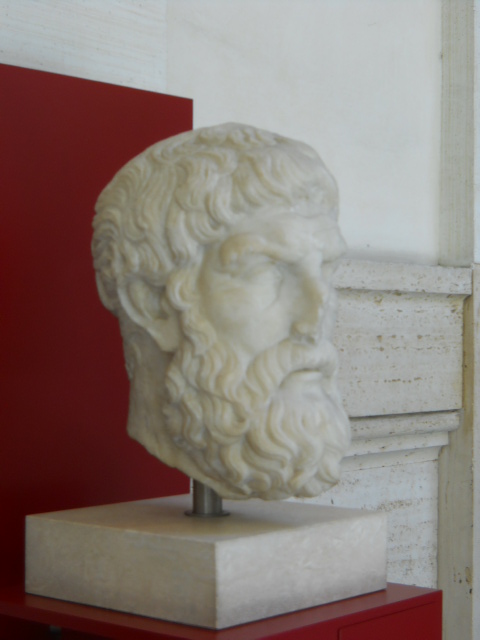
Epicurus
Epicurus asked:
“Is God willing to prevent evil, but not able? Then he is not all-powerful.
Is he able, but not willing? Then he is malevolent.
Is he both able and willing? Then whence cometh evil?
Is he neither able nor willing?Then why call him God?”
When you distill the divine down to only one god, you raise the problem of how perceived evils arise in a creation made by a God who is all Good? Then whence cometh evil? Zoroaster developed the idea that there are two Gods, one Good, the other Evil, with both contesting with one another for control of the universe. But this human construct did not resolve the problem; Epicurus still asked questions that haunted this dualistic concept. If there is but one God who is Good and He is willing to contest with Evil, why can He not overcome Evil? But to be the one God He must be prior to all else, including prior to Evil. He must be omniscient, omnipresent, and omnipotent to be the one God, and thus He must be able to know where Evil is, He must be able to contend with Evil anywhere and everywhere, and He must be able to overcome Evil. So is He incapable or is He unwilling to put a stop to evil occurring in what is supposedly His creation? And if God is necessarily before all else existed, from where did this other deity of Evil derive? Did God the Creator of All things also create evil and the personification of Evil? Human conception of the sublime often leads to unresolved contradictions.
Good things and bad things may be found in the world, but the world itself is neither good nor evil, and the universe in which it is a part is neither good nor evil. Nature transcends both good and evil. Therefore the dualistic perception of Nature is false. There is no god of absolute evil. There is no Devil that causes evil in the world. There is no Devil who causes us to do evil. In a society of many people, each person acting with good intentions, conflicts of interest will arise, and thus the results may benefit some at the expense of others. The Gods and Goddess likewise have Their own areas of Providence, which can at times conflict with one another, thus benefitting some of us and not benefitting others. But the overall good transcends individual interests. Conditions in Nature may cause a forest fire, destroying homes, killing animals and people, and seemingly devastating the land. Yet it is a necessary process to fertilize and revitalize the land, creating new lives, a renewed forest, and a better tomorrow. There are many dichotomies in Nature and Nature always strives for balance. The same may be said of the Gods and Goddesses who relations to one another can be dichotomous and thus Their Providences may seem to conflict at times, but over all They provide a harmony in Nature by striking a Mean between Their collective works. This cannot occur when one assumes that there is only one God. He cannot conflict with Himself. He cannot strike a Mean between two things if there is only one, nor in a dualistic world can a Mean be found between contending extremes. Monotheism is itself a human construct. It is an assumption from hubris to reduce all Gods and Goddesses down to one God and exclude all others, since the human mind is not capable of knowing what the source of divinity may be. Is the source of all divinity a single, paternal God or can the source itself be a multiplicity? We cannot know. We can, however, see a multiplicity of the divine manifested in the world and thus intellectually recognize a potential multiplicity of deities. Therefore not only does a Devil not exist, but his counterpart, necessitated only by human speculation on the sublime, also cannot exist. Monotheism is at best a misunderstanding.
If Nature is neither good nor evil, if the divine in Nature is neither good nor evil, if none of the Gods and Goddesses manifested in Nature are neither good nor evil, then from whence does evil arise?
Whether we wish to or not, our bodies live in accordance with the whims of Nature. We try to live in harmony with Nature, adapting as circumstances allow. We strive, too, to live good lives which are beneficial to ourselves, to our families, and to all those in Nature and in society around us. We may do so by living according to the virtues and by purging vices from ourselves. Evil arises when we neglect virtue and submit to our vices. We can see this in our personal lives where giving into vices may cause ill health, ill fortune, discord, and other evils affecting those around us. We see it when we incorporate the virtues into our lives, treating fairly with everyone, promoting justice, tolerance, and prudent counsel, to build a better family and a better society. No one is a Devil, but what evils we may experience arises from a neglect of virtue by individuals. We must continually work to harmonize ourselves to the changing circumstance of Nature, and we must continually strive to incorporate the virtues into our lives. In this way alone do we experience the Good Life and leave evil behind.
Previous Post
June 17, 2013
The Face of the Goddess
Next Post

June 28, 2013 We Are Not Forgiven
Browse Our Archives
Select a Category Uncategorized
Select a Month July 2013 June 2013 May 2013 April 2013 March 2013 February 2013 January 2013 November 2012 July 2012 June 2012 May 2012 February 2012 January 2012 December 2011 October 2011 August 2011 June 2011 May 2011 April 2011 March 2011
TAKE THE
Religious Wisdom Quiz
Which Christian group is known for monasticism?
Select your answer to see how you score.
Orthodox Methodist Baptist Evangelical
Related posts from Religio et Pietas

What Really Happens When We Die?
Patheos’ New Sitewide Series: What Do I REALLY...

TRENDING AT PATHEOS Pagan

When we talk about Greek religion, we often begin with the dodekatheion—the...

I was recently chatting with someone on Instagram. She asked me what...

While there are many people who share their results, the end of...

On July 23, I saw Christopher Nolan's The Odyssey which is Homer’s...

As I write this two big events have just finished up. One...

Restoring the Watershed of Divine Love
Perhaps cooperation is not something we manufacture through legislation, ideology, or moral...
view all Pagan blogs
Ad-Free & Subscriber Log-In Subscription Support
- About Us
- 2026 Calendar
- Videos
- Podcasts
- Library of World Religions
- Faith In Media Tracker
- Advertise With Us
- Write for Us
- Privacy Policy
- Terms of Service
- Do Not Sell My Data
- Contact Us
- Radiant Digital
- Manage Newsletter Subscriptions
- Unsubscribe From Notifications
- Sitemap
Copyright 2008-2026, Patheos. All rights reserved.
Subscription Support Ad-Free & Subscriber Log-In
Follow Patheos