
BuddhistCatholicContemplativeEvangelicalGeneral ChristianHinduJewishLatter-day SaintMuslimNew VisionsProgressive Christian
Beliefs
- Buddhist
- Catholic
- Contemplative
- Evangelical
- General Christian
- Hindu
- Jewish
- Latter-day Saint
- More Voices
- Muslim
- New Visions
- Pagan
- Progressive Christian
Topics
- Religion News
- Food and Religion
- Sports and Religion
- Religious Art
- Religious Music and Entertainment
- Religious Events
- History and Religion
- Style and Religion
- Politics and Religion
- Women in Religion
- Recreation Outdoors and Religion
- Business Finance and Religion
- Careers Workplace and Religion
- Education and Religion
- Family Parenting and Religion
- Health Fitness and Religion
- Home and Religion
- Relationships and Religion
- Technology and Religion
- Travel and Religion
Columnists
- Buddhist Columnists
- Business Finance and Religion Columnists
- Careers Workplace and Religion Columnists
- Catholic Columnists
- Contemplative Columnists
- Education and Religion Columnists
- Evangelists Columnists
- Family Parenting and Religion Columnists
- General Christian Columnists
- Health Fitness and Religion Columnists
- Hindu Columnists
- History and Religion Columnists
- Home and Religion Columnists
- Jewish Columnists
- More Voices Columnists
- Latter Day Columnists
- Muslim Columnists
- New Visions Columnists
- Nonreligious Columnists
- Pagan Columnists
- Politics and Religion Columnists
- Progressive Columnists
- Recreation Outdoors and Religion Columnists
- Relationships and Religion Columnists
- Religion News Columnists
- Religious Art Columnists
- Religious Events Columnists
- Religious Music and Entertainment Columnists
- Sports and Religion Columnists
- Style and Religion Columnists
- Technology and Religion Columnists
- Travel and Religion Columnists
- Women in Religion Columnists
Resource Library
- 2026 Calendar
- Library of World Religions
- The 100 Most Holy Places on Earth
- Patheos Answers
- Podcasts
- Videos
- Faith Leaders Database
- Anglican Episcopalian
- Bahai
- Baptist
- Buddhism
- Christianity
- Confucianism
- Eastern Orthodoxy
- Hinduism
- Holiness and Pentecostal
- ISKCON
- Islam
- Judaism
- Lutheran
- Methodist
- The Church of Jesus Christ of Latter-day Saints
- New Age
- Paganism
- Presbytarian and Reformed
- Protestantism
- Religion Behind the Scenes
- Roman Catholic
- Scientology
- Shia Islam
- Sikhism
- Sufism
- Sunni Islam
- Taoism
- Zen
- See all religions
Research Tools
 Ad-Free & Subscriber Log-In Subscription Support
Ad-Free & Subscriber Log-In Subscription Support
Follow Patheos 

- Trending:
- Forgiveness
- |
- Marriage
- |
- Consciousness
- |
- Death Penalty
- |
- Election
- |
- Halloween

- Home
- General Christian
- Religion News
- What Was American Religion Like in 1776? What Came Next?
What Was American Religion Like in 1776? What Came Next?
Last updated on: June 23, 2026 at 9:51 pm by Richard Ostling
What Was American Religion Like in 1776? What Came Next? 2026-06-23T21:51:36-04:00 Richard Ostling
Patheos Explore the world's faith through different perspectives on religion and spirituality! Patheos has the views of the prevalent religions and spiritualities of the world.
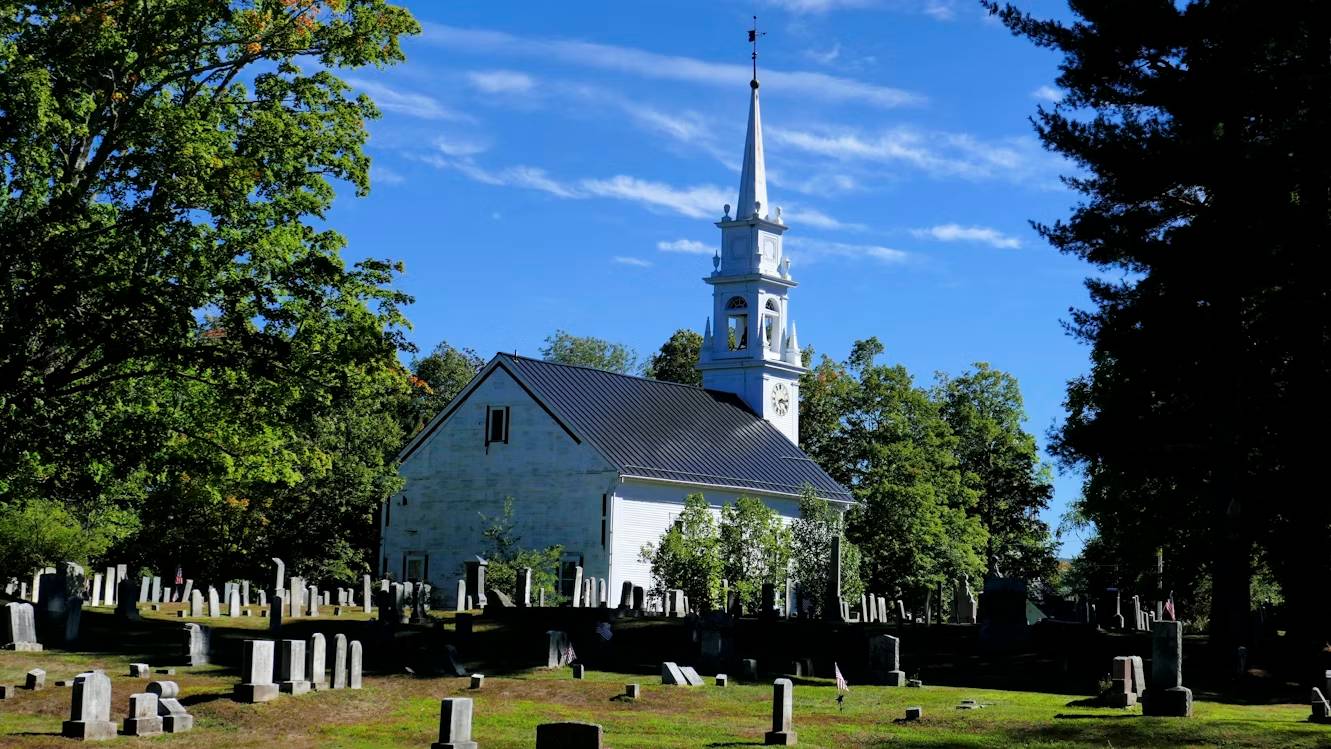
Classic New England vista: the Community Church of Sandwich, New Hampshire / Bill McBee @ unsplash.com
THE RELIGION GUY’S ANSWER:
In the Pew Research Center’s latest Religious Landscape Study, “only” 69% of Americans identify with a particular faith, 62% in some variant of Christianity, plus another 7% for other religions. That means 29% lack any affiliation or identity, in a 21st-century upsurge of religious “nones” that has provoked continual concern and commentary.
How were things when it all began, in 1776? We have sentimental thoughts of 13 colonies drenched in prayerful piety, perhaps with images of the Plymouth flock faithfully trudging through the snow to attend worship. However, experts tell us that in those pioneer days, when social institutions were only just emerging, an estimated 17% of the population were members of a religious group, leaving 83% as 18th-century “nones”!
Protestants operated 3,167 (or 98.3%) of the nation’s churches, compared with the Catholics’ 56. Even in Maryland, established as a discrimination-free refuge for Catholics, they were only 3% of the population. The only non-Christian faith of consequence, Judaism, consisted of five synagogues and perhaps 2,000 members. Their mass immigration did not occur till after the Civil War.
An Unregulated Market
Such data about the founding era and what happened to the nation in subsequent decades was researched for “The Churching of America 1776-1990,” an important 1992 study by sociologists Rodney Stark, (then) at the University of Washington, and his former student Roger Finke, (then) at Purdue University. They broke new ground and toppled many assumptions about the spiritual shape of America, which had a variegated and unregulated free market in religion to an extent that had rarely if ever existed before.
Upon the Founding, four brands of Protestants commanded the field. Congregationalists (emerging from the New England Puritans and Pilgrims, and forebears of today’s United Church of Christ) led the way with 20.4% of Americans who held church membership. Presbyterians (with roots in Scotland as well as England) had 19%. Episcopalians (Church of England missions that would become independent) had 15.7%. All three were central to the Atlantic coast’s cultural establishment led by educated clergy. Baptists, less elitist and centered in their refuge of Rhode Island, claimed 16.9%. The remaining 28% were scattered among Catholic, Dutch Reformed, German Reformed, Lutheran, Mennonite, Methodist, Moravian, Quaker, and assorted other groups.
That denominational competition meant that, unlike with European nations, no one of them could ever dominate. The Bill of Rights, added to the Constitution in 1791, said “Congress shall make no law respecting an establishment of religion” or prohibiting its “free exercise.” To this day, jurists and politicians debate whether the “establishment” clause was written to forbid only a single official religion or, for instance, also rules out the Ten Commandments posted on classroom walls, or authorized school prayers, or taxpayer support for religious agencies.
The U.S. Supreme Court did not require the states to honor religious “free exercise” protection till 1925, followed in 1947 by nationwide application of the “establishment” clause. Present-day Americans accustomed to church-state separation may be surprised that Episcopalians originally benefitted from state establishment and funding in Georgia, Maryland, New York, North Carolina, South Carolina, and Virginia. The Congregationalists held on longer but eventually lost establishment funding in Connecticut (1818), New Hampshire (1819) and finally Massachusetts (1833). Baptist Rhode Island and three other states provided no such favoritism.
A Culture Overturned
The great drama portrayed by Finke and Stark came after the Revolution. Religious energies and competition had totally overturned American culture as of 1850, just before the slavery split temporarily devastated the nation. Overall, the rate of religious affiliation had doubled since 1776 to 34% of the population (and by these sociologists’ calculations rose steadily to 45% in 1890 and 62% by 1980).
Even more surprising, defying the fact that religious change normally occurs very slowly, America had undergone a thorough reconfiguration by 1850. The once-marginal Methodists claimed an impressive 34.2% of the religiously affiliated, followed by Baptists at 20.5%, Catholics at 13.9%, and Presbyterians at 11.6%. There was an astonishing relative decline for the once-regnant established churches of old, Congregationalists now at 4% and Episcopalians at 3.5%.
What happened? Finke and Stark examined in detail the rise of “upstart” Baptists and Methodists, who conquered rural turf and the western frontier while Congregationalists and Episcopalians were content to hold the cities and hug the coast, emphasizing a learned clergy over zeal. The more successful but divided Presbyterians were pulled in both directions.
A Second “Awakening”
This was the time of the 19th Century’s so-called Second Great Awakening, with its traveling evangelists, most notably Charles G. Finney, whose “new methods” and careful preparation were to set the pattern for Billy Graham and many others. While the Finney types worked towns and cities, emotion-laden, week-long “camp meetings” were the innovation that provided the equivalent for widely-scattered farm families.
The Methodist movement commissioned “circuit riders” who built a remarkable network of small frontier fellowships. Their first U.S. bishop, Francis Asbury, traveled nearly 300,000 miles on horseback, whatever the weather and despite ill health. Unlike the elite denominations with clergy who monopolized among the new nation’s college graduates, Baptists and Methodists welcomed legions of anonymous frontier preachers and lay workers with no more schooling than their flocks but ample passion to win souls and plant churches. All were poorly paid and many or most were unpaid, living off handouts or secular jobs with religious activity on the weekends.
Baptist and Methodist denominations began to predominate among African-Americans after the Civil War. By the controversial account of Finke and Stark, the white Methodists gradually lost their edge through more sophisticated secular learning, de-emphasis on distinctive lifestyle demands, and a loosening theology. Baptists became the most popular category in Protestantism permanently, and even more so if we include the baptistic style of churches among later Pentecostalists and today’s 21 million Americans in independent congregations. The Finke-Stark scenario from 1850 through the late 20th Century raises the intriguing long-ago question of Jesus, “What shall it profit a man, if he shall gain the whole world, and lose his own soul?” (Mark 8:36, King James Version).
General Christian
History and Religion
Previous Post

June 5, 2026
Should Prostitution Be Accepted?
Next Post

July 5, 2026 Why Do Americans Convert to Catholicism (JD Vance Included)?
Recent Comments
"(First off, a correction: telescopes were invented about 1,300 years after Ptolemy's death.)Skeptics have been ..."
UFO buzz: Will life on distant ..."
"NIPs... spurn labels and are averse to “organized religion” with its expectations about moral lifestyles ..."
How do categories differ among America’s ..."
"Atheists are those who are certain God does not exist, and the same for all ..."
How do categories differ among America’s ..."
"We already know what happens, Christianity is the only worldview that has completely answered all ..."
Why doesn’t the Bible mention dinosaurs?
Browse Our Archives
Select a Category Uncategorized
Select a Month October 2026 September 2026 August 2026 July 2026 June 2026 May 2026 April 2026 March 2026 February 2026 January 2026 December 2025 November 2025 October 2025 September 2025 August 2025 July 2025 June 2025 May 2025 April 2025 March 2025 February 2025 January 2025 December 2024 November 2024 October 2024 September 2024 August 2024 July 2024 June 2024 May 2024 April 2024 March 2024 February 2024 January 2024 December 2023 November 2023 October 2023 September 2023 August 2023 July 2023 June 2023 May 2023 April 2023 March 2023 February 2023 January 2023 December 2022 November 2022 October 2022 September 2022 August 2022 July 2022 June 2022 May 2022 April 2022 March 2022 February 2022 January 2022 December 2021 November 2021 October 2021 September 2021 August 2021 July 2021 June 2021 May 2021 April 2021 March 2021 February 2021 January 2021 December 2020 November 2020 October 2020 September 2020 August 2020 July 2020 June 2020 May 2020 April 2020 March 2020 February 2020 January 2020 December 2019 November 2019 October 2019 September 2019 August 2019 July 2019 June 2019 May 2019 April 2019 March 2019 February 2019 January 2019 December 2018 November 2018 October 2018 September 2018 August 2018 July 2018 June 2018 May 2018 April 2018 March 2018 February 2018 January 2018 December 2017 November 2017 October 2017 September 2017 August 2017 July 2017 June 2017 May 2017 April 2017 March 2017 February 2017 January 2017 December 2016 November 2016 October 2016 September 2016 August 2016 July 2016 June 2016 May 2016 April 2016 March 2016 February 2016 January 2016 December 2015 November 2015 October 2015 September 2015 August 2015 July 2015 June 2015 May 2015 April 2015 March 2015 February 2015 January 2015 December 2014 November 2014 October 2014 September 2014 August 2014 July 2014 June 2014 May 2014 April 2014 March 2014 February 2014 January 2014 December 2013 November 2013 October 2013 September 2013 August 2013 July 2013 June 2013 May 2013 April 2013 March 2013 February 2013 January 2013 December 2012
TAKE THE
Religious Wisdom Quiz
Who did Moses marry in Midian?
Select your answer to see how you score.
Leah Rebekah Dinah Zipporah
Related posts from Religion Q and A

Should Churches Endorse Political Candidates?

Surrogacy's $15 Billion Boom Raises Hard Moral Questions

How Much Peril Do U.S. Evangelical Colleges Face?

TRENDING AT PATHEOS Religion News

Should Churches Endorse Political Candidates?
Amid a highly charged election season, federal court filings last month will...

Surrogacy's $15 Billion Boom Raises Hard Moral Questions
The current surrogacy situation is confusing and fast-evolving. Most of Europe...

Why the Media Only Sees Faith in a...
Faith Beyond the Headlines Faith rarely makes headlines when it is quietly...

Patheos July 2026 Featured Writer: Dr. Joey Cochran
Dr. Joey Cochran is a historian of religion, a General Editor of...

Patheos June 2026 Featured Writer: Dr. James F....
Dr. James F. McGrath holds the Clarence L. Goodwin Chair in New...

How Faith and Religion Shaped America's First 250...
Faith and the Founding: What Media Gets Wrong Religion has shaped America...
view all Religion News blogs
What Are Your Thoughts?leave a comment
Ad-Free & Subscriber Log-In Subscription Support
- About Us
- 2026 Calendar
- Videos
- Podcasts
- Library of World Religions
- Faith In Media Tracker
- Advertise With Us
- Write for Us
- Privacy Policy
- Terms of Service
- Do Not Sell My Data
- Contact Us
- Radiant Digital
- Manage Newsletter Subscriptions
- Unsubscribe From Notifications
- Sitemap
Copyright 2008-2026, Patheos. All rights reserved.
Subscription Support Ad-Free & Subscriber Log-In
Follow Patheos