
BuddhistCatholicContemplativeEvangelicalGeneral ChristianHinduJewishLatter-day SaintMuslimNew VisionsProgressive Christian
Beliefs
- Buddhist
- Catholic
- Contemplative
- Evangelical
- General Christian
- Hindu
- Jewish
- Latter-day Saint
- More Voices
- Muslim
- New Visions
- Pagan
- Progressive Christian
Topics
- Religion News
- Food and Religion
- Sports and Religion
- Religious Art
- Religious Music and Entertainment
- Religious Events
- History and Religion
- Style and Religion
- Politics and Religion
- Women in Religion
- Recreation Outdoors and Religion
- Business Finance and Religion
- Careers Workplace and Religion
- Education and Religion
- Family Parenting and Religion
- Health Fitness and Religion
- Home and Religion
- Relationships and Religion
- Technology and Religion
- Travel and Religion
Columnists
- Buddhist Columnists
- Business Finance and Religion Columnists
- Careers Workplace and Religion Columnists
- Catholic Columnists
- Contemplative Columnists
- Education and Religion Columnists
- Evangelists Columnists
- Family Parenting and Religion Columnists
- General Christian Columnists
- Health Fitness and Religion Columnists
- Hindu Columnists
- History and Religion Columnists
- Home and Religion Columnists
- Jewish Columnists
- More Voices Columnists
- Latter Day Columnists
- Muslim Columnists
- New Visions Columnists
- Nonreligious Columnists
- Pagan Columnists
- Politics and Religion Columnists
- Progressive Columnists
- Recreation Outdoors and Religion Columnists
- Relationships and Religion Columnists
- Religion News Columnists
- Religious Art Columnists
- Religious Events Columnists
- Religious Music and Entertainment Columnists
- Sports and Religion Columnists
- Style and Religion Columnists
- Technology and Religion Columnists
- Travel and Religion Columnists
- Women in Religion Columnists
Resource Library
- 2026 Calendar
- Library of World Religions
- The 100 Most Holy Places on Earth
- Patheos Answers
- Podcasts
- Videos
- Faith Leaders Database
- Anglican Episcopalian
- Bahai
- Baptist
- Buddhism
- Christianity
- Confucianism
- Eastern Orthodoxy
- Hinduism
- Holiness and Pentecostal
- ISKCON
- Islam
- Judaism
- Lutheran
- Methodist
- The Church of Jesus Christ of Latter-day Saints
- New Age
- Paganism
- Presbytarian and Reformed
- Protestantism
- Religion Behind the Scenes
- Roman Catholic
- Scientology
- Shia Islam
- Sikhism
- Sufism
- Sunni Islam
- Taoism
- Zen
- See all religions
Research Tools
 Ad-Free & Subscriber Log-In Subscription Support
Ad-Free & Subscriber Log-In Subscription Support
Follow Patheos 

- Trending:
- Forgiveness
- |
- Marriage
- |
- Consciousness
- |
- Death Penalty
- |
- Election
- |
- Halloween

- Home
- General Christian
- Religion News
- Did Paul Write the 13 Biblical Letters? Did He Even Exist?
Did Paul Write the 13 Biblical Letters? Did He Even Exist?
Last updated on: April 27, 2026 at 10:18 am by Richard Ostling
Did Paul Write the 13 Biblical Letters? Did He Even Exist? 2026-04-27T10:18:40-04:00 Richard Ostling
Patheos Explore the world's faith through different perspectives on religion and spirituality! Patheos has the views of the prevalent religions and spiritualities of the world.
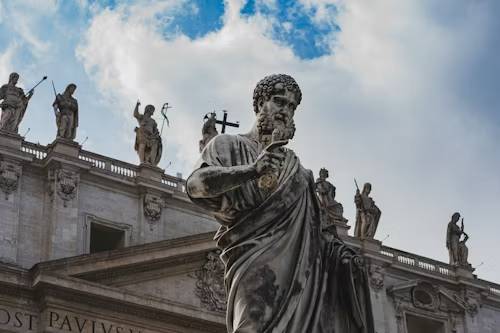
Vatican statue of the Apostle Paul atop St. Peter’s Basilica / Tim Mus @ unsplash.com
THE RELIGION GUY’S ANSWER:
These questions will strike most people as absurd, but they’re taken seriously in a heterodox assessment of the great Christian Apostle by staff writer Adam Gopnik in the April 20 New Yorker magazine. In amusing asides, Gopnik likens Paul’s style to that of Leon Trotsky, the Communist founder assassinated by order of Stalin. And since Frank Capra mused about a movie with Frank Sinatra playing St. Paul, Gopnik nominates rakish Dean Martin as St. Peter.
The article publicizes a book of radical Paul skepticism that to date has won attention on Websites like Myth Vision, Secular Frontier and Gnostic Archive but not major religious periodicals. Still, it’s worth notice for displaying how far modern Bible scholars can go when they totally disregard church tradition.
The book’s deceptively anodyne title is “The Letters of Paul in their Roman Literary Context: Reassessing Apostolic Authorship.” Author Nina Livesey is a credentialed scholar (Ph.D., Southern Methodist) and professor emerita at the University of Oklahoma. The publisher is Britain’s respectable Cambridge University Press. The Guy has not read the book (which costs $110), but the contents are available in thorough articles posted by left-wing New Testament critics.
Dutch Debunking
The attempted debunking of the Paul known to Christians for 20 centuries echoes past hubbub over the “Jesus Seminar,” only one of whose 73 participants contended that Jesus never existed. The Seminar balloted on which words of Jesus in the Gospels were deemed authentic (as this writer covered in a 1988 Time magazine cover story). In the current Seminar follow-up, Livesey leads a panel on the rest of the New Testament. Seminar sponsors promoted her book with an online discussion and called her “the first scholar to present the revolutionary idea that Paul may not be a historical figure.” (Actually, a 19th Century group centered at Holland’s University of Leiden tried the same.)
With Jesus, the Seminar’s assumptions produced conclusions in 1993 that dismissed most of the Nazarene’s sayings. In the Sermon on the Mount, for example, the only fully reliable words were said to be calling God our “Father” and telling followers not to answer evil with evil. Satirists cited Yogi Berra’s “I really didn’t say everything I said.”
Christian tradition believes that Paul wrote the 13 biblical letters that name him as the author (though in some cases with co-authors Timothy, Silvanus, or Sosthenes, or the scribe Tertius). Churchgoers may be unaware that the current consensus at secular universities and liberal seminaries affirms only Paul’s authorship of 1st Thessalonians, 1st and 2nd Corinthians, Philippians, Galatians, Romans, and Philemon. The Jesus Seminar skeptics thought Paul wrote 1st Thessalonians, Galatians, Philemon, and most of Romans, 1st and 2nd Corinthians, and Philippians.
Pseudonyms and Authenticity
Among others, the late Father Raymond Brown, an influential Catholic exegete, thought six were “perhaps or probably not” by Paul**:** 2nd Thessalonians, Ephesians, Colossians, 1st and 2nd Timothy, and Titus. An evangelical expert, Donald Hagner, also questions the last three because of different style and depiction of a maturing church. The one-volume New Testament introductions by Brown and Hagner [each recommended by The Guy] say if letters used a “Paul” pseudonym (common practice in ancient times) but convey Paul’s beliefs, authenticity and authority remain.
Livesey’s book, by contrast, states that “there is no evidence of the historical Paul,” thus entirely rejecting all material in the letters and the Book of Acts. (Such a working assumption, of course, would eliminate most everything we know about other ancient history.) The Bible aside, Paul’s authorship is corroborated by the references to his life and letters in Clement of Rome (conventionally dated at A.D. 96) and Ignatius of Antioch (before 108). Traditionalists say we know all 13 letters must have originated before A.D. 70 because they lack any hint of Rome’s cataclysmic destruction of Jerusalem and the Temple in that year.
Livesey, however, insists “Paul” was a fictional character devised in the 2nd Century sometime after the second Jewish revolt against Roman rule in 132-135, which makes all the letters fraudulent. She proposes that their author was Marcion of Pontus, a prominent heretic the church expelled in 144 because he spurned Jews and (unlike the biblical Paul) rejected the entire Old Testament.
After the Revolt?
In Livesey’s view, the Paul material fits better with the context of the second Jewish revolt than the 1st Century Christian movement it purports to address. Her special contribution is a claim of resemblance between the Paul texts and fictional letter-writing by Seneca in the 1st Century and numerous school exercises in the 2nd Century. Richard Carrier, a secularist and freelance historian, is interesting here. Since he questions the existence of Jesus, he’d be expected to favor Livesey’s disappearing Paul. Instead, he finds it “plausible” but “I just don’t think it holds up as probable.”
Nor is he convinced by her literary analysis. To Carrier, “Paul’s letters repeatedly do not look like Seneca’s and indeed deviate in precisely the ways that contradict her thesis.” As for the school exercises, though 2nd Century examples survived there’s no proof the same styles and practices did not occur in the 1st Century, so no comparative writings disprove Paul’s authorship. Further, Carrier judges Livesey’s comparisons “moot or inept” because Paul’s writings are different, not just letter-writing but combined with religious oration.
If all this rouses interest in whether there’s evidence Jesus existed, even apart from the Bible, there’s this Religion Q&A column: www.patheos.com/blogs/religionqanda/2022/04/did-jesus-exist/
General Christian
History and Religion
Previous Post

April 10, 2026
What Is Christian Zionism and Why Is It So Complex?
Next Post

May 8, 2026 What's New With Famed Christian Convert Ayaan Hirsi Ali?
Recent Comments
"(First off, a correction: telescopes were invented about 1,300 years after Ptolemy's death.)Skeptics have been ..."
UFO buzz: Will life on distant ..."
"NIPs... spurn labels and are averse to “organized religion” with its expectations about moral lifestyles ..."
How do categories differ among America’s ..."
"Atheists are those who are certain God does not exist, and the same for all ..."
How do categories differ among America’s ..."
"We already know what happens, Christianity is the only worldview that has completely answered all ..."
Why doesn’t the Bible mention dinosaurs?
Browse Our Archives
Select a Category Uncategorized
Select a Month October 2026 September 2026 August 2026 July 2026 June 2026 May 2026 April 2026 March 2026 February 2026 January 2026 December 2025 November 2025 October 2025 September 2025 August 2025 July 2025 June 2025 May 2025 April 2025 March 2025 February 2025 January 2025 December 2024 November 2024 October 2024 September 2024 August 2024 July 2024 June 2024 May 2024 April 2024 March 2024 February 2024 January 2024 December 2023 November 2023 October 2023 September 2023 August 2023 July 2023 June 2023 May 2023 April 2023 March 2023 February 2023 January 2023 December 2022 November 2022 October 2022 September 2022 August 2022 July 2022 June 2022 May 2022 April 2022 March 2022 February 2022 January 2022 December 2021 November 2021 October 2021 September 2021 August 2021 July 2021 June 2021 May 2021 April 2021 March 2021 February 2021 January 2021 December 2020 November 2020 October 2020 September 2020 August 2020 July 2020 June 2020 May 2020 April 2020 March 2020 February 2020 January 2020 December 2019 November 2019 October 2019 September 2019 August 2019 July 2019 June 2019 May 2019 April 2019 March 2019 February 2019 January 2019 December 2018 November 2018 October 2018 September 2018 August 2018 July 2018 June 2018 May 2018 April 2018 March 2018 February 2018 January 2018 December 2017 November 2017 October 2017 September 2017 August 2017 July 2017 June 2017 May 2017 April 2017 March 2017 February 2017 January 2017 December 2016 November 2016 October 2016 September 2016 August 2016 July 2016 June 2016 May 2016 April 2016 March 2016 February 2016 January 2016 December 2015 November 2015 October 2015 September 2015 August 2015 July 2015 June 2015 May 2015 April 2015 March 2015 February 2015 January 2015 December 2014 November 2014 October 2014 September 2014 August 2014 July 2014 June 2014 May 2014 April 2014 March 2014 February 2014 January 2014 December 2013 November 2013 October 2013 September 2013 August 2013 July 2013 June 2013 May 2013 April 2013 March 2013 February 2013 January 2013 December 2012
TAKE THE
Religious Wisdom Quiz
Jude urges believers to contend for what?
Select your answer to see how you score.
The faith that was once for all entrusted to God's holy people The crown of righteousness Their inheritance in Christ Justice and mercy
Related posts from Religion Q and A

Should Churches Endorse Political Candidates?

Surrogacy's $15 Billion Boom Raises Hard Moral Questions

How Much Peril Do U.S. Evangelical Colleges Face?

TRENDING AT PATHEOS Religion News

Should Churches Endorse Political Candidates?
Amid a highly charged election season, federal court filings last month will...

Surrogacy's $15 Billion Boom Raises Hard Moral Questions
The current surrogacy situation is confusing and fast-evolving. Most of Europe...

Why the Media Only Sees Faith in a...
Faith Beyond the Headlines Faith rarely makes headlines when it is quietly...

Patheos July 2026 Featured Writer: Dr. Joey Cochran
Dr. Joey Cochran is a historian of religion, a General Editor of...

Patheos June 2026 Featured Writer: Dr. James F....
Dr. James F. McGrath holds the Clarence L. Goodwin Chair in New...

How Faith and Religion Shaped America's First 250...
Faith and the Founding: What Media Gets Wrong Religion has shaped America...
view all Religion News blogs
What Are Your Thoughts?leave a comment
Ad-Free & Subscriber Log-In Subscription Support
- About Us
- 2026 Calendar
- Videos
- Podcasts
- Library of World Religions
- Faith In Media Tracker
- Advertise With Us
- Write for Us
- Privacy Policy
- Terms of Service
- Do Not Sell My Data
- Contact Us
- Radiant Digital
- Manage Newsletter Subscriptions
- Unsubscribe From Notifications
- Sitemap
Copyright 2008-2026, Patheos. All rights reserved.
Subscription Support Ad-Free & Subscriber Log-In
Follow Patheos