
BuddhistCatholicContemplativeEvangelicalGeneral ChristianHinduJewishLatter-day SaintMuslimNew VisionsProgressive Christian
Beliefs
- Buddhist
- Catholic
- Contemplative
- Evangelical
- General Christian
- Hindu
- Jewish
- Latter-day Saint
- More Voices
- Muslim
- New Visions
- Pagan
- Progressive Christian
Topics
- Religion News
- Food and Religion
- Sports and Religion
- Religious Art
- Religious Music and Entertainment
- Religious Events
- History and Religion
- Style and Religion
- Politics and Religion
- Women in Religion
- Recreation Outdoors and Religion
- Business Finance and Religion
- Careers Workplace and Religion
- Education and Religion
- Family Parenting and Religion
- Health Fitness and Religion
- Home and Religion
- Relationships and Religion
- Technology and Religion
- Travel and Religion
Columnists
- Buddhist Columnists
- Business Finance and Religion Columnists
- Careers Workplace and Religion Columnists
- Catholic Columnists
- Contemplative Columnists
- Education and Religion Columnists
- Evangelists Columnists
- Family Parenting and Religion Columnists
- General Christian Columnists
- Health Fitness and Religion Columnists
- Hindu Columnists
- History and Religion Columnists
- Home and Religion Columnists
- Jewish Columnists
- More Voices Columnists
- Latter Day Columnists
- Muslim Columnists
- New Visions Columnists
- Nonreligious Columnists
- Pagan Columnists
- Politics and Religion Columnists
- Progressive Columnists
- Recreation Outdoors and Religion Columnists
- Relationships and Religion Columnists
- Religion News Columnists
- Religious Art Columnists
- Religious Events Columnists
- Religious Music and Entertainment Columnists
- Sports and Religion Columnists
- Style and Religion Columnists
- Technology and Religion Columnists
- Travel and Religion Columnists
- Women in Religion Columnists
Resource Library
- 2026 Calendar
- Library of World Religions
- The 100 Most Holy Places on Earth
- Patheos Answers
- Podcasts
- Videos
- Faith Leaders Database
- Anglican Episcopalian
- Bahai
- Baptist
- Buddhism
- Christianity
- Confucianism
- Eastern Orthodoxy
- Hinduism
- Holiness and Pentecostal
- ISKCON
- Islam
- Judaism
- Lutheran
- Methodist
- The Church of Jesus Christ of Latter-day Saints
- New Age
- Paganism
- Presbytarian and Reformed
- Protestantism
- Religion Behind the Scenes
- Roman Catholic
- Scientology
- Shia Islam
- Sikhism
- Sufism
- Sunni Islam
- Taoism
- Zen
- See all religions
Research Tools
 Ad-Free & Subscriber Log-In Subscription Support
Ad-Free & Subscriber Log-In Subscription Support
Follow Patheos 

- Trending:
- Forgiveness
- |
- Marriage
- |
- Consciousness
- |
- Death Penalty
- |
- Election
- |
- Halloween

- Home
- General Christian
- Religion News
- Why Be A Protestant?
Why Be A Protestant?
Last updated on: September 27, 2025 at 2:36 pm by Richard Ostling
Why Be A Protestant? 2025-09-27T14:36:12-04:00 Richard Ostling
Patheos Explore the world's faith through different perspectives on religion and spirituality! Patheos has the views of the prevalent religions and spiritualities of the world.
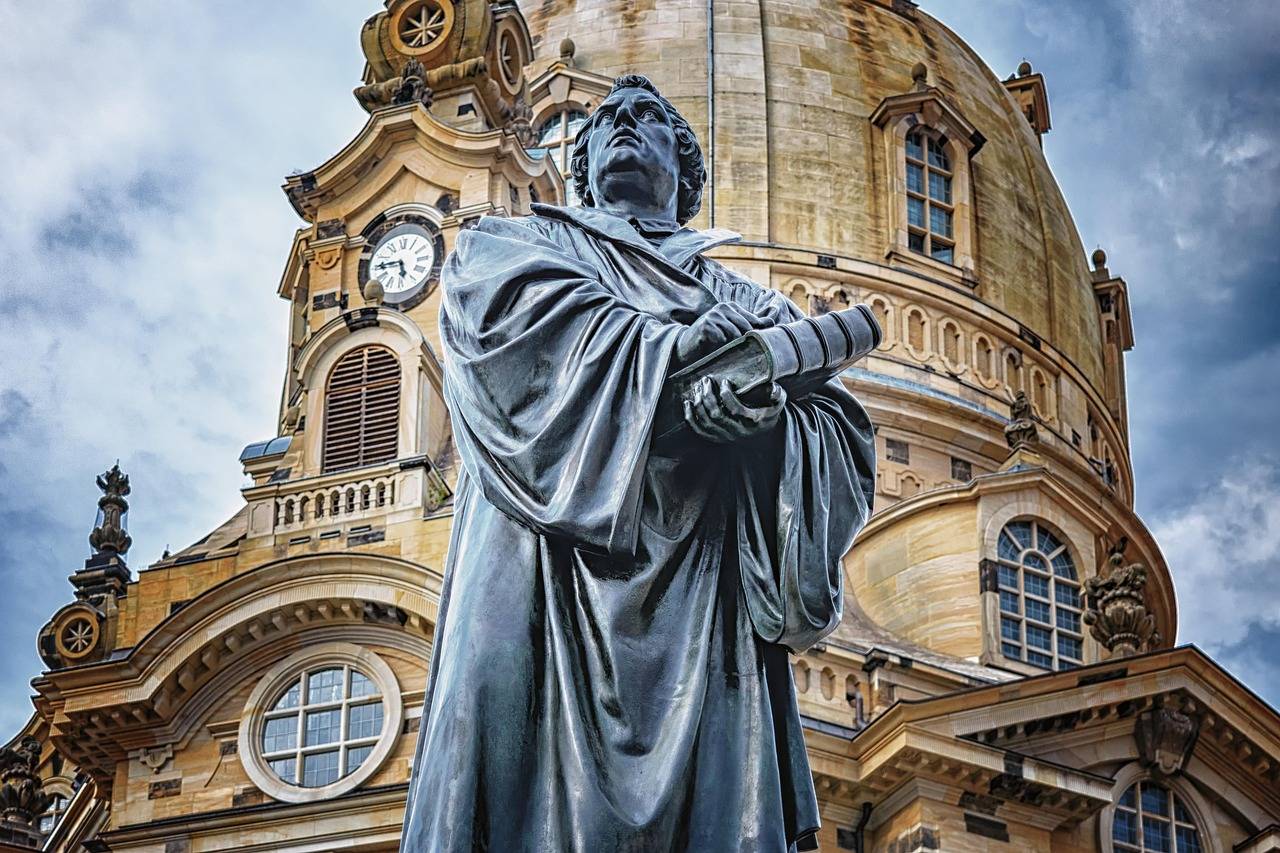
Martin Luther statue in Dresden, Germany / Tama66 @ pixabay.com
THE RELIGION GUY’S ANSWER:
On Hallowe’en 508 years ago, Catholic monk and university professor Martin Luther issued “95 Theses” against church policies, the first of many dramatic eruptions that eventually split Europe and created Protestantism as a major new branch of the Christian religion.
Today, Protestants number 629 million, according to De Gruyter Brill’s World Christian Database, along with 1.72 billion Catholics, 292 million Orthodox, and 409 million “Independents” in Africa, Asia, and Latin America whose modern-day indigenous churches are separate from those founded by Protestant missionaries from overseas.
American culture from Jamestown and Plymouth onward was dominated by the Protestant faith, so much so that only two Catholics have been elected president of the United States. But the Pew Research Center announced in its 2014 Religious Landscape Study that self-identified Protestants were less than half the U.S. population for the first time, at 46.5%. Pew’s latest Landscape from 2023-24 puts them at only 40%, with 19% Catholics, 3% in other Christian groups, 7% in other religions, and 29% religiously unaffiliated. Meanwhile, U.S. Protestants have also suffered their share of recent scandals and splits.
“Separated Brethren”
At Catholicism’s Second Vatican Council, the 1964 Decree on Ecumenism restored charitable relations toward Protestants and acknowledged “the truly Christian endowments from our common heritage which are to be found among our separated brethren.” However, the council also reaffirmed the dogma that Jesus Christ established the church headed by the Roman popes, which uniquely provides “the fulness of the means of salvation.”
Past Protestant polemics like “The Two Babylons or The Papal Worship” (1853) and “Secrets of Romanism” (1949) can still be purchased online, but such writings have largely disappeared. These days, it’s even unusual that a new book on sale next week has a title like “Why I Am Protestant” (InterVarsity Press), even with a respectful tone. The author of this succinct and readable case is Beth Felker Jones, a professor of theology at Northern Seminary and formerly Wheaton College, both in Illinois. She slides past many doctrines and practices that continue to divide these two huge Christian branches, for instance the Catholic celibacy requirement for priests in most countries.
Jones writes that the Protestant Reformation rejected a widespread assumption in medieval Catholicism and instead insisted that our salvation “does not depend on the church, priests, and sacraments, nor does it depend on human action or meritorious work. Salvation is sheer gift. It comes to us by grace alone, through faith alone, because of Christ alone.”
On that question, an historic 1999 accord between the Vatican and the Lutheran World Federation, later endorsed by other international Protestant bodies, echoes New Testament language with this summary affirmation: “Together we confess: By grace alone, in faith in Christ’s saving work and not because of any merit on our part, we are accepted by God and receive the Holy Spirit, who renews our hearts while equipping and calling us to good works.”
Ending “Corruption”
Luther’s original fury was roused especially by Catholic priests’ selling of “indulgences” to lessen penalties due for sins after death in the state of Purgatory. Catholicism’s Council of Trent denounced the “corruption” of such sales in 1563. However, the church still exercises the power to grant indulgences (minus money) and this is a central aspect of Rome’s 2025 Holy Year observance, as “Religion Q & A” explained in January: www.patheos.com/blogs/religionqanda/2025/01/explainer-what-is-romes-holy-year-what-are-indulgences/.
Another classic dividing line is the locus of authority The classic Protestant slogan sola Scriptura (“Scripture alone”) uplifts the Bible as the one unique source of truth against which all church teachings and practices are to be judged. Protestants combined this with Bible translations and worship in common languages instead of Latin. As Jones frames matters, “Scripture is not God” but “is our primary mode of revelation about him,” and it is “different from and prior to any other authority for Christian faith and life.” The Vatican Council stated that the Holy Spirit inspired everything the Bible’s writers teach, “without error,” but believers are to give the church’s “sacred tradition” equal devotion.
Otherwise, Jones asserts that the Catholic Church is simply not “catholic” enough (!) because that word means “universal” and legitimate Christians of vast variety exist outside the Papal communion – according to the above Database some 1.3 billion of them in 50,000 distinct denominations. She insists that “the church cannot be identified with any one institution, such as that of the papacy,” which is “good news” because the faith “takes diverse forms in particular times, places, and communities.” She does not address the related fact that the pope personally appoints Catholic bishops across the world after a secretive process while Protestants’ national or regional bodies choose their own leaders through comparatively open elections or consultations.
Jones makes for an interesting exponent of Protestantism in that her own parents are converts to Catholicism, and likewise friends and colleagues, while she remains a member of the United Methodist Church of her childhood. Also notable is her candid depiction of the three chief Protestant “difficulties,” namely an oft-confusing basis of “authority,” rampant “individualism,” and “fragmentation.” On the last point, her own UMC recently experienced a traditionalist walkout by 7,658 local congregations, a fourth of the total, in America’s largest church schism since the Civil War.
The 21 Million
Individualism is seen in a massive change in the makeup of U.S. Protestantism with the increase of local congregations wholly independent of traditional denominations that ruled American Protestantism for well over three centuries. This newswriter contended that the “Story of the Year” in religion for 2022 was the U.S. Religion Census report that these “non-denominational” independents number 21 million in 44,319 congregations, the largest U.S. Protestant grouping by far, constituting more than 13% of the nation’s churchgoers.
As for authority, the Protestant sola Scriptura governs. But emphasis on personal Bible reading and the “priesthood of all believers” created what Catholics see as an unstable absence of well-defined and agreed teaching. Protestant pluralism reached a crisis point with the modern advent of skeptical Bible scholarship. Jones wants Christians to unite behind the teachings in the shared creeds from the church’s early centuries and bypasses the doctrines as defined in the classic confessions issued by the founders of Protestantism, which can be researched here: https://apostles-creed.org/documents-creeds-catechisms-confessions/.
After pondering all these problems, Jones concludes that they are not the result of the Protestant Reformation but of the inevitable rise of modernity with its personal conscience, liberties, and democracy, which Protestantism both created and reflected. Properly understood, this leaves behind “patriarchy, misogyny, racism, nationalism, and the politics of power.” Protestantism’s built-in “egalitarian impulse” means “the church of grace is not one of hierarchy and authoritarian rule but one in which each and all are called to God’s holy priesthood.”
[Full disclosure: The Religion Guy is a lifelong Protestant who has participated over the years in several “evangelical” and “mainline” denominations.]
General Christian
Catholic
History and Religion
Previous Post

September 12, 2025
Should We Go To Mars?
Next Post
October 10, 2025 Should Christians Have Female Clergy?
Recent Comments
"(First off, a correction: telescopes were invented about 1,300 years after Ptolemy's death.)Skeptics have been ..."
UFO buzz: Will life on distant ..."
"NIPs... spurn labels and are averse to “organized religion” with its expectations about moral lifestyles ..."
How do categories differ among America’s ..."
"Atheists are those who are certain God does not exist, and the same for all ..."
How do categories differ among America’s ..."
"We already know what happens, Christianity is the only worldview that has completely answered all ..."
Why doesn’t the Bible mention dinosaurs?
Browse Our Archives
Select a Category Uncategorized
Select a Month October 2026 September 2026 August 2026 July 2026 June 2026 May 2026 April 2026 March 2026 February 2026 January 2026 December 2025 November 2025 October 2025 September 2025 August 2025 July 2025 June 2025 May 2025 April 2025 March 2025 February 2025 January 2025 December 2024 November 2024 October 2024 September 2024 August 2024 July 2024 June 2024 May 2024 April 2024 March 2024 February 2024 January 2024 December 2023 November 2023 October 2023 September 2023 August 2023 July 2023 June 2023 May 2023 April 2023 March 2023 February 2023 January 2023 December 2022 November 2022 October 2022 September 2022 August 2022 July 2022 June 2022 May 2022 April 2022 March 2022 February 2022 January 2022 December 2021 November 2021 October 2021 September 2021 August 2021 July 2021 June 2021 May 2021 April 2021 March 2021 February 2021 January 2021 December 2020 November 2020 October 2020 September 2020 August 2020 July 2020 June 2020 May 2020 April 2020 March 2020 February 2020 January 2020 December 2019 November 2019 October 2019 September 2019 August 2019 July 2019 June 2019 May 2019 April 2019 March 2019 February 2019 January 2019 December 2018 November 2018 October 2018 September 2018 August 2018 July 2018 June 2018 May 2018 April 2018 March 2018 February 2018 January 2018 December 2017 November 2017 October 2017 September 2017 August 2017 July 2017 June 2017 May 2017 April 2017 March 2017 February 2017 January 2017 December 2016 November 2016 October 2016 September 2016 August 2016 July 2016 June 2016 May 2016 April 2016 March 2016 February 2016 January 2016 December 2015 November 2015 October 2015 September 2015 August 2015 July 2015 June 2015 May 2015 April 2015 March 2015 February 2015 January 2015 December 2014 November 2014 October 2014 September 2014 August 2014 July 2014 June 2014 May 2014 April 2014 March 2014 February 2014 January 2014 December 2013 November 2013 October 2013 September 2013 August 2013 July 2013 June 2013 May 2013 April 2013 March 2013 February 2013 January 2013 December 2012
TAKE THE
Religious Wisdom Quiz
Who said, "I am the way, the truth, and the life"?
Select your answer to see how you score.
Jesus Peter Paul John the Baptist
Related posts from Religion Q and A
How Are Catholic Bishops Chosen?

Should Churches Endorse Political Candidates?

Surrogacy's $15 Billion Boom Raises Hard Moral Questions

How Much Peril Do U.S. Evangelical Colleges Face?
TRENDING AT PATHEOS Religion News

Should Churches Endorse Political Candidates?
Amid a highly charged election season, federal court filings last month will...

Surrogacy's $15 Billion Boom Raises Hard Moral Questions
The current surrogacy situation is confusing and fast-evolving. Most of Europe...

Why the Media Only Sees Faith in a...
Faith Beyond the Headlines Faith rarely makes headlines when it is quietly...

Patheos July 2026 Featured Writer: Dr. Joey Cochran
Dr. Joey Cochran is a historian of religion, a General Editor of...

Patheos June 2026 Featured Writer: Dr. James F....
Dr. James F. McGrath holds the Clarence L. Goodwin Chair in New...

How Faith and Religion Shaped America's First 250...
Faith and the Founding: What Media Gets Wrong Religion has shaped America...
view all Religion News blogs
What Are Your Thoughts?leave a comment
Ad-Free & Subscriber Log-In Subscription Support
- About Us
- 2026 Calendar
- Videos
- Podcasts
- Library of World Religions
- Faith In Media Tracker
- Advertise With Us
- Write for Us
- Privacy Policy
- Terms of Service
- Do Not Sell My Data
- Contact Us
- Radiant Digital
- Manage Newsletter Subscriptions
- Unsubscribe From Notifications
- Sitemap
Copyright 2008-2026, Patheos. All rights reserved.
Subscription Support Ad-Free & Subscriber Log-In
Follow Patheos