
BuddhistCatholicContemplativeEvangelicalGeneral ChristianHinduJewishLatter-day SaintMuslimNew VisionsProgressive Christian
Beliefs
- Buddhist
- Catholic
- Contemplative
- Evangelical
- General Christian
- Hindu
- Jewish
- Latter-day Saint
- More Voices
- Muslim
- New Visions
- Pagan
- Progressive Christian
Topics
- Religion News
- Food and Religion
- Sports and Religion
- Religious Art
- Religious Music and Entertainment
- Religious Events
- History and Religion
- Style and Religion
- Politics and Religion
- Women in Religion
- Recreation Outdoors and Religion
- Business Finance and Religion
- Careers Workplace and Religion
- Education and Religion
- Family Parenting and Religion
- Health Fitness and Religion
- Home and Religion
- Relationships and Religion
- Technology and Religion
- Travel and Religion
Columnists
- Buddhist Columnists
- Business Finance and Religion Columnists
- Careers Workplace and Religion Columnists
- Catholic Columnists
- Contemplative Columnists
- Education and Religion Columnists
- Evangelists Columnists
- Family Parenting and Religion Columnists
- General Christian Columnists
- Health Fitness and Religion Columnists
- Hindu Columnists
- History and Religion Columnists
- Home and Religion Columnists
- Jewish Columnists
- More Voices Columnists
- Latter Day Columnists
- Muslim Columnists
- New Visions Columnists
- Nonreligious Columnists
- Pagan Columnists
- Politics and Religion Columnists
- Progressive Columnists
- Recreation Outdoors and Religion Columnists
- Relationships and Religion Columnists
- Religion News Columnists
- Religious Art Columnists
- Religious Events Columnists
- Religious Music and Entertainment Columnists
- Sports and Religion Columnists
- Style and Religion Columnists
- Technology and Religion Columnists
- Travel and Religion Columnists
- Women in Religion Columnists
Resource Library
- 2026 Calendar
- Library of World Religions
- The 100 Most Holy Places on Earth
- Patheos Answers
- Podcasts
- Videos
- Faith Leaders Database
- Anglican Episcopalian
- Bahai
- Baptist
- Buddhism
- Christianity
- Confucianism
- Eastern Orthodoxy
- Hinduism
- Holiness and Pentecostal
- ISKCON
- Islam
- Judaism
- Lutheran
- Methodist
- The Church of Jesus Christ of Latter-day Saints
- New Age
- Paganism
- Presbytarian and Reformed
- Protestantism
- Religion Behind the Scenes
- Roman Catholic
- Scientology
- Shia Islam
- Sikhism
- Sufism
- Sunni Islam
- Taoism
- Zen
- See all religions
Research Tools
 Ad-Free & Subscriber Log-In Subscription Support
Ad-Free & Subscriber Log-In Subscription Support
Follow Patheos 

- Trending:
- Forgiveness
- |
- Marriage
- |
- Consciousness
- |
- Death Penalty
- |
- Election
- |
- Halloween

- Home
- General Christian
- Religion News
- How Might a Newsman Approach Good Friday and Easter?
How Might a Newsman Approach Good Friday and Easter?
Last updated on: April 13, 2025 at 12:04 pm by Richard Ostling
How Might a Newsman Approach Good Friday and Easter? 2025-04-13T12:04:36-04:00 Richard Ostling
Patheos Explore the world's faith through different perspectives on religion and spirituality! Patheos has the views of the prevalent religions and spiritualities of the world.
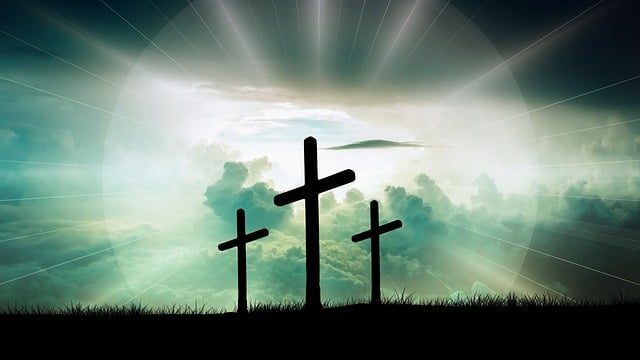
Assessing anew Christianity’s central events | Image courtesy of pixabay.com
THE RELIGION GUY’S ANSWER:
A highly readable new book provides the latest example of such a timely seasonal quest. The author, Ross Douthat, is a sophisticated New York Times columnist and former senior editor of The Atlantic magazine. In his intriguing “Believe: Why Everyone Should Be Religious,” Zondervan mostly prods people to consider the value of belief in general rather than Christianity in particular, building the case upon up-to-date scientific knowledge.
He figures that “the raw data of existence implies religious obligations and matches up to religious assumptions” and what we all experience. The data demonstrate nature as remarkably poised to produce the human species, in a universe “both made and made for us, that the human mind seems to have a cosmic purpose, that spiritual and supernatural realities seem to impinge constantly on our own.” And so forth.
It’s the most engaging popular-level argument in many years for why it’s perfectly reasonable to believe in a religion in these modern times, whatever one’s religious choice might be.
A convert’s tale
However, at the very end, he candidly switches from respectful discussion of all major religions into a specific “case study,” his own Christian faith. After depicting his Protestant boyhood and adult conversion to traditional Catholicism, he asserts that Christianity is not just “pointing toward God” but “actually true.” He ponders the heart of the Christian story, what Jesus Christ’s death on the cross might mean these 2,000 years later, and why people can still believe in the Easter miracle of his bodily resurrection from the dead. “When I say the Nicene Creed I mean it,” he says, including its profession, 1,700 years old this year, that “on the third day he rose again in fulfillment of the Scriptures.”
That Jesus was a revered spiritual teacher who was crucified is as well-established as any event in ancient times could be. But there are long-running academic efforts to raise doubts not only about his resurrection from the grave but many other events and sayings recorded in the New Testament. Douthat is well aware of these arguments, but not impressed. They are “founded on sand,” he insists. As with his case for belief in general, the approach is not that of a preacher or theologian but a journalist, assessing the available evidence – the four Gospels –and what conclusions are the most plausible.
The book does not align with conservative evangelicals who believe the biblical texts were error-free (“inerrant”) in their original written form because God-inspired writers would not have made mistakes, even on historical details. You’ll find definitive statements of that viewpoint here.
Douthat freely admits that there are “various tensions between the four Gospels,” but defends their “basic historicity” as “remarkably credible” source material. He is struck by their “immediacy and intimacy” and “the unsanded roughness of their portrayals” that have not been smoothed out to remove all complications and contradictions.
Detectives and reporters
Any detective at a crime scene, or reporter covering a breaking news event, can affirm Douthat’s outlook: “The variations in which day a particular event took place, who was present for a given miracle, which exact words someone used, are precisely what you’d expect from a collection of authentic testimonies that weren’t smoothed out into propaganda. Likewise for all the difficult sayings and ambiguous teachings that Christians and skeptics have been wrangling over ever since.”
He cites the Scriptures’ “proximity to the events described” (reaching final written form some decades afterward), “their claim to be eyewitness accounts,” and “their credibility relative to the various ‘lost gospels’ ” that the early church judged as too late and inauthentic to belong in the New Testament though championed by some liberal scholars.
With Jesus dead and entombed, that would seem to have crushed his movement. That “makes whatever happened to the disciples in the days after the crucifixion one of the most striking psychological events in the history of movements and ideas,” the conviction that he arose bodily. For Douthat, the logical conclusion is the simplest, that “the resurrection really happened, that here God intervened in human affairs decisively, that this is the defining revelation of His purposes.” Only a couple decades later, Paul would report that the resurrected Jesus was seen by the apostles and “500 brethren at one time, most of whom are still alive” (I Corinthians 15:3-8). This belief, Douthat says, “was somehow perfectly designed to transform the Roman world and spread around the globe.”
The crucifixion may be an undoubted fact, but how do we understand its saving power today? Douthat’s personal interpretation gains depth from his own years of continual pain that doctors were unable to diagnose or alleviate. “With Christianity, we are told that God Himself is on that cross, and through the cross, He is with us also, in all our suffering and to the end of time. And with that movement comes one possible answer to some of the hardest questions people have about God’s distance, God’s silence, the problem of evil, and the problem of sin – not in the form of a logical proof but as a story, an event, a person who also happened to be God.”
And there’s more
To think all of this through more thoroughly, Douthat recommends pertinent writings of three British scholars: “Jesus and the Eyewitnesses” by Richard Bauckham, now retired from the University of St Andrews; “Can We Trust the Gospels?” by Peter J. Williams of the Tyndale House biblical think tank in Cambridge; and varied works of professor and Anglican Bishop N.T. Wright, including (for ambitious readers) the 740-page magnum opus “The Resurrection of the Son of God.”
General Christian
History and Religion
Previous Post

March 28, 2025
Does the Faith Factor Explain “Mainline” Protestant Decline?
Next Post
April 26, 2025 How Are Popes and Other World Religious Leaders Chosen?
Recent Comments
"(First off, a correction: telescopes were invented about 1,300 years after Ptolemy's death.)Skeptics have been ..."
UFO buzz: Will life on distant ..."
"NIPs... spurn labels and are averse to “organized religion” with its expectations about moral lifestyles ..."
How do categories differ among America’s ..."
"Atheists are those who are certain God does not exist, and the same for all ..."
How do categories differ among America’s ..."
"We already know what happens, Christianity is the only worldview that has completely answered all ..."
Why doesn’t the Bible mention dinosaurs?
Browse Our Archives
Select a Category Uncategorized
Select a Month October 2026 September 2026 August 2026 July 2026 June 2026 May 2026 April 2026 March 2026 February 2026 January 2026 December 2025 November 2025 October 2025 September 2025 August 2025 July 2025 June 2025 May 2025 April 2025 March 2025 February 2025 January 2025 December 2024 November 2024 October 2024 September 2024 August 2024 July 2024 June 2024 May 2024 April 2024 March 2024 February 2024 January 2024 December 2023 November 2023 October 2023 September 2023 August 2023 July 2023 June 2023 May 2023 April 2023 March 2023 February 2023 January 2023 December 2022 November 2022 October 2022 September 2022 August 2022 July 2022 June 2022 May 2022 April 2022 March 2022 February 2022 January 2022 December 2021 November 2021 October 2021 September 2021 August 2021 July 2021 June 2021 May 2021 April 2021 March 2021 February 2021 January 2021 December 2020 November 2020 October 2020 September 2020 August 2020 July 2020 June 2020 May 2020 April 2020 March 2020 February 2020 January 2020 December 2019 November 2019 October 2019 September 2019 August 2019 July 2019 June 2019 May 2019 April 2019 March 2019 February 2019 January 2019 December 2018 November 2018 October 2018 September 2018 August 2018 July 2018 June 2018 May 2018 April 2018 March 2018 February 2018 January 2018 December 2017 November 2017 October 2017 September 2017 August 2017 July 2017 June 2017 May 2017 April 2017 March 2017 February 2017 January 2017 December 2016 November 2016 October 2016 September 2016 August 2016 July 2016 June 2016 May 2016 April 2016 March 2016 February 2016 January 2016 December 2015 November 2015 October 2015 September 2015 August 2015 July 2015 June 2015 May 2015 April 2015 March 2015 February 2015 January 2015 December 2014 November 2014 October 2014 September 2014 August 2014 July 2014 June 2014 May 2014 April 2014 March 2014 February 2014 January 2014 December 2013 November 2013 October 2013 September 2013 August 2013 July 2013 June 2013 May 2013 April 2013 March 2013 February 2013 January 2013 December 2012
TAKE THE
Religious Wisdom Quiz
What is the main symbol of Christianity?
Select your answer to see how you score.
The cross Rainbow Olive branch Lion
Related posts from Religion Q and A

Dying at Easter, How Does a Former Senator...

Does Science Point to God? A Journalist Makes...
Could New Science Verify the Famous Shroud of...
How should antisemitism be defined?
TRENDING AT PATHEOS Religion News

Should Churches Endorse Political Candidates?
Amid a highly charged election season, federal court filings last month will...

Surrogacy's $15 Billion Boom Raises Hard Moral Questions
The current surrogacy situation is confusing and fast-evolving. Most of Europe...

Why the Media Only Sees Faith in a...
Faith Beyond the Headlines Faith rarely makes headlines when it is quietly...

Patheos July 2026 Featured Writer: Dr. Joey Cochran
Dr. Joey Cochran is a historian of religion, a General Editor of...

Patheos June 2026 Featured Writer: Dr. James F....
Dr. James F. McGrath holds the Clarence L. Goodwin Chair in New...

How Faith and Religion Shaped America's First 250...
Faith and the Founding: What Media Gets Wrong Religion has shaped America...
view all Religion News blogs
What Are Your Thoughts?leave a comment
Ad-Free & Subscriber Log-In Subscription Support
- About Us
- 2026 Calendar
- Videos
- Podcasts
- Library of World Religions
- Faith In Media Tracker
- Advertise With Us
- Write for Us
- Privacy Policy
- Terms of Service
- Do Not Sell My Data
- Contact Us
- Radiant Digital
- Manage Newsletter Subscriptions
- Unsubscribe From Notifications
- Sitemap
Copyright 2008-2026, Patheos. All rights reserved.
Subscription Support Ad-Free & Subscriber Log-In
Follow Patheos