
BuddhistCatholicContemplativeEvangelicalGeneral ChristianHinduJewishLatter-day SaintMuslimNew VisionsProgressive Christian
Beliefs
- Buddhist
- Catholic
- Contemplative
- Evangelical
- General Christian
- Hindu
- Jewish
- Latter-day Saint
- More Voices
- Muslim
- New Visions
- Pagan
- Progressive Christian
Topics
- Religion News
- Food and Religion
- Sports and Religion
- Religious Art
- Religious Music and Entertainment
- Religious Events
- History and Religion
- Style and Religion
- Politics and Religion
- Women in Religion
- Recreation Outdoors and Religion
- Business Finance and Religion
- Careers Workplace and Religion
- Education and Religion
- Family Parenting and Religion
- Health Fitness and Religion
- Home and Religion
- Relationships and Religion
- Technology and Religion
- Travel and Religion
Columnists
- Buddhist Columnists
- Business Finance and Religion Columnists
- Careers Workplace and Religion Columnists
- Catholic Columnists
- Contemplative Columnists
- Education and Religion Columnists
- Evangelists Columnists
- Family Parenting and Religion Columnists
- General Christian Columnists
- Health Fitness and Religion Columnists
- Hindu Columnists
- History and Religion Columnists
- Home and Religion Columnists
- Jewish Columnists
- More Voices Columnists
- Latter Day Columnists
- Muslim Columnists
- New Visions Columnists
- Nonreligious Columnists
- Pagan Columnists
- Politics and Religion Columnists
- Progressive Columnists
- Recreation Outdoors and Religion Columnists
- Relationships and Religion Columnists
- Religion News Columnists
- Religious Art Columnists
- Religious Events Columnists
- Religious Music and Entertainment Columnists
- Sports and Religion Columnists
- Style and Religion Columnists
- Technology and Religion Columnists
- Travel and Religion Columnists
- Women in Religion Columnists
Resource Library
- 2026 Calendar
- Library of World Religions
- The 100 Most Holy Places on Earth
- Patheos Answers
- Podcasts
- Videos
- Faith Leaders Database
- Anglican Episcopalian
- Bahai
- Baptist
- Buddhism
- Christianity
- Confucianism
- Eastern Orthodoxy
- Hinduism
- Holiness and Pentecostal
- ISKCON
- Islam
- Judaism
- Lutheran
- Methodist
- The Church of Jesus Christ of Latter-day Saints
- New Age
- Paganism
- Presbytarian and Reformed
- Protestantism
- Religion Behind the Scenes
- Roman Catholic
- Scientology
- Shia Islam
- Sikhism
- Sufism
- Sunni Islam
- Taoism
- Zen
- See all religions
Research Tools
 Ad-Free & Subscriber Log-In Subscription Support
Follow Patheos 

- Trending:
- Advent
- |
- Forgiveness
- |
- Thanksgiving
- |
- Election
- |
- Seasonal Holidays
- |
- Marriage

- Home
- About Dr. James F. McGrath
- Publications
- Blogroll
- Useful Websites
- Connections
- Easy Search Posts Page
- FREE NEWSLETTER
- Home
- Progressive Christian
- History and Religion
- The Fourth Synoptic Gospel
The Fourth Synoptic Gospel
Last updated on: September 21, 2026 at 8:29 am by James F. McGrath
The Fourth Synoptic Gospel 2026-09-19T19:45:14-04:00 James F. McGrath
Patheos Explore the world's faith through different perspectives on religion and spirituality! Patheos has the views of the prevalent religions and spiritualities of the world.
As I reached the point in this semester’s class on the historical Jesus that addresses the interrelationship and date of the Gospels, I knew that I wanted and needed to finally turn my attention to Mark Goodacre’s recent book, The Fourth Synoptic Gospel: John’s Knowledge of Matthew, Mark, and Luke. I am grateful to Eerdmans (now part of SPCK!) for sending me a review copy.
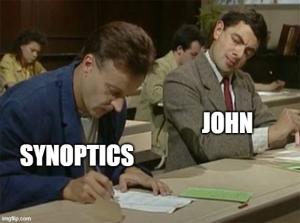 For context, I consider the author of the book a friend as well as a phenomenal scholar. We have had delightful conversations about topics of shared interest (including Doctor Who as well as the Synoptic Problem and the Protevangelium of James). I have often said that the reason that I do not subscribe to the Farrar-Goodacre explanation of the interrelationship of the Gospels probably owes something to my love of underdog positions. Just as I was entering the fray and starting to engage with this area, Goodacre’s views were becoming popular, and I’ve never been one to jump on a trend (unless of course all the alternatives seem utterly implausible).
In response to Mark Goodacre’s latest book, I want to express appreciation as well as hint at where my thinking has been going of later, and how Goodacre’s work might lead to some revolutionary new directions in the study of the Gospels.
In my doctoral work which became my first book, John’s Apologetic Christology, I neither presupposed John’s dependence on earlier Christian writings nor ruled that out. That seemed prudent, so that my conclusions would not be rejected by those who believed John knew the Synoptics nor by those who viewed it as independent. I still think that was a good choice. Being cautious in that way, however, did not mean I was uninterested in investigating the topic in its own right. The things that I read at the time had me leaning in the direction of John’s independence.
Mark Goodacre’s book has persuaded me of the likelihood that the author of the Fourth Gospel knew the other Gospels. James Barker’s recent book started to shift my view more than anything else I had read previously. Hence my endorsement of the book: “Utilizing analogies from Pinocchio to Pier Paolo Pasolini, Barker’s book seeks to draw attention to where scholars complicate what may have been relatively simple and simplify what may have been extremely complicated in the production of Gospels. A thought-provoking read for anyone interested in the interrelationship of Gospels and how they came to be written. Barker’s close attention to detail highlights things that it is easy to miss even if you’ve studied these texts for decades.” But I still wasn’t willing to commit when I wrote that. I think that I am now, but in a way that Mark Goodacre may or may not be happy with.
Let me say more about his book first. Goodacre cleverly focuses his attention to begin with on the fact that the Gospel of John is and has always been a Synoptic Gospel, in the technical sense. That term comes from the creation of Synopses of the Gospels that place them in parallel. For as long as this has been done, it has been done with the four canonical Gospels and not just three of them. John differs more, but it has always been included in such Synopses nonetheless. John is thus and has always been “the fourth Synoptic Gospel.”
The kinds of agreements of details of phrasing between John and other Gospels that Goodacre highlights in the chapters that follow are of precisely the same sort that appear in standard introductions to and explanations of the Synoptic Problem. That means that either John directly used the other Gospels directly in literary form, or a key argument for how the other Gospels’ authors used one another is wrong.
Both of those things may be the case. I will again mention Barker’s book, which challenges readers to think about the way literary authorship and book production happened in the first century. Most engagement with the synoptic problem inevitably cannot avoid influence of our very different literary and communication environment.
The kinds of verbal agreements that John shares with Luke seem, each taken individually, often like the sort of things that two authors might do independently when telling the same story. Convergence on the same striking phrase can definitely result from direct copying. But it also happens when people with similar backgrounds of reading and similar experience of writing turn their attention to the same topic. What makes Goodacre’s case compelling are the things that he notices and highlights that others tend not to. For instance, Luke adds the phrase “lay hands on” when referring to Jesus or his followers being seized (pp.61-64). John takes up the phrase in precisely the contexts in which Luke adds it. Goodacre is appropriately cautious about jumping too quickly to a conclusion, or doing so on the basis of inadequate evidence. He pays attention to the kinds of minutiae that interest “geeks of the guild” (p.72) while also looking at the big picture.
Earlier in the book, Goodacre pointed out the convergence of Mark and John on the phrase “two hundred denarii” in their telling of the feeding of the five thousand. Goodacre says that “If Mark and John picked up both these details from oral tradition, the coincidence would be remarkable” (p.29). I immediately wrote in pencil in the margin the question “Why?” This seems like the sort of detail, precisely because of its uniqueness, that could get fixed in storytelling and circulate widely. It is also the sort of thing that might, having appeared for the first time in Gospel of Mark’s written account, influence someone writing about the story even without having Mark in front of him, if stories from Mark were read aloud in their community with regularity.
This is the key point where I still lean in a different direction than Goodacre. Unusual phrases often stick in folktales, jokes, and other types of stories that circulate widely. For me a paramount question is not whether agreements might indicate literary dependence, but how we do justice to the fact that even when there is literary dependence, a convergence might be something that both authors knew prior to and independently of any literary contact.
My own thinking has been converging on a particular way of thinking about this of late, and The Fourth Synoptic Gospel has pushed me further in that direction. It seems to me that we need an approach to the interrelationship of all the early Gospels, the four within the canon as well as others, in a manner that makes room for the persistence of oral tradition, the regular hearing of literary texts read aloud, and the ability of authors composing new works to consult written texts. I have been arguing for some years now that we need to find ways to do justice to two perfectly compatible facts: that the Gospel authors each in turn knew writings by their predecessors, and they also heard things said that represented independent passing along of tradition in parallel with that literary tradition.
In light of Goodacre’s persuasive book, I want to highlight two areas that I believe need further attention from scholars. I might eventually turn my attention to them, but I’ll be happy if others who have time and interest do so first. One is whether we can tell the difference between a composition crafted by an author who worked with other specific texts in front of her or him, and a composition made by an author who had read those other texts previously or heard them read aloud. Are there features that would make one or the other seem more probable?
The other topic is perhaps even more important in my opinion. If John used Mark and Luke just as Matthew used Mark, in neither instance does that preclude the author having other similar or overlapping information. John’s differences from Mark may at times reflect the fact that John always heard one of Mark’s stories told differently than Mark tells it. In the past we have sought to make a case for independent tradition by making a case for literary independence. Those things need to be separated. If Gospel authors tended to know most or all of the works of the predecessors, what will we look for in terms of the case for them knowing other things in addition to the literary works in question?
Goodacre does not merely make the case for John knowing the (other) Synoptics. He takes the time to explain why it matters. A storyteller writing in our time might refer to things that readers can be presumed to know, without needing to narrate them. John does this in relation to information and stories in the other Gospels (pp.73-92). We also understand Matthew and Luke differently when we know that they are doing things with Mark. and the same is true of John (pp.93-106).
Before ending his book, Goodacre turns his attention to the case that, if the earliest readers of the Gospel of John were familiar with the Synoptics, then John the son of Zebedee would stand out as a likely candidate to be the Beloved Disciple. Goodacre emphasizes that this is a separate matter from whether John son of Zebedee in fact wrote the Gospel (pp.132-133). I must express a bit of disappointment that, in writing about how John transformed what he inherited Christologically, Goodacre did not interact with my John’s Apologetic Christology which is about precisely that. As I mentioned earlier, I left the question open of whether John knew the other canonical Gospels directly, but the book discusses in detail what the Fourth Gospel does with material like that found in those texts, even while leaving open the possibility that the Fourth Gospel’s author did not derive them from these texts in written form. I’m not sure the book would have been different, much less better, had such interaction taken place. I’m mostly just curious what Goodacre would have said about things I wrote there!
One question I still have is whether we will continue to refer to Matthew, Mark, and Luke as the Synoptic Gospels in spite of this case that John be considered Synoptic as well.
I highly recommend that everyone who studies the Gospels read Goodacre’s The Fourth Synoptic Gospel. Whether you work on John or not, and whether your approach is primarily literary or historical, this is the sort of scholarship that will and needs to transform our thinking about the relationship between these texts. Whether it persuades you to think of that relationship in precisely the way Goodacre does, or causes you to think of new possibilities hitherto neglected, it is a book that no one in this field can afford to ignore.
Of related interest:
Cognitive Science, Memory, Oral Tradition, and Biblical Studies
General Christian
History and Religion
Previous Post

September 12, 2026
Agentic AI Apocalypse?
Next Post

September 26, 2026 Cinematic Bible Time
Recent Comments
"And to you!"
Make Evangelicalism Christian Again
"Thank You, I identify as "strange" wink, wink! Anyway, at this point we're not going ..."
Make Evangelicalism Christian Again
"You are such a strange individual and so difficult to have a conversation with. You ..."
Make Evangelicalism Christian Again
"What you're suggesting citing these "rabbinical" interpretations you're favoring are just that - interpretations. There ..."
Make Evangelicalism Christian Again
Browse Our Archives
Select a Category 1 Corinthians 1 John 1 Peter 1 Samuel 1 Thessalonians 1 Timothy 2 Corinthians 2 Kings 2 Peter 2 Samuel 2 Thessalonians 2 Timothy academia Acts of the Apostles afterlife Akhaten Alcatraz American Academy of Religion Amos Anglican Arabic Aramaic archaeology art artificial intelligence astronomy atheism atonement Babylon 5 Baptists Battlestar Galactica Bible Biblical Studies Carnival biblioblogging Black Mirror Blade Runner Book of Job book review Buddhism Call for Papers China Christianity Christmas Christology Chronicles Coptic creation Daniel Deuteronomy Doctor Who Dune Easter Ecclesiastes economics education Eldad Keynan Enoch Seminar Ephesians eschatology Esther Evangelicals evolution Exodus Expanse Ezekiel Ezra fantasy Fringe fundamentalism Galatians games Ge'ez genealogy Genesis Gnosticism Gospel of Jesus' Wife Gospel of John Gospel of Judas Gospel of Luke Gospel of Mark Gospel of Matthew Gospel of Peter Gospel of Thomas Greek Harry Potter Hebrew Hebrews Hinduism historical Jesus history Hitchhiker's Guide to the Galaxy Holidays horror Hosea humor incarnation India inerrancy information literacy inspirational Intelligent Design Ireland Isaiah Islam Israel Italy James Jeremiah John the Baptist Jonah Joshua Judaism Jude Judges Judith Lamentations languages Latin Leviticus libraries literature Lord of the Rings LOST Mandaeans Mandaic memes Methodism Micah monotheism morality Mormons movies music mythicism NASSCAL Nehemiah new perspective New Testament news Numbers Orthodox paganism panentheism pantheism Patheos Paul and his letters Pentecostals Philippians Philippians 2:6-11 philosophy physics Planet of the Apes podcast politics Progressive Christianity Protestantism Proverbs Psalms pseudoscience racism religion Revelation Roman Catholicism Romania Romans Ruth scams science science fiction Secret Gospel of Mark Society of Biblical Literature Song of Songs Star Trek Star Wars Stargate Swahili Syriac Taoism technology Terminator The Handmaid's Tale The Hobbit The Matrix theodicy theology theory Timeless Titus tomb Torchwood travel TRON Uncategorized United Kingdom Westworld X-Files young-earth creationism Zechariah
Select a Month November 2026 October 2026 September 2026 August 2026 July 2026 June 2026 May 2026 April 2026 March 2026 February 2026 January 2026 December 2025 November 2025 October 2025 September 2025 July 2025 June 2025 May 2025 April 2025 March 2025 February 2025 January 2025 December 2024 November 2024 October 2024 September 2024 August 2024 July 2024 June 2024 May 2024 April 2024 March 2024 February 2024 January 2024 December 2023 November 2023 October 2023 September 2023 August 2023 July 2023 May 2023 April 2023 March 2023 February 2023 January 2023 December 2022 November 2022 October 2022 September 2022 August 2022 July 2022 June 2022 May 2022 April 2022 March 2022 February 2022 January 2022 December 2021 November 2021 October 2021 September 2021 August 2021 July 2021 June 2021 May 2021 April 2021 March 2021 February 2021 January 2021 December 2020 November 2020 October 2020 September 2020 August 2020 July 2020 June 2020 May 2020 April 2020 March 2020 February 2020 January 2020 December 2019 November 2019 October 2019 September 2019 August 2019 July 2019 June 2019 May 2019 April 2019 March 2019 February 2019 January 2019 December 2018 November 2018 October 2018 September 2018 August 2018 July 2018 June 2018 May 2018 April 2018 March 2018 February 2018 January 2018 December 2017 November 2017 October 2017 September 2017 August 2017 July 2017 June 2017 May 2017 April 2017 March 2017 February 2017 January 2017 December 2016 November 2016 October 2016 September 2016 August 2016 July 2016 June 2016 May 2016 April 2016 March 2016 February 2016 January 2016 December 2015 November 2015 October 2015 September 2015 August 2015 July 2015 June 2015 May 2015 April 2015 March 2015 February 2015 January 2015 December 2014 November 2014 October 2014 September 2014 August 2014 July 2014 June 2014 May 2014 April 2014 March 2014 February 2014 January 2014 December 2013 November 2013 October 2013 September 2013 August 2013 July 2013 June 2013 May 2013 April 2013 March 2013 February 2013 January 2013 December 2012 November 2012 October 2012 September 2012 August 2012 July 2012 June 2012 May 2012 April 2012 March 2012 February 2012 January 2012 December 2011 November 2011 October 2011 September 2011 August 2011 July 2011 June 2011 May 2011 April 2011 March 2011 February 2011 January 2011 December 2010 November 2010 October 2010 September 2010 August 2010 July 2010 June 2010 May 2010 April 2010 March 2010 February 2010 January 2010 December 2009 November 2009 October 2009 September 2009 August 2009 July 2009 June 2009 May 2009 April 2009 March 2009 February 2009 January 2009 December 2008 November 2008 October 2008 September 2008 August 2008 July 2008 June 2008 May 2008 April 2008 March 2008 February 2008 January 2008 December 2007 November 2007 October 2007 September 2007 August 2007 July 2007 June 2007 February 2007 January 2001
Follow Us!
TAKE THE
Religious Wisdom Quiz
What city did David capture and make his capital?
Select your answer to see how you score.
Hebron Jerusalem Gibeon Bethlehem
Books by This Author Books by James F. McGrath
Related posts from Religion Prof: The Blog of James F. McGrath

The Obsolete Paradigm of a Purely Mythical Jesus
Religion Prof: The Blog of James F. McGrath
Was the "Sinful Woman" in Luke Really a...
Religion Prof: The Blog of James F. McGrath
Faith that Learns (Mark 7:24-31; Luke 16:19-31)
Religion Prof: The Blog of James F. McGrath
Faith that Lives (Matthew 7:12-29)
Religion Prof: The Blog of James F. McGrath
TRENDING AT PATHEOS Progressive Christian

Jesus explicitly mentions the book of Jonah twice, but he retells the...

Peggy Sue Got Married: Coppola’s Always Been Like...
I enjoyed Megalopolis (2024). It’s a mess, but I enjoyed it. The...

My dissertation The Place of Mysticism in the Late Middle Ages concerns...

God and the Contingency of This World
The great Catholic philosopher Aquinas and the great Lutheran philosopher Leibniz developed...

Pope Francis and The Devil – A Pagan...
According to his private diaries, Pope Francis saw visions of the devil...

Rock N' Roll-- Morphing into/for a New Generation...
Well, should we be grateful, or is rock n' roll just dead? ...
view all Progressive Christian blogs
What Are Your Thoughts?leave a comment
Ad-Free & Subscriber Log-In Subscription Support
- About Us
- 2026 Calendar
- Videos
- Podcasts
- Library of World Religions
- Faith In Media Tracker
- Advertise With Us
- Write for Us
- Privacy Policy
- Terms of Service
- Do Not Sell My Data
- Contact Us
- Radiant Digital
- Manage Newsletter Subscriptions
- Unsubscribe From Notifications
- Sitemap
Copyright 2008-2026, Patheos, part of the Radiant Digital network of media brands. All rights reserved.
Subscription Support Ad-Free & Subscriber Log-In
Follow Patheos