
BuddhistCatholicContemplativeEvangelicalGeneral ChristianHinduJewishLatter-day SaintMuslimNew VisionsProgressive Christian
Beliefs
- Buddhist
- Catholic
- Contemplative
- Evangelical
- General Christian
- Hindu
- Jewish
- Latter-day Saint
- More Voices
- Muslim
- New Visions
- Pagan
- Progressive Christian
Topics
- Religion News
- Food and Religion
- Sports and Religion
- Religious Art
- Religious Music and Entertainment
- Religious Events
- History and Religion
- Style and Religion
- Politics and Religion
- Women in Religion
- Recreation Outdoors and Religion
- Business Finance and Religion
- Careers Workplace and Religion
- Education and Religion
- Family Parenting and Religion
- Health Fitness and Religion
- Home and Religion
- Relationships and Religion
- Technology and Religion
- Travel and Religion
Columnists
- Buddhist Columnists
- Business Finance and Religion Columnists
- Careers Workplace and Religion Columnists
- Catholic Columnists
- Contemplative Columnists
- Education and Religion Columnists
- Evangelists Columnists
- Family Parenting and Religion Columnists
- General Christian Columnists
- Health Fitness and Religion Columnists
- Hindu Columnists
- History and Religion Columnists
- Home and Religion Columnists
- Jewish Columnists
- More Voices Columnists
- Latter Day Columnists
- Muslim Columnists
- New Visions Columnists
- Nonreligious Columnists
- Pagan Columnists
- Politics and Religion Columnists
- Progressive Columnists
- Recreation Outdoors and Religion Columnists
- Relationships and Religion Columnists
- Religion News Columnists
- Religious Art Columnists
- Religious Events Columnists
- Religious Music and Entertainment Columnists
- Sports and Religion Columnists
- Style and Religion Columnists
- Technology and Religion Columnists
- Travel and Religion Columnists
- Women in Religion Columnists
Resource Library
- 2026 Calendar
- Library of World Religions
- The 100 Most Holy Places on Earth
- Patheos Answers
- Podcasts
- Videos
- Faith Leaders Database
- Anglican Episcopalian
- Bahai
- Baptist
- Buddhism
- Christianity
- Confucianism
- Eastern Orthodoxy
- Hinduism
- Holiness and Pentecostal
- ISKCON
- Islam
- Judaism
- Lutheran
- Methodist
- The Church of Jesus Christ of Latter-day Saints
- New Age
- Paganism
- Presbytarian and Reformed
- Protestantism
- Religion Behind the Scenes
- Roman Catholic
- Scientology
- Shia Islam
- Sikhism
- Sufism
- Sunni Islam
- Taoism
- Zen
- See all religions
Research Tools
 Ad-Free & Subscriber Log-In Subscription Support
Ad-Free & Subscriber Log-In Subscription Support
Follow Patheos 

- Trending:
- Forgiveness
- |
- Marriage
- |
- Consciousness
- |
- Death Penalty
- |
- Election
- |
- Halloween

- Home
- About Dr. James F. McGrath
- Publications
- Blogroll
- Useful Websites
- Connections
- Easy Search Posts Page
- FREE NEWSLETTER
- Home
- Progressive Christian
- History and Religion
- Was the “Sinful Woman” in Luke Really a Prostitute?
Was the “Sinful Woman” in Luke Really a Prostitute?
Last updated on: August 7, 2026 at 10:38 pm by James F. McGrath
Was the “Sinful Woman” in Luke Really a Prostitute? 2026-08-07T22:38:04-04:00 James F. McGrath
Patheos Explore the world's faith through different perspectives on religion and spirituality! Patheos has the views of the prevalent religions and spiritualities of the world.
A Sinful Woman
When I wrote my book What Jesus Learned from Women, I thought long and hard about Luke’s story of a sinful woman (Luke 7:36-50). Ultimately, I did not find myself able (or at least willing) to decide between a couple of different options. Is the story something Luke created, taking the story of the anointing at Bethany (which he does not narrate) and turning it into a significantly different one? Or were there two events in the life of Jesus, an anointing of his head prior to his crucifixion, and weeping at his feet at the home of Simon the Pharisee, which had similar elements that led to confusion of details between the two. The latter is suggested by the way the Gospel of John makes the feet a focus in his story, in which Mary of Bethany is the actor (John 12:1-8).
Revisiting the story this week in my Sunday school class at Crooked Creek Baptist Church, I have become more convinced that the story in Luke is about a separate event, though I am not certain. More importantly, having had time to reflect further on the story, I think that more can be said about the events Luke narrates than I did in my book. But first, as a reminder, here’s the story in the Gospel of Luke:
One of the Pharisees asked Jesus to eat with him, and when he went into the Pharisee’s house, he reclined to dine. And a woman in the city who was a sinner, having learned that he was eating in the Pharisee’s house, brought an alabaster jar of ointment. She stood at his feet, weeping, and began to bathe his feet with her tears and dry them with her hair, kissing them and anointing them with the ointment. Now when the Pharisee who had invited him saw it, he said to himself, “If this man were a prophet, he would have known who and what kind of woman this is who is touching him, that she is a sinner.” Jesus spoke up and said to him, “Simon, I have something to say to you.” “Teacher,” he replied, “speak.” “A certain moneylender had two debtors; one owed five hundred denarii, and the other fifty. When they could not pay, he canceled the debts for both of them. Now which of them will love him more?” Simon answered, “I suppose the one for whom he canceled the greater debt.” And Jesus said to him, “You have judged rightly.” Then turning toward the woman, he said to Simon, “Do you see this woman? I entered your house; you gave me no water for my feet, but she has bathed my feet with her tears and dried them with her hair. You gave me no kiss, but from the time I came in she has not stopped kissing my feet. You did not anoint my head with oil, but she has anointed my feet with ointment. Therefore, I tell you, her many sins have been forgiven; hence she has shown great love. But the one to whom little is forgiven loves little.” Then he said to her, “Your sins are forgiven.” But those who were at the table with him began to say among themselves, “Who is this who even forgives sins?” But he said to the woman, “Your faith has saved you; go in peace.”
First, the fact that she is “a sinful woman” is often taken to mean that she was a prostitute. That is not said, nor implied, and it is quite implausible that a prostitute was simply allowed to wander in and hang around at this meal. That the woman was Mary Magdalene is ruled out by the fact that Mary is introduced in the next chapter and Luke says nothing to indicate that he had just told a story about her. We should assume that the woman was present at the meal because she was connected with a guest. It is unclear whether women and men typically dined together at meals with invited guests. (Romans and Greeks differed on this point, and I am not aware of clear evidence about Jewish practices in this time and place.) Either way, the woman may have been the spouse or the slave of a guest. She had been impacted by Jesus’ teaching and activity at some point in the past, and thus she brought ointment with her. Why? To pour it on him? To give it as a gift to support his work? We are not told.
In the story immediately prior to this one, which I discussed in a separate post recently, we found the focus to be on Jesus’ refusal to play the game of reciprocity with respect to communal eating. He taught people to invite those who could not repay the invitation, and he accepted invitations without committing to reciprocate. That is probably the background to the poor treatment of Jesus that Luke describes. He refrains from revealing it until the end of the story, so that the reader is liable to make judgments and then have them challenged.
I was aware, thanks to the work of Kenneth Bailey, that Simon’s refusal to offer Jesus a respectful kiss and have his feet washed could only be deliberate disrespect. Perhaps he was aware that an invitation he begrudgingly extended to Jesus would not be reciprocated. Perhaps he had heard about Jesus’ teaching about love for enemies coupled with criticism of Pharisees, and wanted to see how Jesus would respond. Perhaps he would offer an angry outburst, and lose face in the eyes of those who hold him in high esteem. Bailey said that the tension at the meal would be palpable.
Luke holds back from telling us that, because when it is revealed, what would have seemed a surprising act becomes explicable. The woman had come to the dinner aware of Jesus, and she saw the poor treatment he was subjected to. Bailey articulates her response in a more recent book, Jesus Through Middle Eastern Eyes, ‘The woman was deeply dismayed at the insult to Jesus, and said to herself, “They will not offer these courtesies! Very well, I will offer them instead!”’
She is not weeping, seeking forgiveness. She had already been forgiven, had already experienced that through Jesus’ teaching and had likely undergone baptism. She went to the meal expecting to honor Jesus, whether by pouring ointment on his hands or head to refresh him, or to give it as a gift. She did not expect to weep uncontrollably, much less to wipe his feet with her hair. These were spontaneous actions that were a direct response to how the host at the meal treated Jesus.
When we understand these elements of the cultural background, we are led to interpret the story very differently. The Pharisee views the woman as a sinner for whatever reason, but almost certainly not because she was a prostitute or a “loose woman.” Yet he had treated Jesus with disrespect while she had honored him. Jesus’ story about the two debtors, one owing more than a year’s wages, one owing a couple of months wages, pokes fun at him even though he doesn’t recognize it. His own perception of his righteousness in contrast with others he deems sinners prevents him from loving God as lavishly as God deserves.
What Jesus Learned from the Woman Who Washed His Feet/Anointed Him
General Christian
History and Religion
Education and Religion

About James F. McGrath
Clarence L. Goodwin Chair in New Testament Language and Literature at Butler University in Indianapolis, Indiana, USA. BD University of London, PhD Durham University. Author of John's Apologetic Christology, The Only True God, Theology and Science Fiction, and The Burial of Jesus, as well as (with Charles Haberl of Rutgers University) the two-volume Mandaean Book of John critical edition, translation, and commentary. Also author of numerous articles (and a few science fiction short stories) and the editor or co-editor of several volumes. You can read more about the author here.
Previous Post

July 2, 2026
'Disclosure Day': The Real Revelation Isn't Aliens
Next Post

July 13, 2026 A Baptist's Defense of the Muslim Call to Prayer
Recent Comments
"V. good.For me, the gold standard for this sort of thing is still Wikihistory by ..."
The Time-Traveler’s Apprentice (A Short Story)
"The one who says "no one comes to the Father but through me" is the ..."
Attack on Religious Freedom in Indiana
"Until I read, "As a Christian, it is possible but not at all necessary to ..."
Attack on Religious Freedom in Indiana
"Hey James, regarding your penultimate paragraph, I struggle with the same issue. I do think ..."
Browse Our Archives
Select a Category 1 Corinthians 1 John 1 Peter 1 Samuel 1 Thessalonians 1 Timothy 2 Corinthians 2 Kings 2 Peter 2 Samuel 2 Thessalonians 2 Timothy academia Acts of the Apostles afterlife Akhaten Alcatraz American Academy of Religion Amos Anglican Arabic Aramaic archaeology art artificial intelligence astronomy atheism atonement Babylon 5 Baptists Battlestar Galactica Bible Biblical Studies Carnival biblioblogging Black Mirror Blade Runner Book of Job book review Buddhism Call for Papers China Christianity Christmas Christology Chronicles Coptic creation Daniel Deuteronomy Doctor Who Dune Easter Ecclesiastes economics education Eldad Keynan Enoch Seminar Ephesians eschatology Esther Evangelicals evolution Exodus Expanse Ezekiel Ezra fantasy Fringe fundamentalism Galatians games Ge'ez genealogy Genesis Gnosticism Gospel of Jesus' Wife Gospel of John Gospel of Judas Gospel of Luke Gospel of Mark Gospel of Matthew Gospel of Peter Gospel of Thomas Greek Harry Potter Hebrew Hebrews Hinduism historical Jesus history Hitchhiker's Guide to the Galaxy Holidays horror Hosea humor incarnation India inerrancy information literacy inspirational Intelligent Design Ireland Isaiah Islam Israel Italy James Jeremiah John the Baptist Jonah Joshua Judaism Jude Judges Judith Lamentations languages Latin Leviticus libraries literature Lord of the Rings LOST Mandaeans Mandaic memes Methodism Micah monotheism morality Mormons movies music mythicism NASSCAL Nehemiah new perspective New Testament news Numbers Orthodox paganism panentheism pantheism Patheos Paul and his letters Pentecostals Philippians Philippians 2:6-11 philosophy physics Planet of the Apes podcast politics Progressive Christianity Protestantism Proverbs Psalms pseudoscience racism religion Revelation Roman Catholicism Romania Romans Ruth scams science science fiction Secret Gospel of Mark Society of Biblical Literature Song of Songs Star Trek Star Wars Stargate Swahili Syriac Taoism technology Terminator The Handmaid's Tale The Hobbit The Matrix theodicy theology theory Timeless Titus tomb Torchwood travel TRON Uncategorized United Kingdom Westworld X-Files young-earth creationism Zechariah
Select a Month October 2026 September 2026 August 2026 July 2026 June 2026 May 2026 April 2026 March 2026 February 2026 January 2026 December 2025 November 2025 October 2025 September 2025 July 2025 June 2025 May 2025 April 2025 March 2025 February 2025 January 2025 December 2024 November 2024 October 2024 September 2024 August 2024 July 2024 June 2024 May 2024 April 2024 March 2024 February 2024 January 2024 December 2023 November 2023 October 2023 September 2023 August 2023 July 2023 May 2023 April 2023 March 2023 February 2023 January 2023 December 2022 November 2022 October 2022 September 2022 August 2022 July 2022 June 2022 May 2022 April 2022 March 2022 February 2022 January 2022 December 2021 November 2021 October 2021 September 2021 August 2021 July 2021 June 2021 May 2021 April 2021 March 2021 February 2021 January 2021 December 2020 November 2020 October 2020 September 2020 August 2020 July 2020 June 2020 May 2020 April 2020 March 2020 February 2020 January 2020 December 2019 November 2019 October 2019 September 2019 August 2019 July 2019 June 2019 May 2019 April 2019 March 2019 February 2019 January 2019 December 2018 November 2018 October 2018 September 2018 August 2018 July 2018 June 2018 May 2018 April 2018 March 2018 February 2018 January 2018 December 2017 November 2017 October 2017 September 2017 August 2017 July 2017 June 2017 May 2017 April 2017 March 2017 February 2017 January 2017 December 2016 November 2016 October 2016 September 2016 August 2016 July 2016 June 2016 May 2016 April 2016 March 2016 February 2016 January 2016 December 2015 November 2015 October 2015 September 2015 August 2015 July 2015 June 2015 May 2015 April 2015 March 2015 February 2015 January 2015 December 2014 November 2014 October 2014 September 2014 August 2014 July 2014 June 2014 May 2014 April 2014 March 2014 February 2014 January 2014 December 2013 November 2013 October 2013 September 2013 August 2013 July 2013 June 2013 May 2013 April 2013 March 2013 February 2013 January 2013 December 2012 November 2012 October 2012 September 2012 August 2012 July 2012 June 2012 May 2012 April 2012 March 2012 February 2012 January 2012 December 2011 November 2011 October 2011 September 2011 August 2011 July 2011 June 2011 May 2011 April 2011 March 2011 February 2011 January 2011 December 2010 November 2010 October 2010 September 2010 August 2010 July 2010 June 2010 May 2010 April 2010 March 2010 February 2010 January 2010 December 2009 November 2009 October 2009 September 2009 August 2009 July 2009 June 2009 May 2009 April 2009 March 2009 February 2009 January 2009 December 2008 November 2008 October 2008 September 2008 August 2008 July 2008 June 2008 May 2008 April 2008 March 2008 February 2008 January 2008 December 2007 November 2007 October 2007 September 2007 August 2007 July 2007 June 2007 February 2007 January 2001
Follow Us!
TAKE THE
Religious Wisdom Quiz
What animal did Peter see in vision?
Select your answer to see how you score.
Sheep Lions Goats Clean and unclean animals
Books by This Author Books by James F. McGrath
Related posts from Religion Prof: The Blog of James F. McGrath

Religion Prof: The Blog of James F. McGrath
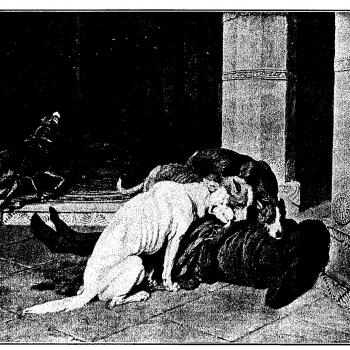
Faith that Learns (Mark 7:24-31; Luke 16:19-31)
Religion Prof: The Blog of James F. McGrath

Using AI to Highlight and Challenge Stereotypes
Religion Prof: The Blog of James F. McGrath

Religion Prof: The Blog of James F. McGrath
TRENDING AT PATHEOS Progressive Christian

I was strolling through the top floor of the brand new Parthenon...

What Does Gêvâh Mean For Kimberley Guifoyle &...
This week, a lot of the news is focused on Kimberly Guilfoyle....

INNER CIRCLE: Profound Mystery (Of Christ In All...
Ephesians 5:31-32 “For this reason, a man will leave his father and...

Do Not Rejoice When Your Enemy Falls: The...
Turning an execution into a public spectacle is a disturbing expression of...

'The Chosen' S6 Trailer: The Passion Gets Very...
Not many watching 'The Chosen' worry about spoilers, but just because they...

The purpose-driven labor priest
A labor activist reads Rick Warren and it gets me wondering about...
view all Progressive Christian blogs
What Are Your Thoughts?leave a comment
Ad-Free & Subscriber Log-In Subscription Support
- About Us
- 2026 Calendar
- Videos
- Podcasts
- Library of World Religions
- Faith In Media Tracker
- Advertise With Us
- Write for Us
- Privacy Policy
- Terms of Service
- Do Not Sell My Data
- Contact Us
- Radiant Digital
- Manage Newsletter Subscriptions
- Unsubscribe From Notifications
- Sitemap
Copyright 2008-2026, Patheos. All rights reserved.
Subscription Support Ad-Free & Subscriber Log-In
Follow Patheos