
BuddhistCatholicContemplativeEvangelicalGeneral ChristianHinduJewishLatter-day SaintMuslimNew VisionsProgressive Christian
Beliefs
- Buddhist
- Catholic
- Contemplative
- Evangelical
- General Christian
- Hindu
- Jewish
- Latter-day Saint
- More Voices
- Muslim
- New Visions
- Pagan
- Progressive Christian
Topics
- Religion News
- Food and Religion
- Sports and Religion
- Religious Art
- Religious Music and Entertainment
- Religious Events
- History and Religion
- Style and Religion
- Politics and Religion
- Women in Religion
- Recreation Outdoors and Religion
- Business Finance and Religion
- Careers Workplace and Religion
- Education and Religion
- Family Parenting and Religion
- Health Fitness and Religion
- Home and Religion
- Relationships and Religion
- Technology and Religion
- Travel and Religion
Columnists
- Buddhist Columnists
- Business Finance and Religion Columnists
- Careers Workplace and Religion Columnists
- Catholic Columnists
- Contemplative Columnists
- Education and Religion Columnists
- Evangelists Columnists
- Family Parenting and Religion Columnists
- General Christian Columnists
- Health Fitness and Religion Columnists
- Hindu Columnists
- History and Religion Columnists
- Home and Religion Columnists
- Jewish Columnists
- More Voices Columnists
- Latter Day Columnists
- Muslim Columnists
- New Visions Columnists
- Nonreligious Columnists
- Pagan Columnists
- Politics and Religion Columnists
- Progressive Columnists
- Recreation Outdoors and Religion Columnists
- Relationships and Religion Columnists
- Religion News Columnists
- Religious Art Columnists
- Religious Events Columnists
- Religious Music and Entertainment Columnists
- Sports and Religion Columnists
- Style and Religion Columnists
- Technology and Religion Columnists
- Travel and Religion Columnists
- Women in Religion Columnists
Resource Library
- 2026 Calendar
- Library of World Religions
- The 100 Most Holy Places on Earth
- Patheos Answers
- Podcasts
- Videos
- Faith Leaders Database
- Anglican Episcopalian
- Bahai
- Baptist
- Buddhism
- Christianity
- Confucianism
- Eastern Orthodoxy
- Hinduism
- Holiness and Pentecostal
- ISKCON
- Islam
- Judaism
- Lutheran
- Methodist
- The Church of Jesus Christ of Latter-day Saints
- New Age
- Paganism
- Presbytarian and Reformed
- Protestantism
- Religion Behind the Scenes
- Roman Catholic
- Scientology
- Shia Islam
- Sikhism
- Sufism
- Sunni Islam
- Taoism
- Zen
- See all religions
Research Tools
 Ad-Free & Subscriber Log-In Subscription Support
Ad-Free & Subscriber Log-In Subscription Support
Follow Patheos 

- Trending:
- Forgiveness
- |
- Marriage
- |
- Consciousness
- |
- Death Penalty
- |
- Election
- |
- Halloween

- Home
- About Dr. James F. McGrath
- Publications
- Blogroll
- Useful Websites
- Connections
- Easy Search Posts Page
- FREE NEWSLETTER
- Home
- Progressive Christian
- Technology and Religion
- Generative AI is Nothing New
Generative AI is Nothing New
Last updated on: June 27, 2026 at 1:30 pm by James F. McGrath
Generative AI is Nothing New 2026-06-27T13:30:00-04:00 James F. McGrath
Patheos Explore the world's faith through different perspectives on religion and spirituality! Patheos has the views of the prevalent religions and spiritualities of the world.
I confess to giving this post a clickbait sort of title in calling it “Generative AI is nothing new.” The statement is true in important ways, however, even if it requires clarification. Let me explain.
In a recent conversation I had with some leading figures at the intersection of AI and religion, one theme was repeated by several of them. We have all seen discussions of AI that cite nothing whatsoever that is more than a few years old.
It took only a moment for me to see the reason why this is likely to be the case. Many who are engaging with generative AI think it is something totally new, unprecedented, and so nothing published a decade or more ago will have anything to say that is relevant to our current moment.
If you aren’t shaking your head at how misguided such a sentiment is, then like those authors, you too have either misunderstood our current AI technology, or are unaware of how many issues of the past are as relevant or more in our current context as they ever were before.
GenAI is Not New Technology
So is my headline deceptive? No, not in any meaningful sense. To say electric cars are nothing new would be absolutely true, even though we live in an era when they are being designed, built, and used in ways that are different from a decade ago, never mind the comparison we might make to the earliest electric vehicles.
The comparison helps to make the point. There are new electric vehicles and they are impressive compared to what we had before. But if you imagined that this technology suddenly appeared as something unprecedented, you might misunderstand both it and its significance.
The same is true of the current state of artificial intelligence.
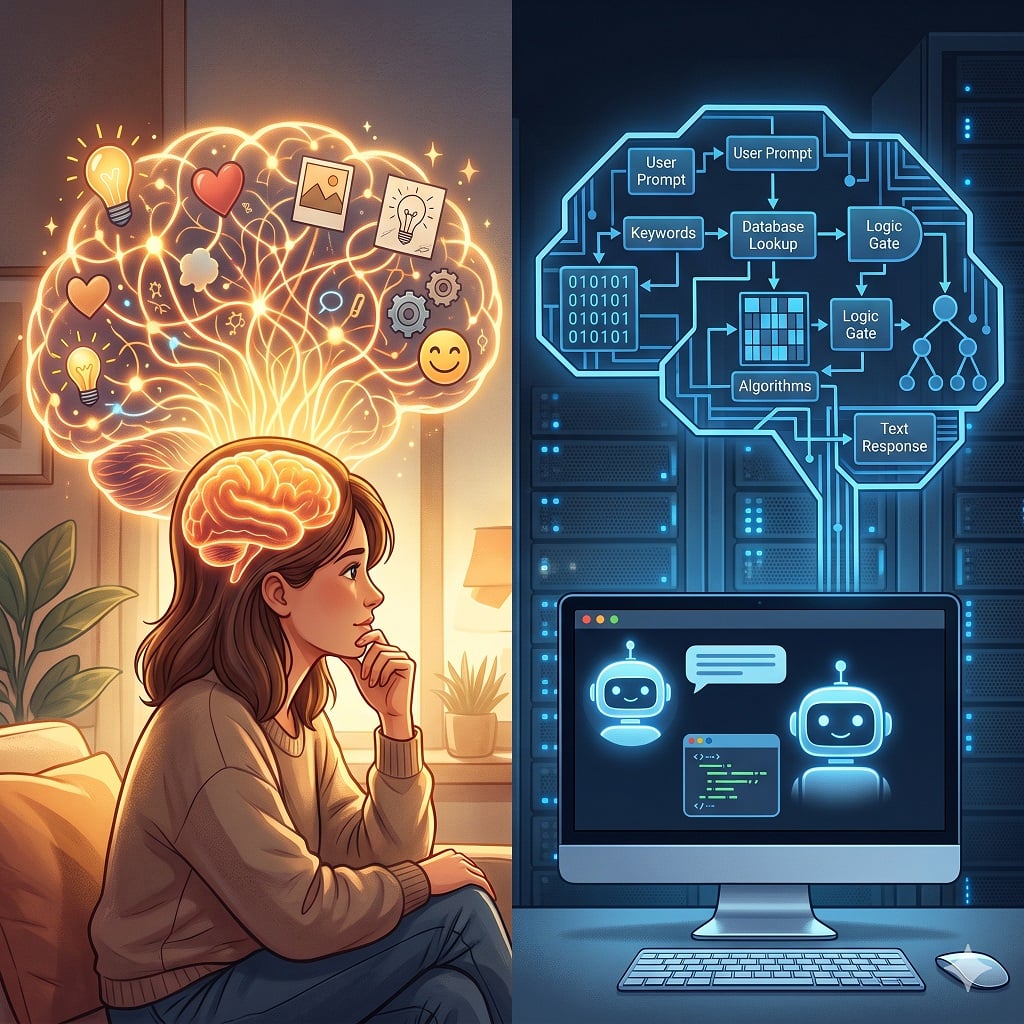 As I have said before, Large Language Models are not fundamentally different than the large chess models or large Go models that allowed machine learning to play those games so well that they can beat humans.
That is essentially what LLM-powered chatbots are doing to a lot of humans. Playing the game of human language, and beating them at it.
In what sense are chatbots “beating” people at language? They are persuading people that they have an inner life, that they draw rational conclusions, that they judge and do so fairly.
AI chatbots are absolutely impressive. So are the so-called “self-driving” capacities of autonomous vehicles. In both instances, the terminology used (artificial intelligence and self-driving) misleads people to think that these marketing labels are being put on products that represent the full realization of things that science fiction has imagined, and using special effects, has depicted.
What we have at present are machines that, by imitating human speech patterns, can imitate human reasoning to a truly impressive extent. Pose a question that brings together things that do not usually get associated, and following the patterns in language related to the two, it will produce output that will include enough that is sufficiently impressive that any flubs and shortcomings pale in comparison.
As long as people treated that with the same qualifications and cautions as “driverless cars” are supposed to have, things might be okay.
Driverless cars do a good job quite often. They do things that were sheer imagination a few years ago. But as we see time after time as drivers leave the driving entirely in the hands of their vehicles, the consequences of overestimating these technologies has tragic outcomes. Like chatbots, “driverless cars” can indeed drive well much of the time. That is because driving and speech both involve rules, and most driving like most communication is fairly predicable.
But anyone who cannot cope with the unpredictable is not a good driver and not a good writer or speaker.
Chatbots will be useful tools to human beings who stay in the driver’s seat and are always ready to take hold of the wheel. Those who think that the computer is the superior driver and they should leave things to them will contribute significant harm to our society, whether on a grand scale or simply through the cheapening of relationships, the spread of misinformation, and the promulgation of confusion about our current technology.
To sum up: The creation of generative AI did not involve the invention of a new type of computer or writing a new type of program. It involves using more data and more computing power to get a computer system to do a better job of imitating human speech.
GenAI is Not New Ethically
Generative AI is nothing new also when it comes to ethics. It is new in the sense that any new technology is new. As we have already seen, it builds on what came before it.
Like all technologies, it may raise issues on a different scale or with a new configuration, but the issues are not themselves unprecedented.
When human beings became capable of harming the climate, it cranked things up several notches beyond anything ancient humanity envisaged. Yet human beings have been impacting the climate for as long as we have been around.
The ethical issues raised by present generative AI are not fundamentally different from those raised by Eliza the chatbot, and by the AI tool we take for granted known as the search engine, and another than we scarcely think of as AI any longer, the social media algorithm.
In the example of using AI to find information or write, with which we made the analogy to autonomous vehicles, the ethical questions are ones that had already been raised. One of them is whether, if an AI drives safely or provides accurate information 9 times out of 10, the 10% that it doesn’t is worth accepting at the price of having our minds elsewhere when traveling, or producing text quickly and cheaply.
I do not expect human beings to all agree on the answer to such questions. But they are nothing new. That is why it is so important to emphasize the sense in which generative AI is nothing new. If we ignore the extensive discussion of ethics and technology that preceded the emergence of ChatGPT, we will be ignoring a wealth of crucially important material that is relevant to addressing the concerns and issues this technology raises.
Conclusion
Why write this? Why say that generative AI is nothing new?
Because too many are writing about it and ignoring the extensive work that addressed past technologies, and imagined where the future might take us, and did so in the years prior to the release of ChatGPT.
As the pope’s encyclical emphasized, the things that we need to know in order to respond in appropriate moral and spiritual ways to current technology are already available to us. They have been for a very long time.
Because chatbots imitate speech in such a compelling way, and authentic speech has been associated in our experience exclusively with minds, we are prone to evaluate what the machines are doing in an incorrect way.
Pointing out how the current technology builds on what came before it can help. Someone playing a modern video game, especially if they had not prior experience with video games, might mistakenly think the world they see on the screen exists somewhere, and that NPCs think and have inner lives. One thing that keeps most of us from doing that is the fact that we have experienced the development of video games incrementally. We know that current ones are just improvements on the previous generation. Some of us can trace this all the way back to games like Zork that we loaded onto our TRS-80 from a cassette tape player. That history, far from being made irrelevant by the most recent gaming technology, can contextualize and evaluate it in ways that make an important contribution to understanding them.
The same is true of generative AI. It creates text, images, music, and other things and it is impressive. They have made it even more impressive by adding additional scaffolding around the chatbot’s function that picks up where the language imitation function leaves off, performs tasks that have been programmed, and inserts results seamlessly back into the chat, so that it looks like the chatbot is actually an agent in the human sense, understanding a request and performing an action in response. The association between natural language and code that allows it to vibe code novel scripts and apps draws on patterns of language and associations in product descriptions and ReadMe.txt files. It is still the same thing that is happening as when it generates English prose. It does not reproduce existing code or text, it works with patterns across a huge body of training data. It is impressive. No one should think that I am suggesting otherwise. The point is not to stop anyone from being impressed, but to prevent anyone from drawing the wrong conclusion because they are impressed.
I have used the analogy to magic tricks before. Our association of speech with cognition leads us to assume that is what is happening in the case of chatbots. Those who understand the technology that underpins them will understand how the trick is done, and judge what is happening appropriately.
Generative AI is something new like your latest game is something new. Generative AI is nothing new in the sense that it is the latest in a sequential development in computing, exploring how to use neural networks and machine learning to train machines to perform certain tasks. As impressive as it is when the task in question is speech, or putting a ship from Star Wars on your university campus, it is important that we understand accurately how the impressive task is performed. Otherwise, we may mistake it for magic. And when we misjudge technology, we will not be able to think about its ethical ramifications in the ways that we crucially need to.
I will include more things of likely interest below. Before I do, having mentioned the pope’s encyclical, I want to point out that biblical scholars have comments about its use of the stories of the Tower of Babel and Nehemiah’s wall-building that need to be considered. I’ll make one example of that the first link.
Further Reading on Generative AI
What ‘Magnifica Humanitas’ misunderstood about The Tower of Babel, Nehemiah and A.I.
Ethan Mollick on Mythos, and on his book about AI published two years ago
Beth Singler on the pope’s encyclical, and on the broader intersection of religion and AI
What Does AI Reveal about Creation and Vocation?
Jim Stump on Babel vs. Nehemiah
The Humanities need a Better Name for Artificial Intelligence
Why a Philosophy professor is training AI to replace him
AI Collapses on a Classic Psychology Test
Grappling with the post-AI university
Defending the Humanities in the era of generative AI
On AI and “Jagged Intelligence”
The Two Sides Of The Room: What A Negotiation Class Reveals About Generative AI And Learning
The Guide That Fades: What One Student’s Mathematica Project Reveals About Learning With AI
Judgment and Discernment Are Doing Different Work
Slow Takes Ep. 13: The Pope vs the IPO
Slow Takes Ep. 14: A Trillion Dollars and a Vaccine
Slow Takes Ep. 15: Who’s Asking?
Slow Takes Ep 16: Who’s Checking?
Your AI Agrees With You, Even When You’re Wrong
Your Data Is Training AI, and Silence Counted as Yes
American College Students Are Refusing AI. The Resistance Is Real. The Strategy Is Wrong.
12% of UK Adults Use AI as a Friend. The Question Nobody Is Asking.
You Cannot Willpower Your Way Out of AI Deskilling
We Are Using the Wrong Words for AI
When Your AI Disappears, What Happens to Your Work?
AI Detection Will Always Be Broken
We Shouldn’t Destroy Ourselves Fighting About AI
Teaching Through Uncertainty: Graduate Instructors, GenAI, and the Writing Classroom
From Nervous to Nuanced: How GTAs Changed Their Minds About GenAI
Possibilities, Cautions, and the Work That Remains
We Blame the Phone Because It Doesn’t Implicate Us
New Publication: Governing Generative AI in Higher Education
Apathies and Artifices in Education
The Audacious Ask of Higher Education
The Reverse Centaur’s Guide to Life After AI by Cory Doctorow
Interview with the author of Future of Truth
Herbie: A Near-Future Debatably Conscious AI Person

Technology and Religion
Previous Post

June 26, 2026
Christology within Judaism (Enoch Seminar June 2026)
Next Post

July 1, 2026 Mourning John and Dancing Jesus?
Recent Comments
"V. good.For me, the gold standard for this sort of thing is still Wikihistory by ..."
The Time-Traveler’s Apprentice (A Short Story)
"The one who says "no one comes to the Father but through me" is the ..."
Attack on Religious Freedom in Indiana
"Until I read, "As a Christian, it is possible but not at all necessary to ..."
Attack on Religious Freedom in Indiana
"Hey James, regarding your penultimate paragraph, I struggle with the same issue. I do think ..."
Browse Our Archives
Select a Category 1 Corinthians 1 John 1 Peter 1 Samuel 1 Thessalonians 1 Timothy 2 Corinthians 2 Kings 2 Peter 2 Samuel 2 Thessalonians 2 Timothy academia Acts of the Apostles afterlife Akhaten Alcatraz American Academy of Religion Amos Anglican Arabic Aramaic archaeology art artificial intelligence astronomy atheism atonement Babylon 5 Baptists Battlestar Galactica Bible Biblical Studies Carnival biblioblogging Black Mirror Blade Runner Book of Job book review Buddhism Call for Papers China Christianity Christmas Christology Chronicles Coptic creation Daniel Deuteronomy Doctor Who Dune Easter Ecclesiastes economics education Eldad Keynan Enoch Seminar Ephesians eschatology Esther Evangelicals evolution Exodus Expanse Ezekiel Ezra fantasy Fringe fundamentalism Galatians games Ge'ez genealogy Genesis Gnosticism Gospel of Jesus' Wife Gospel of John Gospel of Judas Gospel of Luke Gospel of Mark Gospel of Matthew Gospel of Peter Gospel of Thomas Greek Harry Potter Hebrew Hebrews Hinduism historical Jesus history Hitchhiker's Guide to the Galaxy Holidays horror Hosea humor incarnation India inerrancy information literacy inspirational Intelligent Design Ireland Isaiah Islam Israel Italy James Jeremiah John the Baptist Jonah Joshua Judaism Jude Judges Judith Lamentations languages Latin Leviticus libraries literature Lord of the Rings LOST Mandaeans Mandaic memes Methodism Micah monotheism morality Mormons movies music mythicism NASSCAL Nehemiah new perspective New Testament news Numbers Orthodox paganism panentheism pantheism Patheos Paul and his letters Pentecostals Philippians Philippians 2:6-11 philosophy physics Planet of the Apes podcast politics Progressive Christianity Protestantism Proverbs Psalms pseudoscience racism religion Revelation Roman Catholicism Romania Romans Ruth scams science science fiction Secret Gospel of Mark Society of Biblical Literature Song of Songs Star Trek Star Wars Stargate Swahili Syriac Taoism technology Terminator The Handmaid's Tale The Hobbit The Matrix theodicy theology theory Timeless Titus tomb Torchwood travel TRON Uncategorized United Kingdom Westworld X-Files young-earth creationism Zechariah
Select a Month October 2026 September 2026 August 2026 July 2026 June 2026 May 2026 April 2026 March 2026 February 2026 January 2026 December 2025 November 2025 October 2025 September 2025 July 2025 June 2025 May 2025 April 2025 March 2025 February 2025 January 2025 December 2024 November 2024 October 2024 September 2024 August 2024 July 2024 June 2024 May 2024 April 2024 March 2024 February 2024 January 2024 December 2023 November 2023 October 2023 September 2023 August 2023 July 2023 May 2023 April 2023 March 2023 February 2023 January 2023 December 2022 November 2022 October 2022 September 2022 August 2022 July 2022 June 2022 May 2022 April 2022 March 2022 February 2022 January 2022 December 2021 November 2021 October 2021 September 2021 August 2021 July 2021 June 2021 May 2021 April 2021 March 2021 February 2021 January 2021 December 2020 November 2020 October 2020 September 2020 August 2020 July 2020 June 2020 May 2020 April 2020 March 2020 February 2020 January 2020 December 2019 November 2019 October 2019 September 2019 August 2019 July 2019 June 2019 May 2019 April 2019 March 2019 February 2019 January 2019 December 2018 November 2018 October 2018 September 2018 August 2018 July 2018 June 2018 May 2018 April 2018 March 2018 February 2018 January 2018 December 2017 November 2017 October 2017 September 2017 August 2017 July 2017 June 2017 May 2017 April 2017 March 2017 February 2017 January 2017 December 2016 November 2016 October 2016 September 2016 August 2016 July 2016 June 2016 May 2016 April 2016 March 2016 February 2016 January 2016 December 2015 November 2015 October 2015 September 2015 August 2015 July 2015 June 2015 May 2015 April 2015 March 2015 February 2015 January 2015 December 2014 November 2014 October 2014 September 2014 August 2014 July 2014 June 2014 May 2014 April 2014 March 2014 February 2014 January 2014 December 2013 November 2013 October 2013 September 2013 August 2013 July 2013 June 2013 May 2013 April 2013 March 2013 February 2013 January 2013 December 2012 November 2012 October 2012 September 2012 August 2012 July 2012 June 2012 May 2012 April 2012 March 2012 February 2012 January 2012 December 2011 November 2011 October 2011 September 2011 August 2011 July 2011 June 2011 May 2011 April 2011 March 2011 February 2011 January 2011 December 2010 November 2010 October 2010 September 2010 August 2010 July 2010 June 2010 May 2010 April 2010 March 2010 February 2010 January 2010 December 2009 November 2009 October 2009 September 2009 August 2009 July 2009 June 2009 May 2009 April 2009 March 2009 February 2009 January 2009 December 2008 November 2008 October 2008 September 2008 August 2008 July 2008 June 2008 May 2008 April 2008 March 2008 February 2008 January 2008 December 2007 November 2007 October 2007 September 2007 August 2007 July 2007 June 2007 February 2007 January 2001
Follow Us!
TAKE THE
Religious Wisdom Quiz
What animal did Peter see in vision?
Select your answer to see how you score.
Sheep Lions Goats Clean and unclean animals
Books by This Author Books by James F. McGrath
Related posts from Religion Prof: The Blog of James F. McGrath

Religion Prof: The Blog of James F. McGrath

Rogue AI Isn't the Threat You Think It...
Religion Prof: The Blog of James F. McGrath
AI Syllabus Statements You Can Steal for Your...
Religion Prof: The Blog of James F. McGrath

AGI Has Not Arrived, and No Tech Company...
Religion Prof: The Blog of James F. McGrath
TRENDING AT PATHEOS Progressive Christian

I was strolling through the top floor of the brand new Parthenon...

What Does Gêvâh Mean For Kimberley Guifoyle &...
This week, a lot of the news is focused on Kimberly Guilfoyle....

INNER CIRCLE: Profound Mystery (Of Christ In All...
Ephesians 5:31-32 “For this reason, a man will leave his father and...

Do Not Rejoice When Your Enemy Falls: The...
Turning an execution into a public spectacle is a disturbing expression of...

'The Chosen' S6 Trailer: The Passion Gets Very...
Not many watching 'The Chosen' worry about spoilers, but just because they...

The purpose-driven labor priest
A labor activist reads Rick Warren and it gets me wondering about...
view all Progressive Christian blogs
What Are Your Thoughts?leave a comment
Ad-Free & Subscriber Log-In Subscription Support
- About Us
- 2026 Calendar
- Videos
- Podcasts
- Library of World Religions
- Faith In Media Tracker
- Advertise With Us
- Write for Us
- Privacy Policy
- Terms of Service
- Do Not Sell My Data
- Contact Us
- Radiant Digital
- Manage Newsletter Subscriptions
- Unsubscribe From Notifications
- Sitemap
Copyright 2008-2026, Patheos. All rights reserved.
Subscription Support Ad-Free & Subscriber Log-In
Follow Patheos