
BuddhistCatholicContemplativeEvangelicalGeneral ChristianHinduJewishLatter-day SaintMuslimNew VisionsProgressive Christian
Beliefs
- Buddhist
- Catholic
- Contemplative
- Evangelical
- General Christian
- Hindu
- Jewish
- Latter-day Saint
- More Voices
- Muslim
- New Visions
- Pagan
- Progressive Christian
Topics
- Religion News
- Food and Religion
- Sports and Religion
- Religious Art
- Religious Music and Entertainment
- Religious Events
- History and Religion
- Style and Religion
- Politics and Religion
- Women in Religion
- Recreation Outdoors and Religion
- Business Finance and Religion
- Careers Workplace and Religion
- Education and Religion
- Family Parenting and Religion
- Health Fitness and Religion
- Home and Religion
- Relationships and Religion
- Technology and Religion
- Travel and Religion
Columnists
- Buddhist Columnists
- Business Finance and Religion Columnists
- Careers Workplace and Religion Columnists
- Catholic Columnists
- Contemplative Columnists
- Education and Religion Columnists
- Evangelists Columnists
- Family Parenting and Religion Columnists
- General Christian Columnists
- Health Fitness and Religion Columnists
- Hindu Columnists
- History and Religion Columnists
- Home and Religion Columnists
- Jewish Columnists
- More Voices Columnists
- Latter Day Columnists
- Muslim Columnists
- New Visions Columnists
- Nonreligious Columnists
- Pagan Columnists
- Politics and Religion Columnists
- Progressive Columnists
- Recreation Outdoors and Religion Columnists
- Relationships and Religion Columnists
- Religion News Columnists
- Religious Art Columnists
- Religious Events Columnists
- Religious Music and Entertainment Columnists
- Sports and Religion Columnists
- Style and Religion Columnists
- Technology and Religion Columnists
- Travel and Religion Columnists
- Women in Religion Columnists
Resource Library
- 2026 Calendar
- Library of World Religions
- The 100 Most Holy Places on Earth
- Patheos Answers
- Podcasts
- Videos
- Faith Leaders Database
- Anglican Episcopalian
- Bahai
- Baptist
- Buddhism
- Christianity
- Confucianism
- Eastern Orthodoxy
- Hinduism
- Holiness and Pentecostal
- ISKCON
- Islam
- Judaism
- Lutheran
- Methodist
- The Church of Jesus Christ of Latter-day Saints
- New Age
- Paganism
- Presbytarian and Reformed
- Protestantism
- Religion Behind the Scenes
- Roman Catholic
- Scientology
- Shia Islam
- Sikhism
- Sufism
- Sunni Islam
- Taoism
- Zen
- See all religions
Research Tools
 Ad-Free & Subscriber Log-In Subscription Support
Ad-Free & Subscriber Log-In Subscription Support
Follow Patheos 

- Trending:
- Forgiveness
- |
- Marriage
- |
- Consciousness
- |
- Death Penalty
- |
- Election
- |
- Halloween

- Home
- About Dr. James F. McGrath
- Publications
- Blogroll
- Useful Websites
- Connections
- Easy Search Posts Page
- FREE NEWSLETTER
- Home
- Progressive Christian
- Faith that Lives (Matthew 7:12-29)
Faith that Lives (Matthew 7:12-29)
Last updated on: June 17, 2026 at 4:53 am by James F. McGrath
Faith that Lives (Matthew 7:12-29) 2026-06-17T04:53:03-04:00 James F. McGrath
Patheos Explore the world's faith through different perspectives on religion and spirituality! Patheos has the views of the prevalent religions and spiritualities of the world.
Faith that Lives (Matthew 7:12-29): Wise and foolish builders
Faith for Living talk, Lakeside Chautauqua, June 16th, 2026
“Everyone, then, who hears these words of mine and acts on them will be like a wise man who built his house on rock. The rain fell, the floods came, and the winds blew and beat on that house, but it did not fall because it had been founded on rock. And everyone who hears these words of mine and does not act on them will be like a foolish man who built his house on sand. The rain fell, and the floods came, and the winds blew and beat against that house, and it fell—and great was its fall!”
How many of you know the song? “The wise man built his house upon the rock…” The final verse of the familiar children’s song takes the parable in a direction very different than we find in the Gospel of Matthew, where this teaching functions as the conclusion of the famous Sermon on the Mount. My aim here is not to criticize a children’s song. When we craft songs or retell stories for children, we have to adapt and simplify. If as adults we still view Jesus and read biblical texts in ways that are constrained by those adaptations and simplifications for children, however, we risk at the very least missing out on some of the depth that are on offer. In a worst case scenario, we risk misunderstanding them.
I hope the topic of this first talk will work well as a Faith for Living Seminar, because it is precisely about faith for living, about how the two can relate to one another positively, but also how faith understood a particular way has been turned into a substitute for and distraction from living.
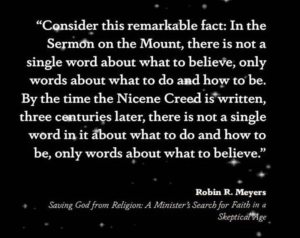
Robin R. Meyers famously wrote: “Consider this remarkable fact: In the Sermon on the Mount, there is not a single word about what to believe, only words about what to do and how to be. By the time the Nicene Creed is written, only three centuries later, there is not a single word in it about what to do and how to be – only words about what to believe” (Saving God from Religion: A Minister’s Search for Faith in a Sceptical Age, p.14).
This can seem like a gotcha, especially in an era when there is a skepticism of dogma and an embrace of the practical. I’m not at all interested in offering a simplistic contrast, much less an absolute opposition, between what we believe and what we do. The two are indeed connected in all kinds of ways, and we’re going to explore some of them together today.
Yet we also need to be honest. Never in our sources does Jesus confront a Roman centurion with great faith, asking them to first recite the Shema, the classic Jewish affirmation of allegiance to one God alone found in Deuteronomy 6:4. “Hear O Israel, the Lord our God, the Lord is one.” He could have. Some appear to think that he should have.
What we believe influences what we do. The point is not that beliefs do not matter. They absolutely do. The point is that Jesus did not make them his focus, much less do so to the extent that Christians today do. Surely as followers of Jesus, or merely as readers of the Gospels, we ought to take note of this.
This could also be a moment when the instinct of some might be to pit Paul against Jesus. Are you familiar with that phenomenon, people who credit everything they like about Christianity to Jesus, and blame everything they don’t like on Paul? I’ll be the first to push back on that. I don’t think Jesus and Paul were nearly as far apart as some imagine, far less diametrically opposed to one another.
Consider what Paul emphasized about faith. He chose Abraham as his exemplar, in both Galatians and Romans. That’s significant. How much did Abraham know about Jesus? Did Abraham affirm the trinity? Abraham comes across in the sources as someone with no awareness of later Israelite beliefs, never mind Christian ones. The patriarchs were worshiping using sacred stones and recognizing sacred trees. Scripture is honest at this point, saying what many who preach on these texts seek to avoid. Abraham was an example of faith only if what Paul means by faith is not assent to doctrines but trust in God.
It is a favorite memory verse of many: “Trust in the Lord with all your heart and lean not on your own understanding.” How often do we turn that into something that we find more comforting? “Trust in the Bible with all your heart and your understanding will be God’s understanding.” That isn’t what the text says. It is not about relying on supposedly revealed dogmas so that we can confidently say we know. It is about trusting in God precisely because we are aware of our human limitations. Even if God had provided us with an inerrant revelation of dogma, we would (according to scripture) bring our fallible understanding and our biases to it, and end up interpreting it in all different sorts of ways, leaning on our own understandings. Just as well that God didn’t give us that, although in our eagerness to feel certain, some claim otherwise.
Now, someone might well object that we are called to love God with all our heart, mind, soul, and strength. How can we be expected to love someone that we don’t know and understand?
If there’s anyone in the audience who is married, including those of us who have been for a few decades or more, you’ll probably guess where I’m going with this.
Even on the level of loving other human beings, we know in part and we understand in part. I can say that I feel I know my wife well and at the same time will say how much she remains an enigma to me.
If this is true at the level of human interpersonal relationships, of love among human beings, how can we demand that we first understand the God who is all-encompassing, whose love and peace (never mind God’s very self) exceed our understanding?
If anyone has a god that they can wrap their minds around, and who can be fully and adequately described using human language, they have an idol. The image may point to the real thing, but that’s what’s at the heart of the biblical warnings about idols and images. Once we have them set up, whether made of stone and gold, or concepts and words, we start to imagine that the image corresponds precisely to the reality it is supposed to point to.
People love their idols. Here too, our human relationships provide a useful analogy. Human relationships often face troubles because of idolatry as well. We may love an imagined, flattened version of a person rather than who they are in all the reality of their multifaceted and multidimensional human existence. We often love the person that we imagine someone else to be, not who they are in all its difference from ourselves. When we love who we imagine someone to be, who we wish they were, rather than who they are, we find ourselves in a constant state of tension and frustration, and the result will be unpleasant. If you have ever done this, then you understand the pitfall of idolatry. Let me say again, my point is not that we relate to God in a manner that is really similar to how we relate to one another. I don’t argue with God nearly as much as I do with my wife…I probably should. Biblical characters do. When God always seems to be saying things that we agree with, it may be an indication of the extent of our idolatry, rather than of the extent of our conformity to God’s will.
So we can, and have no choice but to, love despite not fully comprehending. Perhaps not understanding isn’t a hindrance to loving in the end. Perhaps the possibility of love only exists where there are depths to explore that will last a lifetime, if not indeed an eternity.
Let’s return to the relationship between loving God and loving other human beings, as between comprehending doctrine and pursuing practical action.
1 John 4:20 emphasizes that we cannot in fact love God unless we are also capable of loving our fellow human beings. The letter says that if we claim to love God, and do not love other people, we do not in fact love God. Here’s what it says exactly, in context:
God is love, and those who abide in love abide in God, and God abides in them. Love has been perfected among us in this: that we may have boldness on the day of judgment, because as he is, so are we in this world. There is no fear in love, but perfect love casts out fear; for fear has to do with punishment, and whoever fears has not reached perfection in love. We love because God first loved us. Those who say, “I love God,” and hate a brother or sister are liars, for those who do not love a brother or sister, whom they have seen, cannot love God, whom they have not seen. The commandment we have from God is this: those who love God must love their brothers and sisters also.
I was aware of this important teaching for a long time, before I fully grasped the full implications of what it is saying.
It is not enough to say that love of fellow human beings proves we love God. That is true, but it doesn’t go nearly far enough. What we do and how we love on the human level is the criterion by which our claims about more theoretical spiritual matters are evaluated. If our faith does not express itself in love for other human beings, then we have misunderstood God and the love of God. What we do is the test of what we believe. How we love, whom we love, and whether we love is the standard by which not only our claim to love God and our concept of God’s love are evaluated and judged. If we think that we have to narrow the focus of our love because of the narrowness of God’s love, the former shows that we have the latter wrong.
We live in an era when this is more important to understand than ever. People who claim to be teachers of Christian truth are warning about “toxic empathy” and even calling empathy a “sin”! Don’t miss how astonishing this is. It has been reported on so widely that it may already have begun to fail to shock us. The claim is that our compassion may move us to love, include, and express solidarity with people that God does not want us to love, include, or be in solidarity with.
The teaching of Jesus is clear. Empathy is the core of how we are to make moral decisions. The people who warn about “toxic empathy” are usually the same people who insist that there is objective morality. I don’t disagree that there is truly right and wrong. But Jesus said that the way to discover it is through radical empathy, by doing to others what we would want done to us.
Jesus’ famous story about the Samaritan shows how all this fit together in Jesus’ teaching. We read in Luke 10:25-37:
An expert in the law stood up to test Jesus. “Teacher,” he said, “what must I do to inherit eternal life?” He said to him, “What is written in the law? What do you read there?” He answered, “You shall love the Lord your God with all your heart and with all your soul and with all your strength and with all your mind and your neighbor as yourself.” And he said to him, “You have given the right answer; do this, and you will live.”
But wanting to vindicate himself, he asked Jesus, “And who is my neighbor?” Jesus replied, “A man was going down from Jerusalem to Jericho and fell into the hands of robbers, who stripped him, beat him, and took off, leaving him half dead. Now by chance a priest was going down that road, and when he saw him he passed by on the other side. So likewise a Levite, when he came to the place and saw him, passed by on the other side. But a Samaritan while traveling came upon him, and when he saw him he was moved with compassion. He went to him and bandaged his wounds, treating them with oil and wine. Then he put him on his own animal, brought him to an inn, and took care of him. The next day he took out two denarii, gave them to the innkeeper, and said, ‘Take care of him, and when I come back I will repay you whatever more you spend.’ Which of these three, do you think, was a neighbor to the man who fell into the hands of the robbers?” He said, “The one who showed him mercy.” Jesus said to him, “Go and do likewise.”
Like everyone else, I was in the habit of referring to this parable as the parable of the “good Samaritan.” Lately I have been making a conscious effort to refer to it in other ways. Why? Because of the implications of that language, and the way we use it today. If you’re visiting another country, and someone says that you’re an American, but “a good one” or “one of the good ones,” you’d understand that their impression of people from the US is negative and they consider you an exception.
I am thus doing my best not to call it the parable of the good Samaritan, as though this one was “one of the good ones” among a people that you would not expect to be so kind. The language of “one of the good ones” shows up time and again in contexts of discrimination and bias, or when we have restricted our love to those who are like us. We make rare exceptions, but don’t change our overall judgment about others.
I know exactly when it clicked for me that this traditional name for the parable was a problem. I was visiting Samaria for the first time. I was in a car with our Samaritan tour guide, who happened to be the grandson of the Samaritan high priest. We were chatting about my work on the historical Jesus and other such matters, and was struck by the fact that this literal good Samaritan deserved for me to talk about Jesus’ story in a different way, one that did not convey the assumption that a good Samaritan was an exception.
Let’s think about the details of that famous story Jesus told. Luke’s Gospel is the only one that records it, and it contextualizes it as a response to the question “who is my neighbor?” That in turn was a reply to Jesus’ summation of the Law in terms of two greatest commandments: Love the Lord your God with all your heart, soul, mind, and strength; and love your neighbor as yourself.
The question “who is my neighbor” is a question about the limits of this obligation.
There is no way that any one of us can help every single other human being who is in need. Some are too distant geographically, so that even if we went to where they were, while helping them we’d be neglecting others in the place that we came from. Even if we spent every moment without sleeping offering assistance to others, we would not manage to help everyone. There must surely be limits to whom we are obligated to help! The scriptures, however, do not specify the limits. Asking about them is a natural question, even if it can for some who ask it be an attempt to justify ourselves and excuse ourselves.
Jesus doesn’t answer the question with a list or a law, but with a story. The details of that story make abundantly clear why Jesus responded in this precise way to this precise question.
The priest and the Levite passed the man on the road between Jerusalem and Jericho.
Leviticus 21:1 is unambiguous: “A priest must not make himself unclean by touching a dead person.” The situation, however, is ambiguous. The man is left “half dead.” That suggests that it might take a close inspection to figure out whether he was dead or not. The process of doing so would mean the priest had violated this law, if it turned out that the man was indeed dead.
We are not told which way these travelers were headed. They might have been traveling behind the man who was robbed, or in the opposite direction. That can make a huge difference, at least for the Levite. Those who served in the temple had to be ritually undefiled. Even if not prohibited from touching a corpse the way priests were, Levites could not touch a corpse and then serve in the temple.
The Bible says lots of things, which is why saying “the Bible says” doesn’t settle things. It commands that we help those in need. It demands that priests not touch a corpse unless it is that of a close relative. So much of Jesus’ distinctive emphasis in his teaching relates to what we do when two commandments conflict. He explicitly mentioned the legal precedent regarding what to do when the 8th day after the birth of a male child fell on the sabbath. If it was your job to circumcise, then you’ll be breaking the sabbath by performing a circumcision on the sabbath. Yet if you don’t, then you’ll be violating the commandment to circumcise all male children on the 8th day. “The Bible says” didn’t help since the Bible commanded both and provided no explicit instructions about what to do when you had to choose. You had to pick one to obey.
We regularly have to choose what to prioritize.
So what should the priest do, and the Levite? Prioritizing purity is obeying God, and so they could in theory have claimed that prioritizing that was an expression of love for and dedication to God.
Jesus’ stance was, I think, that it is inappropriate to use love for God as an excuse for withholding love and care from your neighbor.
The toxic empathy folks are saying that the priest and the Levite were right, that empathy for the victim lying on the road should not be treated as justification for them to violate their commitment to the temple and the ritual purity that went along with it.
Jesus’ story threw listeners another curveball, even before the biggest one at the conclusion. It wasn’t an everyday occurrence for thieves to steal even your clothes. The fact that the victim is left naked has less to do with realism, and more to do with the ethical thought experiment that Jesus crafted.
Our clothing says a lot about us. You might guess that someone is not from the United States just based on their clothing. Clothing also divides subcultures within our society.
If you encounter a naked body on the road, not only may you wonder if they are alive, you may also wonder whether they are “one of your own people” however you might define that.
Jesus really wanted to make this hard on us. That’s the point of such thought experiments. What do you do when you have to choose between an unambiguous law that offers no exceptions, and an ambiguous body that may not even be alive?
Jesus is unambiguous about what to do with this ambiguity: prioritize compassion, empathy, and mercy. Never use alleged love for God as an excuse to withhold love from neighbor.
That’s why I said that, when we read in 1 John that whoever claims to love God and does not love his brother or sister is a liar, it isn’t just that love for other human beings proves our love for God. If we claim to love God in ways that reduce our love for other human beings, we have misunderstood God and what it means to love God. Our love for others is the testing ground of our love for God.
So what do we do if we are Protestants and have taken to heart that we are saved by grace rather than by works? I think that how we raise that question will tell us a lot about ourselves. Notice that in none of the preceding discussion was the issue ever posed in terms of “earning salvation.” When we pose the issue of how we are to do the will of God in terms of what we get out of it individually, we’ve already shifted our focus in an unhelpful direction.
A co-worker who reached out to me after reading my book Beyond Deconstruction put it nicely. The approach to right and wrong that she grew up with was all focused on how actions related to some other motivation, whether luring people to faith, or one’s own salvation. And so she described it as making other people NPCs in one’s individual spiritual journey. For those who may not know this abbreviation, it stands for Non-Player Character. Those are the characters that show up in roleplaying games and who are not central and long-term parts of the narrative. They are there to make your experience as a player interesting, rather than being characters in their own right who have lives and experiences that matter as much as our own. If our approach to faith makes the others to whom we show kindness mere means to an end for ourselves, surely something isn’t right.
The Book of Job also addresses the good that we do and why we do it. In a very real sense, that’s what the book is about. The figure whose title is often rendered into English as a name, as “Satan,” is in fact referred to in the text as the Accuser. This is the prosecuting attorney in the celestial realm. God shows off Job’s righteousness, and the Accuser objects. Of course he’s well behaved! He’s well paid for it. I often ask my students when teaching about the Book of Job: if helping a little old lady cross the street is the stereotypical good deed, how many of you do it? Few hands go up. How many of you would do that if each time you helped a little old lady cross the street, a $50 bill appeared in your wallet. Lots more hands this time. But now the crucial question: would it still be a good deed if you did it and were paid for doing so?
Ideally, we should do what is right simply because it is right. The Bible makes allowances, however, suggesting that just as we are to do unto others as we would want them to do to us, we must do to others as we want God to do to us. But the overall emphasis is that anyone whose aim in doing “good deeds” is to personally be rewarded, isn’t actually doing good deeds.
The imagery that runs throughout the New Testament is primarily relational. You can behave in ways that might lead your family to disown you. But apart from such extreme cases, your siblings are your siblings and your children are your children, even when their actions lead you to despair and cause you grief and frustration. And it presumably goes without saying that no actions on someone’s part can make them automatically members of a family.
That was what the people of Israel were fully aware of, and the apostle Paul’s message as I understand it was addressing how that understanding of our relationship with God can be abused and taken for granted. Just as we can use the fact that we are family no matter what we do, to act badly towards family resting confidently on ties of blood, some religious people have said that as long as we are part of God’s people, we can literally or at least metaphorically get away with murder. Meanwhile, those who aren’t family simply aren’t, even if they respect our parents and siblings more than we do.
That’s why Paul says what he does about “works of the Law,” or perhaps we might want to say “works of Torah.” While some claimed that the circumcised descendants of Abraham were God’s family no matter their behavior, and everyone else excluded no matter their behavior, Paul said that God’s people are defined by faith, by trust in and faithfulness to God, rather than any boundary markers of ethnicity, or we might say in our case, any membership in church.
The irony is thus that many Christians today sound more like Paul’s opponents than like Paul. We imagine that we are in no matter what we do, and others are out no matter what they do.
So as we return to the teaching of Jesus, his emphasis on what we do in his story about wise and foolish builders and throughout the Sermon on the Mount, we find it goes hand in hand with Paul’s emphatic statements, such as when he lists the works of the flesh in Galatians and says that those who do such things will not inherit the kingdom of God.
But where does that leave us? Not with “salvation by works” of the sort that was Martin Luther’s concern at the time of the Protestant Reformation. But neither with the notion that all that matters is being included in a particular group, whether defined by circumcision or by baptism. The impression that the Bible gives is that what we do matters, and is supposed to matter, but that if we are doing things because of how it will benefit us, then we’re not in fact thinking and living as we should. What we think and what we do are connected, but not in the sense that if we subscribe to the right dogmas then good behavior and habits automatically follow. When we embrace the love of God and genuinely understand it (to the extent that our human minds can grasp just a hint or glimmer of it), that love transforms us and how we view and act towards others.
Jesus says that God shows mercy to the ungrateful, and send rain on the deserving and undeserving alike. To be part of God’s family means to be similar, to show kindness neither because of the merit of the recipient or our own hope that we will be judged meritorious in God’s eyes through our actions. To be part of God’s people means to have that family resemblance.
That is what God’s love is like, and our actions show whether we have grasped this, and our own lives are shaped by it, or not.
So it is truly about love from start to finish, and from heaven to earth, whether we’re looking at the teaching of Jesus, or that of Paul.
Recap:
- In the Bible, what we do matters, in the Gospels and in Paul’s letters
- Faith in the Bible is mainly trust, not assent to doctrine
- Earning salvation or blessings is not the focus, and if it becomes the focus we are not doing what is right
- To the extent that we understand even a glimmer of God’s all-encompassing love, empathy and compassion will be natural expressions of it.
- It is in that sense that what we believe is central to what we do, with the two nonetheless going hand in hand.
Previous Post

June 15, 2026
Generosity and Justice (Mark 12:38-44)
Next Post

June 18, 2026 Faith that Learns (Mark 7:24-31; Luke 16:19-31)
Recent Comments
"V. good.For me, the gold standard for this sort of thing is still Wikihistory by ..."
The Time-Traveler’s Apprentice (A Short Story)
"The one who says "no one comes to the Father but through me" is the ..."
Attack on Religious Freedom in Indiana
"Until I read, "As a Christian, it is possible but not at all necessary to ..."
Attack on Religious Freedom in Indiana
"Hey James, regarding your penultimate paragraph, I struggle with the same issue. I do think ..."
Browse Our Archives
Select a Category 1 Corinthians 1 John 1 Peter 1 Samuel 1 Thessalonians 1 Timothy 2 Corinthians 2 Kings 2 Peter 2 Samuel 2 Thessalonians 2 Timothy academia Acts of the Apostles afterlife Akhaten Alcatraz American Academy of Religion Amos Anglican Arabic Aramaic archaeology art artificial intelligence astronomy atheism atonement Babylon 5 Baptists Battlestar Galactica Bible Biblical Studies Carnival biblioblogging Black Mirror Blade Runner Book of Job book review Buddhism Call for Papers China Christianity Christmas Christology Chronicles Coptic creation Daniel Deuteronomy Doctor Who Dune Easter Ecclesiastes economics education Eldad Keynan Enoch Seminar Ephesians eschatology Esther Evangelicals evolution Exodus Expanse Ezekiel Ezra fantasy Fringe fundamentalism Galatians games Ge'ez genealogy Genesis Gnosticism Gospel of Jesus' Wife Gospel of John Gospel of Judas Gospel of Luke Gospel of Mark Gospel of Matthew Gospel of Peter Gospel of Thomas Greek Harry Potter Hebrew Hebrews Hinduism historical Jesus history Hitchhiker's Guide to the Galaxy Holidays horror Hosea humor incarnation India inerrancy information literacy inspirational Intelligent Design Ireland Isaiah Islam Israel Italy James Jeremiah John the Baptist Jonah Joshua Judaism Jude Judges Judith Lamentations languages Latin Leviticus libraries literature Lord of the Rings LOST Mandaeans Mandaic memes Methodism Micah monotheism morality Mormons movies music mythicism NASSCAL Nehemiah new perspective New Testament news Numbers Orthodox paganism panentheism pantheism Patheos Paul and his letters Pentecostals Philippians Philippians 2:6-11 philosophy physics Planet of the Apes podcast politics Progressive Christianity Protestantism Proverbs Psalms pseudoscience racism religion Revelation Roman Catholicism Romania Romans Ruth scams science science fiction Secret Gospel of Mark Society of Biblical Literature Song of Songs Star Trek Star Wars Stargate Swahili Syriac Taoism technology Terminator The Handmaid's Tale The Hobbit The Matrix theodicy theology theory Timeless Titus tomb Torchwood travel TRON Uncategorized United Kingdom Westworld X-Files young-earth creationism Zechariah
Select a Month October 2026 September 2026 August 2026 July 2026 June 2026 May 2026 April 2026 March 2026 February 2026 January 2026 December 2025 November 2025 October 2025 September 2025 July 2025 June 2025 May 2025 April 2025 March 2025 February 2025 January 2025 December 2024 November 2024 October 2024 September 2024 August 2024 July 2024 June 2024 May 2024 April 2024 March 2024 February 2024 January 2024 December 2023 November 2023 October 2023 September 2023 August 2023 July 2023 May 2023 April 2023 March 2023 February 2023 January 2023 December 2022 November 2022 October 2022 September 2022 August 2022 July 2022 June 2022 May 2022 April 2022 March 2022 February 2022 January 2022 December 2021 November 2021 October 2021 September 2021 August 2021 July 2021 June 2021 May 2021 April 2021 March 2021 February 2021 January 2021 December 2020 November 2020 October 2020 September 2020 August 2020 July 2020 June 2020 May 2020 April 2020 March 2020 February 2020 January 2020 December 2019 November 2019 October 2019 September 2019 August 2019 July 2019 June 2019 May 2019 April 2019 March 2019 February 2019 January 2019 December 2018 November 2018 October 2018 September 2018 August 2018 July 2018 June 2018 May 2018 April 2018 March 2018 February 2018 January 2018 December 2017 November 2017 October 2017 September 2017 August 2017 July 2017 June 2017 May 2017 April 2017 March 2017 February 2017 January 2017 December 2016 November 2016 October 2016 September 2016 August 2016 July 2016 June 2016 May 2016 April 2016 March 2016 February 2016 January 2016 December 2015 November 2015 October 2015 September 2015 August 2015 July 2015 June 2015 May 2015 April 2015 March 2015 February 2015 January 2015 December 2014 November 2014 October 2014 September 2014 August 2014 July 2014 June 2014 May 2014 April 2014 March 2014 February 2014 January 2014 December 2013 November 2013 October 2013 September 2013 August 2013 July 2013 June 2013 May 2013 April 2013 March 2013 February 2013 January 2013 December 2012 November 2012 October 2012 September 2012 August 2012 July 2012 June 2012 May 2012 April 2012 March 2012 February 2012 January 2012 December 2011 November 2011 October 2011 September 2011 August 2011 July 2011 June 2011 May 2011 April 2011 March 2011 February 2011 January 2011 December 2010 November 2010 October 2010 September 2010 August 2010 July 2010 June 2010 May 2010 April 2010 March 2010 February 2010 January 2010 December 2009 November 2009 October 2009 September 2009 August 2009 July 2009 June 2009 May 2009 April 2009 March 2009 February 2009 January 2009 December 2008 November 2008 October 2008 September 2008 August 2008 July 2008 June 2008 May 2008 April 2008 March 2008 February 2008 January 2008 December 2007 November 2007 October 2007 September 2007 August 2007 July 2007 June 2007 February 2007 January 2001
Follow Us!
TAKE THE
Religious Wisdom Quiz
Which church did Martin Luther post his famous 95 Theses on?
Select your answer to see how you score.
Canterbury Cathedral St. Peter's Wittenberg Castle Church Notre Dame
Books by This Author Books by James F. McGrath
Related posts from Religion Prof: The Blog of James F. McGrath

Religion Prof: The Blog of James F. McGrath

Faith that Lasts (Colossians 1:9-14,24-29)
Religion Prof: The Blog of James F. McGrath

Religion Prof: The Blog of James F. McGrath

Religion Prof: The Blog of James F. McGrath
TRENDING AT PATHEOS Progressive Christian

I was strolling through the top floor of the brand new Parthenon...

What Does Gêvâh Mean For Kimberley Guifoyle &...
This week, a lot of the news is focused on Kimberly Guilfoyle....

INNER CIRCLE: Profound Mystery (Of Christ In All...
Ephesians 5:31-32 “For this reason, a man will leave his father and...

Do Not Rejoice When Your Enemy Falls: The...
Turning an execution into a public spectacle is a disturbing expression of...

'The Chosen' S6 Trailer: The Passion Gets Very...
Not many watching 'The Chosen' worry about spoilers, but just because they...

The purpose-driven labor priest
A labor activist reads Rick Warren and it gets me wondering about...
view all Progressive Christian blogs
What Are Your Thoughts?leave a comment
Ad-Free & Subscriber Log-In Subscription Support
- About Us
- 2026 Calendar
- Videos
- Podcasts
- Library of World Religions
- Faith In Media Tracker
- Advertise With Us
- Write for Us
- Privacy Policy
- Terms of Service
- Do Not Sell My Data
- Contact Us
- Radiant Digital
- Manage Newsletter Subscriptions
- Unsubscribe From Notifications
- Sitemap
Copyright 2008-2026, Patheos. All rights reserved.
Subscription Support Ad-Free & Subscriber Log-In
Follow Patheos