
BuddhistCatholicContemplativeEvangelicalGeneral ChristianHinduJewishLatter-day SaintMuslimNew VisionsProgressive Christian
Beliefs
- Buddhist
- Catholic
- Contemplative
- Evangelical
- General Christian
- Hindu
- Jewish
- Latter-day Saint
- More Voices
- Muslim
- New Visions
- Pagan
- Progressive Christian
Topics
- Religion News
- Food and Religion
- Sports and Religion
- Religious Art
- Religious Music and Entertainment
- Religious Events
- History and Religion
- Style and Religion
- Politics and Religion
- Women in Religion
- Recreation Outdoors and Religion
- Business Finance and Religion
- Careers Workplace and Religion
- Education and Religion
- Family Parenting and Religion
- Health Fitness and Religion
- Home and Religion
- Relationships and Religion
- Technology and Religion
- Travel and Religion
Columnists
- Buddhist Columnists
- Business Finance and Religion Columnists
- Careers Workplace and Religion Columnists
- Catholic Columnists
- Contemplative Columnists
- Education and Religion Columnists
- Evangelists Columnists
- Family Parenting and Religion Columnists
- General Christian Columnists
- Health Fitness and Religion Columnists
- Hindu Columnists
- History and Religion Columnists
- Home and Religion Columnists
- Jewish Columnists
- More Voices Columnists
- Latter Day Columnists
- Muslim Columnists
- New Visions Columnists
- Nonreligious Columnists
- Pagan Columnists
- Politics and Religion Columnists
- Progressive Columnists
- Recreation Outdoors and Religion Columnists
- Relationships and Religion Columnists
- Religion News Columnists
- Religious Art Columnists
- Religious Events Columnists
- Religious Music and Entertainment Columnists
- Sports and Religion Columnists
- Style and Religion Columnists
- Technology and Religion Columnists
- Travel and Religion Columnists
- Women in Religion Columnists
Resource Library
- 2026 Calendar
- Library of World Religions
- The 100 Most Holy Places on Earth
- Patheos Answers
- Podcasts
- Videos
- Faith Leaders Database
- Anglican Episcopalian
- Bahai
- Baptist
- Buddhism
- Christianity
- Confucianism
- Eastern Orthodoxy
- Hinduism
- Holiness and Pentecostal
- ISKCON
- Islam
- Judaism
- Lutheran
- Methodist
- The Church of Jesus Christ of Latter-day Saints
- New Age
- Paganism
- Presbytarian and Reformed
- Protestantism
- Religion Behind the Scenes
- Roman Catholic
- Scientology
- Shia Islam
- Sikhism
- Sufism
- Sunni Islam
- Taoism
- Zen
- See all religions
Research Tools
 Ad-Free & Subscriber Log-In Subscription Support
Ad-Free & Subscriber Log-In Subscription Support
Follow Patheos 

- Trending:
- Forgiveness
- |
- Marriage
- |
- Consciousness
- |
- Death Penalty
- |
- Election
- |
- Halloween

- Home
- About Dr. James F. McGrath
- Publications
- Blogroll
- Useful Websites
- Connections
- Easy Search Posts Page
- FREE NEWSLETTER
- Home
- Progressive Christian
- Education and Religion
- Faith that Learns (Mark 7:24-31; Luke 16:19-31)
Faith that Learns (Mark 7:24-31; Luke 16:19-31)
Last updated on: June 18, 2026 at 5:45 pm by James F. McGrath
Faith that Learns (Mark 7:24-31; Luke 16:19-31) 2026-06-18T17:45:42-04:00 James F. McGrath
Patheos Explore the world's faith through different perspectives on religion and spirituality! Patheos has the views of the prevalent religions and spiritualities of the world.
Faith that Learns (Mark 7:24-31; Luke 16:19-31)
Syrophoenician woman; Rich man and Lazarus
Lakeside Chautauqua Faith for Living talk June 2026
This talk is about two texts that, until relatively recently, it never occurred to me to connect.
Rather than begin by trying to persuade you that they are indeed linked, let me start with one of them, arguably the more difficult, then move to the other, and then return us to the relationship between the two passages. So here’s the first of them:
From there he set out and went away to the region of Tyre. He entered a house and did not want anyone to know he was there. Yet he could not escape notice, but a woman whose little daughter had an unclean spirit immediately heard about him, and she came and bowed down at his feet. Now the woman was a gentile, of Syrophoenician origin. She begged him to cast the demon out of her daughter. He said to her, “Let the children be fed first, for it is not fair to take the children’s food and throw it to the dogs.” But she answered him, “Sir, even the dogs under the table eat the children’s crumbs.” Then he said to her, “For saying that, you may go—the demon has left your daughter.” And when she went home, she found the child lying on the bed and the demon gone.
Then he returned from the region of Tyre and went by way of Sidon toward the Sea of Galilee, in the region of the Decapolis.
As a way of introducing the first text, which I think is a well known story, let me share a thought experiment. It is not one that I came up with myself. It is one that an atheist who read my blog presented to me. He asked me to imagine that I had a time machine.
 A TARDIS, for those who are Doctor Who fans. I could go anywhere in time and space. The question I was to take with me in this thought experiment was the following: What could I possibly see, at any point in history and anywhere at all, that might cause me to lose my faith.
The person who presented this to me was hoping that it would cause me to realize that my beliefs are unfalsifiable, that is, that I am not open to them being disproven and so they are essentially worthless and meaningless. The result of the thought experiment for me was quite the opposite, to deepen my faith. I won’t get into the full story of that here, but am happy to say more if there’s interest.
The reason that I mention this thought experiment is because of one of the directions it took me. Initially, I thought that the best place to go would be outside Jerusalem around the year 30, to sit outside a particular tomb and see if anything interesting happened one Sunday morning.
Thinking about that made me realize that, even if the Romans had burned the body of Jesus, or thrown it to the scavengers, that would not have meant that God could not justify and vindicate Jesus beyond death. And so that turned out to be a matter of theology rather than history. In a sense that point was unfalsifiable, or should be, but that wasn’t the big aha moment that the thought experiment gave me. What was really revelatory was the fact that the question of what happened Easter morning turned out not to be the most central question for my faith in the deepest sense.
What if I went back earlier, I wondered, to Galilee in the years before that? What if I saw Jesus behaving in a manner that was cruel and unkind? I realized that if that happened, it would be more challenging for my Christian faith than anything that I might see or fail to see on Easter morning. Who Jesus was and is turned out to be more central to my Christian faith than even the greatest miracle.
You can perhaps see now why I decided to share this story before turning to our texts. Since that thought experiment was first posed to me, I’ve discovered that I am confronted with the problem even without having a time machine. The story of Jesus’ encounter with a Syrophoenician or Canaanite woman seems to offer precisely what I worried about finding through time travel: a moment when Jesus seems to have been cruel and unkind.
Is this a story about “Jesus behaving badly”? There have been many attempts to avoid that conclusion, and I fully understand the desire. As I’ve already said, what kind of person Jesus was turned out to be more central to my worldview than any miracle or abstract theological doctrine. This story troubled me as much as anyone.
How have commentators tried to avoid the impression that Jesus treats this woman badly? Some have said that he was testing her. But when someone comes to you pleading for you to help their sick daughter, if you decide to put them through some hoops to test them, surely we can agree that such behavior is not compassionate or kind?
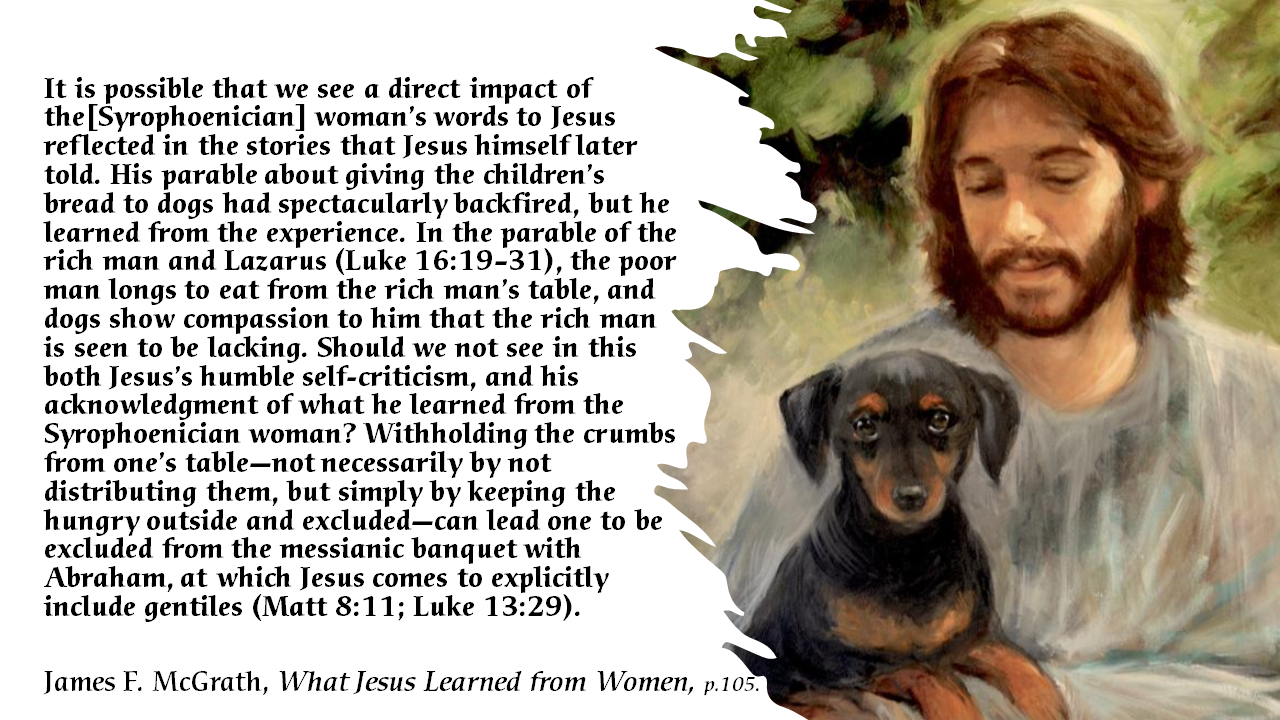
Others have suggested that, because Jesus used the diminutive form of the word for dogs, he meant cute puppies, pets rather than stray mongrels. Perhaps—but that doesn’t eliminate the problem. If someone were to come up to me who belonged to a different national, religious, or other group from me, and asked me for assistance, and I said that helping them would be giving to the household pets what belongs to the children of the household, surely we can agree that it would be insulting, and literally dehumanizing.
How can we make sense of Jesus speaking in this way? I’ve shared why this story is troubling. Now you get to find out why I think the story is crucially important, and why I chose to speak about it today and genuinely believe that you’ll be glad I did.
Despite what you’ll hear in some churches and on some radio stations in the US, sin isn’t just a matter of individual choices and actions performed in complete isolation from everyone else, who in their turn also choose and act in isolation. Sin is a tangled mess of interconnections and interdependencies.
If you watch the TV show The Good Place, it explores this. You can buy someone flowers to make their day brighter, and the underpaid grower, the person who used pesticides to protect them so they look nice, the driver whose truck pollutes the environment, and countless others are involved in those flowers being on sale in the supermarket (and don’t even get me started on the supermarket), in ways that you’d probably never be able to figure out. [The show uses a tomato as an example, but flowers seemed like a better illustration of trying to do something nice for others, since I’d probably want the tomato simply for my own enjoyment. Then again, sometimes the reasons we give flowers make any attempt to evaluate the merit of doing so…complicated]
The Catholic Church has a doctrine that tried to disentangle Jesus from the influence of sin. It is called the Immaculate Conception. Some mistakenly use that to refer to the virginal conception of Jesus, but it is a different doctrine. The Immaculate Conception claims that Mary was conceived without original sin, so that she could avoid passing it on to Jesus. I personally don’t think that works. In my view, sin isn’t just the genetic instincts and impulses that get us into trouble. It is also the tangled web of influences on us, which are an inescapable part of the fabric of human society.
Which brings us to the crucial question: could Jesus have grown up without encountering negative views of other people groups? Even if no others were disparaged, the Canaanites are maligned in the scriptures themselves. Jesus may have heard negative things about Canaanites not from other children playing in the street, but in synagogue, from scripture.
That in turn leads to another question: If it will be rare, and certainly impossible to guarantee, that anyone will grow up never hearing other nationalities insulted at some point, then what is the best we can hope for in the case of Jesus? What does maximal human righteousness look like in the midst of this tangled web of influences, including negative ones?
The answer is in the title of today’s talk: it is openness to learning, to changing our minds. There was no way that Jesus or any of us could have been born into the midst of human society as fully human beings, and yet at the same time be completely isolated from all the biases that are found in every culture, in every group of classmates, in every nation, and in every religion.
The best that a human being can be is open to learning, to overcoming biases that are rooted in our genes and fostered in cultures and communities.
In other words, humanity at its best is humanity open to learning.
I will have more to say about maturity and faith in my next talk. For today, I want to focus on faith and learning, and to continue approaching this topic through the lens of Jesus as learner, as we encounter it in the passages that I’ve chosen for us to explore, but also in the Gospels more generally.
We find it ever so difficult to embrace the fact that Jesus, unless we deny that he was a human being, would have learned. This is so difficult for us that we regularly rewrite what the Gospel of Luke explicitly says about this. It says that Jesus, when he was 12 years old and his family made a visit to Jerusalem, stayed behind in the temple, to be found there later by his parents. He was asking questions, and giving good answers when asked him questions. Despite what you will see in many movies, and in TV shows like The Chosen, according to the Gospel of Luke, Jesus did not take over the role of teacher. He was participating as an exemplary learner. That same Gospel emphasizes the point, that Jesus went home and was obedient to his parents after this incident, and he continued to grow not only in stature but in wisdom. He continued to learn.
As an educator who hopes that my students will learn, and that they will do so not merely in my classes but will become lifelong learners, I am delighted that Jesus provides an example of this, and the story of the Syrophoenician or Canaanite woman is a particularly vivid example.
In the Gospel of Mark, our earliest Gospel, Jesus might well have gone off to the vicinity of Tyre and Sidon on his own. There is no mention of an audience of disciples as the events unfold. We’re not told whose house he was in, but presumably it was someone he knew or had a connection with. The ancient Mediterranean world wasn’t like today where you can fairly easily go somewhere you’ve never been and check into a hotel. Paul in Acts traveled all over and never are we told that he stayed at an inn. We should assume, unless we are told otherwise, that Jesus was relying on accommodation from someone he knew, whether that be a family connection, or someone who had heard him speak and decided to support him and his movement.
Why was Jesus there? I have often assumed, even though the Gospels do not explicitly say it here, that Jesus needed rest. He did not want his presence there to be known. Yet someone found out that he was there, someone who had heard about his renown as a healer. That woman came to plead for mercy for her daughter. Instead of help, she got an insult.
I am sure she was furious. I would have been. Wouldn’t you?
In her determination, and I think also her defiance, but also her wisdom and her motherly concern, she doesn’t scream, nor merely leave disappointed. She sees a weak point in Jesus’ argument about children and dogs, and uses it to make her case.
I think Jesus was impressed. He wasn’t going to heal the woman’s daughter, and because of her persuasive comeback, he changes his mind.
I think this was an important moment in Jesus’ life. Although the Gospel of Matthew places this story after Jesus’ encounter with a centurion, you presumably know that the Gospels do not consistently order things as they happened in the life of Jesus. Logically, Jesus’ experience with the Syrophoenician or Canaanite woman surely came first. Finding himself impressed with the centurion’s faith, he said that people like him would join the Israelite patriarchs at the messianic banquet. Getting crumbs was the first step. Giving them a place at the table was a further step.
Christians regularly talk about Jesus as an example of humility. Yet so often, we avoid the implications of stories in which we see Jesus being humble.
I think it is safe to say that there is no learning without humility. Unless we are open to the possibility that there are things we may be wrong about, or things that we simply do not yet know, then we will not learn. Is the reverse also true? Can we say that there is no humility without learning and changing our minds? Is there any way to foster humility other than by discovering our own limitations and being surprised by the breadth and extent of reality?
So how does this connect with the story of the rich man and Lazarus? Before doing research on the story of the Syrophoenician woman and how it represented a pivotal moment in the life of Jesus, I hadn’t noticed the connections. Listen to the story:
“There was a rich man who was dressed in purple and fine linen and who feasted sumptuously every day. And at his gate lay a poor man named Lazarus, covered with sores, who longed to satisfy his hunger with what fell from the rich man’s table; even the dogs would come and lick his sores. The poor man died and was carried away by the angels to be with Abraham. The rich man also died and was buried. In Hades, where he was being tormented, he lifted up his eyes and saw Abraham far away with Lazarus by his side. He called out, ‘Father Abraham, have mercy on me, and send Lazarus to dip the tip of his finger in water and cool my tongue, for I am in agony in these flames.’ But Abraham said, ‘Child, remember that during your lifetime you received your good things and Lazarus in like manner evil things, but now he is comforted here, and you are in agony. Besides all this, between you and us a great chasm has been fixed, so that those who might want to pass from here to you cannot do so, and no one can cross from there to us.’ He said, ‘Then I beg you, father, to send him to my father’s house— for I have five brothers—that he may warn them, so that they will not also come into this place of torment.’ Abraham replied, ‘They have Moses and the prophets; they should listen to them.’ He said, ‘No, father Abraham, but if someone from the dead goes to them, they will repent.’ He said to him, ‘If they do not listen to Moses and the prophets, neither will they be convinced even if someone rises from the dead.’ ”
Did you notice the points of contact? The person who longs to partake of crumbs from the table? The person who has an abundance yet does not share even that? The dogs who show more mercy than a fellow human being does?
I find it impossible to imagine that Jesus used this imagery without thinking about his experience with the Syrophoenician woman. In this story that Jesus told, we see Jesus exemplifying humility at its most impressive. He has taken what he learned to heart in a way that acknowledges change and growth. There is a strand of self-criticism in the story. Jesus had withheld what he had from someone in need. She had challenged him, and he took it to heart. It became part of his life, his example, and his teaching.
I find that makes the example and teaching of Jesus here more powerful, not less. We’ll come back to the topic of Christology, of how we think about the person of Jesus in light of this, towards the end of this talk. For now, let’s just continue pursuing this thread.
I don’t just want to focus on the story’s connection to Jesus’ experience with the Syrophoenician woman. The story that emerged as a result of that encounter is wonderful just in its own right.
One of my book projects that I’m slowly working on is about humor in the teaching of Jesus. I think there’s more comedy, more irony, more hyperbole in the teaching of Jesus than we tend to realize. Let’s start with this story. We all know it by a name that reflects the first two lines of the story. It is the story of the rich man and Lazarus. That’s already striking in the context of Jesus’ time. Note how we are never told the name of the Syrophoenician woman. Women are regularly left unnamed in the Gospels, as in other ancient literature, reflecting the patriarchal values of that time. There are also lots of stories that neglect to name the poor beggars who appear. Think even of your own experience in the present day, in a cultural context and era in history significantly different from that of Jesus. How many names of rich people do you know? How many names of poor beggars do you know?
The very act of telling a story about a rich man whose name we never learn, and a poor man named Lazarus, already conveys a radical reversal that reflects the values of the kingdom of God that Jesus proclaimed. The last will be first and the first last. The named will be anonymous and the anonymous will have their names remembered.
When they die, Lazarus is taken to the bosom of Abraham. What does that mean? Think of John 1, which mentions the only Son in the bosom of the Father. It means sitting at someone’s right hand, sitting in the place of honor next to them. The rich man, on the other hand, is in agony.
First, we are to notice that the unnamed rich man recognizes Lazarus, and apparently knew his name. He was not unaware of the man’s plight while he was still alive. He simply did not care.
We are also to notice that the rich man doesn’t address Lazarus to ask forgiveness or even to request help. He addresses himself to Abraham, assuming that Lazarus is a servant who can be sent on an errand, rather than an honored guest at the feast.
As we reach the mention of the “great chasm” that separates the rich man from Lazarus and Abraham, this seems a good point to say something about what sort of story we are dealing with. I agree with Kenneth Bailey that this is a “pearly gates story.” The point is not to lay out the groundwork for a systematic theology of rewards and punishment in the afterlife. That isn’t to say that the details are unimportant. On the contrary, in jokes about St. Peter at the pearly gates, the details tend to be very important. So too with the details in Jesus’ story. When we look at them, we’ll see that they serve to make important points, even if they may not be offering us a literal glimpse of the landscape of the afterlife.
Abraham says that the great chasm is there first and foremost to prevent those who might wish to from going to those like the rich man who are in agony. We’re probably supposed to laugh, or at least appreciate the irony. While the rich man had nothing preventing him from offering Lazarus a drop of water to soothe his agony while they were alive, he did not do so. Now, on the other hand, individuals like Abraham and Lazarus would act with compassion even towards the merciless. God needs to actively prevent them from doing so.
Hopefully you can see now why I offered the disclaimer. Is that actually what God does in the afterlife? I doubt it. The point is comedic, even if it is dark comedy. In order for those who were unkind and uncaring towards their fellow human beings in this life to get what they deserve, their victims will need to be physically restrained from acting in the merciful way that they will instinctively want to.
The rich man still doesn’t get the most important points about what has befallen him, and about whom he is dealing with. He still addresses Abraham assuming that Lazarus is a servant that Abraham may order to run errands for him. He asks that Lazarus be sent to his brothers. They presumably had visited and feasted at this rich man’s house, and the story implies in the end that they might recognize Lazarus. At the same time, it implies that they are in the same situation as their now deceased sibling. They are wealthy, and will be held accountable for how they accumulated abundance while others lacked basic necessities.
One key point of the story is that those who have abundance judge the value of other human beings wrongly when we withhold what is in our stockpiles from those who urgently need it. If we are willing to pay attention to our fellow human beings, and treat them with the respect they deserve, we will avoid judgment. Lazarus’ life was a miracle all along. If these siblings could not appreciate the message of his life before he died, they won’t respect him enough to heed a warning from him if he returns from the dead.
Those who have the scriptures have still further information, more than enough to alert us that God cares for the poor and the downtrodden. The central message of the prophets is that God cares passionately about injustice.
Let’s return now to the connections between this story and Jesus’ encounter with the Syrophoenician or Canaanite woman. In the case of the scriptures, there was much that might seem to justify viewing and treating Canaanites with contempt. The overall gist of the scriptures was that the Canaanites were utterly excluded from and unworthy of the blessings that God had for his covenant people. Indeed, the land of the latter was taken from the former. What could be clearer?
The rich man might have said the same about his wealth. Job was righteous and was blessed with abundance. Even if not as exemplary as Job, the man’s wealth was surely indication of divine favor, merited by the man’s righteousness.
We hear what we want to, and conveniently fail to notice what we want to.
In the background to the story of the Syrophoenician woman, we have Jesus’ visit to her part of the world. What was he doing there? I have tended to assume that this was an instance of Jesus needing rest and rejuvenation. The Gospel of Mark says that Jesus didn’t want anyone to know he was there, yet he could not escape notice. [SLIDE 16] Mark 3:8 tells us that people from the region of Tyre and Sidon heard about Jesus and what he was doing. That statement is directly connected with Jesus asking his disciples to have a boat ready so that he would not be crushed by the crowd. It seems logical to surmise that Jesus went as far away as he had connections, seeking respite from the constant demands and physical press of the crowds.
The fatigue of Jesus that we encounter in the Gospels is an important reminder of his humanity for those who might be inclined to forget it.
The creeds tell us that Jesus was fully human and fully God. The Gospels make clear that Jesus was a human being. Yet time and again, because we do not know and cannot hope to fathom how it would work for humanity and divinity to coincide in this human life, we deny aspects of Jesus’ human existence in the interest of safeguarding his divinity. Yet there is no encounter with the divine in and through the life of Jesus except through his human life, or at least there wasn’t for those who followed him, those who met him when he walked the earth. They did not have the option of starting with a doctrine about his divine nature and then trying to crowbar and trim his humanity to somehow make it fit. They encountered a person. We need to allow the Gospels to give us that same kind of experience. If we fail to do so, we undermine one of the historic emphases of Christian discipleship, namely Jesus as example. How often have we excused ourselves from not emulating him by saying, “But he was God?” The Gospels tell us that the incredible life that Jesus lived, he lived as a human being relying on God’s power. Taking the humanity of Jesus seriously, truly seriously, invited and inspires us to do the same.
Tying the threads together, Jesus the lifelong learner is another aspect of his humanity that we are liable to miss if we are trained to read in ways that avoid seeing it, yet if we take it seriously, it becomes a source of inspiration rather than a doctrinal puzzle to be solved.
Jesus had taken to heart the negative statements about Canaanites, the woes against Tyre and Sidon, but not the examples of faith and uprightness among them. The Gospel of Matthew lists Rahab the Canaanite among Jesus’ own ancestors, and also Tamar who is assumed to be Canaanite. By the time that Gospel was written, Jesus’ followers were open to recognizing that Canaanites were part of Jesus’ story and their own.
Also according to the Gospel of Matthew, in 11:21, Jesus made reference to Tyre and Sidon in warning his fellow Galileans:
“Woe to you, Chorazin! Woe to you, Bethsaida! For if the deeds of power done in you had been done in Tyre and Sidon, they would have repented long ago in sackcloth and ashes. But I tell you, on the day of judgment it will be more tolerable for Tyre and Sidon than for you…”
Notice what Jesus says—that if he were to perform miracles in Tyre and Sidon, powerful Canaanite cities, they would have repented, and so they will be judged less harshly than the Jewish towns of Galilee.
Yet having said that, when he goes to the vicinity of Tyre and Sidon, Jesus doesn’t see it as an opportunity for this theoretical statement to become reality. He speaks insultingly about the native inhabitants of that region. Yet one of them pushes back, and it makes a lasting impact on Jesus. It leads him to grant a centurion a place at the table with Abraham. And it leads him to tell a story about the judgment of one who has good things to share and yet withholds even the crumbs from his table. Where once I found this troubling to my doctrine, now I hope and aspire that I might have the humility and the wiliness to learn that I affirmed theoretically about Jesus, yet so often failed to acknowledge in practice.
The story isn’t quite done. How’s this for a happy ending? In Acts 21, as the author recounts Paul’s travels, he writes:
We came in sight of Cyprus, and leaving it on our left, we sailed to Syria and landed at Tyre, because the ship was to unload its cargo there. We looked up the disciples and stayed there for seven days. . Through the Spirit they told Paul not to go on to Jerusalem. When our days there were ended, we left and proceeded on our journey, and all of them, with wives and children, escorted us outside the city. There we knelt down on the beach and prayed and said farewell to one another. Then we went on board the ship, and they returned home.
What disciples in Tyre? Who preached there, and when? Although we should not assume that other things did not happen, the only instance we are explicitly told about, when it comes to spreading the message of the kingdom of God in Tyre and its vicinity, is the story about Jesus’ visit there, coupled with the statement that some from there heard about him and went to see him as he taught and healed in other places.
By Paul’s time, there is a community of disciples. It explicitly mentions families. That’s the fruit of the seeds that were planted by Jesus visiting there, and learning from his encounter with a woman from the region. His interaction with her and his openness to changing his mind made an impression. May the same be true of us, and may we embody that same attitude as we seek to follow Jesus’ teaching and his example in our own lives.
So, to sum up:
I don’t think there is a way to avoid the conclusion that Jesus spoke in a disparaging manner about a people group other than his own.
By taking Jesus’ humanity seriously, including this story, we have a powerful example for ourselves. The best that is possible for human beings is not static perfection from birth but openness to learning.
We see the impact of what Jesus learned from his encounter with the Syrophoenician woman in what he says about and to a centurion, his parable about the rich man and Lazarus, and in the existence of a vibrant community of followers of Jesus in Tyre a couple of decades later.
Catholic
Education and Religion
Previous Post
June 17, 2026
Faith that Lives (Matthew 7:12-29)
Next Post

June 20, 2026 Faith that Lasts (Colossians 1:9-14,24-29)
Recent Comments
"V. good.For me, the gold standard for this sort of thing is still Wikihistory by ..."
The Time-Traveler’s Apprentice (A Short Story)
"The one who says "no one comes to the Father but through me" is the ..."
Attack on Religious Freedom in Indiana
"Until I read, "As a Christian, it is possible but not at all necessary to ..."
Attack on Religious Freedom in Indiana
"Hey James, regarding your penultimate paragraph, I struggle with the same issue. I do think ..."
Browse Our Archives
Select a Category 1 Corinthians 1 John 1 Peter 1 Samuel 1 Thessalonians 1 Timothy 2 Corinthians 2 Kings 2 Peter 2 Samuel 2 Thessalonians 2 Timothy academia Acts of the Apostles afterlife Akhaten Alcatraz American Academy of Religion Amos Anglican Arabic Aramaic archaeology art artificial intelligence astronomy atheism atonement Babylon 5 Baptists Battlestar Galactica Bible Biblical Studies Carnival biblioblogging Black Mirror Blade Runner Book of Job book review Buddhism Call for Papers China Christianity Christmas Christology Chronicles Coptic creation Daniel Deuteronomy Doctor Who Dune Easter Ecclesiastes economics education Eldad Keynan Enoch Seminar Ephesians eschatology Esther Evangelicals evolution Exodus Expanse Ezekiel Ezra fantasy Fringe fundamentalism Galatians games Ge'ez genealogy Genesis Gnosticism Gospel of Jesus' Wife Gospel of John Gospel of Judas Gospel of Luke Gospel of Mark Gospel of Matthew Gospel of Peter Gospel of Thomas Greek Harry Potter Hebrew Hebrews Hinduism historical Jesus history Hitchhiker's Guide to the Galaxy Holidays horror Hosea humor incarnation India inerrancy information literacy inspirational Intelligent Design Ireland Isaiah Islam Israel Italy James Jeremiah John the Baptist Jonah Joshua Judaism Jude Judges Judith Lamentations languages Latin Leviticus libraries literature Lord of the Rings LOST Mandaeans Mandaic memes Methodism Micah monotheism morality Mormons movies music mythicism NASSCAL Nehemiah new perspective New Testament news Numbers Orthodox paganism panentheism pantheism Patheos Paul and his letters Pentecostals Philippians Philippians 2:6-11 philosophy physics Planet of the Apes podcast politics Progressive Christianity Protestantism Proverbs Psalms pseudoscience racism religion Revelation Roman Catholicism Romania Romans Ruth scams science science fiction Secret Gospel of Mark Society of Biblical Literature Song of Songs Star Trek Star Wars Stargate Swahili Syriac Taoism technology Terminator The Handmaid's Tale The Hobbit The Matrix theodicy theology theory Timeless Titus tomb Torchwood travel TRON Uncategorized United Kingdom Westworld X-Files young-earth creationism Zechariah
Select a Month October 2026 September 2026 August 2026 July 2026 June 2026 May 2026 April 2026 March 2026 February 2026 January 2026 December 2025 November 2025 October 2025 September 2025 July 2025 June 2025 May 2025 April 2025 March 2025 February 2025 January 2025 December 2024 November 2024 October 2024 September 2024 August 2024 July 2024 June 2024 May 2024 April 2024 March 2024 February 2024 January 2024 December 2023 November 2023 October 2023 September 2023 August 2023 July 2023 May 2023 April 2023 March 2023 February 2023 January 2023 December 2022 November 2022 October 2022 September 2022 August 2022 July 2022 June 2022 May 2022 April 2022 March 2022 February 2022 January 2022 December 2021 November 2021 October 2021 September 2021 August 2021 July 2021 June 2021 May 2021 April 2021 March 2021 February 2021 January 2021 December 2020 November 2020 October 2020 September 2020 August 2020 July 2020 June 2020 May 2020 April 2020 March 2020 February 2020 January 2020 December 2019 November 2019 October 2019 September 2019 August 2019 July 2019 June 2019 May 2019 April 2019 March 2019 February 2019 January 2019 December 2018 November 2018 October 2018 September 2018 August 2018 July 2018 June 2018 May 2018 April 2018 March 2018 February 2018 January 2018 December 2017 November 2017 October 2017 September 2017 August 2017 July 2017 June 2017 May 2017 April 2017 March 2017 February 2017 January 2017 December 2016 November 2016 October 2016 September 2016 August 2016 July 2016 June 2016 May 2016 April 2016 March 2016 February 2016 January 2016 December 2015 November 2015 October 2015 September 2015 August 2015 July 2015 June 2015 May 2015 April 2015 March 2015 February 2015 January 2015 December 2014 November 2014 October 2014 September 2014 August 2014 July 2014 June 2014 May 2014 April 2014 March 2014 February 2014 January 2014 December 2013 November 2013 October 2013 September 2013 August 2013 July 2013 June 2013 May 2013 April 2013 March 2013 February 2013 January 2013 December 2012 November 2012 October 2012 September 2012 August 2012 July 2012 June 2012 May 2012 April 2012 March 2012 February 2012 January 2012 December 2011 November 2011 October 2011 September 2011 August 2011 July 2011 June 2011 May 2011 April 2011 March 2011 February 2011 January 2011 December 2010 November 2010 October 2010 September 2010 August 2010 July 2010 June 2010 May 2010 April 2010 March 2010 February 2010 January 2010 December 2009 November 2009 October 2009 September 2009 August 2009 July 2009 June 2009 May 2009 April 2009 March 2009 February 2009 January 2009 December 2008 November 2008 October 2008 September 2008 August 2008 July 2008 June 2008 May 2008 April 2008 March 2008 February 2008 January 2008 December 2007 November 2007 October 2007 September 2007 August 2007 July 2007 June 2007 February 2007 January 2001
Follow Us!
TAKE THE
Religious Wisdom Quiz
Who received the Ten Commandments from God?
Select your answer to see how you score.
Aaron Joshua Abraham Moses
Books by This Author Books by James F. McGrath
Related posts from Religion Prof: The Blog of James F. McGrath

Religion Prof: The Blog of James F. McGrath

AI Syllabus Statements You Can Steal for Your...
Religion Prof: The Blog of James F. McGrath

Was the "Sinful Woman" in Luke Really a...
Religion Prof: The Blog of James F. McGrath
Faith that Lasts (Colossians 1:9-14,24-29)
Religion Prof: The Blog of James F. McGrath
TRENDING AT PATHEOS Progressive Christian

I was strolling through the top floor of the brand new Parthenon...

What Does Gêvâh Mean For Kimberley Guifoyle &...
This week, a lot of the news is focused on Kimberly Guilfoyle....

INNER CIRCLE: Profound Mystery (Of Christ In All...
Ephesians 5:31-32 “For this reason, a man will leave his father and...

Do Not Rejoice When Your Enemy Falls: The...
Turning an execution into a public spectacle is a disturbing expression of...

'The Chosen' S6 Trailer: The Passion Gets Very...
Not many watching 'The Chosen' worry about spoilers, but just because they...

The purpose-driven labor priest
A labor activist reads Rick Warren and it gets me wondering about...
view all Progressive Christian blogs
What Are Your Thoughts?leave a comment
Ad-Free & Subscriber Log-In Subscription Support
- About Us
- 2026 Calendar
- Videos
- Podcasts
- Library of World Religions
- Faith In Media Tracker
- Advertise With Us
- Write for Us
- Privacy Policy
- Terms of Service
- Do Not Sell My Data
- Contact Us
- Radiant Digital
- Manage Newsletter Subscriptions
- Unsubscribe From Notifications
- Sitemap
Copyright 2008-2026, Patheos. All rights reserved.
Subscription Support Ad-Free & Subscriber Log-In
Follow Patheos