
BuddhistCatholicContemplativeEvangelicalGeneral ChristianHinduJewishLatter-day SaintMuslimNew VisionsProgressive Christian
Beliefs
- Buddhist
- Catholic
- Contemplative
- Evangelical
- General Christian
- Hindu
- Jewish
- Latter-day Saint
- More Voices
- Muslim
- New Visions
- Pagan
- Progressive Christian
Topics
- Religion News
- Food and Religion
- Sports and Religion
- Religious Art
- Religious Music and Entertainment
- Religious Events
- History and Religion
- Style and Religion
- Politics and Religion
- Women in Religion
- Recreation Outdoors and Religion
- Business Finance and Religion
- Careers Workplace and Religion
- Education and Religion
- Family Parenting and Religion
- Health Fitness and Religion
- Home and Religion
- Relationships and Religion
- Technology and Religion
- Travel and Religion
Columnists
- Buddhist Columnists
- Business Finance and Religion Columnists
- Careers Workplace and Religion Columnists
- Catholic Columnists
- Contemplative Columnists
- Education and Religion Columnists
- Evangelists Columnists
- Family Parenting and Religion Columnists
- General Christian Columnists
- Health Fitness and Religion Columnists
- Hindu Columnists
- History and Religion Columnists
- Home and Religion Columnists
- Jewish Columnists
- More Voices Columnists
- Latter Day Columnists
- Muslim Columnists
- New Visions Columnists
- Nonreligious Columnists
- Pagan Columnists
- Politics and Religion Columnists
- Progressive Columnists
- Recreation Outdoors and Religion Columnists
- Relationships and Religion Columnists
- Religion News Columnists
- Religious Art Columnists
- Religious Events Columnists
- Religious Music and Entertainment Columnists
- Sports and Religion Columnists
- Style and Religion Columnists
- Technology and Religion Columnists
- Travel and Religion Columnists
- Women in Religion Columnists
Resource Library
- 2026 Calendar
- Library of World Religions
- The 100 Most Holy Places on Earth
- Patheos Answers
- Podcasts
- Videos
- Faith Leaders Database
- Anglican Episcopalian
- Bahai
- Baptist
- Buddhism
- Christianity
- Confucianism
- Eastern Orthodoxy
- Hinduism
- Holiness and Pentecostal
- ISKCON
- Islam
- Judaism
- Lutheran
- Methodist
- The Church of Jesus Christ of Latter-day Saints
- New Age
- Paganism
- Presbytarian and Reformed
- Protestantism
- Religion Behind the Scenes
- Roman Catholic
- Scientology
- Shia Islam
- Sikhism
- Sufism
- Sunni Islam
- Taoism
- Zen
- See all religions
Research Tools
 Ad-Free & Subscriber Log-In Subscription Support
Ad-Free & Subscriber Log-In Subscription Support
Follow Patheos 

- Trending:
- Forgiveness
- |
- Marriage
- |
- Consciousness
- |
- Death Penalty
- |
- Election
- |
- Halloween

- Home
- About Dr. James F. McGrath
- Publications
- Blogroll
- Useful Websites
- Connections
- Easy Search Posts Page
- FREE NEWSLETTER
- Home
- Progressive Christian
- Education and Religion
- Faith that Lasts (Colossians 1:9-14,24-29)
Faith that Lasts (Colossians 1:9-14,24-29)
Last updated on: June 20, 2026 at 8:49 am by James F. McGrath
Faith that Lasts (Colossians 1:9-14,24-29) 2026-06-19T13:08:00-04:00 James F. McGrath
Patheos Explore the world's faith through different perspectives on religion and spirituality! Patheos has the views of the prevalent religions and spiritualities of the world.
Faith that Lasts (Colossians 1:9-14,24-29)
The third in my series of Faith for Living talks at Lakeside Chautauqua, June 2026
For this reason, since the day we heard it, we have not ceased praying for you and asking that you may be filled with the knowledge of God’s will in all spiritual wisdom and understanding, so that you may walk worthy of the Lord, fully pleasing to him, as you bear fruit in every good work and as you grow in the knowledge of God. May you be made strong with all the strength that comes from his glorious power, so that you may have all endurance and patience, joyfully giving thanks to the Father, who has enabled you to share in the inheritance of the saints in the light. He has rescued us from the power of darkness and transferred us into the kingdom of his beloved Son, in whom we have redemption, the forgiveness of sins…
I am now rejoicing in my sufferings for your sake, and in my flesh I am completing what is lacking in Christ’s afflictions for the sake of his body, that is, the church. I became its minister according to God’s commission that was given to me for you, to make the word of God fully known, the mystery that has been hidden throughout the ages and generations but has now been revealed to his saints. To them God chose to make known how great among the gentiles are the riches of the glory of this mystery, which is Christ in you, the hope of glory. It is he whom we proclaim, warning everyone and teaching everyone in all wisdom, so that we may present everyone mature in Christ. For this I toil and strive with all the energy that he powerfully inspires within me.
As a New Testament scholar, and one who works on Christology as a major research area, it is very unusual, and took a significant amount of effort on my part, to skip Colossians 1:15-20 and focus instead on what comes before and after it. That passage is one of those Christological hymns or poems that academics love to write articles and even whole books about. “He is the image of the invisible God, the firstborn of all creation…” Yet Paul never quotes poems or hymns, or creates ones of his own, just because he’s feeling poetic. Like preachers nowadays, if he quotes a song or something else familiar, it will typically be to help reinforce a point in the sermon. Paul often digs into doctrinal explorations, but eventually he gets back to being practical, often transitioning with a “therefore.” (As an aside, the New International Version has three “therefores” in Colossians, in 2:16, 3:5, and 3:12. There are also “for this reason” and other similar statements.) I was taught in Bible college that whenever there’s a therefore, you have to explain what the therefore is there for. And so in this talk, rather than wrestle with a difficult text that even mature Christians struggle with at times, I want to explore what is written before and after, which has a lot to say about reaching the point where we might just possibly be ready to wrestle with those more advanced poetic passages. The hymn or poem, as important as it is, is there to provide a basis for practical instruction.
While all across the Christian tradition one can find references to a mature faith, there are some individuals and communities that don’t seem to really mean it. Or at the very least, they seem not to have thought it through.
I’ve titled this talk “Faith that Lasts” because like with human beings, like with trees, even with objects like cars and houses, something or someone that remains unchanging is either dead or headed for obsolescence. A vintage car or antiquated home with no modern heating and cooling will certainly be interesting, but it won’t meet your needs. And if a tree isn’t still growing, it’s dead or will be soon. Life is not static. Life is vibrant and dynamic. A living faith needs to have those characteristics as well. The kind of faith that lasts is a living faith. And I will add that just as the kind of vine or tree that bears fruit is a living plant, Christians are called to bear fruit, and that requires a faith that is growing. One that is stagnant is dying or will be soon, and that isn’t just an unhealthy situation to be in for an organism, it is also one that will not lead to fruitfulness. (I will have you know that I climbed up our sour cherry tree just a few days ago in order to conduct practical research to verify what I planned to tell you today!)
So what are the stages of human maturation, and do they have parallels in our journeys of faith? I believe the answer is yes. The famous United Methodist minister James Fowler famously outlined “stages of faith” that were informed by theology as well as what human psychology tells us. His work builds in particular on the work of Jean Piaget about children’s development more generally. This isn’t a lecture about child development or cognitive psychology. I am sure there will be other speakers for whom that is their specialty, and I leave it to them. Yet I want to relate what I do in my own area of expertise to what others do in their respective fields. What I bring to this topic of mature faith is, on the one hand, close examination of the relevant biblical texts, and on the other hand, longstanding involvement in education in both church and university settings.
For many of us, perhaps most or indeed all of us, our journey of faith begins before we remember. Working out what is happening in the minds of children is challenging, precisely because words are only as useful as our ability to communicate, the clarity of our concepts, and the correspondence of our concepts. We can set some of those challenges aside and start at the point at which we begin to think of childlike faith. Jesus said to become like children. He never actually mentions “childlike faith.” He never said that we are to become like children with respect to our faith. That doesn’t mean that we can stop here and be done with this topic. But let’s start with what Jesus actually said. Each of the three Gospels known as the Synoptic Gospels says something on the topic. If the Gospel of John’s statements about being born again are a variation on the same teaching of Jesus, then that too could be included. But let’s stick with Matthew Mark and Luke. [SLIDE 7] Matthew 18:3, Mark 10:14, and Luke 18:17 offer us the following:
“Truly I tell you, unless you change and become like children, you will never enter the kingdom of heaven.”
“Let the children come to me; do not stop them, for it is to such as these that the kingdom of God belongs.”
“Truly I tell you, whoever does not receive the kingdom of God as a little child will never enter it.”
Before we get to childlike faith, we should ask whether receiving the kingdom as (or like) a child is about “childlike faith,” and whether changing and becoming like children is about “childlike faith.” The answer is: probably not. I say that because we do not find ancient authors paying attention to how children perceive and understand things. Of course, as I’ve already mentioned in talks that I’ve given this week, Jesus often said things that were surprising and unconventional. I’m not saying that Jesus could not have said something because others did not say it. My point is that, if Jesus were drawing attention to an aspect of childhood that others would not have thought of and paid attention to, he would have been specific and made that clear. Otherwise he would have been misunderstood.
Children were without status, even though when they became adults they would (if all went well) have the same status as their parents. It is because children were not valued in and of themselves that the disciples objected to parents bringing children to Jesus. Jesus’ response was striking, and it wasn’t until I happened to read one of these passages in Greek and look up the word that it struck me. Many translations mention Jesus taking a child in his arms. I had envisaged Jesus taking a baby and holding it up as an illustration. But the word used more likely envisages a hug. Jesus indicated that those whom society fails to value and respect are those who will literally inherit the world, and this provided a powerful analogy to the way that those whom society disregards and marginalizes will inherit the kingdom of God.
That Jesus’ point about becoming like children, and children inheriting the kingdom, was not primarily about “childlike faith” does not mean that that is irrelevant. The faith of the poor, the outcast, and the child are at least implicitly the best perspectives to have on the coming kingdom. And so even if Jesus’ sayings about children were not focused on their faith, it is still worth paying attention to.
So what are we usually told about “childlike faith,” and is it plausible? Have you heard, as I have, that children supposedly believe what they are told without questioning, and that is the kind of faith we are supposed to have even as adults?
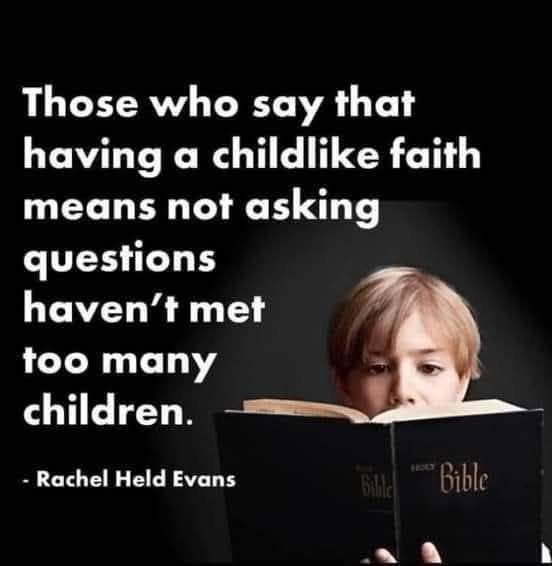 I think those who say that must never have had children.
For those of us who have, the opposite is what we associate with childhood. “Why?” We answer. “But why?” We go a step further. “But why?” The curiosity and questioning of children exceed the limits of parental patience, and we typically stop answering before children stop asking “why.”
What would it be like to have, to value, and to foster faith like that? Faith that is curious and inquisitive? Faith that when it comes to maturity, if we do not squelch it along the way, becomes the basis for science and for other forms of investigation and discovery?
There is a way of being childlike that is not incompatible with becoming mature. It is possible to become a fully mature individual, able to cope with the complexity of reality, and yet keep alive that childlike inquisitiveness.
Perhaps a useful way of making the distinction is between childlike faith and childish faith.
This is where Fowler’s work seems particularly relevant. The mythic-literal phase is the second of six stages that Fowler identifies. Until you get to the fourth of the stages he identifies, you aren’t in the realm of maturity. And so it is striking that something that Fowler identifies as immature is so popular.
Not that anyone is actually a literalist. I always bristle when journalists or others describe narrow religionists as “biblical literalists.” All you have to do is ask them about the dome in the Genesis creation story, Paul’s statements that we believe with our hearts rather than our brains, or Jesus’ statement in the Gospel of Luke that no one can be his disciple unless they give up all their possessions, and it quickly becomes clear that there are only selective literalists. They may criticize others for “picking and choosing.” That doesn’t mean that they don’t do it. To recognize the disconnects between a package we inherited and what we actually believe and do is precisely the sort of thing that maturity entails.
But before we get to maturity, we hit adolescence. Adolescent faith is not mature faith. It is a necessary phase, and not everyone experiences adolescence in the same ways, nor do we all exemplify the stereotypical characteristics to the same extent. There may be elements of rebellion against things we were told, dogmatism about our new convictions, rejection of childlike curiosity, and a self-consciousness about how others perceive us that interferes with exploration and learning. A narrowing of our horizons is the result. Often the greater the extent to which appeals to authority were used to get us to comply and conform when we were young, the more likely we are to rebel and become defiant as adolescents.
Adolescence can be traumatic, and it is a problematic phase to get stuck, but this stage in our development is a necessary and hopefully ends up being a positive one, once we move beyond it. It contributes skepticism that, as part of a balanced approach to life and faith, has not merely a positive role to play, but a crucially important one.
I often tell my students that there is no requirement that they change their minds in my classes. They don’t have to reject and abandon the beliefs they inherited. What I do expect is that they cease to be assumptions they inherited. If they still hold to them, I want them to be conclusions, convictions they hold to not based on tradition or someone else’s authority, but their own investigation. I want them to look at the evidence for themselves and draw their own conclusions, whether the conclusions be what they already assumed or something very different.
Skepticism emerges as we reach the phase of adolescence. Doubt and skepticism are often characterized as antithetical to faith. I’d like to suggest that they are necessary to faith and can be expressions of a healthy faith.
Now being partway through the third talk in a series titled “Faith for Living,” with each of my talks mentioning “faith,” it is kind of late in the process to define faith! We did explore this a little bit, as we thought about Abraham as an example of faith in the primary sense of that term when it occurs in the Bible. He is an example of faith not in the sense that he affirmed a creed or particular doctrines, but in the sense that he had faith in God, that is to say, he trusted God.
Trust is the key component, but we can think of faith as something deeper and broader even than trust. Faith can also denote that which we focus our lives on and revolve our lives around. Theologian Paul Tillich called this “ultimate concern.”
When our faith is in God in that sense, when seeking God is the center of our lives and our beings, that around which everything else revolves, then doubt is not antithetical to that. On the contrary, because God defies our human ability to comprehend and describe, and yet so many people offer conflicting claims about what God is like and what God wants, we have no choice but to evaluate, to investigate. Even when others aren’t trying to deceive us, we human beings are notoriously prone to deceiving ourselves. Doubt and skepticism are tools without which we are far more likely to fall into error and delusion.
Let me make this point again so that it isn’t missed. If knowing God and drawing closer to God are your top priority, then doubt and skepticism are not antithetical to that, but crucial expressions of that. Without doubt, we may never realize when our trust is misplaced, our confidence misguided and based on something flimsy.
My last book is titled Beyond Deconstruction. The term “deconstruction” was once a technical term in philosophy and the study of literature, but it has come to have a popular use in reference to this adolescent phase of faith. Adolescence is when we start to doubt, not usually because we realize that this has a healthy role to play in our development, but because the authorities that we once trusted have shown their fallibility, their humanness.
If your trust was in a preacher or a sacred text that you thought was inerrant, then the discovery that what you had been told was divine is in fact merely human can be extremely traumatic.
To be clear, this stage in faith development doesn’t have to be traumatic. It is only when we have been explicitly reassured that our worldview (religious, cultural, political, moral, whatever) is perfect, that the discovery of imperfection leads to a crisis of faith. When we don’t have that added layer of dogmatic deception involved, discovering that our parents are human beings like us may initially cause us dismay and then rebellion, but eventually we realize that their fallibility doesn’t mean that they were not wise. Parental fallibility doesn’t mean that everything our parents said was wrong, much less that we will come to better conclusions than they did.
I am reminded of a bit of humor that is relevant to faith development. I mentioned Fowler’s stages of faith, and some of you had already heard of that. How many of you know the four stages of life, sometimes referred to as the four stages of Santa?
Stage one, you believe in Santa Claus. You accept the story you’ve been told. You inhabit the reality expressed through the story.
Stage two, you don’t believe in Santa. You spotted the fake beard. You noticed the one at the mall doesn’t look like the one who showed up at home. You spot your parents putting the gifts under the tree. You go from shock and horror that a story you believed to be literally true is not, to pride in having seen through lies and outgrown fairytales.
That third stage is an important one as it pertains to development of mature faith. In stage three, you are Santa Claus. Having gone from naïve belief to adolescent disbelief, many of us then step into the role of appreciating the magic of telling the stories and playing the role in relation to our own children.
The French philosopher Paul Ricoeur talks about reaching a “second naiveté.” Having believed fairy tales and then disbelieved them, we can come to appreciate them as story despite being aware that they are not literally true.
With respect to faith, and the relationship between faith and sacred texts, it is not the case that the entire Bible turns out to be like fairy stories and fables. The Bible is a much more complex and multifaceted anthology than that. It has songs, biography, poetry, parable, and much else. To be able to accept that the Bible is not all one thing is part of reaching a level of mature faith.
Being able to appreciate that there is truth even in stories that are not about historical events is also part of reaching a mature faith.
For many mature Christians, the story of Jesus becomes one that we love, we choose to inhabit, and we stake our lives on, not because we know it is factual in all its details, but because its significance and its power is clear even in those moments when we cannot prove or disprove factuality. The historicity of the detail is uncertain. The significance, the profound importance, is clear nonetheless.
So what’s the fourth phase of Santa? It’s looking like Santa. My dad certainly got to that point, and there’s a reasonable chance that I may too. But for now, I’m happy not to rush to the final phase in that particular journey.
 When we look at descriptions of the stages of faith such as those outlined by James Fowler, we all have a tendency to look at the most mature or advanced stages and persuade ourselves that we have reached them. Yet Fowler was emphatic that we tend to overestimate where we are on the spectrum, and that most people never reach the sixth and final phase that he outlined.
That phase involves more than looking like Santa. It is beyond merely recognizing that reality may be paradoxical and that we will never tie up all loose ends. Fowler’s final stage is when we serve others without worrying about what we can pin down cognitively. It is when we are ready for radical self-sacrifice.
There’s a sense in which that is well summed up by looking like Santa, if we aren’t focused on mere outward resemblance.
In a Christian context, it is even better summed up in terms of looking like Jesus, “being conformed to his image.”
When Paul talks about the end goal of the spiritual formation that he sought to foster in the churches he founded or was connected with, being conformed to the image of Christ features prominently. That’s why he quotes a hymn or poem about Christ as the image of God.
You may have noticed that I haven’t talked too much about the passage in Colossians since introducing the topic of this talk. I’ve been building up to this point deliberately, and so now having thought about the journey of faith and the goal of spiritual maturity, let’s hear the scripture reading again, and notice key points:
For this reason, since the day we heard it, we have not ceased praying for you and asking that you may be filled with the knowledge of God’s will in all spiritual wisdom and understanding, so that you may walk worthy of the Lord, fully pleasing to him, as you bear fruit in every good work and as you grow in the knowledge of God. May you be made strong with all the strength that comes from his glorious power, so that you may have all endurance and patience, joyfully giving thanks to the Father, who has enabled you to share in the inheritance of the saints in the light. He has rescued us from the power of darkness and transferred us into the kingdom of his beloved Son, in whom we have redemption, the forgiveness of sins…
I am now rejoicing in my sufferings for your sake, and in my flesh I am completing what is lacking in Christ’s afflictions for the sake of his body, that is, the church. I became its minister according to God’s commission that was given to me for you, to make the word of God fully known, the mystery that has been hidden throughout the ages and generations but has now been revealed to his saints. To them God chose to make known how great among the gentiles are the riches of the glory of this mystery, which is Christ in you, the hope of glory. It is he whom we proclaim, warning everyone and teaching everyone in all wisdom, so that we may present everyone mature in Christ. For this I toil and strive with all the energy that he powerfully inspires within me.
Some key points to note:
The authors of the letter have been praying that the recipients be filled with the knowledge of God’s will in all spiritual wisdom. When we are immature, we seek knowledge so that we may be proud about and confident in our own understanding. Here the point of knowledge and wisdom is walking worthily and bearing good fruit. How? When? As we grow in the knowledge of God. Last time we focused on learning. This time we’re focused on growing. The two are inseparable, and are crucial to a faith that lasts.
There is also a prayer or wish that the recipients be made strong. Here too, the immature can be competitive. Who is the strongest? The point of the strength, according to Colossians, is that we may have endurance and patience, and joyfully give thanks.
There has been extensive debate about the reference to completing what is lacking in Christ’s sufferings. It is an astonishing statement, and I suspect that those who composed the letter expected that reaction. It is intentional. The point is surely that, no matter how sufficient the sufferings of Jesus might be in accomplishing God’s plan, if the process stops there, so does the growth, so does the fruit.
The image of the church as the body of Christ is explicitly mentioned, and is the crucial background. There is no avoiding suffering. We either experience growing pains, or the pains of degeneration as growth has stopped and our bodies wear out. We are called to participate in growth, in life, with the suffering that comes with it. This is the point of the toiling, the striving, and the teaching.
That’s the reason for choosing the three topics that I did for my series of talks. I love alliteration when it works, but I looked for words that not only resonate in their sound but together connect and convey what we are called to. Whether we are thinking about our individual lives, our families, faith communities, our towns and cities, our countries, or our world, trying to keep things as they have always been is impossible, but to the extent we succeed, we are embracing death rather than life. The vibrant process of living does not require us to abandon all that we were, just to embrace change and recognize that our futures build on our pasts, but are not simply our pasts with nothing new. Or at least, ideally they shouldn’t be.
General Christian
Education and Religion
Family, Parenting and Religion
Previous Post
June 18, 2026
Faith that Learns (Mark 7:24-31; Luke 16:19-31)
Next Post
June 24, 2026 The Murder of the Beloved Son
Recent Comments
"V. good.For me, the gold standard for this sort of thing is still Wikihistory by ..."
The Time-Traveler’s Apprentice (A Short Story)
"The one who says "no one comes to the Father but through me" is the ..."
Attack on Religious Freedom in Indiana
"Until I read, "As a Christian, it is possible but not at all necessary to ..."
Attack on Religious Freedom in Indiana
"Hey James, regarding your penultimate paragraph, I struggle with the same issue. I do think ..."
Browse Our Archives
Select a Category 1 Corinthians 1 John 1 Peter 1 Samuel 1 Thessalonians 1 Timothy 2 Corinthians 2 Kings 2 Peter 2 Samuel 2 Thessalonians 2 Timothy academia Acts of the Apostles afterlife Akhaten Alcatraz American Academy of Religion Amos Anglican Arabic Aramaic archaeology art artificial intelligence astronomy atheism atonement Babylon 5 Baptists Battlestar Galactica Bible Biblical Studies Carnival biblioblogging Black Mirror Blade Runner Book of Job book review Buddhism Call for Papers China Christianity Christmas Christology Chronicles Coptic creation Daniel Deuteronomy Doctor Who Dune Easter Ecclesiastes economics education Eldad Keynan Enoch Seminar Ephesians eschatology Esther Evangelicals evolution Exodus Expanse Ezekiel Ezra fantasy Fringe fundamentalism Galatians games Ge'ez genealogy Genesis Gnosticism Gospel of Jesus' Wife Gospel of John Gospel of Judas Gospel of Luke Gospel of Mark Gospel of Matthew Gospel of Peter Gospel of Thomas Greek Harry Potter Hebrew Hebrews Hinduism historical Jesus history Hitchhiker's Guide to the Galaxy Holidays horror Hosea humor incarnation India inerrancy information literacy inspirational Intelligent Design Ireland Isaiah Islam Israel Italy James Jeremiah John the Baptist Jonah Joshua Judaism Jude Judges Judith Lamentations languages Latin Leviticus libraries literature Lord of the Rings LOST Mandaeans Mandaic memes Methodism Micah monotheism morality Mormons movies music mythicism NASSCAL Nehemiah new perspective New Testament news Numbers Orthodox paganism panentheism pantheism Patheos Paul and his letters Pentecostals Philippians Philippians 2:6-11 philosophy physics Planet of the Apes podcast politics Progressive Christianity Protestantism Proverbs Psalms pseudoscience racism religion Revelation Roman Catholicism Romania Romans Ruth scams science science fiction Secret Gospel of Mark Society of Biblical Literature Song of Songs Star Trek Star Wars Stargate Swahili Syriac Taoism technology Terminator The Handmaid's Tale The Hobbit The Matrix theodicy theology theory Timeless Titus tomb Torchwood travel TRON Uncategorized United Kingdom Westworld X-Files young-earth creationism Zechariah
Select a Month October 2026 September 2026 August 2026 July 2026 June 2026 May 2026 April 2026 March 2026 February 2026 January 2026 December 2025 November 2025 October 2025 September 2025 July 2025 June 2025 May 2025 April 2025 March 2025 February 2025 January 2025 December 2024 November 2024 October 2024 September 2024 August 2024 July 2024 June 2024 May 2024 April 2024 March 2024 February 2024 January 2024 December 2023 November 2023 October 2023 September 2023 August 2023 July 2023 May 2023 April 2023 March 2023 February 2023 January 2023 December 2022 November 2022 October 2022 September 2022 August 2022 July 2022 June 2022 May 2022 April 2022 March 2022 February 2022 January 2022 December 2021 November 2021 October 2021 September 2021 August 2021 July 2021 June 2021 May 2021 April 2021 March 2021 February 2021 January 2021 December 2020 November 2020 October 2020 September 2020 August 2020 July 2020 June 2020 May 2020 April 2020 March 2020 February 2020 January 2020 December 2019 November 2019 October 2019 September 2019 August 2019 July 2019 June 2019 May 2019 April 2019 March 2019 February 2019 January 2019 December 2018 November 2018 October 2018 September 2018 August 2018 July 2018 June 2018 May 2018 April 2018 March 2018 February 2018 January 2018 December 2017 November 2017 October 2017 September 2017 August 2017 July 2017 June 2017 May 2017 April 2017 March 2017 February 2017 January 2017 December 2016 November 2016 October 2016 September 2016 August 2016 July 2016 June 2016 May 2016 April 2016 March 2016 February 2016 January 2016 December 2015 November 2015 October 2015 September 2015 August 2015 July 2015 June 2015 May 2015 April 2015 March 2015 February 2015 January 2015 December 2014 November 2014 October 2014 September 2014 August 2014 July 2014 June 2014 May 2014 April 2014 March 2014 February 2014 January 2014 December 2013 November 2013 October 2013 September 2013 August 2013 July 2013 June 2013 May 2013 April 2013 March 2013 February 2013 January 2013 December 2012 November 2012 October 2012 September 2012 August 2012 July 2012 June 2012 May 2012 April 2012 March 2012 February 2012 January 2012 December 2011 November 2011 October 2011 September 2011 August 2011 July 2011 June 2011 May 2011 April 2011 March 2011 February 2011 January 2011 December 2010 November 2010 October 2010 September 2010 August 2010 July 2010 June 2010 May 2010 April 2010 March 2010 February 2010 January 2010 December 2009 November 2009 October 2009 September 2009 August 2009 July 2009 June 2009 May 2009 April 2009 March 2009 February 2009 January 2009 December 2008 November 2008 October 2008 September 2008 August 2008 July 2008 June 2008 May 2008 April 2008 March 2008 February 2008 January 2008 December 2007 November 2007 October 2007 September 2007 August 2007 July 2007 June 2007 February 2007 January 2001
Follow Us!
TAKE THE
Religious Wisdom Quiz
What does the name "Elijah" mean?
Select your answer to see how you score.
God Saves God Provides The Chosen One The Lord is my God
Books by This Author Books by James F. McGrath
Related posts from Religion Prof: The Blog of James F. McGrath

AI Syllabus Statements You Can Steal for Your...
Religion Prof: The Blog of James F. McGrath
Faith that Learns (Mark 7:24-31; Luke 16:19-31)
Religion Prof: The Blog of James F. McGrath
Faith that Lives (Matthew 7:12-29)
Religion Prof: The Blog of James F. McGrath
Insights from Project Hail Mary
Religion Prof: The Blog of James F. McGrath
TRENDING AT PATHEOS Progressive Christian

I was strolling through the top floor of the brand new Parthenon...

What Does Gêvâh Mean For Kimberley Guifoyle &...
This week, a lot of the news is focused on Kimberly Guilfoyle....

INNER CIRCLE: Profound Mystery (Of Christ In All...
Ephesians 5:31-32 “For this reason, a man will leave his father and...

Do Not Rejoice When Your Enemy Falls: The...
Turning an execution into a public spectacle is a disturbing expression of...

'The Chosen' S6 Trailer: The Passion Gets Very...
Not many watching 'The Chosen' worry about spoilers, but just because they...

The purpose-driven labor priest
A labor activist reads Rick Warren and it gets me wondering about...
view all Progressive Christian blogs
What Are Your Thoughts?leave a comment
Ad-Free & Subscriber Log-In Subscription Support
- About Us
- 2026 Calendar
- Videos
- Podcasts
- Library of World Religions
- Faith In Media Tracker
- Advertise With Us
- Write for Us
- Privacy Policy
- Terms of Service
- Do Not Sell My Data
- Contact Us
- Radiant Digital
- Manage Newsletter Subscriptions
- Unsubscribe From Notifications
- Sitemap
Copyright 2008-2026, Patheos. All rights reserved.
Subscription Support Ad-Free & Subscriber Log-In
Follow Patheos