
BuddhistCatholicContemplativeEvangelicalGeneral ChristianHinduJewishLatter-day SaintMuslimNew VisionsProgressive Christian
Beliefs
- Buddhist
- Catholic
- Contemplative
- Evangelical
- General Christian
- Hindu
- Jewish
- Latter-day Saint
- More Voices
- Muslim
- New Visions
- Pagan
- Progressive Christian
Topics
- Religion News
- Food and Religion
- Sports and Religion
- Religious Art
- Religious Music and Entertainment
- Religious Events
- History and Religion
- Style and Religion
- Politics and Religion
- Women in Religion
- Recreation Outdoors and Religion
- Business Finance and Religion
- Careers Workplace and Religion
- Education and Religion
- Family Parenting and Religion
- Health Fitness and Religion
- Home and Religion
- Relationships and Religion
- Technology and Religion
- Travel and Religion
Columnists
- Buddhist Columnists
- Business Finance and Religion Columnists
- Careers Workplace and Religion Columnists
- Catholic Columnists
- Contemplative Columnists
- Education and Religion Columnists
- Evangelists Columnists
- Family Parenting and Religion Columnists
- General Christian Columnists
- Health Fitness and Religion Columnists
- Hindu Columnists
- History and Religion Columnists
- Home and Religion Columnists
- Jewish Columnists
- More Voices Columnists
- Latter Day Columnists
- Muslim Columnists
- New Visions Columnists
- Nonreligious Columnists
- Pagan Columnists
- Politics and Religion Columnists
- Progressive Columnists
- Recreation Outdoors and Religion Columnists
- Relationships and Religion Columnists
- Religion News Columnists
- Religious Art Columnists
- Religious Events Columnists
- Religious Music and Entertainment Columnists
- Sports and Religion Columnists
- Style and Religion Columnists
- Technology and Religion Columnists
- Travel and Religion Columnists
- Women in Religion Columnists
Resource Library
- 2026 Calendar
- Library of World Religions
- The 100 Most Holy Places on Earth
- Patheos Answers
- Podcasts
- Videos
- Faith Leaders Database
- Anglican Episcopalian
- Bahai
- Baptist
- Buddhism
- Christianity
- Confucianism
- Eastern Orthodoxy
- Hinduism
- Holiness and Pentecostal
- ISKCON
- Islam
- Judaism
- Lutheran
- Methodist
- The Church of Jesus Christ of Latter-day Saints
- New Age
- Paganism
- Presbytarian and Reformed
- Protestantism
- Religion Behind the Scenes
- Roman Catholic
- Scientology
- Shia Islam
- Sikhism
- Sufism
- Sunni Islam
- Taoism
- Zen
- See all religions
Research Tools
 Ad-Free & Subscriber Log-In Subscription Support
Ad-Free & Subscriber Log-In Subscription Support
Follow Patheos 

- Trending:
- Forgiveness
- |
- Marriage
- |
- Consciousness
- |
- Death Penalty
- |
- Election
- |
- Halloween

- Home
- About Dr. James F. McGrath
- Publications
- Blogroll
- Useful Websites
- Connections
- Easy Search Posts Page
- FREE NEWSLETTER
- Home
- Progressive Christian
- Relationships and Religion
- Queer and Christian: Review of Brandan Robertson’s New Book
Queer and Christian: Review of Brandan Robertson’s New Book
Last updated on: May 12, 2026 at 9:52 am by James F. McGrath
Queer and Christian: Review of Brandan Robertson’s New Book 2026-05-12T09:52:04-04:00 James F. McGrath
Patheos Explore the world's faith through different perspectives on religion and spirituality! Patheos has the views of the prevalent religions and spiritualities of the world.
I am long overdue to offer a review of Brandan Robertson’s powerful book Queer and Christian: Reclaiming the Bible, Our Faith, and Our Place at the Table. The book came out in May, and I have been reading and making notes. It is a testament to the importance and power of this book that I could not just skim it and churn out a quick review on that basis. This book is prophetic. It is quotable and memeable. It is a book that, as you read it, you will be underlining, and hopefully sharing.
A statement in the introduction on p.xix encapsulates succinctly what the book is addressing: “I’ve been made afraid to pursue my faith because I was assured that this aspect of myself that I did not choose and could not change had made me detestable to God.” That is the experience of so many LGBTQ+ Christians. Like Job, their friends have shown up to defend their theology, making them the victims of the effort. This book indicates that, like the character of Job, Brandan has had the experience of God showing up to say “I am angry with your friends, for they have not spoken the truth about me as you have.”
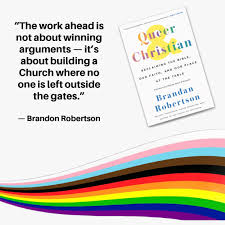 Brandan’s efforts to grapple with the Bible are not in any way dishonest about its dark side. What he is emphasizing is not that the scriptures speak in a uniform way to embrace him and all who identify with the label queer, but that the Bible is a book that contains works that have pushed at such borders and boundaries before, and when we read and understand that aspect of the biblical literature, these writings continue to do likewise. He writes on p.xxii, “When we concede a book as influential as the Bible to those who use it to justify narrow, exclusive, fear-based theology, we not only allow a misunderstanding of the Bible to flourish, but we also enable religious and political leaders to continue to manipulate billions of people into believing that they represent God’s perspective and therefore must not be questioned.” And again on p.xxiii, “For far too long, pastors have gotten away with justifying their own homophobia and transphobia by pointing to a few obscure verses in Scripture, with their congregations simply accepting this theology as God’s truth.”
That’s still just the introduction, and yet I’m sure you’ll agree that this is already substantive and engaging stuff. In the first chapter, the connection between queerness and holiness is explored. The holy in its original sense, like the queer in its modern as well as its traditional sense, is that which does not fit in, which calls out to be handled with caution since it has the potential to shake things up and turn them upside down. Brandan quotes bell hooks’ definition of queer as “being at odds with everything around it,” to which he adds, “We live in a world shaped and controlled by ideas, beliefs, systems, and structures that particular humans have created to benefit their own particular groups. The things accepted as ‘normal’ haven’t always been normal, even though people continue claiming they have been. Nothing in our world has always been the way it is, and nothing in our world must stay the way it is. In fact, things shouldn’t remain the same” (p.5). Let me dare to paraphrase this. To be queer is at least potentially to be prophetic, and certainly to be prophetic is to be queer. Seeing that the world could be other than it is and inviting people towards that vision is what prophecy is all about. Thus, it needs to be emphasized, those who seek to stifle queer Christian voices are seeking to stifle prophecy, to maintain the status quo and stop their ears to the voice of God calling us on towards new, exciting, and liberating experiences. Brandan, more humbly but no less significantly, characterizes queering as reforming. I am not sure that religions are any more resistant to change and reformation that society in general. Religion is an expression of human beings, whether that religious expression calls for inclusion and liberation or exclusion and enslavement. Religions do this because people do, and if there has consistently been a history of majorities working hard to maintain the status quo, there are so many moments when queer prophetic voices have shifted the direction of a people, a nation, and ultimately the world that we need to balance realism with hope. Those powerful upsurges in human inclusivity and wellbeing are then met with efforts to domesticate them and restore the status quo. Brandan thus warns that the desire to be accepted within the mainstream can undercut the prophetic message (p.9).
Chapter 2 of Queer and Christian shifts gear into a more biographical mode. Especially if you are someone who is, has been, or is connected with people who are on the fence about queer inclusion in Christianity, please do not skip this section. You cannot read and believe the experiences of queer Christians and deny that they are different in a way that has biological roots beyond their control which expressed themselves at a young age. Nor can you read and believe what they write about their experience and deny that they have a genuine experience of God and of faith as Christians. It is precisely this evidence that must be allowed to overturn any attempt to insist that reality must be otherwise because of some doctrinal framework that you have been told to subscribe to. If a doctrine is incompatible with the real lived experience of Christians, then once again we must embrace the message of the Book of Job and discard such doctrine. The alternative is to have God angry with us as God was with Job’s friends (Job 42:7). God values honesty in light of experience, not the defense of theology at the expense of an individual’s lived truth. As someone who experienced childhood with an alcoholic father and found it difficult in countless ways, my heart goes out to Brandan and everyone who had to navigate that type of situation with additional burdens and challenges. I will add that my adult experience has more than made up for that childhood trauma. That again is precisely why I am so adamant and passionate as an ally. I am filled with indignation when people try to rob a brother or sister of their joy as they embrace who they are as human beings and as Christians. The sad irony is that many of the attackers, the bigots, are people who themselves are bearing burdens and have been robbed of the joy of being affirmed and comfortable in their own identity.
Chapter 2 ends with a profound religious experience (p.14) not unlike my own, except for the fact that when I had mine, it did not come with Chick-fil-A coupons. One of the things that is powerful about fervent religion is the sense of community. It is emphatically not the case that that experience of community is only for those who deny their queerness. If you have never experienced that, Theology Beer Camp is a place where you can. What convinced me that this was an event that I wanted to return to year after year was precisely taking communion where queer siblings in faith were not merely welcome at the table, but invited to be the ones who served communion to the rest of us. Returning to Brandan’s book, it is always fascinating to read what friends write and discover how similar the journeys were that we have each been on separately.
Chapter 3 then explores the heartbreaking turn that cisgender heterosexual Christians are spared even if we veer into views called heresy. There may be rejection, but when someone declares your deepest desire for connection to another human being to be sinful, that is pitting your biological nature against the grace and goodness of God in a way that is horrifyingly traumatic. The giveaway that this is something human rather than divine is summed up nicely when Brandan writes, “Authenticity was not valued, but conformity” (p.19). The chapters that follow offer the tragic if ultimately joyous and redemptive journey Brandan followed towards ministry, but initially believing that this required him to be “cured” of who he was at the deepest level. Chapter 5 should persuade any reader of the unnecessary and harmful trauma that heteronormative Christianity has inflicted on people at the moment when they experience what Genesis 2 describes, encountering another and feeling a deep connection of love. I hope that you will cheer for Brandan’s maturity of insight as he realized that the prayers to “cure” him of the experience of loving another human being could not possibly be of God (pp.30-31).
Reading Brandan’s biography, it wasn’t until chapter 6 that I realized that I had been part of his journey from quite so early. When we blog and engage in other forms of public scholarship, we don’t necessarily know that what for us is a stance of confidence after many years of reflection may be intersecting with what someone else is articulating for the first time. When I quoted Brandan in 2014, I did not then know that I was doing so to someone who was courageously expressing their progressive Christian voice for the first time. I am glad I did, all the more so now that I see the significance of that with hindsight.
Having already written at length, and still not finished, I will make this a multi-part review. I won’t promise from now that there will be only two parts, given how rich the first part of the book is. That won’t surprise anyone who has read what Brandan writes. As was getting ready to post this, an article of his about the recent Supreme Court decision showed up in my inbox, and so I am linking to that as well.
Hopefully this will already convince you to buy Queer and Christian. Even so, my review will continue in due course.
Relationships and Religion
Previous Post

May 2, 2026
Insights from Project Hail Mary
Next Post
May 14, 2026 Paul, Mark, and Revelation Within Judaism (Enoch Seminar)
Recent Comments
"V. good.For me, the gold standard for this sort of thing is still Wikihistory by ..."
The Time-Traveler’s Apprentice (A Short Story)
"The one who says "no one comes to the Father but through me" is the ..."
Attack on Religious Freedom in Indiana
"Until I read, "As a Christian, it is possible but not at all necessary to ..."
Attack on Religious Freedom in Indiana
"Hey James, regarding your penultimate paragraph, I struggle with the same issue. I do think ..."
Browse Our Archives
Select a Category 1 Corinthians 1 John 1 Peter 1 Samuel 1 Thessalonians 1 Timothy 2 Corinthians 2 Kings 2 Peter 2 Samuel 2 Thessalonians 2 Timothy academia Acts of the Apostles afterlife Akhaten Alcatraz American Academy of Religion Amos Anglican Arabic Aramaic archaeology art artificial intelligence astronomy atheism atonement Babylon 5 Baptists Battlestar Galactica Bible Biblical Studies Carnival biblioblogging Black Mirror Blade Runner Book of Job book review Buddhism Call for Papers China Christianity Christmas Christology Chronicles Coptic creation Daniel Deuteronomy Doctor Who Dune Easter Ecclesiastes economics education Eldad Keynan Enoch Seminar Ephesians eschatology Esther Evangelicals evolution Exodus Expanse Ezekiel Ezra fantasy Fringe fundamentalism Galatians games Ge'ez genealogy Genesis Gnosticism Gospel of Jesus' Wife Gospel of John Gospel of Judas Gospel of Luke Gospel of Mark Gospel of Matthew Gospel of Peter Gospel of Thomas Greek Harry Potter Hebrew Hebrews Hinduism historical Jesus history Hitchhiker's Guide to the Galaxy Holidays horror Hosea humor incarnation India inerrancy information literacy inspirational Intelligent Design Ireland Isaiah Islam Israel Italy James Jeremiah John the Baptist Jonah Joshua Judaism Jude Judges Judith Lamentations languages Latin Leviticus libraries literature Lord of the Rings LOST Mandaeans Mandaic memes Methodism Micah monotheism morality Mormons movies music mythicism NASSCAL Nehemiah new perspective New Testament news Numbers Orthodox paganism panentheism pantheism Patheos Paul and his letters Pentecostals Philippians Philippians 2:6-11 philosophy physics Planet of the Apes podcast politics Progressive Christianity Protestantism Proverbs Psalms pseudoscience racism religion Revelation Roman Catholicism Romania Romans Ruth scams science science fiction Secret Gospel of Mark Society of Biblical Literature Song of Songs Star Trek Star Wars Stargate Swahili Syriac Taoism technology Terminator The Handmaid's Tale The Hobbit The Matrix theodicy theology theory Timeless Titus tomb Torchwood travel TRON Uncategorized United Kingdom Westworld X-Files young-earth creationism Zechariah
Select a Month October 2026 September 2026 August 2026 July 2026 June 2026 May 2026 April 2026 March 2026 February 2026 January 2026 December 2025 November 2025 October 2025 September 2025 July 2025 June 2025 May 2025 April 2025 March 2025 February 2025 January 2025 December 2024 November 2024 October 2024 September 2024 August 2024 July 2024 June 2024 May 2024 April 2024 March 2024 February 2024 January 2024 December 2023 November 2023 October 2023 September 2023 August 2023 July 2023 May 2023 April 2023 March 2023 February 2023 January 2023 December 2022 November 2022 October 2022 September 2022 August 2022 July 2022 June 2022 May 2022 April 2022 March 2022 February 2022 January 2022 December 2021 November 2021 October 2021 September 2021 August 2021 July 2021 June 2021 May 2021 April 2021 March 2021 February 2021 January 2021 December 2020 November 2020 October 2020 September 2020 August 2020 July 2020 June 2020 May 2020 April 2020 March 2020 February 2020 January 2020 December 2019 November 2019 October 2019 September 2019 August 2019 July 2019 June 2019 May 2019 April 2019 March 2019 February 2019 January 2019 December 2018 November 2018 October 2018 September 2018 August 2018 July 2018 June 2018 May 2018 April 2018 March 2018 February 2018 January 2018 December 2017 November 2017 October 2017 September 2017 August 2017 July 2017 June 2017 May 2017 April 2017 March 2017 February 2017 January 2017 December 2016 November 2016 October 2016 September 2016 August 2016 July 2016 June 2016 May 2016 April 2016 March 2016 February 2016 January 2016 December 2015 November 2015 October 2015 September 2015 August 2015 July 2015 June 2015 May 2015 April 2015 March 2015 February 2015 January 2015 December 2014 November 2014 October 2014 September 2014 August 2014 July 2014 June 2014 May 2014 April 2014 March 2014 February 2014 January 2014 December 2013 November 2013 October 2013 September 2013 August 2013 July 2013 June 2013 May 2013 April 2013 March 2013 February 2013 January 2013 December 2012 November 2012 October 2012 September 2012 August 2012 July 2012 June 2012 May 2012 April 2012 March 2012 February 2012 January 2012 December 2011 November 2011 October 2011 September 2011 August 2011 July 2011 June 2011 May 2011 April 2011 March 2011 February 2011 January 2011 December 2010 November 2010 October 2010 September 2010 August 2010 July 2010 June 2010 May 2010 April 2010 March 2010 February 2010 January 2010 December 2009 November 2009 October 2009 September 2009 August 2009 July 2009 June 2009 May 2009 April 2009 March 2009 February 2009 January 2009 December 2008 November 2008 October 2008 September 2008 August 2008 July 2008 June 2008 May 2008 April 2008 March 2008 February 2008 January 2008 December 2007 November 2007 October 2007 September 2007 August 2007 July 2007 June 2007 February 2007 January 2001
Follow Us!
TAKE THE
Religious Wisdom Quiz
I am an ancestor of King David, born from a foreign widow's faithfulness. Who am I?
Select your answer to see how you score.
Jesse Salmon Boaz Obed
Books by This Author Books by James F. McGrath
Related posts from Religion Prof: The Blog of James F. McGrath

Religion Prof: The Blog of James F. McGrath

The Obsolete Paradigm of a Purely Mythical Jesus
Religion Prof: The Blog of James F. McGrath

Religion Prof: The Blog of James F. McGrath
Reviews of Beyond Deconstruction (and an Easter Excerpt)
Religion Prof: The Blog of James F. McGrath
TRENDING AT PATHEOS Progressive Christian

I was strolling through the top floor of the brand new Parthenon...

What Does Gêvâh Mean For Kimberley Guifoyle &...
This week, a lot of the news is focused on Kimberly Guilfoyle....

INNER CIRCLE: Profound Mystery (Of Christ In All...
Ephesians 5:31-32 “For this reason, a man will leave his father and...

Do Not Rejoice When Your Enemy Falls: The...
Turning an execution into a public spectacle is a disturbing expression of...

'The Chosen' S6 Trailer: The Passion Gets Very...
Not many watching 'The Chosen' worry about spoilers, but just because they...

The purpose-driven labor priest
A labor activist reads Rick Warren and it gets me wondering about...
view all Progressive Christian blogs
What Are Your Thoughts?leave a comment
Ad-Free & Subscriber Log-In Subscription Support
- About Us
- 2026 Calendar
- Videos
- Podcasts
- Library of World Religions
- Faith In Media Tracker
- Advertise With Us
- Write for Us
- Privacy Policy
- Terms of Service
- Do Not Sell My Data
- Contact Us
- Radiant Digital
- Manage Newsletter Subscriptions
- Unsubscribe From Notifications
- Sitemap
Copyright 2008-2026, Patheos. All rights reserved.
Subscription Support Ad-Free & Subscriber Log-In
Follow Patheos