
BuddhistCatholicContemplativeEvangelicalGeneral ChristianHinduJewishLatter-day SaintMuslimNew VisionsProgressive Christian
Beliefs
- Buddhist
- Catholic
- Contemplative
- Evangelical
- General Christian
- Hindu
- Jewish
- Latter-day Saint
- More Voices
- Muslim
- New Visions
- Pagan
- Progressive Christian
Topics
- Religion News
- Food and Religion
- Sports and Religion
- Religious Art
- Religious Music and Entertainment
- Religious Events
- History and Religion
- Style and Religion
- Politics and Religion
- Women in Religion
- Recreation Outdoors and Religion
- Business Finance and Religion
- Careers Workplace and Religion
- Education and Religion
- Family Parenting and Religion
- Health Fitness and Religion
- Home and Religion
- Relationships and Religion
- Technology and Religion
- Travel and Religion
Columnists
- Buddhist Columnists
- Business Finance and Religion Columnists
- Careers Workplace and Religion Columnists
- Catholic Columnists
- Contemplative Columnists
- Education and Religion Columnists
- Evangelists Columnists
- Family Parenting and Religion Columnists
- General Christian Columnists
- Health Fitness and Religion Columnists
- Hindu Columnists
- History and Religion Columnists
- Home and Religion Columnists
- Jewish Columnists
- More Voices Columnists
- Latter Day Columnists
- Muslim Columnists
- New Visions Columnists
- Nonreligious Columnists
- Pagan Columnists
- Politics and Religion Columnists
- Progressive Columnists
- Recreation Outdoors and Religion Columnists
- Relationships and Religion Columnists
- Religion News Columnists
- Religious Art Columnists
- Religious Events Columnists
- Religious Music and Entertainment Columnists
- Sports and Religion Columnists
- Style and Religion Columnists
- Technology and Religion Columnists
- Travel and Religion Columnists
- Women in Religion Columnists
Resource Library
- 2026 Calendar
- Library of World Religions
- The 100 Most Holy Places on Earth
- Patheos Answers
- Podcasts
- Videos
- Faith Leaders Database
- Anglican Episcopalian
- Bahai
- Baptist
- Buddhism
- Christianity
- Confucianism
- Eastern Orthodoxy
- Hinduism
- Holiness and Pentecostal
- ISKCON
- Islam
- Judaism
- Lutheran
- Methodist
- The Church of Jesus Christ of Latter-day Saints
- New Age
- Paganism
- Presbytarian and Reformed
- Protestantism
- Religion Behind the Scenes
- Roman Catholic
- Scientology
- Shia Islam
- Sikhism
- Sufism
- Sunni Islam
- Taoism
- Zen
- See all religions
Research Tools
 Ad-Free & Subscriber Log-In Subscription Support
Ad-Free & Subscriber Log-In Subscription Support
Follow Patheos 

- Trending:
- Forgiveness
- |
- Marriage
- |
- Consciousness
- |
- Death Penalty
- |
- Election
- |
- Halloween

- Home
- About Dr. James F. McGrath
- Publications
- Blogroll
- Useful Websites
- Connections
- Easy Search Posts Page
- FREE NEWSLETTER
- Home
- Progressive Christian
- Technology and Religion
- Insights from Project Hail Mary
Insights from Project Hail Mary
Last updated on: May 4, 2026 at 2:53 pm by James F. McGrath
Insights from Project Hail Mary 2026-05-04T14:53:45-04:00 James F. McGrath
Patheos Explore the world's faith through different perspectives on religion and spirituality! Patheos has the views of the prevalent religions and spiritualities of the world.
Introduction: Project Hail Mary and the Future of Schools and Churches
A former student of mine recommended the novel Project Hail Mary to me several years ago, and I have been eager to read it. When the movie came out, I was determined to read the novel first. What prompted me finally read the novel as quickly as I could, and then see the movie, was my university president making reference to it when circulating an article he wrote about AI and our present moment in higher education. As I read the novel, I grew increasingly excited (amaze amaze amaze!) because there are moments in the novel that really do speak to the present moment. What they indicate is not, however, what one might think if one believed all the hype from tech companies. Since this is Patheos, and I have been giving a lot of thought to the similar challenges faced by religious congregations and educational institutions, I will be offering reflections below on and insights from Project Hail Mary that relate to the future of schools and churches. I am confident that most if not all of what I say about one applies equally to the other.
Thanking God for Apocalypses and Salvation
Project Hail Mary has so much that is great about it, but it illustrates the limitations of science fiction when it comes to predicting even the near future. Published in 2022, there is nothing like ChatGPT anywhere in sight in the novel (the movie updates the ship’s computer voice interface a bit, while still plausibly showing they would use an expert system rather than a generative AI chatbot). The depiction of how swiftly the main character Grace Ryland and Rocky learn one another’s languages is implausible, but it does provide a great example of a human being using technology as a tool to accomplish something that the technology or the person on their own could not. There are also issues with some of the musical aspects of Rocky’s language, although since musical harmony is based in physics, that there would be similarities to our own music is plausible, especially given that we also share biological origins. None of that should be treated as a serious complaint about the story. No one wants to read a novel in which the entirety of 1000 pages is spent trying to figure out a linguistic puzzle. We need stories that oversimplify, just as we need scholarship that makes us aware that reality is different and more challenging than our oversimplifications.
The same is true about discussions of theology, although some of us can tolerate and even enjoy quite lengthy ones. Religious dialogue is one of the places where the film makes changes to the novel, but both the novel and the movie contain some engagement with the question of God. A number of viewers have seen implicit Christian themes in the film as well. In the novel, the one place where it comes up explicitly is in the form of an engineer who expresses gratitude to God for relativity and time dilation, which makes it possible for finite beings to travel across vast stretches of space. Grace remarks in response that if God can be thanked for an aspect of the universe that facilitates their quest for a solution to their predicament, then surely God must also be blamed for that predicament. It is an old question, and the way it is handled is not particularly profound, but I appreciate that Weir seized an opportunity to illustrate the different ways one may interpret the same events in relation to religion, and also that he did not try to resolve the matter.
The takeaway here is that often, when a completely unprecedented situation arises, the questions that it raises and the skills we need to respond are the same as ever. To survive the arrival of astrophage in our solar system, we need science and engineering. To wrestle with the theological implications, one needs theological skills to get beyond the surface level. And in order to cope with encountering sentient alien life for the first time, you need things that have been the focus of the liberal arts and the classic core curriculum at the best universities for centuries: an understanding of culture and of how languages work, the ability to think critically, to trust and to reason logically, to listen to the opinion of others, and let’s not forget the one that everyone complains about, namely the ability to work collaboratively on group projects.
Reinventing the Wheel
Some have said that we need to completely reimagine education in light of the latest technology. There is a key moment in Project Hail Mary that suggests to me the opposite. It gets more attention in the novel, but I am glad they kept it in the movie. A scientist points out that the lab equipment that will be needed when they reach the star Tau Ceti will not work in zero gravity. The project director says they are aware of that and are working on developing equipment that will work without gravity. The scientist says that is not a viable solution. On the one hand, it took hundreds of years developing and refining the tools that we use in order to get them to perform with precision. Developing new ones that work equally well would require time they do not have. On the other hand, sending inadequately tested new equipment on a long deep space voyage risks finding out upon arrival that it will not work as they hoped.
The alternative? Create artificial gravity by using a centrifuge.

The lesson for education is clear. The moment that we find ourselves in requires courage, ambition, and ingenuity. That doesn’t mean designing completely new systems from scratch. We need to take what we have shown works well, and figure out how to use it in the new setting that we find ourselves in. We already have robust systems to foster human learning and development. It is not sufficient to let them merely continue on Earth when we need them in space. Neither is it helpful to jettison them because thus far they have only been used on Earth. Evolution, adaptation, and innovation have been part of our educational journey since the beginning and present and future challenges may need some creative new innovations, but they also crucially need much that we have been focused on fostering for longer than any of us have been alive.
Moments of crisis, including but not limited to fast-paced technological change, are good at sifting out what should be phased out versus what stands the test of time. Both the church and the classroom had longstanding models of people sitting facing in one direction to listen to an expert speak, and sitting in a circle to discuss. The former has been largely rendered redundant. Not that it cannot be absolutely amazing to listen to a powerful sermon or an insightful lecture. The point is that we set up classrooms and churches to do primarily that, and now one can listen at home, in the car, on the treadmill, wherever. One can listen over and over if it is helpful to do so, on one’s own time.
The discussion, the conversation, are the things that are no less valuable despite the changes in our technology. If anything, the technology makes more room for this, while at the same time making it more crucial that we do so.
All of the above was true before the release of ChatGPT. We have talked about the “flipped classroom” and should be talking more about the “flipped church” model. For the latter, it may be as simple as shifting the focus, so that where Sunday school was a thing that some people came to sometimes while the main service was the focus, now the sermon will be the thing for those who want it, but what you really should be at consistently is the Bible study in a discussion format.
The arrival of generative AI doesn’t change this. Can a chatbot generate text that will look like a lecture or sermon? Absolutely. Will the details of the lecture be consistently accurate, and the quotations real? There will never be a guarantee of this with Large Language Models. Will the chatbot-generated sermon reflect the proponderance of conservative Evangelical devotional material online? Most likely. Will it challenge exegetical and homiletical tendencies that reflect patriarchy? Probably not.
Critical thinking, empathy, human insight, and creativity are not outmoded in the era of AI. They are more essential than ever. No matter how good generative AI gets, and no matter what existential, scientific, and social crises confront humankind in the future, these skills will be the ones that will put the latest technology to use in finding solutions.
Loving Classroom Education
The ending of the novel is one of those moments that doesn’t seem fully plausible, and yet is symbolically beautiful and deeply meaningful and moving.
What is implausible, to be clear, is not that Dr. Ryland Grace ends up an educator among the Eridians. If a person from another world ended up on Earth, we would have them teach adults at a university where the adult human students could prepare to share what they learned with larger numbers of younger students around the world. We won’t give them one middle school class to teach, we will give them a university position so that they train an exponentially larger number of middle school teachers.
What is much more implausible than the scenario at the end of the novel is that classroom education will become a thing of the past, and that human educators will be replaced by machines.
Education will always involve sentient beings sharing what they have learned with those who are coming through the process of learning behind them.
There is no way to automate that. There is no machine that can do it better than a human can.
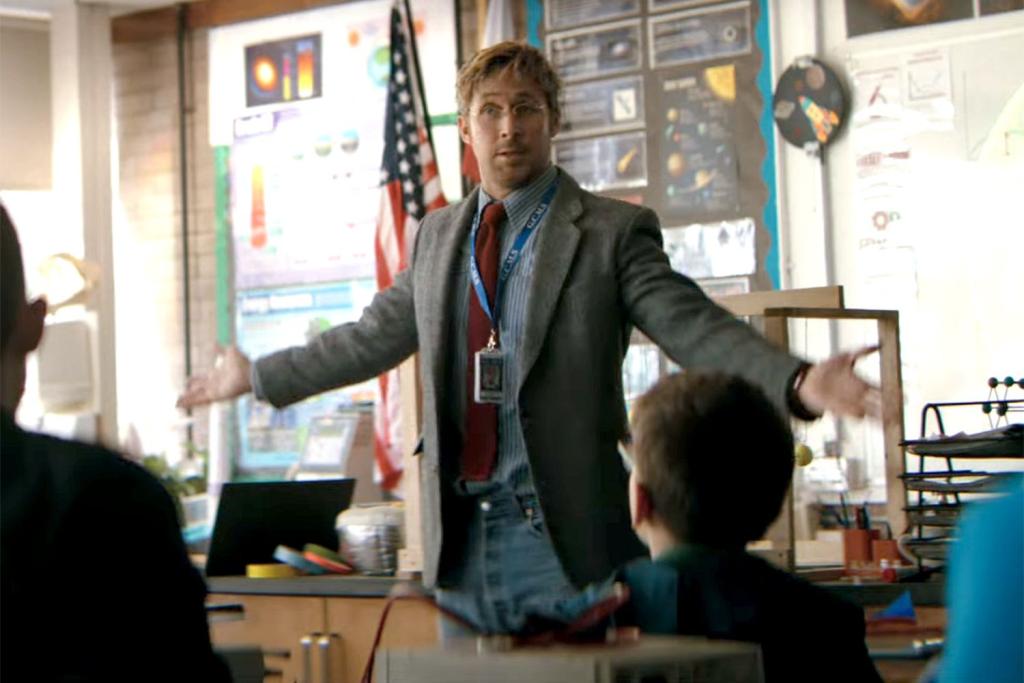 A Google search and Wikipedia might have more raw information about a wider array of topics than any one human being can carry. We don’t imagine that simply hanging young people a search engine and a crowdsourced encyclopedia will have them set for life. AI chatbots don’t even offer what search engines and Wikipedia do. They can respond in speech, but they do so probabilistically and so they are guaranteed to offer confabulations periodically where a traditional search or a Reddit forum would have offered a mixture of good information and mistaken, and someone could discern which are reliable and be likely to fact check their way to the truth more quickly.
In both the novel and the movie, Ryland Grace gives Rocky a laptop. In the movie, Rocky calls it a “thinking machine.” We who use them know that they are not that. Yet the information gathered by the inhabitants of another world would be a treasure.
As we use the movie Project Hail Mary as a basis for reflecting on learning and education, both secular and religious, a key point becomes clear. Dr. Grace ending up among the Eridians offered something that would be countless times more valuable than a laptop.
The Bravery This Moment Requires
Those outside academia are liable to misunderstand or simply gloss over a key element in the novel. Weir depicts Ryland Grace as someone who proposed a controversial idea and was ostracized for it. Unfortunately, that does happen. Yet as the novel illustrates, the academic endeavor as a whole thrives not because some of us make quirky unconventional proposals, but because the combination of creative innovation and rigorous testing is the best method we have found to move our knowledge forward. Dr. Grace was simply wrong in one of his views. He continues to be such a valued part of the endeavor not because he had an earlier hunch that was right, but because coupled with feedback from others, outside the box thinking will provide us not only with countless dead ends but also a few brilliant insights that others would almost certainly have missed. Just creative imagining without rigorous evaluation in relation to evidence gets us to a fictional world. Just sticking to what we already feel we confidently know keeps us from making essential progress. Put the two together, and gosh is it powerful.
The cowardice of Ryland Grace prior to launch, trying to avoid going on the suicide mission, illustrates something else that is relevant to education. In the movie, Stratt says that she isn’t betraying Grace but believing in him. A lot of education is pushing students to do things they are sure they cannot do, creating a context in which we can do so more gently, rather than putting them in a coma and sending them into deep space despite their protestations. When, at the end of the movie, we see Grace’s message in which he calls himself Captain Dr. Ryland Grace, it is deeply moving even if we’ve read the novel. We are capable of more than we think we are. Life may or may not bring that out from us. Education and spiritual community both have a long history of doing so effectively. They are the lab equipment that we need to keep in our classrooms even in zero gravity, rather than try to substitute.
The movie and the novel are about two lone individuals from different worlds surviving from among their crews to encounter one another and work together to save both their worlds. The technology facilitated them meeting and it facilitated them researching. There was no scenario in which automated probes from the two worlds would have accomplished what the two people did. That’s the ultimate message of Project Hail Mary for education and for religion. Technology can facilitate our learning and our spiritual growth if we use it wisely. It will never under any circumstances be able to take the place of human beings, or of whatever other sentient beings may be out there.
The fact that the movie ends not only with Grace teaching Eridian children (presumably) in a classroom, but then moves to a gospel song so that we next hear “glory glory hallelujah”, indicates the extent to which a story like this is implicitly religious and has the potential to become explicitly so. There is no encounter across human or galactic difference that doesn’t raise questions about meaning, and the constructed frameworks for making meaning that we so often take for granted. Education at universities and in churches, at its best, provides us a context in which we can explore and interrogate our assumptions so that we build a worldview that can serve us well.
Conclusion: Insights from Project Hail Mary
I highly recommend reading the novel Project Hail Mary, and then seeing the movie. The movie probably works on its own, but I am quite sure it works better as a cinematic realization of a fuller story you already know.
The novel and the movie both depict a future that requires well-rounded people with technical competencies, and also the kind of creativity and thinking outside the box that are fostered best through study and cultivation of the arts and the humanities. If that is true for the era of astrophage, it is no less true for the era of AI. To paraphrase G. K. Chesterton, the modern fairy tale that is Project Hail Mary does not tell us that astrophage exists. We already know that unknown and scarcely imaginable dangers fill our cosmos. Stories like Project Hail Mary tell us that these threats can be overcome.
Here are some other things to read that relate to AI. First, I spoke about AI and education at my university’s end of year celebration, together with Ankur Gupta, with attention drawn to our book Real Intelligence: Teaching in the Era of Generative AI. At the end of the event, our president talked about the article that inspired my previous post as well as this one, and in the process explicitly mentioned my previous blog post in a positive way!
And now for some others…
When God Does Not Answer: Prayer, Silence, and Response in the Age of AI
What Happens when Students Stop Believing their Work Matters?
The Smarter AI Gets, the Less You Can Trust it on the Hard Stuff
AI Summaries are Making You Worse at Reading
Strategic Cognitive Offloading
What We Lose When Artificial Intelligence Does Our Shopping
AI Collaboration Rather Than Replacement
Ryan Gosling on the Hope, Inspiration of ‘Project Hail Mary’
Why We Are Drawn to Space Stories
Seasons of Love: An AI Poetry Experiment
How 5 Colleges are Approaching AI
You Already Have What It Takes
AI Doesn’t Just Make You Worse. It Makes You Stop Trying
AI Destroying Student Performance and Student Learning
AGI and the Value of Education
When the Notes Take Themselves
Interview with the Founder of the Higher Ed Discussions of AI Writing & Use Facebook Group
Immersive Gaming in the Classroom
Hallucinated Citations and Related Problems
Key Questions on Energy and AI
The Actual Environmental Cost of AI
AI in the Networked Public Sphere
Technology and Religion
Education and Religion
Previous Post
April 19, 2026
Does AI Write Better Than Students?
Next Post
May 12, 2026 Queer and Christian: Review of Brandan Robertson's New Book
Recent Comments
"V. good.For me, the gold standard for this sort of thing is still Wikihistory by ..."
The Time-Traveler’s Apprentice (A Short Story)
"The one who says "no one comes to the Father but through me" is the ..."
Attack on Religious Freedom in Indiana
"Until I read, "As a Christian, it is possible but not at all necessary to ..."
Attack on Religious Freedom in Indiana
"Hey James, regarding your penultimate paragraph, I struggle with the same issue. I do think ..."
Browse Our Archives
Select a Category 1 Corinthians 1 John 1 Peter 1 Samuel 1 Thessalonians 1 Timothy 2 Corinthians 2 Kings 2 Peter 2 Samuel 2 Thessalonians 2 Timothy academia Acts of the Apostles afterlife Akhaten Alcatraz American Academy of Religion Amos Anglican Arabic Aramaic archaeology art artificial intelligence astronomy atheism atonement Babylon 5 Baptists Battlestar Galactica Bible Biblical Studies Carnival biblioblogging Black Mirror Blade Runner Book of Job book review Buddhism Call for Papers China Christianity Christmas Christology Chronicles Coptic creation Daniel Deuteronomy Doctor Who Dune Easter Ecclesiastes economics education Eldad Keynan Enoch Seminar Ephesians eschatology Esther Evangelicals evolution Exodus Expanse Ezekiel Ezra fantasy Fringe fundamentalism Galatians games Ge'ez genealogy Genesis Gnosticism Gospel of Jesus' Wife Gospel of John Gospel of Judas Gospel of Luke Gospel of Mark Gospel of Matthew Gospel of Peter Gospel of Thomas Greek Harry Potter Hebrew Hebrews Hinduism historical Jesus history Hitchhiker's Guide to the Galaxy Holidays horror Hosea humor incarnation India inerrancy information literacy inspirational Intelligent Design Ireland Isaiah Islam Israel Italy James Jeremiah John the Baptist Jonah Joshua Judaism Jude Judges Judith Lamentations languages Latin Leviticus libraries literature Lord of the Rings LOST Mandaeans Mandaic memes Methodism Micah monotheism morality Mormons movies music mythicism NASSCAL Nehemiah new perspective New Testament news Numbers Orthodox paganism panentheism pantheism Patheos Paul and his letters Pentecostals Philippians Philippians 2:6-11 philosophy physics Planet of the Apes podcast politics Progressive Christianity Protestantism Proverbs Psalms pseudoscience racism religion Revelation Roman Catholicism Romania Romans Ruth scams science science fiction Secret Gospel of Mark Society of Biblical Literature Song of Songs Star Trek Star Wars Stargate Swahili Syriac Taoism technology Terminator The Handmaid's Tale The Hobbit The Matrix theodicy theology theory Timeless Titus tomb Torchwood travel TRON Uncategorized United Kingdom Westworld X-Files young-earth creationism Zechariah
Select a Month October 2026 September 2026 August 2026 July 2026 June 2026 May 2026 April 2026 March 2026 February 2026 January 2026 December 2025 November 2025 October 2025 September 2025 July 2025 June 2025 May 2025 April 2025 March 2025 February 2025 January 2025 December 2024 November 2024 October 2024 September 2024 August 2024 July 2024 June 2024 May 2024 April 2024 March 2024 February 2024 January 2024 December 2023 November 2023 October 2023 September 2023 August 2023 July 2023 May 2023 April 2023 March 2023 February 2023 January 2023 December 2022 November 2022 October 2022 September 2022 August 2022 July 2022 June 2022 May 2022 April 2022 March 2022 February 2022 January 2022 December 2021 November 2021 October 2021 September 2021 August 2021 July 2021 June 2021 May 2021 April 2021 March 2021 February 2021 January 2021 December 2020 November 2020 October 2020 September 2020 August 2020 July 2020 June 2020 May 2020 April 2020 March 2020 February 2020 January 2020 December 2019 November 2019 October 2019 September 2019 August 2019 July 2019 June 2019 May 2019 April 2019 March 2019 February 2019 January 2019 December 2018 November 2018 October 2018 September 2018 August 2018 July 2018 June 2018 May 2018 April 2018 March 2018 February 2018 January 2018 December 2017 November 2017 October 2017 September 2017 August 2017 July 2017 June 2017 May 2017 April 2017 March 2017 February 2017 January 2017 December 2016 November 2016 October 2016 September 2016 August 2016 July 2016 June 2016 May 2016 April 2016 March 2016 February 2016 January 2016 December 2015 November 2015 October 2015 September 2015 August 2015 July 2015 June 2015 May 2015 April 2015 March 2015 February 2015 January 2015 December 2014 November 2014 October 2014 September 2014 August 2014 July 2014 June 2014 May 2014 April 2014 March 2014 February 2014 January 2014 December 2013 November 2013 October 2013 September 2013 August 2013 July 2013 June 2013 May 2013 April 2013 March 2013 February 2013 January 2013 December 2012 November 2012 October 2012 September 2012 August 2012 July 2012 June 2012 May 2012 April 2012 March 2012 February 2012 January 2012 December 2011 November 2011 October 2011 September 2011 August 2011 July 2011 June 2011 May 2011 April 2011 March 2011 February 2011 January 2011 December 2010 November 2010 October 2010 September 2010 August 2010 July 2010 June 2010 May 2010 April 2010 March 2010 February 2010 January 2010 December 2009 November 2009 October 2009 September 2009 August 2009 July 2009 June 2009 May 2009 April 2009 March 2009 February 2009 January 2009 December 2008 November 2008 October 2008 September 2008 August 2008 July 2008 June 2008 May 2008 April 2008 March 2008 February 2008 January 2008 December 2007 November 2007 October 2007 September 2007 August 2007 July 2007 June 2007 February 2007 January 2001
Follow Us!
TAKE THE
Religious Wisdom Quiz
According to Romans, what is the gift of God?
Select your answer to see how you score.
Eternal life in Christ Jesus Grace The Holy Spirit Salvation
Books by This Author Books by James F. McGrath
Related posts from Religion Prof: The Blog of James F. McGrath

The Time-Traveler’s Apprentice (A Short Story)
Religion Prof: The Blog of James F. McGrath
AI Syllabus Statements You Can Steal for Your...
Religion Prof: The Blog of James F. McGrath

'Disclosure Day': The Real Revelation Isn't Aliens
Religion Prof: The Blog of James F. McGrath

Faith that Lasts (Colossians 1:9-14,24-29)
Religion Prof: The Blog of James F. McGrath
TRENDING AT PATHEOS Progressive Christian

I was strolling through the top floor of the brand new Parthenon...

What Does Gêvâh Mean For Kimberley Guifoyle &...
This week, a lot of the news is focused on Kimberly Guilfoyle....

INNER CIRCLE: Profound Mystery (Of Christ In All...
Ephesians 5:31-32 “For this reason, a man will leave his father and...

Do Not Rejoice When Your Enemy Falls: The...
Turning an execution into a public spectacle is a disturbing expression of...

'The Chosen' S6 Trailer: The Passion Gets Very...
Not many watching 'The Chosen' worry about spoilers, but just because they...

The purpose-driven labor priest
A labor activist reads Rick Warren and it gets me wondering about...
view all Progressive Christian blogs
What Are Your Thoughts?leave a comment
Ad-Free & Subscriber Log-In Subscription Support
- About Us
- 2026 Calendar
- Videos
- Podcasts
- Library of World Religions
- Faith In Media Tracker
- Advertise With Us
- Write for Us
- Privacy Policy
- Terms of Service
- Do Not Sell My Data
- Contact Us
- Radiant Digital
- Manage Newsletter Subscriptions
- Unsubscribe From Notifications
- Sitemap
Copyright 2008-2026, Patheos. All rights reserved.
Subscription Support Ad-Free & Subscriber Log-In
Follow Patheos