
BuddhistCatholicContemplativeEvangelicalGeneral ChristianHinduJewishLatter-day SaintMuslimNew VisionsProgressive Christian
Beliefs
- Buddhist
- Catholic
- Contemplative
- Evangelical
- General Christian
- Hindu
- Jewish
- Latter-day Saint
- More Voices
- Muslim
- New Visions
- Pagan
- Progressive Christian
Topics
- Religion News
- Food and Religion
- Sports and Religion
- Religious Art
- Religious Music and Entertainment
- Religious Events
- History and Religion
- Style and Religion
- Politics and Religion
- Women in Religion
- Recreation Outdoors and Religion
- Business Finance and Religion
- Careers Workplace and Religion
- Education and Religion
- Family Parenting and Religion
- Health Fitness and Religion
- Home and Religion
- Relationships and Religion
- Technology and Religion
- Travel and Religion
Columnists
- Buddhist Columnists
- Business Finance and Religion Columnists
- Careers Workplace and Religion Columnists
- Catholic Columnists
- Contemplative Columnists
- Education and Religion Columnists
- Evangelists Columnists
- Family Parenting and Religion Columnists
- General Christian Columnists
- Health Fitness and Religion Columnists
- Hindu Columnists
- History and Religion Columnists
- Home and Religion Columnists
- Jewish Columnists
- More Voices Columnists
- Latter Day Columnists
- Muslim Columnists
- New Visions Columnists
- Nonreligious Columnists
- Pagan Columnists
- Politics and Religion Columnists
- Progressive Columnists
- Recreation Outdoors and Religion Columnists
- Relationships and Religion Columnists
- Religion News Columnists
- Religious Art Columnists
- Religious Events Columnists
- Religious Music and Entertainment Columnists
- Sports and Religion Columnists
- Style and Religion Columnists
- Technology and Religion Columnists
- Travel and Religion Columnists
- Women in Religion Columnists
Resource Library
- 2026 Calendar
- Library of World Religions
- The 100 Most Holy Places on Earth
- Patheos Answers
- Podcasts
- Videos
- Faith Leaders Database
- Anglican Episcopalian
- Bahai
- Baptist
- Buddhism
- Christianity
- Confucianism
- Eastern Orthodoxy
- Hinduism
- Holiness and Pentecostal
- ISKCON
- Islam
- Judaism
- Lutheran
- Methodist
- The Church of Jesus Christ of Latter-day Saints
- New Age
- Paganism
- Presbytarian and Reformed
- Protestantism
- Religion Behind the Scenes
- Roman Catholic
- Scientology
- Shia Islam
- Sikhism
- Sufism
- Sunni Islam
- Taoism
- Zen
- See all religions
Research Tools
 Ad-Free & Subscriber Log-In Subscription Support
Ad-Free & Subscriber Log-In Subscription Support
Follow Patheos 

- Trending:
- Forgiveness
- |
- Marriage
- |
- Consciousness
- |
- Death Penalty
- |
- Election
- |
- Halloween

- Home
- About Dr. James F. McGrath
- Publications
- Blogroll
- Useful Websites
- Connections
- Easy Search Posts Page
- FREE NEWSLETTER
- Home
- Progressive Christian
- Technology and Religion
- Five Stages of AI Grief
Five Stages of AI Grief
Last updated on: January 9, 2026 at 7:00 am by James F. McGrath
Five Stages of AI Grief 2026-01-08T06:56:42-05:00 James F. McGrath
Patheos Explore the world's faith through different perspectives on religion and spirituality! Patheos has the views of the prevalent religions and spiritualities of the world.
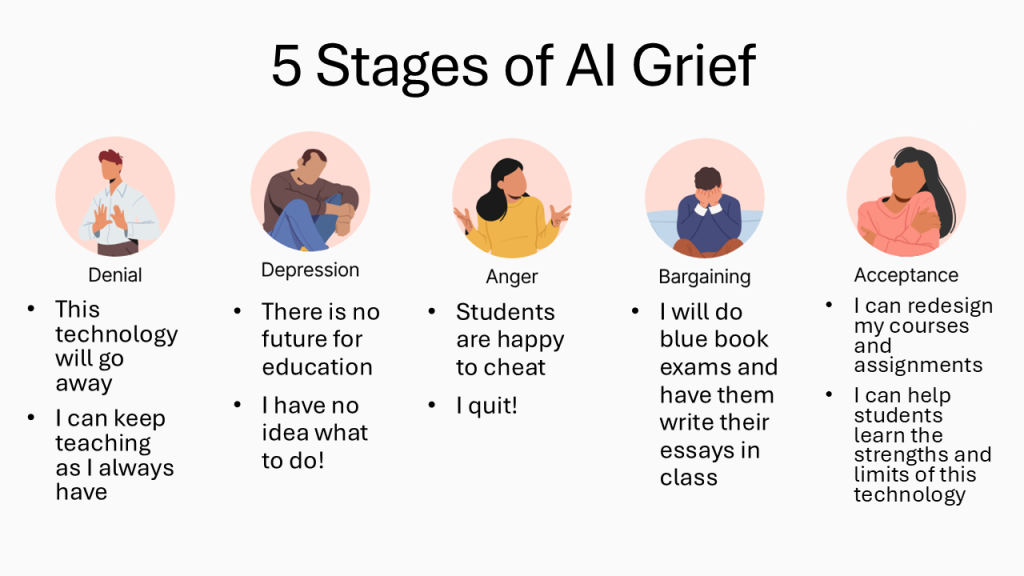
It strikes me that the best way to think about the process of faculty grappling with the new technology of LLMs (Large Language Models) is by analogy to the process of working through grief outlined by Elisabeth Kübler-Ross in her well-known five stages of grief.
Denial
The first stage is denial, and we have certainly seen that among faculty. I think that the attempt to present the technology as especially harmful to the environment resulted not only from a misunderstanding of the technology (what was involved in training LLMs versus what is involved in ordinary use of the resulting chatbots) and a failure to compare its impact with other technologies (such as Netflix usage), but more fundamentally was driven by a hope that it would be possible to make an ethical case against the technology itself such that it would be outlawed and cease to be a problem. Some just hope that it will be a flash in the pan, a passing fad. While there has definitely been hype from tech companies and there is a bubble that will burst in terms of the promises made about how adopting AI will enhance productivity and profits, that burst is unlikely to mean that the technology goes away, any more than the “dot com” bubble bursting meant that for the internet.
Depression
The second stage is depression. Educators who have said they feel like quitting surely exemplify this. I have at least heard some voices indicating that they were indeed quitting teaching, although I am not sure whether they in fact did so in the end.
Anger
The third stage is anger. If you don’t think faculty have been angry, visit the Professors subreddit on Reddit. This anger also issues in deep distrust for students, viewing them all with suspicion.
Bargaining
The bargaining stage appears to me to be what is happening when faculty say that they can just prohibit use in the classroom and give handwritten blue book exams. Now, that will work for some classes and will in some instances be a really good option. If you teach online, it isn’t an option at all. Jumping for the hyped promises offered by tech companies in the form of “AI detectors” is also a form of bargaining. Those products are snake oil. They produce false positives. There is no clarity about what features the “detectors” are using to determine that AI was used. With TurnItIn’s plagiarism detector, if you failed a student because of the percentage, ignoring the fact that some of the matching text was in quotation marks, or the title of a book, you would hopefully be reprimanded. Letting that tool decide for you is unethical. How much more unethical is it to use a tool that tells you that something was created by AI when you don’t know the basis, it has shown to be unreliable, and you are provided no data to allow you to render your own judgment?
Acceptance
The final stage is acceptance. When I refer to acceptance, it doesn’t mean acceptance of the hyped claims of tech companies. Most people who accept the loss that is the cause of their grief do not come to love and celebrate loss. That isn’t what acceptance means in this context. It is important to emphasize this, since there are some who imagine AI doing all sorts of things that are still pure imagination. Science fiction may become science fact, but the fact that we have speech-imitators does not mean that we have systems that can serve as consistently reliable tutors, counsellors, or whatever else. This post predicting trends for 2026 is just one example. Its suggestion that traditional educational skills and “forced breadth” are outmoded is radically at odds with what we are seeing in the world, where people participate in democratic processes with a lack of scientific, economic, political, and cultural literacy, as well as more generally a lack of critical thinking skills, and do great harm in the process.
Acceptance also doesn’t mean using AI for grading and letting students use it to produce assignments and carrying on as usual.
Acceptance means accepting that the technology is here to stay, just as happened with other new technologies from chalkboards (boy were those controversial initially!) to Wikipedia. That is what Ankur Gupta and I sought to do in our book Real Intelligence: Teaching in the Era of Generative AI. It is absolutely possible to redesign assignment and craft new ones that will work in the context of current technology. We did it with Wikipedia (or at least I hope you did) and we can do it for LLM-powered chatbots.
Teaching Students to be AI Savvy
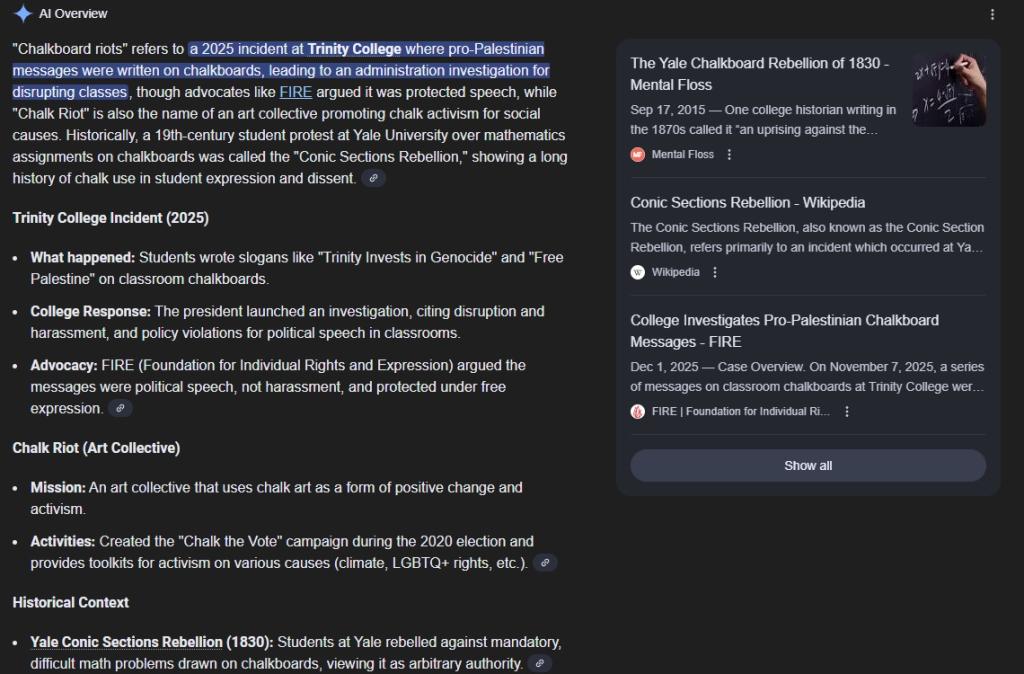
Another crucial thing to do is show students how hit or miss AI is at doing something that, if you understand the technology, it isn’t inherently capable of, namely providing information. Google’s AI previews offer lots of these. I wanted to link to the “Chalkboard Riots” (technically the “Conic Sections Rebellion”) that I mentioned and got something even better: this hodge-podge blurring of that event and more recent ones.
AI in the Context of Religious Studies
As another example, I was struck by the Christian Post advocating for an AI tool that is allegedly better for their variety of conservative Christian reader. It is called Freespoke, and the Christian Post site actually flagged it as sponsored advertising that may not reflect the values and views of that site. I nonetheless took a look. What I found was a site that aggregated news and sought to flag things that offered a viewpoint far from that of conservative Evangelicalism as “Left” so that readers would avoid them. The same news outlet would have a different rating depending on the article, suggesting that it was not just platform but content that was being filtered. The takeaway should be clear: AI can be used to reinforce biases, and never automatically eliminates them. Human programmers write the code and the programs work with human data.
There was also an article about AI pastors stealing attention away from real human ones. Not only is it possible to teach students about AI in and through religious studies courses, it is natural and indeed urgent to do so. For those of us who teach core curriculum courses, we can highlight that learning to cope with misinformation about religion in the era of AI teaches skills of media and information literacy that are directly applicable to medicine and other areas.
Conclusion
So what does that mean for educators passing through the five stages of AI grief? Accept that the technology is here to stay, and accept that as an educator you need to experimentexperiment with it, understand it, and help your students understand what will undoubtedly befall them if they rely on it uncritically. They need to be AI savvy, including a healthy dose of skepticism. As Lance Eaton writes:
With AI, yes, it will be interesting. But for all the hype, what it can actually deliver right now is still incredibly limited. A lot of the discourse is, “It’s interesting now, but just wait.” That’s been the story of AI for decades. With generative AI in particular, we’re already on year three of hearing that real artificial general intelligence is six months away.
There are serious questions about whether we can actually get there from here. When people talk about AI as transformational, a lot of that depends on moving it from here to there, and “there” keeps moving just a little farther away.
I agree that if we get there, it will change a lot of things. But there’s no guarantee that we can, at least not right now, especially when you factor in companies with billions of dollars shaping the narratives about how we talk about AI.
These same companies make comparisons of this moment to the Manhattan Project, one of the big technological gambles that paid off (sorta, given where we stand with nuclear arms and nuclear power). But there are lots of technologies that never took off, regardless of how promising they were going to be. Whether it was the Segway from Bezos or the Hyperloop from Musk, these were technologies that would change everything but have largely disappeared.
That’s the tension a lot of people in teaching and learning spaces, and in higher ed more broadly, are sitting with.
Talk to students about their views of AI. You will likely find that they want to be trusted and to trust you not to use AI inappropriately either. Help them understand how they are short changing themselves by misusing it, including relying on it uncritically, as though it were in fact intelligent. Explain where the term AI comes from and why it is a misnomer.
Use tools, from simple cloud storage folders for students to save work into (where you can see the revision history), to PISA Editor. The latter is a good start but I am sure that more robust tools for documenting the process of research and writing are still to come. There is a great opportunity for educators in any field to collaborate with colleagues in computer science to create tools that help ensure to the extent possible that students themselves engage in the assigned activities that are necessary for them to learn.
Because, as Sonja Drimmer and Christopher Nygren note, “Learning is not a problem to be solved; it’s a process to be undertaken.”
I felt like an infographic was called for and so made this about the Five Stages of AI Grief:
Technology and Religion
Education and Religion
Previous Post

January 6, 2026
Venezuela, Greenland, and the Apocalypse
Next Post

January 10, 2026 How Evangelicals View God as Like Donald Trump
Recent Comments
"V. good.For me, the gold standard for this sort of thing is still Wikihistory by ..."
The Time-Traveler’s Apprentice (A Short Story)
"The one who says "no one comes to the Father but through me" is the ..."
Attack on Religious Freedom in Indiana
"Until I read, "As a Christian, it is possible but not at all necessary to ..."
Attack on Religious Freedom in Indiana
"Hey James, regarding your penultimate paragraph, I struggle with the same issue. I do think ..."
Browse Our Archives
Select a Category 1 Corinthians 1 John 1 Peter 1 Samuel 1 Thessalonians 1 Timothy 2 Corinthians 2 Kings 2 Peter 2 Samuel 2 Thessalonians 2 Timothy academia Acts of the Apostles afterlife Akhaten Alcatraz American Academy of Religion Amos Anglican Arabic Aramaic archaeology art artificial intelligence astronomy atheism atonement Babylon 5 Baptists Battlestar Galactica Bible Biblical Studies Carnival biblioblogging Black Mirror Blade Runner Book of Job book review Buddhism Call for Papers China Christianity Christmas Christology Chronicles Coptic creation Daniel Deuteronomy Doctor Who Dune Easter Ecclesiastes economics education Eldad Keynan Enoch Seminar Ephesians eschatology Esther Evangelicals evolution Exodus Expanse Ezekiel Ezra fantasy Fringe fundamentalism Galatians games Ge'ez genealogy Genesis Gnosticism Gospel of Jesus' Wife Gospel of John Gospel of Judas Gospel of Luke Gospel of Mark Gospel of Matthew Gospel of Peter Gospel of Thomas Greek Harry Potter Hebrew Hebrews Hinduism historical Jesus history Hitchhiker's Guide to the Galaxy Holidays horror Hosea humor incarnation India inerrancy information literacy inspirational Intelligent Design Ireland Isaiah Islam Israel Italy James Jeremiah John the Baptist Jonah Joshua Judaism Jude Judges Judith Lamentations languages Latin Leviticus libraries literature Lord of the Rings LOST Mandaeans Mandaic memes Methodism Micah monotheism morality Mormons movies music mythicism NASSCAL Nehemiah new perspective New Testament news Numbers Orthodox paganism panentheism pantheism Patheos Paul and his letters Pentecostals Philippians Philippians 2:6-11 philosophy physics Planet of the Apes podcast politics Progressive Christianity Protestantism Proverbs Psalms pseudoscience racism religion Revelation Roman Catholicism Romania Romans Ruth scams science science fiction Secret Gospel of Mark Society of Biblical Literature Song of Songs Star Trek Star Wars Stargate Swahili Syriac Taoism technology Terminator The Handmaid's Tale The Hobbit The Matrix theodicy theology theory Timeless Titus tomb Torchwood travel TRON Uncategorized United Kingdom Westworld X-Files young-earth creationism Zechariah
Select a Month October 2026 September 2026 August 2026 July 2026 June 2026 May 2026 April 2026 March 2026 February 2026 January 2026 December 2025 November 2025 October 2025 September 2025 July 2025 June 2025 May 2025 April 2025 March 2025 February 2025 January 2025 December 2024 November 2024 October 2024 September 2024 August 2024 July 2024 June 2024 May 2024 April 2024 March 2024 February 2024 January 2024 December 2023 November 2023 October 2023 September 2023 August 2023 July 2023 May 2023 April 2023 March 2023 February 2023 January 2023 December 2022 November 2022 October 2022 September 2022 August 2022 July 2022 June 2022 May 2022 April 2022 March 2022 February 2022 January 2022 December 2021 November 2021 October 2021 September 2021 August 2021 July 2021 June 2021 May 2021 April 2021 March 2021 February 2021 January 2021 December 2020 November 2020 October 2020 September 2020 August 2020 July 2020 June 2020 May 2020 April 2020 March 2020 February 2020 January 2020 December 2019 November 2019 October 2019 September 2019 August 2019 July 2019 June 2019 May 2019 April 2019 March 2019 February 2019 January 2019 December 2018 November 2018 October 2018 September 2018 August 2018 July 2018 June 2018 May 2018 April 2018 March 2018 February 2018 January 2018 December 2017 November 2017 October 2017 September 2017 August 2017 July 2017 June 2017 May 2017 April 2017 March 2017 February 2017 January 2017 December 2016 November 2016 October 2016 September 2016 August 2016 July 2016 June 2016 May 2016 April 2016 March 2016 February 2016 January 2016 December 2015 November 2015 October 2015 September 2015 August 2015 July 2015 June 2015 May 2015 April 2015 March 2015 February 2015 January 2015 December 2014 November 2014 October 2014 September 2014 August 2014 July 2014 June 2014 May 2014 April 2014 March 2014 February 2014 January 2014 December 2013 November 2013 October 2013 September 2013 August 2013 July 2013 June 2013 May 2013 April 2013 March 2013 February 2013 January 2013 December 2012 November 2012 October 2012 September 2012 August 2012 July 2012 June 2012 May 2012 April 2012 March 2012 February 2012 January 2012 December 2011 November 2011 October 2011 September 2011 August 2011 July 2011 June 2011 May 2011 April 2011 March 2011 February 2011 January 2011 December 2010 November 2010 October 2010 September 2010 August 2010 July 2010 June 2010 May 2010 April 2010 March 2010 February 2010 January 2010 December 2009 November 2009 October 2009 September 2009 August 2009 July 2009 June 2009 May 2009 April 2009 March 2009 February 2009 January 2009 December 2008 November 2008 October 2008 September 2008 August 2008 July 2008 June 2008 May 2008 April 2008 March 2008 February 2008 January 2008 December 2007 November 2007 October 2007 September 2007 August 2007 July 2007 June 2007 February 2007 January 2001
Follow Us!
TAKE THE
Religious Wisdom Quiz
Who is the head of the Vatican City and the Roman Catholic Church?
Select your answer to see how you score.
Patriarch Archbishop Cardinal Pope
Books by This Author Books by James F. McGrath
Related posts from Religion Prof: The Blog of James F. McGrath

Religion Prof: The Blog of James F. McGrath

Rogue AI Isn't the Threat You Think It...
Religion Prof: The Blog of James F. McGrath

AI Syllabus Statements You Can Steal for Your...
Religion Prof: The Blog of James F. McGrath

AGI Has Not Arrived, and No Tech Company...
Religion Prof: The Blog of James F. McGrath
TRENDING AT PATHEOS Progressive Christian

The Sermon on the Mount, Part I: Matthew...
The Sermon on the Mount, Part I (Matthew 4:12-5:12) St. Matthew moves...

What's up from Crossway: Reviewing some of their latest A few weeks...

Janie Learns the Way of the Cross: A...
Teaching children about Jesus' Passion can be challenging. Many parents and educators...

Looking For Good Catholic Writing - October 2026
He alone extends the heavens, and he walks upon the waves of...

In "Irreplaceable," our book on vocation and technology, Trevor Sutton and I...

I was strolling through the top floor of the brand new Parthenon...
view all Progressive Christian blogs
What Are Your Thoughts?leave a comment
Ad-Free & Subscriber Log-In Subscription Support
- About Us
- 2026 Calendar
- Videos
- Podcasts
- Library of World Religions
- Faith In Media Tracker
- Advertise With Us
- Write for Us
- Privacy Policy
- Terms of Service
- Do Not Sell My Data
- Contact Us
- Radiant Digital
- Manage Newsletter Subscriptions
- Unsubscribe From Notifications
- Sitemap
Copyright 2008-2026, Patheos. All rights reserved.
Subscription Support Ad-Free & Subscriber Log-In
Follow Patheos