
BuddhistCatholicContemplativeEvangelicalGeneral ChristianHinduJewishLatter-day SaintMuslimNew VisionsProgressive Christian
Beliefs
- Buddhist
- Catholic
- Contemplative
- Evangelical
- General Christian
- Hindu
- Jewish
- Latter-day Saint
- More Voices
- Muslim
- New Visions
- Pagan
- Progressive Christian
Topics
- Religion News
- Food and Religion
- Sports and Religion
- Religious Art
- Religious Music and Entertainment
- Religious Events
- History and Religion
- Style and Religion
- Politics and Religion
- Women in Religion
- Recreation Outdoors and Religion
- Business Finance and Religion
- Careers Workplace and Religion
- Education and Religion
- Family Parenting and Religion
- Health Fitness and Religion
- Home and Religion
- Relationships and Religion
- Technology and Religion
- Travel and Religion
Columnists
- Buddhist Columnists
- Business Finance and Religion Columnists
- Careers Workplace and Religion Columnists
- Catholic Columnists
- Contemplative Columnists
- Education and Religion Columnists
- Evangelists Columnists
- Family Parenting and Religion Columnists
- General Christian Columnists
- Health Fitness and Religion Columnists
- Hindu Columnists
- History and Religion Columnists
- Home and Religion Columnists
- Jewish Columnists
- More Voices Columnists
- Latter Day Columnists
- Muslim Columnists
- New Visions Columnists
- Nonreligious Columnists
- Pagan Columnists
- Politics and Religion Columnists
- Progressive Columnists
- Recreation Outdoors and Religion Columnists
- Relationships and Religion Columnists
- Religion News Columnists
- Religious Art Columnists
- Religious Events Columnists
- Religious Music and Entertainment Columnists
- Sports and Religion Columnists
- Style and Religion Columnists
- Technology and Religion Columnists
- Travel and Religion Columnists
- Women in Religion Columnists
Resource Library
- 2026 Calendar
- Library of World Religions
- The 100 Most Holy Places on Earth
- Patheos Answers
- Podcasts
- Videos
- Faith Leaders Database
- Anglican Episcopalian
- Bahai
- Baptist
- Buddhism
- Christianity
- Confucianism
- Eastern Orthodoxy
- Hinduism
- Holiness and Pentecostal
- ISKCON
- Islam
- Judaism
- Lutheran
- Methodist
- The Church of Jesus Christ of Latter-day Saints
- New Age
- Paganism
- Presbytarian and Reformed
- Protestantism
- Religion Behind the Scenes
- Roman Catholic
- Scientology
- Shia Islam
- Sikhism
- Sufism
- Sunni Islam
- Taoism
- Zen
- See all religions
Research Tools
 Ad-Free & Subscriber Log-In Subscription Support
Ad-Free & Subscriber Log-In Subscription Support
Follow Patheos 

- Trending:
- Forgiveness
- |
- Marriage
- |
- Consciousness
- |
- Death Penalty
- |
- Election
- |
- Halloween

- Home
- About Dr. James F. McGrath
- Publications
- Blogroll
- Useful Websites
- Connections
- Easy Search Posts Page
- FREE NEWSLETTER
- Home
- Progressive Christian
- Technology and Religion
- John’s Adoptionist Christology? Limits of AI Lit Reviews
John’s Adoptionist Christology? Limits of AI Lit Reviews
Last updated on: March 3, 2025 at 7:17 am by James F. McGrath
John’s Adoptionist Christology? Limits of AI Lit Reviews 2025-03-02T17:43:50-05:00 James F. McGrath
Patheos Explore the world's faith through different perspectives on religion and spirituality! Patheos has the views of the prevalent religions and spiritualities of the world.
At a recent gathering of local New Testament scholars here in Indianapolis, the question of whether the Gospel of John’s Christology might be adoptionist came up. In my own work on the Gospel of John, I looked closely at the few and often neglected academic studies of this topic, and found myself persuaded that the Gospel of John can be plausibly interpreted in this way. My very first academic publication, in Princeton’s journal of graduate research Koinonia Journal, addressed this topic. Since it is rather niche and not the dominant view on the internet nor in print, it seemed like a good way to test the capacity and limitations of AI to perform literature reviews.
For those unfamiliar with the term, a literature review is what academic (especially graduate students) do prior to trying to break new ground with their research. For a researcher, the question of what has already been done is the crucial foundation for trying to say something new. If you are not a professional researcher, your own investigation is probably asking much the same question: what conclusions have others drawn on this topic? Thus for any and all interested parties, the “lit review” gets you at what you need to know. So how do AI tools do in providing this?
The Test
I gave ChatGPT, Perplexity, and Grok the same prompt: Perform a literature review on the question of whether the Christology of the Gospel of John is rightly categorized as adoptionist. Perplexity and Grok got right to work. It is difficult to know whether the scratchpad in which an LLM supposedly “shows its work” is evidence of its reasoning process. It is entirely possible that it is simply the LLM generating more of the kind of output that LLMs generate, showing what would be plausible text if a human were working through the process in imitation of human text, rather than a genuine presentation of its reasoning. Because machine learning algorithms are a black box, we cannot know.
At any rate, Grok showed its work by writing “The request is about Christology in the Gospel of John and its adoptionist categorization. First, I’m figuring out what Christology means and the adoptionist concept.” Not a promising start, but things got worse as it turned to Wikipedia, Brittanica, gotquestions, and Desiring God websites. You can hopefully see why I’m skeptical that LLMs are genuinely showing us their reasoning. It is not as though an LLM had not been trained on all these texts already.
It supposedly searched for “adoptionism in the Gospel of John” and got 10 weak generic web results. Nothing academic, nothing likely to reflect relevant scholarship. When it did eventually refer to New Testament scholars, they were D. A. Carson and Leon Morris.
Perplexity drew heavily on The Gospel Coalition and cited Mike Bird. Readers may recall that I expressed disappointment with Mike Bird’s book on this topic. It showed a complete lack of awareness of the relevant scholarship on the Gospel of John’s Christology and adoptionism.
The Winner
ChatGPT did a much better job. It asked a follow-up question about the scope of my interest, which has become a standard feature in its Deep Research functionality. It then worked on the question for quite some time after the other two platforms had produced their output. The most striking and exciting moment was when I happened to notice what it was currently working on. It was looking for “McGrath 1996 adoption…”
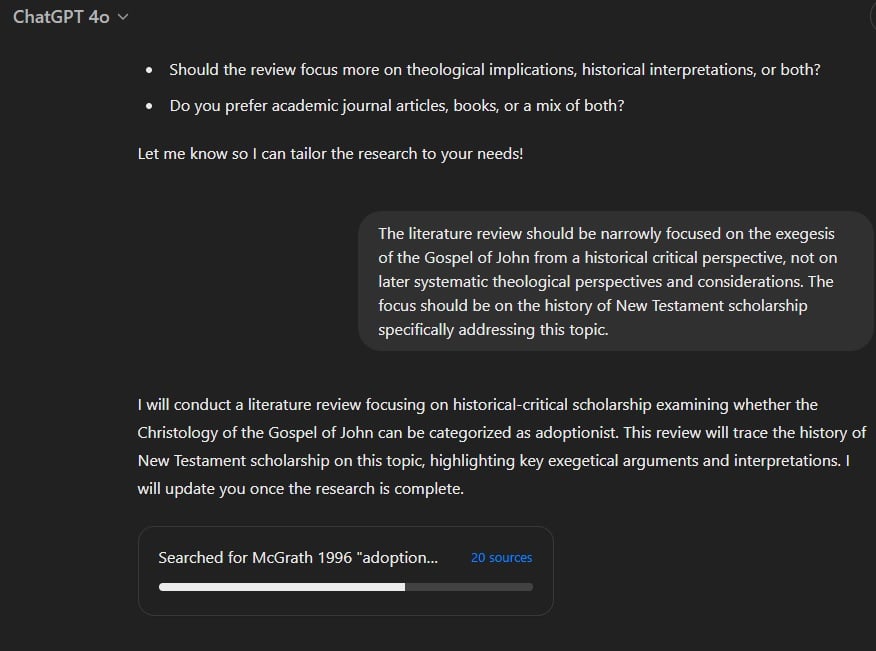
Eventually when it was done, it had found that article of mine via James Tabor’s blog. It also seemed to be looking for my thesis on Durham University’s repository of theses. Again, whether this genuinely reflected something akin to a reasoning process is hard to say. Can you see the sidebar the same way I can?
ChatGPT didn’t go to my article first, I should point out. It initially got things in the right order, starting with Reginald Fuller’s 1976 “The Incarnation in Historical Perspective.” Then it proceeded to Francis Watson. While I am honored that it turned to me next, it would have been more chronologically appropriate for Charles Talbert to be next, then me, and then Pamela Kinlaw.
Ultimately ChatGPT too emphasized that this is not the dominant view of John’s Christology. Unlike the others, it provided and interacted with the right sources. This was the bibliography:
Brown, Raymond E. An Introduction to New Testament Christology. New York: Paulist Press, 1994.
Ehrman, Bart D. How Jesus Became God: The Exaltation of a Jewish Preacher from Galilee. New York: HarperOne, 2014.
Fuller, Reginald H. “The Incarnation in Historical Perspective.” In Theology and Culture: Essays in Honor of A. T. Mollegen, 57–66. Anglican Theological Review Supp. Series 7, 1976.
Kinlaw, Pamela E. The Christ is Jesus: Metamorphosis, Possession, and Johannine Christology. SBL/Brill, 2005.
McGrath, James F. “Johannine Christianity – Jewish Christianity?” Koinonia 8.1 (1996): 1–20.
Watson, Francis. “Is John’s Christology Adoptionist?” In The Glory of Christ in the New Testament: Studies in Christology, ed. L. D. Hurst & N. T. Wright, 113–124. Oxford: Clarendon, 1987.
The Reason
My impression is that it was able to do so well due to the source that it cited, Michael Kok’s blog and his post citing these and other relevant sources.
Its conclusion was this:
In light of the textual evidence and scholarly study, the Christology of the Gospel of John is overwhelmingly characterized as incarnational (high), not adoptionist (low). Historical-critical scholarship has largely confirmed what the Gospel’s patristic reception already suggested: John presents Jesus as the pre-existent Son who became human, rather than a human who was elevated to Sonship. Key debates in the literature – such as the timing of “the Word became flesh” or the nature of Jesus’ anointing by the Spirit – have probed whether any adoptionist interpretation is tenable. The consensus outcome of these debates is that any adoptionist reading of John is at best forced and at worst contradicted by the Gospel’s central claims. As Francis Watson concluded after thorough analysis, John’s Gospel does not espouse an adoptionist Christology. Rather, it consciously asserts a view of Christ that transcends that category.
Kok’s judgment becomes ChatGPT’s judgment. He and it may be right or wrong, just as I may be right or wrong about this. In the context of the present discussion, which is about the technology more than the Christological question per se, the most interesting thing that deserves further investigation is why and how ChatGPT did so much better than its competitors. Ultimately the black box character of machine learning algorithms means that we cannot know for certain. What is to be noted is that it could only offer major academic publications inasmuch as these were mentioned online in places that are not paywalled. My books that touch on this topic are never mentioned.
The Takeaway
What is to be highlighted and emphasized is that an LLM performing a literature review will only do as well as the best available human-created material available online and not behind a paywall. It may do significantly worse, but it simply cannot do better by virtue of what the technology is and does, and what it has access to. Thus it needs to be emphasized that outsourcing your literature review to an LLM tout court is seriously unwise. This point applies to those doing academic literature reviews prior to their own research, as well as those simply asking an LLM to answer a question (such as the one I focused on here about the Christology in the Gospel of John).
The fact that we call these systems “artificial intelligence” doesn’t mean that they can do what you do. They have an exponentially larger set of data points by an order of magnitude that the human mind finds unfathomable. It is easy to be impressed and the reaction is appropriate. Deferring to the technology, however, reflects a serious misunderstanding. This is a system trained on human text that can often connect you with answers found in that human text more quickly than you would have managed on your own. Even in that best case scenario (note again the much more disappointing outputs of Grok and Perplexity) it does what it does because it was trained on human text.
Ultimately it is never ever the AI that is providing the information you need. It is human beings, with the AI sometimes connecting you effectively with that human-generated content, even as the more familiar and older AI tool of Google search has long done.
I have shared the chat with ChatGPT so that you can see it for yourself.
The Fun
As I was working on this, I also read an article that was praising the ability of Claude to create games in response to prompts from users. Like the author of that article, I was impressed by what it was able to do, and am eager to explore the potential uses of this for educators.
I asked Claude to create a game in which one solves riddles from Jesus. This is a link to what it came up with. Try out the game and let me know what you think. It may seem “rudimentary” until you consider that it was created by an AI in a matter of seconds in response to a vague half-baked idea that I provided. If you try it out, you will see that it is not without issues. Yet it had some impressive features, including accepting “kingdom of God” as a response when the hint text from the Gospel of Matthew made me wonder whether only “kingdom of heaven” would be accepted.
Since I am teaching Women in Early Christianity this semester, I also asked Claude for a game about women in the teaching of Jesus. It offered a board game, and while I am not sure it is a marketable product or something that students would find fun, to have a game on a specific topic generated in seconds is itself impressive. Here too I think the point is that AI can be a useful tool in exploring ideas and possibilities, and realizing them in at least rough draft form very quickly. It is not poised to replace human beings or to offer what we alone can.
The Rest
For more from me on this topic (with lots of links to others):
Of related interest elsewhere:
Follow Liza Long’s Substack
Here are two recent podcasts from Tripp Fuller:
The Tech Takeover: Reimagining Connection in a Digital World
The New Colonialism: Power, Data, and the Transformation of Human Experience
From AI in Society:
The AI Recruiter Will See You Now
From Inside Higher Ed:
Cheating, and Assessment, and AI
AI Companies Want to Take Educators’ Jobs
From Existential Comics: Residential Philosopher for AI Ethics
From this post, hopefully I have made clear some of the shortcomings of AI as well as good reason to be skeptical of hyped marketing claims about the capacity of AI to replace humans. Let me thus end with a video that illustrates how humans using AI tools can accomplish amazing things.
Technology and Religion
Previous Post

March 1, 2025
Artificial Intelligence and Plagiarism
Next Post

March 5, 2025 The Assault on Diversity, Equity, and Inclusion
Recent Comments
"V. good.For me, the gold standard for this sort of thing is still Wikihistory by ..."
The Time-Traveler’s Apprentice (A Short Story)
"The one who says "no one comes to the Father but through me" is the ..."
Attack on Religious Freedom in Indiana
"Until I read, "As a Christian, it is possible but not at all necessary to ..."
Attack on Religious Freedom in Indiana
"Hey James, regarding your penultimate paragraph, I struggle with the same issue. I do think ..."
Browse Our Archives
Select a Category 1 Corinthians 1 John 1 Peter 1 Samuel 1 Thessalonians 1 Timothy 2 Corinthians 2 Kings 2 Peter 2 Samuel 2 Thessalonians 2 Timothy academia Acts of the Apostles afterlife Akhaten Alcatraz American Academy of Religion Amos Anglican Arabic Aramaic archaeology art artificial intelligence astronomy atheism atonement Babylon 5 Baptists Battlestar Galactica Bible Biblical Studies Carnival biblioblogging Black Mirror Blade Runner Book of Job book review Buddhism Call for Papers China Christianity Christmas Christology Chronicles Coptic creation Daniel Deuteronomy Doctor Who Dune Easter Ecclesiastes economics education Eldad Keynan Enoch Seminar Ephesians eschatology Esther Evangelicals evolution Exodus Expanse Ezekiel Ezra fantasy Fringe fundamentalism Galatians games Ge'ez genealogy Genesis Gnosticism Gospel of Jesus' Wife Gospel of John Gospel of Judas Gospel of Luke Gospel of Mark Gospel of Matthew Gospel of Peter Gospel of Thomas Greek Harry Potter Hebrew Hebrews Hinduism historical Jesus history Hitchhiker's Guide to the Galaxy Holidays horror Hosea humor incarnation India inerrancy information literacy inspirational Intelligent Design Ireland Isaiah Islam Israel Italy James Jeremiah John the Baptist Jonah Joshua Judaism Jude Judges Judith Lamentations languages Latin Leviticus libraries literature Lord of the Rings LOST Mandaeans Mandaic memes Methodism Micah monotheism morality Mormons movies music mythicism NASSCAL Nehemiah new perspective New Testament news Numbers Orthodox paganism panentheism pantheism Patheos Paul and his letters Pentecostals Philippians Philippians 2:6-11 philosophy physics Planet of the Apes podcast politics Progressive Christianity Protestantism Proverbs Psalms pseudoscience racism religion Revelation Roman Catholicism Romania Romans Ruth scams science science fiction Secret Gospel of Mark Society of Biblical Literature Song of Songs Star Trek Star Wars Stargate Swahili Syriac Taoism technology Terminator The Handmaid's Tale The Hobbit The Matrix theodicy theology theory Timeless Titus tomb Torchwood travel TRON Uncategorized United Kingdom Westworld X-Files young-earth creationism Zechariah
Select a Month October 2026 September 2026 August 2026 July 2026 June 2026 May 2026 April 2026 March 2026 February 2026 January 2026 December 2025 November 2025 October 2025 September 2025 July 2025 June 2025 May 2025 April 2025 March 2025 February 2025 January 2025 December 2024 November 2024 October 2024 September 2024 August 2024 July 2024 June 2024 May 2024 April 2024 March 2024 February 2024 January 2024 December 2023 November 2023 October 2023 September 2023 August 2023 July 2023 May 2023 April 2023 March 2023 February 2023 January 2023 December 2022 November 2022 October 2022 September 2022 August 2022 July 2022 June 2022 May 2022 April 2022 March 2022 February 2022 January 2022 December 2021 November 2021 October 2021 September 2021 August 2021 July 2021 June 2021 May 2021 April 2021 March 2021 February 2021 January 2021 December 2020 November 2020 October 2020 September 2020 August 2020 July 2020 June 2020 May 2020 April 2020 March 2020 February 2020 January 2020 December 2019 November 2019 October 2019 September 2019 August 2019 July 2019 June 2019 May 2019 April 2019 March 2019 February 2019 January 2019 December 2018 November 2018 October 2018 September 2018 August 2018 July 2018 June 2018 May 2018 April 2018 March 2018 February 2018 January 2018 December 2017 November 2017 October 2017 September 2017 August 2017 July 2017 June 2017 May 2017 April 2017 March 2017 February 2017 January 2017 December 2016 November 2016 October 2016 September 2016 August 2016 July 2016 June 2016 May 2016 April 2016 March 2016 February 2016 January 2016 December 2015 November 2015 October 2015 September 2015 August 2015 July 2015 June 2015 May 2015 April 2015 March 2015 February 2015 January 2015 December 2014 November 2014 October 2014 September 2014 August 2014 July 2014 June 2014 May 2014 April 2014 March 2014 February 2014 January 2014 December 2013 November 2013 October 2013 September 2013 August 2013 July 2013 June 2013 May 2013 April 2013 March 2013 February 2013 January 2013 December 2012 November 2012 October 2012 September 2012 August 2012 July 2012 June 2012 May 2012 April 2012 March 2012 February 2012 January 2012 December 2011 November 2011 October 2011 September 2011 August 2011 July 2011 June 2011 May 2011 April 2011 March 2011 February 2011 January 2011 December 2010 November 2010 October 2010 September 2010 August 2010 July 2010 June 2010 May 2010 April 2010 March 2010 February 2010 January 2010 December 2009 November 2009 October 2009 September 2009 August 2009 July 2009 June 2009 May 2009 April 2009 March 2009 February 2009 January 2009 December 2008 November 2008 October 2008 September 2008 August 2008 July 2008 June 2008 May 2008 April 2008 March 2008 February 2008 January 2008 December 2007 November 2007 October 2007 September 2007 August 2007 July 2007 June 2007 February 2007 January 2001
Follow Us!
TAKE THE
Religious Wisdom Quiz
In Philemon, what does Paul call Onesimus?
Select your answer to see how you score.
My friend My very heart My brother My helper
Books by This Author Books by James F. McGrath
Related posts from Religion Prof: The Blog of James F. McGrath

Religion Prof: The Blog of James F. McGrath

Christology within Judaism (Enoch Seminar June 2026)
Religion Prof: The Blog of James F. McGrath

Religion Prof: The Blog of James F. McGrath

Artificial Intelligence and Plagiarism
Religion Prof: The Blog of James F. McGrath
TRENDING AT PATHEOS Progressive Christian

I was strolling through the top floor of the brand new Parthenon...

What Does Gêvâh Mean For Kimberley Guifoyle &...
This week, a lot of the news is focused on Kimberly Guilfoyle....

INNER CIRCLE: Profound Mystery (Of Christ In All...
Ephesians 5:31-32 “For this reason, a man will leave his father and...

Do Not Rejoice When Your Enemy Falls: The...
Turning an execution into a public spectacle is a disturbing expression of...

'The Chosen' S6 Trailer: The Passion Gets Very...
Not many watching 'The Chosen' worry about spoilers, but just because they...

The purpose-driven labor priest
A labor activist reads Rick Warren and it gets me wondering about...
view all Progressive Christian blogs
What Are Your Thoughts?leave a comment
Ad-Free & Subscriber Log-In Subscription Support
- About Us
- 2026 Calendar
- Videos
- Podcasts
- Library of World Religions
- Faith In Media Tracker
- Advertise With Us
- Write for Us
- Privacy Policy
- Terms of Service
- Do Not Sell My Data
- Contact Us
- Radiant Digital
- Manage Newsletter Subscriptions
- Unsubscribe From Notifications
- Sitemap
Copyright 2008-2026, Patheos. All rights reserved.
Subscription Support Ad-Free & Subscriber Log-In
Follow Patheos