
BuddhistCatholicContemplativeEvangelicalGeneral ChristianHinduJewishLatter-day SaintMuslimNew VisionsProgressive Christian
Beliefs
- Buddhist
- Catholic
- Contemplative
- Evangelical
- General Christian
- Hindu
- Jewish
- Latter-day Saint
- More Voices
- Muslim
- New Visions
- Pagan
- Progressive Christian
Topics
- Religion News
- Food and Religion
- Sports and Religion
- Religious Art
- Religious Music and Entertainment
- Religious Events
- History and Religion
- Style and Religion
- Politics and Religion
- Women in Religion
- Recreation Outdoors and Religion
- Business Finance and Religion
- Careers Workplace and Religion
- Education and Religion
- Family Parenting and Religion
- Health Fitness and Religion
- Home and Religion
- Relationships and Religion
- Technology and Religion
- Travel and Religion
Columnists
- Buddhist Columnists
- Business Finance and Religion Columnists
- Careers Workplace and Religion Columnists
- Catholic Columnists
- Contemplative Columnists
- Education and Religion Columnists
- Evangelists Columnists
- Family Parenting and Religion Columnists
- General Christian Columnists
- Health Fitness and Religion Columnists
- Hindu Columnists
- History and Religion Columnists
- Home and Religion Columnists
- Jewish Columnists
- More Voices Columnists
- Latter Day Columnists
- Muslim Columnists
- New Visions Columnists
- Nonreligious Columnists
- Pagan Columnists
- Politics and Religion Columnists
- Progressive Columnists
- Recreation Outdoors and Religion Columnists
- Relationships and Religion Columnists
- Religion News Columnists
- Religious Art Columnists
- Religious Events Columnists
- Religious Music and Entertainment Columnists
- Sports and Religion Columnists
- Style and Religion Columnists
- Technology and Religion Columnists
- Travel and Religion Columnists
- Women in Religion Columnists
Resource Library
- 2026 Calendar
- Library of World Religions
- The 100 Most Holy Places on Earth
- Patheos Answers
- Podcasts
- Videos
- Faith Leaders Database
- Anglican Episcopalian
- Bahai
- Baptist
- Buddhism
- Christianity
- Confucianism
- Eastern Orthodoxy
- Hinduism
- Holiness and Pentecostal
- ISKCON
- Islam
- Judaism
- Lutheran
- Methodist
- The Church of Jesus Christ of Latter-day Saints
- New Age
- Paganism
- Presbytarian and Reformed
- Protestantism
- Religion Behind the Scenes
- Roman Catholic
- Scientology
- Shia Islam
- Sikhism
- Sufism
- Sunni Islam
- Taoism
- Zen
- See all religions
Research Tools
 Ad-Free & Subscriber Log-In Subscription Support
Ad-Free & Subscriber Log-In Subscription Support
Follow Patheos 

- Trending:
- Forgiveness
- |
- Marriage
- |
- Consciousness
- |
- Death Penalty
- |
- Election
- |
- Halloween

- Home
- About Dr. James F. McGrath
- Publications
- Blogroll
- Useful Websites
- Connections
- Easy Search Posts Page
- FREE NEWSLETTER
- Home
- Progressive Christian
- Religious Art
- The Freedom to Be Offended and to Offend: At the Intersection of Academic Freedom, Art History, Respect, and Religion
The Freedom to Be Offended and to Offend: At the Intersection of Academic Freedom, Art History, Respect, and Religion
Last updated on: January 18, 2023 at 7:30 am by James F. McGrath
The Freedom to Be Offended and to Offend: At the Intersection of Academic Freedom, Art History, Respect, and Religion 2023-01-18T07:30:39-05:00 James F. McGrath
Patheos Explore the world's faith through different perspectives on religion and spirituality! Patheos has the views of the prevalent religions and spiritualities of the world.
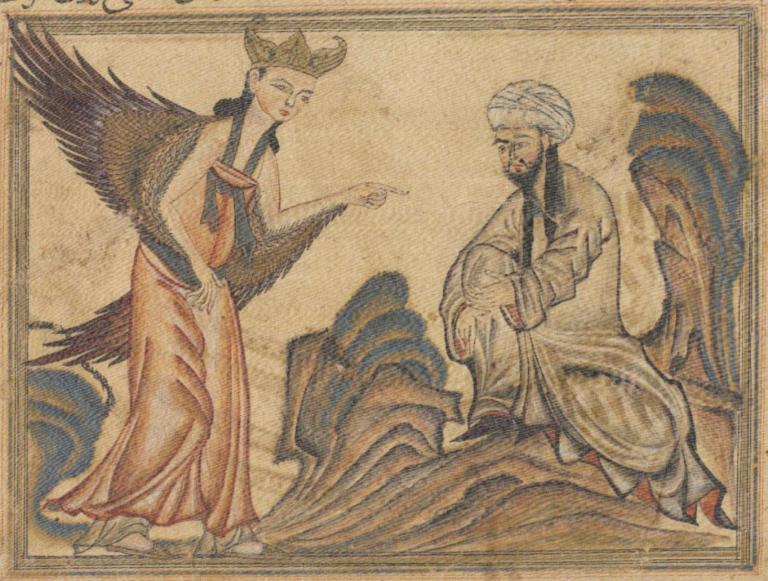
A lot of people have written already about the recent case in which Hamline University decided not to continue to employ an adjunct art history professor, Erika López Prater, after a student took offense at her showing (with due warning in advance) of a Medieval Muslim work of art depicting the prophet Muhammad. Prater is now suing Hamline. Below is my effort to articulate my stance on the matter.
Inclusivity and respect on the one hand, and freedom of expression/academic freedom on the other, are positive values. Sometimes the pursuit of one of our important values is in tension with another. Then we have to choose which to prioritize. If more institutions would indicate up front what they put first when these values conflict, there would be less shock and less public outcry when they apply their clearly-stated prioritization, even from those who might disagree with their stance.
Ultimately, for me there are two key concerns. One is that history includes things that some people find offensive. Whether one is dealing with individuals who want to believe that the historical Jesus thought of himself as fully God as per the later creeds, or individuals who want to believe that their nation never committed any atrocities, history presents inconvenient data. To hide that information is to put one’s teaching in the service of an ideologies that educators should not be required to subscribe to or promote.
Of course, that’s not strictly analogous with the case of Islam and the depiction of Muhammad, since there is nothing in conservative Christianity that constitutes a prohibition of hearing or seeing something you disagree with. In some streams of Islam, however, there is a prohibition against depicting the Prophet, and some would say that depiction of any living thing is prohibited. I think there’s more to be gained by making analogies with Judaism. Most Jews won’t pronounce the divine name, but they don’t expect others to share that scruple. If you are serving food that isn’t kosher you alert Jews and they abstain or you come to some arrangement for an alternative. The particular Muslim student who objected to the art being shown was equivalent to saying “you shouldn’t have served pork even though you announced the menu in advance and offered an alternative, because my religion prohibits me from consuming pork.” The student was demanding that no one see the image because of her scruples, in essence, wasn’t she? In a pluralist society you should not be obligated to make an image of Muhammad if you find that objectionable, but neither should you be able to prohibit others from seeing such images if they choose. There isn’t a perfect balance that will make everyone happy, but there is a tried and true approach in the United States that, however imperfect, seems to work better than alternatives.
The other major concern I have is that over-prioritizing not causing offense puts the professor in the role of deciding which voices within a tradition get to speak for that tradition and impose their values on everyone else. Not all religious people agree on what it is appropriate to see or to say. In the recent case in which an adjunct art history professor was not hired again to teach, the school did not take the side of respecting Islam, they took one side in a debate internal to Islam, the more conservative and restrictive side. To my way of thinking, more important than the issue of whether you think that is the side they ought to take is the question whether you think universities and other educational institutions ought to be taking sides in such debates at all.
When I first started teaching I subscribed to the view that I should try to keep my values and my own personal opinions out of the classroom. I eventually realized that was impossible. The very basis of what I do is value-laden. I believe that it is a positive thing for religious people (whether within my own tradition or any other) and non-religious people to critically examine their assumptions, wrestle with history as we are best able to reconstruct it, and to hear opinions different from their own. Those are values that are embraced by most who support liberal education. There are certainly instances at least on occasion when other important things should be elevated above these educational aims. However, if we prioritize other values above them as a rule, we dilute and diminish our commitment to education with all its life-transforming power. No university and no professor should do that lightly.
I also wrote the following on Facebook in response to Kate Blanchard’s article siding with Hamline against the decision and actions of the art history professor:
I am troubled by some of what you wrote in the article, as a religious studies professor. Is it really condescending “professor-splaining” if I say that most of my students who happen to be Christian have big gaps in their knowledge of their own tradition and its history, and have little prior exposure to historical-critical study of their scriptures? A Christian student who adheres to the creeds and affirms the divinity of Christ may find many conclusions of scholars—including the majority of Christian scholars—offensive. Some Protestants will be offended on the other hand if most of church history before the Reformation is taught as the history of Christianity—I was shocked to discover that in Indiana many people talk about “Christians and Catholics” as though the former denotes Protestants and Catholics are not Christians. Should we forego teaching history relevant to these controversial topics that should challenge students’ perception of their own religion? Or is that inherent in the very nature of education?
See also Jacques Berlinerblau’s and Christiane Gruber’s articles on the topic, and a statement from art history professors. Inside Higher Ed has covered the incident and shared opinion pieces. There is more background information here, including that the image below of a work of art in University of Edinburgh’s library was at the heart of the controversy. Many others have shared things that are relevant to this topic.
What are your thoughts about this? Please feel free to share them!
Religious Art
Education and Religion
Previous Post
January 16, 2023
God’s Ideal for Human Flourishing
Next Post
January 23, 2023 Why I Encouraged My Students to Use ChatGPT
Recent Comments
"V. good.For me, the gold standard for this sort of thing is still Wikihistory by ..."
The Time-Traveler’s Apprentice (A Short Story)
"The one who says "no one comes to the Father but through me" is the ..."
Attack on Religious Freedom in Indiana
"Until I read, "As a Christian, it is possible but not at all necessary to ..."
Attack on Religious Freedom in Indiana
"Hey James, regarding your penultimate paragraph, I struggle with the same issue. I do think ..."
Browse Our Archives
Select a Category 1 Corinthians 1 John 1 Peter 1 Samuel 1 Thessalonians 1 Timothy 2 Corinthians 2 Kings 2 Peter 2 Samuel 2 Thessalonians 2 Timothy academia Acts of the Apostles afterlife Akhaten Alcatraz American Academy of Religion Amos Anglican Arabic Aramaic archaeology art artificial intelligence astronomy atheism atonement Babylon 5 Baptists Battlestar Galactica Bible Biblical Studies Carnival biblioblogging Black Mirror Blade Runner Book of Job book review Buddhism Call for Papers China Christianity Christmas Christology Chronicles Coptic creation Daniel Deuteronomy Doctor Who Dune Easter Ecclesiastes economics education Eldad Keynan Enoch Seminar Ephesians eschatology Esther Evangelicals evolution Exodus Expanse Ezekiel Ezra fantasy Fringe fundamentalism Galatians games Ge'ez genealogy Genesis Gnosticism Gospel of Jesus' Wife Gospel of John Gospel of Judas Gospel of Luke Gospel of Mark Gospel of Matthew Gospel of Peter Gospel of Thomas Greek Harry Potter Hebrew Hebrews Hinduism historical Jesus history Hitchhiker's Guide to the Galaxy Holidays horror Hosea humor incarnation India inerrancy information literacy inspirational Intelligent Design Ireland Isaiah Islam Israel Italy James Jeremiah John the Baptist Jonah Joshua Judaism Jude Judges Judith Lamentations languages Latin Leviticus libraries literature Lord of the Rings LOST Mandaeans Mandaic memes Methodism Micah monotheism morality Mormons movies music mythicism NASSCAL Nehemiah new perspective New Testament news Numbers Orthodox paganism panentheism pantheism Patheos Paul and his letters Pentecostals Philippians Philippians 2:6-11 philosophy physics Planet of the Apes podcast politics Progressive Christianity Protestantism Proverbs Psalms pseudoscience racism religion Revelation Roman Catholicism Romania Romans Ruth scams science science fiction Secret Gospel of Mark Society of Biblical Literature Song of Songs Star Trek Star Wars Stargate Swahili Syriac Taoism technology Terminator The Handmaid's Tale The Hobbit The Matrix theodicy theology theory Timeless Titus tomb Torchwood travel TRON Uncategorized United Kingdom Westworld X-Files young-earth creationism Zechariah
Select a Month October 2026 September 2026 August 2026 July 2026 June 2026 May 2026 April 2026 March 2026 February 2026 January 2026 December 2025 November 2025 October 2025 September 2025 July 2025 June 2025 May 2025 April 2025 March 2025 February 2025 January 2025 December 2024 November 2024 October 2024 September 2024 August 2024 July 2024 June 2024 May 2024 April 2024 March 2024 February 2024 January 2024 December 2023 November 2023 October 2023 September 2023 August 2023 July 2023 May 2023 April 2023 March 2023 February 2023 January 2023 December 2022 November 2022 October 2022 September 2022 August 2022 July 2022 June 2022 May 2022 April 2022 March 2022 February 2022 January 2022 December 2021 November 2021 October 2021 September 2021 August 2021 July 2021 June 2021 May 2021 April 2021 March 2021 February 2021 January 2021 December 2020 November 2020 October 2020 September 2020 August 2020 July 2020 June 2020 May 2020 April 2020 March 2020 February 2020 January 2020 December 2019 November 2019 October 2019 September 2019 August 2019 July 2019 June 2019 May 2019 April 2019 March 2019 February 2019 January 2019 December 2018 November 2018 October 2018 September 2018 August 2018 July 2018 June 2018 May 2018 April 2018 March 2018 February 2018 January 2018 December 2017 November 2017 October 2017 September 2017 August 2017 July 2017 June 2017 May 2017 April 2017 March 2017 February 2017 January 2017 December 2016 November 2016 October 2016 September 2016 August 2016 July 2016 June 2016 May 2016 April 2016 March 2016 February 2016 January 2016 December 2015 November 2015 October 2015 September 2015 August 2015 July 2015 June 2015 May 2015 April 2015 March 2015 February 2015 January 2015 December 2014 November 2014 October 2014 September 2014 August 2014 July 2014 June 2014 May 2014 April 2014 March 2014 February 2014 January 2014 December 2013 November 2013 October 2013 September 2013 August 2013 July 2013 June 2013 May 2013 April 2013 March 2013 February 2013 January 2013 December 2012 November 2012 October 2012 September 2012 August 2012 July 2012 June 2012 May 2012 April 2012 March 2012 February 2012 January 2012 December 2011 November 2011 October 2011 September 2011 August 2011 July 2011 June 2011 May 2011 April 2011 March 2011 February 2011 January 2011 December 2010 November 2010 October 2010 September 2010 August 2010 July 2010 June 2010 May 2010 April 2010 March 2010 February 2010 January 2010 December 2009 November 2009 October 2009 September 2009 August 2009 July 2009 June 2009 May 2009 April 2009 March 2009 February 2009 January 2009 December 2008 November 2008 October 2008 September 2008 August 2008 July 2008 June 2008 May 2008 April 2008 March 2008 February 2008 January 2008 December 2007 November 2007 October 2007 September 2007 August 2007 July 2007 June 2007 February 2007 January 2001
Follow Us!
TAKE THE
Religious Wisdom Quiz
True or False: Cornelius was a Roman centurion who was the first Gentile convert.
Select your answer to see how you score.
TRUE FALSE
Books by This Author Books by James F. McGrath
Related posts from Religion Prof: The Blog of James F. McGrath
A Religion Scholar's Rome Recommendations
Religion Prof: The Blog of James F. McGrath
Religion Prof: The Blog of James F. McGrath

Review of Sandra van Rompaey, Mandaean Symbolic Art
Religion Prof: The Blog of James F. McGrath

Knox College Undergraduate Conference in Religious Studies
Religion Prof: The Blog of James F. McGrath
TRENDING AT PATHEOS Progressive Christian

The Sermon on the Mount, Part I: Matthew...
The Sermon on the Mount, Part I (Matthew 4:12-5:12) St. Matthew moves...

What's up from Crossway: Reviewing some of their latest A few weeks...

Janie Learns the Way of the Cross: A...
Teaching children about Jesus' Passion can be challenging. Many parents and educators...

Looking For Good Catholic Writing - October 2026
He alone extends the heavens, and he walks upon the waves of...

In "Irreplaceable," our book on vocation and technology, Trevor Sutton and I...

I was strolling through the top floor of the brand new Parthenon...
view all Progressive Christian blogs
What Are Your Thoughts?leave a comment
Ad-Free & Subscriber Log-In Subscription Support
- About Us
- 2026 Calendar
- Videos
- Podcasts
- Library of World Religions
- Faith In Media Tracker
- Advertise With Us
- Write for Us
- Privacy Policy
- Terms of Service
- Do Not Sell My Data
- Contact Us
- Radiant Digital
- Manage Newsletter Subscriptions
- Unsubscribe From Notifications
- Sitemap
Copyright 2008-2026, Patheos. All rights reserved.
Subscription Support Ad-Free & Subscriber Log-In
Follow Patheos