
BuddhistCatholicContemplativeEvangelicalGeneral ChristianHinduJewishLatter-day SaintMuslimNew VisionsProgressive Christian
Beliefs
- Buddhist
- Catholic
- Contemplative
- Evangelical
- General Christian
- Hindu
- Jewish
- Latter-day Saint
- More Voices
- Muslim
- New Visions
- Pagan
- Progressive Christian
Topics
- Religion News
- Food and Religion
- Sports and Religion
- Religious Art
- Religious Music and Entertainment
- Religious Events
- History and Religion
- Style and Religion
- Politics and Religion
- Women in Religion
- Recreation Outdoors and Religion
- Business Finance and Religion
- Careers Workplace and Religion
- Education and Religion
- Family Parenting and Religion
- Health Fitness and Religion
- Home and Religion
- Relationships and Religion
- Technology and Religion
- Travel and Religion
Columnists
- Buddhist Columnists
- Business Finance and Religion Columnists
- Careers Workplace and Religion Columnists
- Catholic Columnists
- Contemplative Columnists
- Education and Religion Columnists
- Evangelists Columnists
- Family Parenting and Religion Columnists
- General Christian Columnists
- Health Fitness and Religion Columnists
- Hindu Columnists
- History and Religion Columnists
- Home and Religion Columnists
- Jewish Columnists
- More Voices Columnists
- Latter Day Columnists
- Muslim Columnists
- New Visions Columnists
- Nonreligious Columnists
- Pagan Columnists
- Politics and Religion Columnists
- Progressive Columnists
- Recreation Outdoors and Religion Columnists
- Relationships and Religion Columnists
- Religion News Columnists
- Religious Art Columnists
- Religious Events Columnists
- Religious Music and Entertainment Columnists
- Sports and Religion Columnists
- Style and Religion Columnists
- Technology and Religion Columnists
- Travel and Religion Columnists
- Women in Religion Columnists
Resource Library
- 2026 Calendar
- Library of World Religions
- The 100 Most Holy Places on Earth
- Patheos Answers
- Podcasts
- Videos
- Faith Leaders Database
- Anglican Episcopalian
- Bahai
- Baptist
- Buddhism
- Christianity
- Confucianism
- Eastern Orthodoxy
- Hinduism
- Holiness and Pentecostal
- ISKCON
- Islam
- Judaism
- Lutheran
- Methodist
- The Church of Jesus Christ of Latter-day Saints
- New Age
- Paganism
- Presbytarian and Reformed
- Protestantism
- Religion Behind the Scenes
- Roman Catholic
- Scientology
- Shia Islam
- Sikhism
- Sufism
- Sunni Islam
- Taoism
- Zen
- See all religions
Research Tools
 Ad-Free & Subscriber Log-In Subscription Support
Follow Patheos 

- Trending:
- Advent
- |
- Forgiveness
- |
- Thanksgiving
- |
- Election
- |
- Seasonal Holidays
- |
- Marriage

- Home
- About Dr. James F. McGrath
- Publications
- Blogroll
- Useful Websites
- Connections
- Easy Search Posts Page
- FREE NEWSLETTER
- Home
- Progressive Christian
- Who is the Founder of Progressive Christianity?
Who is the Founder of Progressive Christianity?
Last updated on: July 16, 2022 at 10:00 am by James F. McGrath
Who is the Founder of Progressive Christianity? 2022-07-16T09:59:35-04:00 James F. McGrath
Patheos Explore the world's faith through different perspectives on religion and spirituality! Patheos has the views of the prevalent religions and spiritualities of the world.
Rather than give “Jesus” as a one-word answer to the question of who founded progressive Christianity, let me begin with a quote from something I wrote here on my Patheos blog some years ago which makes that same point but in more words and with more detail, which those who are skeptical of my assertion will need if they are to be persuaded:
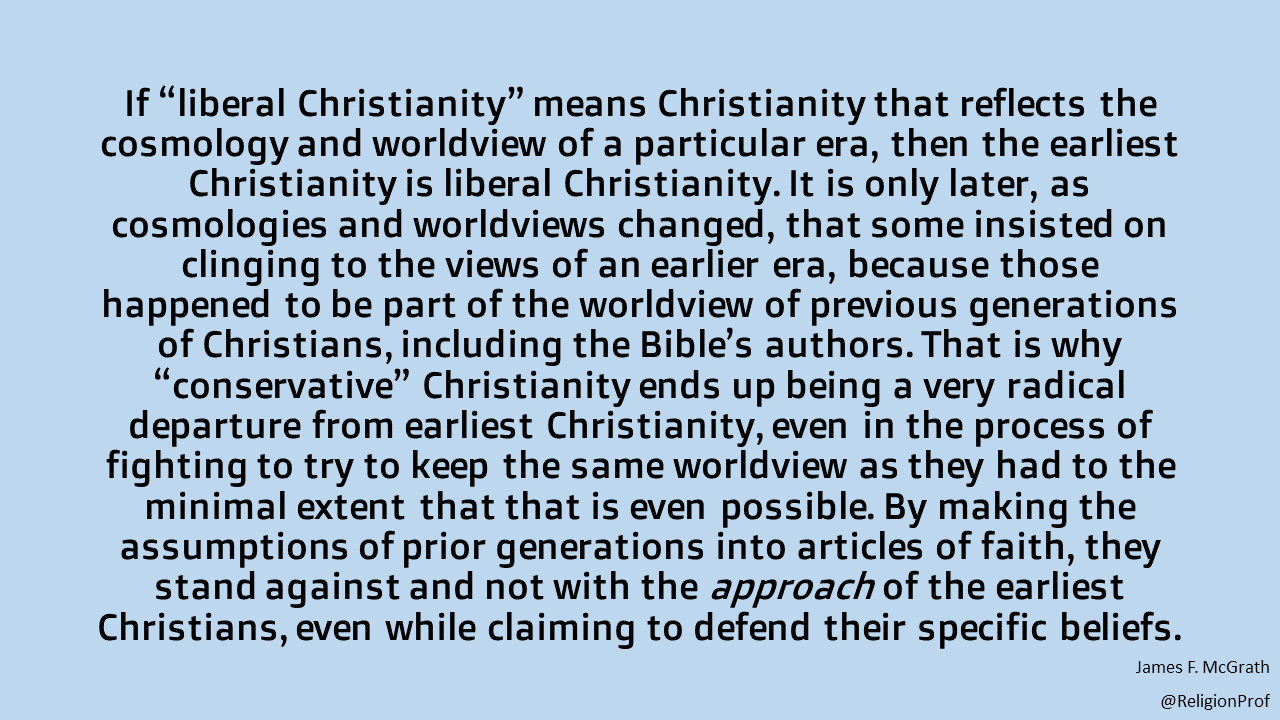
If “liberal Christianity” means Christianity that reflects the cosmology and worldview of a particular era, then the earliest Christianity is liberal Christianity. It is only later, as cosmologies and worldviews changed, that some insisted on clinging to the views of an earlier era, because those happened to be part of the worldview of previous generations of Christians, including the Bible’s authors. That is why “conservative” Christianity ends up being a very radical departure from earliest Christianity, even in the process of fighting to try to keep the same worldview as they had to the minimal extent that that is even possible. By making the assumptions of prior generations into articles of faith, they stand against and not with the approach of the earliest Christians, even while claiming to defend their specific beliefs.
Let me immediately add that it may not be helpful to speak of Jesus as the “founder” of Christianity, as though he was seeking to start a new world religion. Jesus, like most “founders” of new religions, did not intend to do so but was instead a reformer within his own religion, Judaism. The process of getting from there to here reflects the progressiveness of Jesus that I’ll be seeking to highlight here. My point is that, to the extent that progressive Christianity has a beginning, that beginning is with Jesus and has continued unabated ever since.
Everyone is more progressive or liberal than some people and less so than others. Progressive and liberal are tendencies along a spectrum and not absolute binary categories. In the case of Jesus, can anyone really deny that he was open to taking things in a new direction, to innovation and change? He taught his followers to do the same. This doesn’t mean that there weren’t elements in which Jesus was conservative, just as is true of his progressive followers today. Many progressives are also interested in getting back behind developments in doctrine and institutional structures to a simplicity they associate with Jesus and his first disciples. That’s very Protestant, and in one sense is inherently conservatives. Those who are defined as conservatives today often claim to be doing (or at least trying to do) the same thing. But those who are most often labeled conservative are seeking to go back to the supposed original beliefs and practices of Christians and to replicate them irrespective of the changes that have taken place since then and the differences between our own context and that in which Christianity first arose. Progressives, on the other hand, seek to implement in our time the same openness, the same guiding principles, that Jesus emphasized. Just as he was open to recognizing genuine and even superior faith among those who tended to be defined out of the people of God in his time (Matthew 8:10), today’s progressive Christians seek to do likewise. As Jesus envisaged Gentiles coming to the messianic banquet to dine alongside the Israelite Patriarchs (Matthew 8:11), Paul and others went against the clear teaching of Genesis which required the circumcision of all who were part of Abraham’s household. Instead these Christians insisted (over against the conservative Christians of their own time) that if God had shown that uncircumcised Gentiles are accepted by pouring out the Holy Spirit on them, circumcision must not be essential (Galatians 3:2-5). As I have said here on my blog before, “Conservative Christians often claim to be the most faithful interpreters of Scripture. But it seems to me that if we have ears to hear what the Spirit was saying to the churches down the ages, it will become clear that focusing on written words and using them to argue against what the Spirit is doing often led people to be on the ‘wrong side’ as far as the Bible’s own perspective is concerned. And part of the message of many parts of the Bible is a warning to learn from such mistakes of the past.” Paul did not feel that pointing out “what the Bible says” settled a matter. Neither did Jesus, who famously said that Moses was the one who permitted divorce in scripture but God’s ideal for human beings was lifelong fidelity (Matthew 19:8).
Those who wrote the Gospels in Greek were likewise progressive inasmuch as they cared less about preserving the exact words of Jesus in his native tongue Aramaic, than they did about communicating the core of his message as they understood it to as wide an audience as possible, which meant writing in Greek, the lingua franca of the Eastern Roman Empire. Early Christian apologists like Justin Martyr (the original “apologists” before modern internet debaters sullied the term) stood in this tradition as well, being open to Greek and Roman philosophies and the insights they offered. All through the ages there have been those who have stood in this tradition, and so in that sense there is an unbroken lineage of progressive Christianity that connects Jesus to the present day. Liberal Protestants closer to our time such as Martin Luther King Jr. must also be included. Many conservatives embrace his emphasis on racial equality, completely unaware that he represents a liberal Baptist position. If one reads his essay on the topic of the divinity, virgin birth, and resurrection of Jesus that he wrote while a student at Crozer Theological Seminary, one will find things that reflect the stance of today’s liberal and progressive Christians.
Having put matters in those terms let me now pose an important question: Why Switch to Progressive?
I realize that sounds like a slogan in a car insurance ad but that’s not what I mean here, as is hopefully clear from the context. In the first instance the question is about the terminology (which I confess I don’t find all that helpful). Why do people tend to identify as “progressive” Christians nowadays when a generation ago they tended to use the label “liberal”? Progressive doesn’t have a meaning that is clearly distinct from liberal. Moreover, some progressive or liberal Christians are theologically conservative but politically liberal, while others are the exact reverse. There’s potential for misunderstanding, to say the least. However, because liberalism reflected a stance that was very modern and shaped by the values of the Enlightenment (just as fundamentalism is shaped by that same context as the flip side of liberalism and a reaction against it), those who have accepted postmodern critiques of liberalism tend to prefer the term “progressive.” Yet the same openness to new insights (whether from biblical study, history, science, psychology, or anywhere else) characterize the two. Progressive Christianity thus reflects the present-day iteration of a liberal/progressive approach to God, faith, and other human beings that we can trace back as far as the very beginnings of Christianity, to Jesus himself.
Hopefully the above makes clear another sense in which I want to answer the question, “Why switch to Progressive?” Why do I think others should embrace progressive Christianity? Because it reflects the outlook of Jesus and his earliest followers. Christianity has always been bridging gaps, including outsiders, challenging assumptions, and innovating new beliefs and structures. Some deny that, and so rather than speak about progressive Christianity I’d much rather talk simply about Christianity, or about honest Christianity, one that doesn’t pretend that there is no picking and choosing going on, just a preservation of a faith in static stagnant sameness. That has never been the case. The key difference between progressive Christians and conservatives is that progressives acknowledge the fact that we preserve things selectively, that we pick and choose, and that we never fail to experience change. We do not view this process negatively the way conservatives do, even though they participate in the same processes, however much they might try to deny this is so.
That’s the answer in a nutshell. It could have been briefer, as I indicated at the outset. I could have said “Jesus is the founder of progressive Christianity” and left it at that. But many people today treat conservative forms of Christianity as the default, as though they genuinely represent the classic historic Christian faith. In actual fact they merely preserve a dogmatic rejection of change that arose in that specific form relatively recently in history. There were conservatives among the earliest Christians, and we read about them because they did things like opposing Paul’s proclamation to Gentiles of a gospel that did not require circumcision. It is ironic that today’s conservatives cite Paul’s letters as authoritative when they represent the stance of Paul’s opponents.
TL; DR: The core of Christianity was progressive from its beginning, and today’s progressives continue that tradition.
Also related to this topic:
Finally, a couple of memes you can share:

Previous Post

July 14, 2022
Blaming Bathsheba
Next Post

July 19, 2022 In the Footsteps of John the Baptist Part 3: Aenon near Salim
Browse Our Archives
Select a Category 1 Corinthians 1 John 1 Peter 1 Samuel 1 Thessalonians 1 Timothy 2 Corinthians 2 Kings 2 Peter 2 Samuel 2 Thessalonians 2 Timothy academia Acts of the Apostles afterlife Akhaten Alcatraz American Academy of Religion Amos Anglican Arabic Aramaic archaeology art artificial intelligence astronomy atheism atonement Babylon 5 Baptists Battlestar Galactica Bible Biblical Studies Carnival biblioblogging Black Mirror Blade Runner Book of Job book review Buddhism Call for Papers China Christianity Christmas Christology Chronicles Coptic creation Daniel Deuteronomy Doctor Who Dune Easter Ecclesiastes economics education Eldad Keynan Enoch Seminar Ephesians eschatology Esther Evangelicals evolution Exodus Expanse Ezekiel Ezra fantasy Fringe fundamentalism Galatians games Ge'ez genealogy Genesis Gnosticism Gospel of Jesus' Wife Gospel of John Gospel of Judas Gospel of Luke Gospel of Mark Gospel of Matthew Gospel of Peter Gospel of Thomas Greek Harry Potter Hebrew Hebrews Hinduism historical Jesus history Hitchhiker's Guide to the Galaxy Holidays horror Hosea humor incarnation India inerrancy information literacy inspirational Intelligent Design Ireland Isaiah Islam Israel Italy James Jeremiah John the Baptist Jonah Joshua Judaism Jude Judges Judith Lamentations languages Latin Leviticus libraries literature Lord of the Rings LOST Mandaeans Mandaic memes Methodism Micah monotheism morality Mormons movies music mythicism NASSCAL Nehemiah new perspective New Testament news Numbers Orthodox paganism panentheism pantheism Patheos Paul and his letters Pentecostals Philippians Philippians 2:6-11 philosophy physics Planet of the Apes podcast politics Progressive Christianity Protestantism Proverbs Psalms pseudoscience racism religion Revelation Roman Catholicism Romania Romans Ruth scams science science fiction Secret Gospel of Mark Society of Biblical Literature Song of Songs Star Trek Star Wars Stargate Swahili Syriac Taoism technology Terminator The Handmaid's Tale The Hobbit The Matrix theodicy theology theory Timeless Titus tomb Torchwood travel TRON Uncategorized United Kingdom Westworld X-Files young-earth creationism Zechariah
Select a Month November 2026 October 2026 September 2026 August 2026 July 2026 June 2026 May 2026 April 2026 March 2026 February 2026 January 2026 December 2025 November 2025 October 2025 September 2025 July 2025 June 2025 May 2025 April 2025 March 2025 February 2025 January 2025 December 2024 November 2024 October 2024 September 2024 August 2024 July 2024 June 2024 May 2024 April 2024 March 2024 February 2024 January 2024 December 2023 November 2023 October 2023 September 2023 August 2023 July 2023 May 2023 April 2023 March 2023 February 2023 January 2023 December 2022 November 2022 October 2022 September 2022 August 2022 July 2022 June 2022 May 2022 April 2022 March 2022 February 2022 January 2022 December 2021 November 2021 October 2021 September 2021 August 2021 July 2021 June 2021 May 2021 April 2021 March 2021 February 2021 January 2021 December 2020 November 2020 October 2020 September 2020 August 2020 July 2020 June 2020 May 2020 April 2020 March 2020 February 2020 January 2020 December 2019 November 2019 October 2019 September 2019 August 2019 July 2019 June 2019 May 2019 April 2019 March 2019 February 2019 January 2019 December 2018 November 2018 October 2018 September 2018 August 2018 July 2018 June 2018 May 2018 April 2018 March 2018 February 2018 January 2018 December 2017 November 2017 October 2017 September 2017 August 2017 July 2017 June 2017 May 2017 April 2017 March 2017 February 2017 January 2017 December 2016 November 2016 October 2016 September 2016 August 2016 July 2016 June 2016 May 2016 April 2016 March 2016 February 2016 January 2016 December 2015 November 2015 October 2015 September 2015 August 2015 July 2015 June 2015 May 2015 April 2015 March 2015 February 2015 January 2015 December 2014 November 2014 October 2014 September 2014 August 2014 July 2014 June 2014 May 2014 April 2014 March 2014 February 2014 January 2014 December 2013 November 2013 October 2013 September 2013 August 2013 July 2013 June 2013 May 2013 April 2013 March 2013 February 2013 January 2013 December 2012 November 2012 October 2012 September 2012 August 2012 July 2012 June 2012 May 2012 April 2012 March 2012 February 2012 January 2012 December 2011 November 2011 October 2011 September 2011 August 2011 July 2011 June 2011 May 2011 April 2011 March 2011 February 2011 January 2011 December 2010 November 2010 October 2010 September 2010 August 2010 July 2010 June 2010 May 2010 April 2010 March 2010 February 2010 January 2010 December 2009 November 2009 October 2009 September 2009 August 2009 July 2009 June 2009 May 2009 April 2009 March 2009 February 2009 January 2009 December 2008 November 2008 October 2008 September 2008 August 2008 July 2008 June 2008 May 2008 April 2008 March 2008 February 2008 January 2008 December 2007 November 2007 October 2007 September 2007 August 2007 July 2007 June 2007 February 2007 January 2001
Follow Us!
TAKE THE
Religious Wisdom Quiz
True or False: Jeremiah was known as the weeping prophet.
Select your answer to see how you score.
TRUE FALSE
Books by This Author Books by James F. McGrath
Related posts from Religion Prof: The Blog of James F. McGrath
Religion Prof: The Blog of James F. McGrath

Religion Prof: The Blog of James F. McGrath

Religion Prof: The Blog of James F. McGrath

Neither Conservative Nor Christian
Religion Prof: The Blog of James F. McGrath
TRENDING AT PATHEOS Progressive Christian

Are You a Scrooge or an Ebenezer?
A Call to Remember As the Christmas season rings in, will we...

Noah’s Ark Archaeologists: Gopher Wood or Should We...
Ancient wood, a boat-shaped formation and dates that invite a second look:...

Smart people saying smart things (11.24.26)
Please take time to listen to Perry Bacon, Sarah Posner, Adam Serwer,...

The Contingency of Our Technology
Last week we were hit with a raft of massive technology outages....

In 1939, President Franklin D. Roosevelt moved Thanksgiving from November 30 to...

Reasons for Restraint: Ricardo Gonzalez, Florida and Dec...
The Morning of January 3 I begin with the dead. On the...
view all Progressive Christian blogs
Ad-Free & Subscriber Log-In Subscription Support
- About Us
- 2026 Calendar
- Videos
- Podcasts
- Library of World Religions
- Faith In Media Tracker
- Advertise With Us
- Write for Us
- Privacy Policy
- Terms of Service
- Do Not Sell My Data
- Contact Us
- Radiant Digital
- Manage Newsletter Subscriptions
- Unsubscribe From Notifications
- Sitemap
Copyright 2008-2026, Patheos, part of the Radiant Digital network of media brands. All rights reserved.
Subscription Support Ad-Free & Subscriber Log-In
Follow Patheos