
BuddhistCatholicContemplativeEvangelicalGeneral ChristianHinduJewishLatter-day SaintMuslimNew VisionsProgressive Christian
Beliefs
- Buddhist
- Catholic
- Contemplative
- Evangelical
- General Christian
- Hindu
- Jewish
- Latter-day Saint
- More Voices
- Muslim
- New Visions
- Pagan
- Progressive Christian
Topics
- Religion News
- Food and Religion
- Sports and Religion
- Religious Art
- Religious Music and Entertainment
- Religious Events
- History and Religion
- Style and Religion
- Politics and Religion
- Women in Religion
- Recreation Outdoors and Religion
- Business Finance and Religion
- Careers Workplace and Religion
- Education and Religion
- Family Parenting and Religion
- Health Fitness and Religion
- Home and Religion
- Relationships and Religion
- Technology and Religion
- Travel and Religion
Columnists
- Buddhist Columnists
- Business Finance and Religion Columnists
- Careers Workplace and Religion Columnists
- Catholic Columnists
- Contemplative Columnists
- Education and Religion Columnists
- Evangelists Columnists
- Family Parenting and Religion Columnists
- General Christian Columnists
- Health Fitness and Religion Columnists
- Hindu Columnists
- History and Religion Columnists
- Home and Religion Columnists
- Jewish Columnists
- More Voices Columnists
- Latter Day Columnists
- Muslim Columnists
- New Visions Columnists
- Nonreligious Columnists
- Pagan Columnists
- Politics and Religion Columnists
- Progressive Columnists
- Recreation Outdoors and Religion Columnists
- Relationships and Religion Columnists
- Religion News Columnists
- Religious Art Columnists
- Religious Events Columnists
- Religious Music and Entertainment Columnists
- Sports and Religion Columnists
- Style and Religion Columnists
- Technology and Religion Columnists
- Travel and Religion Columnists
- Women in Religion Columnists
Resource Library
- 2026 Calendar
- Library of World Religions
- The 100 Most Holy Places on Earth
- Patheos Answers
- Podcasts
- Videos
- Faith Leaders Database
- Anglican Episcopalian
- Bahai
- Baptist
- Buddhism
- Christianity
- Confucianism
- Eastern Orthodoxy
- Hinduism
- Holiness and Pentecostal
- ISKCON
- Islam
- Judaism
- Lutheran
- Methodist
- The Church of Jesus Christ of Latter-day Saints
- New Age
- Paganism
- Presbytarian and Reformed
- Protestantism
- Religion Behind the Scenes
- Roman Catholic
- Scientology
- Shia Islam
- Sikhism
- Sufism
- Sunni Islam
- Taoism
- Zen
- See all religions
Research Tools
 Ad-Free & Subscriber Log-In Subscription Support
Ad-Free & Subscriber Log-In Subscription Support
Follow Patheos 

- Trending:
- Forgiveness
- |
- Marriage
- |
- Consciousness
- |
- Death Penalty
- |
- Election
- |
- Halloween

- Home
- About Dr. James F. McGrath
- Publications
- Blogroll
- Useful Websites
- Connections
- Easy Search Posts Page
- FREE NEWSLETTER
- Home
- Progressive Christian
- The Past, Present, and Future of Christianity in Science Fiction Part Three: Future
The Past, Present, and Future of Christianity in Science Fiction Part Three: Future
Last updated on: April 23, 2021 at 5:11 am by James F. McGrath
The Past, Present, and Future of Christianity in Science Fiction Part Three: Future 2021-04-22T11:17:09-04:00 James F. McGrath
Patheos Explore the world's faith through different perspectives on religion and spirituality! Patheos has the views of the prevalent religions and spiritualities of the world.
Future: Telling the old old story ten thousand years from now
Science fiction sometimes depicts Christianity as it might become in the future, as well as futures in which there seems to be little or no place for it or memory of it. Such stories provide a helpful counterbalance to the tendency to treat our own time and perspective as normative. In every Christian denomination, someone at some point has drawn up a timeline of church history, typically reaching its zenith in their own denomination. If we imagine that the future from then on will simply preserve this purported perfection with no need for or experience of further change, we are clearly fooling ourselves. But we sometimes do indeed manage to fool ourselves, which is why it is a useful exercise to draw the timeline further, to imagine the future as it might be, whether in utopian, dystopian, or realist fashion.
The Expanse incorporated the Church of Jesus Christ of Latter-Day Saints into its story for a very pragmatic reason: the storytellers needed there to be a very large spaceship of a sort that could be used to take a sizeable population to another world. Asking who could realistically be expected to build such a thing, human governments with their focus on immediate problems and reelection quickly excluded themselves as serious contenders. The LDS Church, on the other hand, could be imagined in the future to have both the funds to undertake such an endeavor, and a theological framework that might lead them to actually do so. Sometimes a particular type of religious figure or theological concept is just what is needed to tell a particular story or accomplish a particular future. [click SLIDE]
The Expanse also provides a good example of the depiction of a Christian clergyperson in a manner that is futuristic yet directly related to current trajectories. Rev. Anna Volovodov is both sympathetic and fallible. In other words, she is portrayed as genuinely and realistically human in a way that clergy in fiction aren’t always.
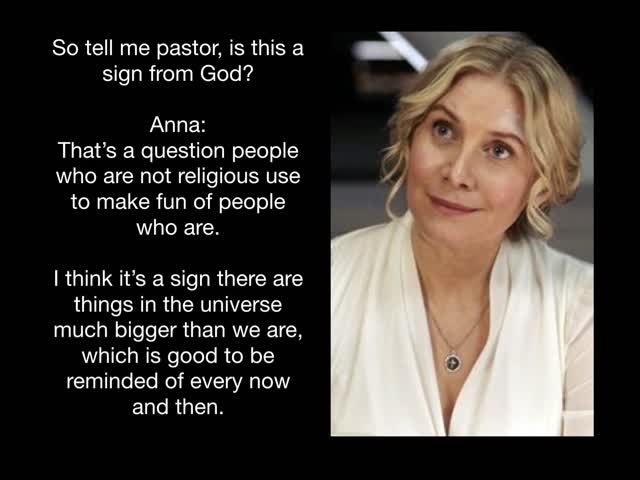
Anna is a Methodist, representing the Christian liberal mainline in her activism for matters of socioeconomic justice, her peacemaking concerns, and her marriage. Since there is no one Methodist church these characteristics are entirely plausible even today, never mind a few centuries from now. (I avoided saying “united Methodist” since capitalized that is the title of one of the many Methodist denominations). Anna offers good responses to those who mock her faith, and avoids offering pat answers to questions. Yet in one instance, in the very act of doing that, she fails to offer comfort to a fellow Methodist who is experiencing a crisis. She is human, well-rounded, and a fine counterexample to the notion that the future of Christianity is just something to be pessimistic about, or that clergy will be universally lined up to speak against anything groundbreaking whether ecclesiastical or in the realm of space exploration. She approaches the crossing of a new frontier with awe.
Star Trek’s Starfleet is often viewed as a depiction of a secular future, and it is that in the actual meaning of the term, but not necessarily in the pejorative sense in which it is sometimes misunderstood. We get the impression that crewmembers such as Lt. Uhura and Dr. McCoy have some personal religion of one sort or another, most likely Christian. The absence of a chaplain on the Enterprise is noteworthy but ultimately unsurprising. If we assume that Starfleet genuinely represents human diversity, and at least some non-human diversity, how many chaplains might be needed aboard the Enterprise to serve their needs? Chekhov might need a Russian Orthodox chaplain, Scotty one from the Church of Scotland (perhaps any Presbyterian might do), there are bound to be atheists and secular humanists on board, and on and on the list would go. If the lone Vulcan’s needs are not catered to is that discrimination? If you can get counseling via subspace and at some starbases is that adequate?
(Babylon 5 featured a famous scene in which, in order to introduce the representatives of various non-human religions and cultures to a representative of human religion and culture, a long line is formed with many people in it).
Faced with the impossibility of catering fairly to everyone’s needs on a starship, Starfleet would not need to be anti-religious to refrain from providing chaplains on board.
I spoke once at a seminary about this topic, discussing the absence of a chaplain on the Enterprise in the original series. We observed that there is a chaplain of sorts on the Enterprise-D in The Next Generation, in the form of Guinan. That the closest the ship has to a chaplain is at least formally the bartender is worth reflecting on.
Voyager provided a technology that could potentially address this issue, and which might be useful in hospitals and other contexts on Earth if it could ever be developed. The Emergency Medical Hologram that provides medical advice and treatment in the absence of a qualified organic life form raises the question of whether we could envisage an Emergency Clerical Hologram. The program could provide an AI human-like interface that was made to look appropriate to the religious tradition of the individual seeking assistance. Presumably when it appeared it would ask, much as the medical hologram did, “Please state the nature of your spiritual emergency.”

It is absolutely appropriate to ask about the usefulness of technology of this sort in the near and not merely the distant future. It will never be the case that every hospital, school, or for that matter town will have a resident member of every type of clergyperson that individuals in that community might desire to speak to in moments of hardship and difficulty. Even if we agree that an AI hologram is not ideal as a source of comfort and support for the human soul, is it better than nothing? Conjuring one up with a few taps on a screen certainly would be convenient, whatever the shortcomings of the service provided.
Frank Herbert’s Dune novels imagine the future of Bibles as well as religion(s). Herbert imagined a distant future in which a number of traditions had consolidated both their identity and their scriptures. Even so, some had preserved ancient traditions in secret, although we do not learn just how faithfully or accurately they managed to do so. Dan Simmons’ Hyperion Cantos envisages a church transformed by the discovery of a cross-shaped organism, called the cruciform, that reconstitutes the person if they die, rendering them practically immortal. Mary Doria Russell’s The Sparrow and Children of God, and more recently Michel Faber’s The Book of Strange New Things, envisage a future in which clergy are involved in spacefaring, contact with intelligent living things on other planets, and in the process wrestle with the terrestrial faith they had beforehand and what it means in relation to such experiences. But even for humanity without direct contact with intelligent life elsewhere, what will it be like if people try to keep singing “O Little Town of Bethlehem” not merely on the other side of the planet but the other side of the galaxy? Can we envisage people singing “on a hill far away, stood an old rugged cross,” when the distance represented by “far away” is measured not in miles but in light years?
Christianity has been entangled with empire both officially and unofficially over the history of what we call Christendom. There are similarities between religions and empires or civilizations even when considered separately. Thus things that we learn about empires are relevant to our consideration of Christianity in science fiction. As has already been mentioned, Star Trek imagined a Roman Empire that never fell. There has as yet never been an empire that has persisted on Earth for so many millennia. The scenario makes for a useful thought experiment, however implausible. The real lack of imagination, however, is in the fact that the Roman Empire was depicted as so similar to its ancient precursor despite the massive changes in technology. If it is difficult to imagine a civilization enduring for so long, it is even more difficult to envisage it achieving the kind of equilibrium that would allow its major cultural components to remain unchanged. The same is true of religion in general and Christianity in particular. The idea that the people of New New York (in fact, the 15th New York) in the year 5 billion 29 will still be singing the hymn Abide With Me makes for a very moving scene, but it defies any hint of plausibility—not that Doctor Who tends to worry about that, of course. The inclusion of hymns in the Doctor Who episode “Gridlock” was intended to critique faith, as something that led people to accept things as they were and not question. Yet when the people sing in response to the end of the multi-year traffic jam that serves as a major focus in the episode, it moves the Doctor to share things about himself that he hadn’t before. Russell T. Davies was focused on the critique of faith as fostering complacency. He ended up depicting it as also providing an outlet for rejoicing in community. It can of course at times be both, and at times neither.
There are countless other examples of Christianity in Doctor Who episodes set in the past, the present, and the distant future. We get to see the Massacre of St. Bartholemew Square in the past, a minister who is vulnerable to haemovores (i.e. sci-fi vampires) because he has lost his faith in human goodness (in “The Curse of Fenric”), and Anglican Marines which are a military body very different from what we see in the present day (in “A Good Man Goes to War”). We have already seen that Doctor Who is just one currently popular and ongoing franchise that itself represents but a small sliver of what sci-fi can bring to bear in expressing Christian faith or critiquing it. One can time travel to the past to see Jesus or become him. One can imagine an unspecified time in the future—it could be later today—in which Jesus returns, having been gone for so long because after he levitated into the sky, he encountered an alien ship which carried him away, delaying things considerably. In case you think I’m kidding or speaking hypothetically, that’s the delightful and genuinely interesting scenario featured in the story “Jesus Christ, Reanimator” by Ken MacLeod.

If aliens arrive tomorrow, only those who have already been thinking about the matter will be well poised to offer a substantive serious suggestion for how to respond. That is true not just of theologians but of the military and the world’s political leaders. The point of hypothetical scenarios and thought experiments is to help us prepare for when the unimaginable happens, as well as for more mundane happenings.
The conclusion of the public lecture will follow next time…
The Past, Present, and Future of Christianity in Science Fiction Part Two: Present

Browse Our Archives
Select a Category 1 Corinthians 1 John 1 Peter 1 Samuel 1 Thessalonians 1 Timothy 2 Corinthians 2 Kings 2 Peter 2 Samuel 2 Thessalonians 2 Timothy academia Acts of the Apostles afterlife Akhaten Alcatraz American Academy of Religion Amos Anglican Arabic Aramaic archaeology art artificial intelligence astronomy atheism atonement Babylon 5 Baptists Battlestar Galactica Bible Biblical Studies Carnival biblioblogging Black Mirror Blade Runner Book of Job book review Buddhism Call for Papers China Christianity Christmas Christology Chronicles Coptic creation Daniel Deuteronomy Doctor Who Dune Easter Ecclesiastes economics education Eldad Keynan Enoch Seminar Ephesians eschatology Esther Evangelicals evolution Exodus Expanse Ezekiel Ezra fantasy Fringe fundamentalism Galatians games Ge'ez genealogy Genesis Gnosticism Gospel of Jesus' Wife Gospel of John Gospel of Judas Gospel of Luke Gospel of Mark Gospel of Matthew Gospel of Peter Gospel of Thomas Greek Harry Potter Hebrew Hebrews Hinduism historical Jesus history Hitchhiker's Guide to the Galaxy Holidays horror Hosea humor incarnation India inerrancy information literacy inspirational Intelligent Design Ireland Isaiah Islam Israel Italy James Jeremiah John the Baptist Jonah Joshua Judaism Jude Judges Judith Lamentations languages Latin Leviticus libraries literature Lord of the Rings LOST Mandaeans Mandaic memes Methodism Micah monotheism morality Mormons movies music mythicism NASSCAL Nehemiah new perspective New Testament news Numbers Orthodox paganism panentheism pantheism Patheos Paul and his letters Pentecostals Philippians Philippians 2:6-11 philosophy physics Planet of the Apes podcast politics Progressive Christianity Protestantism Proverbs Psalms pseudoscience racism religion Revelation Roman Catholicism Romania Romans Ruth scams science science fiction Secret Gospel of Mark Society of Biblical Literature Song of Songs Star Trek Star Wars Stargate Swahili Syriac Taoism technology Terminator The Handmaid's Tale The Hobbit The Matrix theodicy theology theory Timeless Titus tomb Torchwood travel TRON Uncategorized United Kingdom Westworld X-Files young-earth creationism Zechariah
Select a Month October 2026 September 2026 August 2026 July 2026 June 2026 May 2026 April 2026 March 2026 February 2026 January 2026 December 2025 November 2025 October 2025 September 2025 July 2025 June 2025 May 2025 April 2025 March 2025 February 2025 January 2025 December 2024 November 2024 October 2024 September 2024 August 2024 July 2024 June 2024 May 2024 April 2024 March 2024 February 2024 January 2024 December 2023 November 2023 October 2023 September 2023 August 2023 July 2023 May 2023 April 2023 March 2023 February 2023 January 2023 December 2022 November 2022 October 2022 September 2022 August 2022 July 2022 June 2022 May 2022 April 2022 March 2022 February 2022 January 2022 December 2021 November 2021 October 2021 September 2021 August 2021 July 2021 June 2021 May 2021 April 2021 March 2021 February 2021 January 2021 December 2020 November 2020 October 2020 September 2020 August 2020 July 2020 June 2020 May 2020 April 2020 March 2020 February 2020 January 2020 December 2019 November 2019 October 2019 September 2019 August 2019 July 2019 June 2019 May 2019 April 2019 March 2019 February 2019 January 2019 December 2018 November 2018 October 2018 September 2018 August 2018 July 2018 June 2018 May 2018 April 2018 March 2018 February 2018 January 2018 December 2017 November 2017 October 2017 September 2017 August 2017 July 2017 June 2017 May 2017 April 2017 March 2017 February 2017 January 2017 December 2016 November 2016 October 2016 September 2016 August 2016 July 2016 June 2016 May 2016 April 2016 March 2016 February 2016 January 2016 December 2015 November 2015 October 2015 September 2015 August 2015 July 2015 June 2015 May 2015 April 2015 March 2015 February 2015 January 2015 December 2014 November 2014 October 2014 September 2014 August 2014 July 2014 June 2014 May 2014 April 2014 March 2014 February 2014 January 2014 December 2013 November 2013 October 2013 September 2013 August 2013 July 2013 June 2013 May 2013 April 2013 March 2013 February 2013 January 2013 December 2012 November 2012 October 2012 September 2012 August 2012 July 2012 June 2012 May 2012 April 2012 March 2012 February 2012 January 2012 December 2011 November 2011 October 2011 September 2011 August 2011 July 2011 June 2011 May 2011 April 2011 March 2011 February 2011 January 2011 December 2010 November 2010 October 2010 September 2010 August 2010 July 2010 June 2010 May 2010 April 2010 March 2010 February 2010 January 2010 December 2009 November 2009 October 2009 September 2009 August 2009 July 2009 June 2009 May 2009 April 2009 March 2009 February 2009 January 2009 December 2008 November 2008 October 2008 September 2008 August 2008 July 2008 June 2008 May 2008 April 2008 March 2008 February 2008 January 2008 December 2007 November 2007 October 2007 September 2007 August 2007 July 2007 June 2007 February 2007 January 2001
Follow Us!
TAKE THE
Religious Wisdom Quiz
Who dreamed about the sun, moon, and stars bowing to him?
Select your answer to see how you score.
Adam Elijah Daniel Joseph
Books by This Author Books by James F. McGrath
Related posts from Religion Prof: The Blog of James F. McGrath

The Time-Traveler’s Apprentice (A Short Story)
Religion Prof: The Blog of James F. McGrath
A Baptist's Defense of the Muslim Call to...
Religion Prof: The Blog of James F. McGrath

'Disclosure Day': The Real Revelation Isn't Aliens
Religion Prof: The Blog of James F. McGrath

Insights from Project Hail Mary
Religion Prof: The Blog of James F. McGrath
TRENDING AT PATHEOS Progressive Christian

Nearly every morning, I make the drive to Detroit with my high-school-age...

The Real AI Story Is Adoption Without Trust
Artificial intelligence has crossed a political threshold. It is no longer a...

A new article, written by Jeff Lindsay and Gale L. Pooley,...

Swimfan: Forgotten Aughts Pleasures
This is a recovery effort. In 2002, My Big Fat Greek Wedding...

Top Three Anti-Catholic Lies About Catholicism
This is my initial transcript for the video, "THE 3 WORST...

Pope Leo Celebrates Mass for Nurses & Docs...
I don't have any idea how he did it, but Pope Leo...
view all Progressive Christian blogs
Ad-Free & Subscriber Log-In Subscription Support
- About Us
- 2026 Calendar
- Videos
- Podcasts
- Library of World Religions
- Faith In Media Tracker
- Advertise With Us
- Write for Us
- Privacy Policy
- Terms of Service
- Do Not Sell My Data
- Contact Us
- Radiant Digital
- Manage Newsletter Subscriptions
- Unsubscribe From Notifications
- Sitemap
Copyright 2008-2026, Patheos. All rights reserved.
Subscription Support Ad-Free & Subscriber Log-In
Follow Patheos