
BuddhistCatholicContemplativeEvangelicalGeneral ChristianHinduJewishLatter-day SaintMuslimNew VisionsProgressive Christian
Beliefs
- Buddhist
- Catholic
- Contemplative
- Evangelical
- General Christian
- Hindu
- Jewish
- Latter-day Saint
- More Voices
- Muslim
- New Visions
- Pagan
- Progressive Christian
Topics
- Religion News
- Food and Religion
- Sports and Religion
- Religious Art
- Religious Music and Entertainment
- Religious Events
- History and Religion
- Style and Religion
- Politics and Religion
- Women in Religion
- Recreation Outdoors and Religion
- Business Finance and Religion
- Careers Workplace and Religion
- Education and Religion
- Family Parenting and Religion
- Health Fitness and Religion
- Home and Religion
- Relationships and Religion
- Technology and Religion
- Travel and Religion
Columnists
- Buddhist Columnists
- Business Finance and Religion Columnists
- Careers Workplace and Religion Columnists
- Catholic Columnists
- Contemplative Columnists
- Education and Religion Columnists
- Evangelists Columnists
- Family Parenting and Religion Columnists
- General Christian Columnists
- Health Fitness and Religion Columnists
- Hindu Columnists
- History and Religion Columnists
- Home and Religion Columnists
- Jewish Columnists
- More Voices Columnists
- Latter Day Columnists
- Muslim Columnists
- New Visions Columnists
- Nonreligious Columnists
- Pagan Columnists
- Politics and Religion Columnists
- Progressive Columnists
- Recreation Outdoors and Religion Columnists
- Relationships and Religion Columnists
- Religion News Columnists
- Religious Art Columnists
- Religious Events Columnists
- Religious Music and Entertainment Columnists
- Sports and Religion Columnists
- Style and Religion Columnists
- Technology and Religion Columnists
- Travel and Religion Columnists
- Women in Religion Columnists
Resource Library
- 2026 Calendar
- Library of World Religions
- The 100 Most Holy Places on Earth
- Patheos Answers
- Podcasts
- Videos
- Faith Leaders Database
- Anglican Episcopalian
- Bahai
- Baptist
- Buddhism
- Christianity
- Confucianism
- Eastern Orthodoxy
- Hinduism
- Holiness and Pentecostal
- ISKCON
- Islam
- Judaism
- Lutheran
- Methodist
- The Church of Jesus Christ of Latter-day Saints
- New Age
- Paganism
- Presbytarian and Reformed
- Protestantism
- Religion Behind the Scenes
- Roman Catholic
- Scientology
- Shia Islam
- Sikhism
- Sufism
- Sunni Islam
- Taoism
- Zen
- See all religions
Research Tools
 Ad-Free & Subscriber Log-In Subscription Support
Ad-Free & Subscriber Log-In Subscription Support
Follow Patheos 

- Trending:
- Forgiveness
- |
- Marriage
- |
- Consciousness
- |
- Death Penalty
- |
- Election
- |
- Halloween

- Home
- About Dr. James F. McGrath
- Publications
- Blogroll
- Useful Websites
- Connections
- Easy Search Posts Page
- FREE NEWSLETTER
- Home
- Progressive Christian
- The Past, Present, and Future of Christianity in Science Fiction Part One: Past
The Past, Present, and Future of Christianity in Science Fiction Part One: Past
Last updated on: April 21, 2021 at 5:24 am by James F. McGrath
The Past, Present, and Future of Christianity in Science Fiction Part One: Past 2021-04-20T19:30:09-04:00 James F. McGrath
Patheos Explore the world's faith through different perspectives on religion and spirituality! Patheos has the views of the prevalent religions and spiritualities of the world.
My previous post shared the introduction to this public lecture. The first major section of this lecture focuses on the past, and so I gave it the section heading “Part One – Past: Were You There When They Crucified My Lord?”
I often tell the story of a thought experiment presented to me by a commenter on my blog, an atheist. His aim was to get at the issue of falsifiability, that is, the question of whether beliefs in general (and my beliefs in particular) are based in evidence and open to revision in light of new evidence or arguments. He thus offered me a time and space machine—let’s just call it a TARDIS—which could take me anywhere and anywhen I choose to go. It came with this question: What would it take to make you lose your faith? I took the question seriously, both as a Christian and as a science fiction fan. My first instinct was to go to the vicinity of Jerusalem in or around the year 33, to see whether anything extraordinary happened at a particular tomb one Sunday morning.
I soon realized (more clearly than I had when pondering the subject from historical and theological angles) that the question of what happened to the body of Jesus was not the same as the question of whether God vindicated Jesus beyond death. If Jesus had been thrown to dogs and devoured, would that prevent God from resurrecting him? If the disciples stole the body, would that necessarily mean that God did not vindicate Jesus in some manner beyond the grave? Thinking through the topic further, I realized more clearly than I had previously that my faith was something deeper than my allegiance to Christianity. If my beliefs changed (and I was fully convinced that they should and must change in light of evidence) then I could at some point reach a point where I would no longer categorize myself as a Christian. But my faith is ultimately something else. In the end my answer to the challenge was to say that if I went trillions of years back in time and trillions of years forward and saw that there was nothing, no God, no universe, nothing, that all our cosmic history is a blip that eventually vanishes leaving no trace, that would cause me to change my worldview in a more drastic way. My faith is about meaning and transcendence, and not ultimately about doctrine.
Some Christians say that if it were proven that Jesus did not rise from the dead, they would become atheists. Why is the only alternative they contemplate atheism and not Judaism, or Buddhism, or something else? Science fiction is often particularly good at problematizing false dichotomies and binaries. Religious rhetoric, on the other hand, has a penchant for false antitheses. An atheist’s sci-fi thought experiment involving a TARDIS, intended to challenge my faith, was instrumental in strengthening it and in helping me to understand it better. It eventually led to me writing a science fiction short story of my (included in my book Theology and Science Fiction) that imagines this scenario of time travel to the first century in more detail.
One particularly popular science fiction series at the moment is Doctor Who, a franchise I’ve already been alluding to in calling my time and space machine a TARDIS. The show has never featured episodes about the Doctor going to the time of Jesus. Yet it has hinted at him having done so more than once. Let’s watch clips from two different episodes of the show that allude to this:
It was customary for a while for Doctor Who to have specials at Christmas and/or Easter, when the program was otherwise between seasons. The episodes above make at least some reference to this. The first involves the Doctor on an alien ship that is visiting Earth and aware that Christmas is a special time there, but with a great deal of confusion about it and what it’s about. The Doctor does not offer an explanation akin to Linus’ in the famous Charlie Brown special. He only says very succinctly that it is a long story, which he knows because he was there—and got the last room. This is a comical hint that the Doctor, going to see the original Christmas, contributed to the story unfolding as it is recounted in the Gospel of Luke in English translations. New Testament scholars and informed laypeople of course know that the translation “inn” is problematic and that the nativity story in Luke is more likely set in a peasant home in which a manger, a feeding trough, would have been found in the home itself rather than a separate stable or barn. Doctor Who, just in passing, hints at the literal truth of the story as traditionally told, even though that is historically problematic. It also highlights in a fun way the paradox that those who go to see history may contribute to it. On the other hand, in the second clip, the Doctor takes a swipe at the awkwardness of Easter’s lack of fixed date, and hints that what “really happened” is not the story as anyone on Earth tells it or knows it. Time travel stories provide opportunities for literalism and faith becoming sight, for revisionism, and for paradoxical contributions of time travelers to the events they go to witness. Two very different examples of this in literature which are illustrative, and which you may care to read if you haven’t previously, are “Let’s Go to Golgotha” by Garry Kilworth and “Behold the Man” by Michael Moorcock.
Returning to Doctor Who, there is a cartoon that envisages the Doctor contributing to the rise of Easter beliefs.
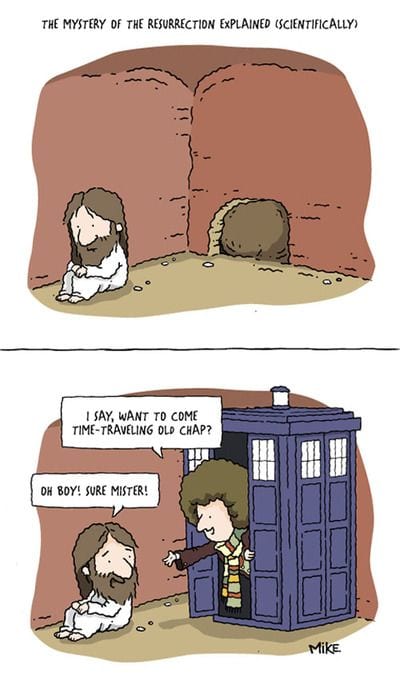
It is ironic that the Doctor and his TARDIS are here invoked as though they were a “scientific explanation.” The Doctor’s TARDIS, like Star Trek’s warp drive and transporters, and Star Wars’ midichlorians and lightsabers, are not scientific. The question of how to define science fiction and what distinguishes it from fantasy is a longstanding one. If one travels to Narnia in a magic wardrobe, that’s fantasy. If you reach there through a wormhole opened by a quantum fluctuation, that’s science fiction. In some stories, as for instance those about Thor in the Marvel superhero universe, gods and aliens, miracle and science, are simply the same thing. It is never as far removed from fantasy as some of its adherents would like to believe.
Science fiction often finds itself situated—sometimes deservedly so, sometimes undeservedly—within the mythical war between science and religion. There certainly have been individuals—real-world scientists and clergy, authors and fictional characters—who have insisted one must choose one or the other. There are just as many if not more who see no need to do so and who illustrate that the choice is an unnecessary one.
When Star Trek presents a real Apollo who is “no god” but an alien from another planet, and Doctor Who does the same, envisaging real “Daemons” that are aliens, it is often perceived as challenging religion and presenting science as an alternative. Yet the stories are surprisingly literalistic, more so than any Classicist would be. Science fiction illustrates time and again the desire not to replace magic with science, but to embrace science while keeping the epic, heroic, mythical, and miraculous elements within that new framework. Yet merely inserting technobabble into stories of monsters and wizardry does not make them scientific. Far from illustrating a war between religion and science, it illustrates a desire for something that brings the two together in a meaningful way that can make sense of our existence.
I would be remiss if I did not mention that there is an audiobook about Doctor Who and the Council of Nicaea. I won’t retell the story here. I will mention, however, that the author, Caroline Symcox, is an ordained minister. Her husband is a Doctor Who author responsible for several famous episodes as well as many more stories in print. Faith and fandom intersect in their lives, in parish ministry, and in stories they tell.
There is also a very early episode of Doctor Who, “The Romans,” in which a character who helps the Doctor and his companions is shown to be a Christian (albeit through the historical anachronism of having him wear a cross around his neck).
When we imagine ourselves witnessing ancient events, whether as religious people or as historians, we are not doing something fundamentally different from science fiction, even if we do not invoke speculative technology to get us there. Science fiction provides helpful thought experiments for those whose interest in Christianity is historical rather than devotional. There are a lot of assumptions and misinformation that interfere with the public understanding of history. It is not science fiction that is primarily responsible for that. Can it help counter such trends? Doctor Who began as a show geared for children, with the aim of educating them about history and science. The Doctor Who Council of Nicaea audiobook encounters disagreements from those who know the history of that event well. Nevertheless, as with most biopics, documentaries, and other depictions based in history, however much things are oversimplified or one possibility is presented as though it were the only one and certain, it is usually the case that most viewers learn things they simply would not have otherwise. Science fiction can be a teaching tool, and at times a particularly effective one precisely because those watching, listening, or reading don’t view it as education but as entertainment.
The television series Devs is also relevant here. That miniseries focused on the effort to create a computer program that could replicate our reality as the subatomic level, and doing so in a deterministic way, could both reconstruct the past based on the present, and foresee the future. Several times we see them use the crucifixion of Jesus as a test case, the computer allowing them a fuzzy glimpse of those events, as well as a crystal-clear view of what will happen in the immediate future, that which is closer to our time being exponentially easier to reconstruct precisely based on the current state of reality and extrapolating causality in either direction. The show raises questions about free will, among other things. In one crucially important scene, one of the computer programmers decides to substitute a different view of the universe into his approach, adopting the many worlds view rather than the one they had been told to work with. The result is a clear audio of Jesus speaking Aramaic where before there had been too much uncertainty and thus only fuzzy garbled noise. The tech genius behind the project, however, emphasizes that that is “not our Jesus.” It is one of many possible Jesuses in each of the infinite number of branching universes. He might be different just by a hair, or in other radical ways. The computer programmer is fired rather than praised.
We might consider every effort to reconstruct the historical Jesus something similar to what Devs envisages its computer program doing. From available evidence a portrait is extrapolated. The reason we have so many different and incompatible portraits of Jesus is not because something is wrong with the method, but because there are too many possibilities and too many uncertainties. Even among those who insist that every single thing found in the canonical Gospels is pure historical truth, different portraits will emerge. The idea that history works as a science that can provide greater clarity and certainty ignores what historical reconstruction entails. Some pieces of evidence provide historical details that are secure. Others are probable. Still others are merely possible, and others unlikely. These may be configured in different ways. Neither simply by listening to the Gospels, nor by undertaking historical research, do we get to hear the voice of Jesus clearly and ungarbled. Whether it is Heisenberg’s uncertainty principle or the nature of historical uncertainty that renders the image and sound fuzzy may differ, but there are things we can usefully reflect on by placing the effort to know with certainty through science-fictional computing alongside and in conversation with other approaches to the same quest.
This leads us naturally to our next topic, which will be shared in a separate blog post.
Browse Our Archives
Select a Category 1 Corinthians 1 John 1 Peter 1 Samuel 1 Thessalonians 1 Timothy 2 Corinthians 2 Kings 2 Peter 2 Samuel 2 Thessalonians 2 Timothy academia Acts of the Apostles afterlife Akhaten Alcatraz American Academy of Religion Amos Anglican Arabic Aramaic archaeology art artificial intelligence astronomy atheism atonement Babylon 5 Baptists Battlestar Galactica Bible Biblical Studies Carnival biblioblogging Black Mirror Blade Runner Book of Job book review Buddhism Call for Papers China Christianity Christmas Christology Chronicles Coptic creation Daniel Deuteronomy Doctor Who Dune Easter Ecclesiastes economics education Eldad Keynan Enoch Seminar Ephesians eschatology Esther Evangelicals evolution Exodus Expanse Ezekiel Ezra fantasy Fringe fundamentalism Galatians games Ge'ez genealogy Genesis Gnosticism Gospel of Jesus' Wife Gospel of John Gospel of Judas Gospel of Luke Gospel of Mark Gospel of Matthew Gospel of Peter Gospel of Thomas Greek Harry Potter Hebrew Hebrews Hinduism historical Jesus history Hitchhiker's Guide to the Galaxy Holidays horror Hosea humor incarnation India inerrancy information literacy inspirational Intelligent Design Ireland Isaiah Islam Israel Italy James Jeremiah John the Baptist Jonah Joshua Judaism Jude Judges Judith Lamentations languages Latin Leviticus libraries literature Lord of the Rings LOST Mandaeans Mandaic memes Methodism Micah monotheism morality Mormons movies music mythicism NASSCAL Nehemiah new perspective New Testament news Numbers Orthodox paganism panentheism pantheism Patheos Paul and his letters Pentecostals Philippians Philippians 2:6-11 philosophy physics Planet of the Apes podcast politics Progressive Christianity Protestantism Proverbs Psalms pseudoscience racism religion Revelation Roman Catholicism Romania Romans Ruth scams science science fiction Secret Gospel of Mark Society of Biblical Literature Song of Songs Star Trek Star Wars Stargate Swahili Syriac Taoism technology Terminator The Handmaid's Tale The Hobbit The Matrix theodicy theology theory Timeless Titus tomb Torchwood travel TRON Uncategorized United Kingdom Westworld X-Files young-earth creationism Zechariah
Select a Month October 2026 September 2026 August 2026 July 2026 June 2026 May 2026 April 2026 March 2026 February 2026 January 2026 December 2025 November 2025 October 2025 September 2025 July 2025 June 2025 May 2025 April 2025 March 2025 February 2025 January 2025 December 2024 November 2024 October 2024 September 2024 August 2024 July 2024 June 2024 May 2024 April 2024 March 2024 February 2024 January 2024 December 2023 November 2023 October 2023 September 2023 August 2023 July 2023 May 2023 April 2023 March 2023 February 2023 January 2023 December 2022 November 2022 October 2022 September 2022 August 2022 July 2022 June 2022 May 2022 April 2022 March 2022 February 2022 January 2022 December 2021 November 2021 October 2021 September 2021 August 2021 July 2021 June 2021 May 2021 April 2021 March 2021 February 2021 January 2021 December 2020 November 2020 October 2020 September 2020 August 2020 July 2020 June 2020 May 2020 April 2020 March 2020 February 2020 January 2020 December 2019 November 2019 October 2019 September 2019 August 2019 July 2019 June 2019 May 2019 April 2019 March 2019 February 2019 January 2019 December 2018 November 2018 October 2018 September 2018 August 2018 July 2018 June 2018 May 2018 April 2018 March 2018 February 2018 January 2018 December 2017 November 2017 October 2017 September 2017 August 2017 July 2017 June 2017 May 2017 April 2017 March 2017 February 2017 January 2017 December 2016 November 2016 October 2016 September 2016 August 2016 July 2016 June 2016 May 2016 April 2016 March 2016 February 2016 January 2016 December 2015 November 2015 October 2015 September 2015 August 2015 July 2015 June 2015 May 2015 April 2015 March 2015 February 2015 January 2015 December 2014 November 2014 October 2014 September 2014 August 2014 July 2014 June 2014 May 2014 April 2014 March 2014 February 2014 January 2014 December 2013 November 2013 October 2013 September 2013 August 2013 July 2013 June 2013 May 2013 April 2013 March 2013 February 2013 January 2013 December 2012 November 2012 October 2012 September 2012 August 2012 July 2012 June 2012 May 2012 April 2012 March 2012 February 2012 January 2012 December 2011 November 2011 October 2011 September 2011 August 2011 July 2011 June 2011 May 2011 April 2011 March 2011 February 2011 January 2011 December 2010 November 2010 October 2010 September 2010 August 2010 July 2010 June 2010 May 2010 April 2010 March 2010 February 2010 January 2010 December 2009 November 2009 October 2009 September 2009 August 2009 July 2009 June 2009 May 2009 April 2009 March 2009 February 2009 January 2009 December 2008 November 2008 October 2008 September 2008 August 2008 July 2008 June 2008 May 2008 April 2008 March 2008 February 2008 January 2008 December 2007 November 2007 October 2007 September 2007 August 2007 July 2007 June 2007 February 2007 January 2001
Follow Us!
TAKE THE
Religious Wisdom Quiz
In 1 Timothy, what does Paul say is a trustworthy saying?
Select your answer to see how you score.
Faith without works is dead God is love The righteous will live by faith Christ Jesus came into the world to save sinners
Books by This Author Books by James F. McGrath
Related posts from Religion Prof: The Blog of James F. McGrath

The Time-Traveler’s Apprentice (A Short Story)
Religion Prof: The Blog of James F. McGrath

A Baptist's Defense of the Muslim Call to...
Religion Prof: The Blog of James F. McGrath

'Disclosure Day': The Real Revelation Isn't Aliens
Religion Prof: The Blog of James F. McGrath

Insights from Project Hail Mary
Religion Prof: The Blog of James F. McGrath
TRENDING AT PATHEOS Progressive Christian

Pope Leo Celebrates Mass for Nurses & Docs...
I don't have any idea how he did it, but Pope Leo...

The Sermon on the Mount, Part I: Matthew...
The Sermon on the Mount, Part I (Matthew 4:12-5:12) St. Matthew moves...

What's up from Crossway: Reviewing some of their latest A few weeks...

Janie Learns the Way of the Cross: A...
Teaching children about Jesus' Passion can be challenging. Many parents and educators...

Looking For Good Catholic Writing - October 2026
He alone extends the heavens, and he walks upon the waves of...

In "Irreplaceable," our book on vocation and technology, Trevor Sutton and I...
view all Progressive Christian blogs
Ad-Free & Subscriber Log-In Subscription Support
- About Us
- 2026 Calendar
- Videos
- Podcasts
- Library of World Religions
- Faith In Media Tracker
- Advertise With Us
- Write for Us
- Privacy Policy
- Terms of Service
- Do Not Sell My Data
- Contact Us
- Radiant Digital
- Manage Newsletter Subscriptions
- Unsubscribe From Notifications
- Sitemap
Copyright 2008-2026, Patheos. All rights reserved.
Subscription Support Ad-Free & Subscriber Log-In
Follow Patheos