
BuddhistCatholicContemplativeEvangelicalGeneral ChristianHinduJewishLatter-day SaintMuslimNew VisionsProgressive Christian
Beliefs
- Buddhist
- Catholic
- Contemplative
- Evangelical
- General Christian
- Hindu
- Jewish
- Latter-day Saint
- More Voices
- Muslim
- New Visions
- Pagan
- Progressive Christian
Topics
- Religion News
- Food and Religion
- Sports and Religion
- Religious Art
- Religious Music and Entertainment
- Religious Events
- History and Religion
- Style and Religion
- Politics and Religion
- Women in Religion
- Recreation Outdoors and Religion
- Business Finance and Religion
- Careers Workplace and Religion
- Education and Religion
- Family Parenting and Religion
- Health Fitness and Religion
- Home and Religion
- Relationships and Religion
- Technology and Religion
- Travel and Religion
Columnists
- Buddhist Columnists
- Business Finance and Religion Columnists
- Careers Workplace and Religion Columnists
- Catholic Columnists
- Contemplative Columnists
- Education and Religion Columnists
- Evangelists Columnists
- Family Parenting and Religion Columnists
- General Christian Columnists
- Health Fitness and Religion Columnists
- Hindu Columnists
- History and Religion Columnists
- Home and Religion Columnists
- Jewish Columnists
- More Voices Columnists
- Latter Day Columnists
- Muslim Columnists
- New Visions Columnists
- Nonreligious Columnists
- Pagan Columnists
- Politics and Religion Columnists
- Progressive Columnists
- Recreation Outdoors and Religion Columnists
- Relationships and Religion Columnists
- Religion News Columnists
- Religious Art Columnists
- Religious Events Columnists
- Religious Music and Entertainment Columnists
- Sports and Religion Columnists
- Style and Religion Columnists
- Technology and Religion Columnists
- Travel and Religion Columnists
- Women in Religion Columnists
Resource Library
- 2026 Calendar
- Library of World Religions
- The 100 Most Holy Places on Earth
- Patheos Answers
- Podcasts
- Videos
- Faith Leaders Database
- Anglican Episcopalian
- Bahai
- Baptist
- Buddhism
- Christianity
- Confucianism
- Eastern Orthodoxy
- Hinduism
- Holiness and Pentecostal
- ISKCON
- Islam
- Judaism
- Lutheran
- Methodist
- The Church of Jesus Christ of Latter-day Saints
- New Age
- Paganism
- Presbytarian and Reformed
- Protestantism
- Religion Behind the Scenes
- Roman Catholic
- Scientology
- Shia Islam
- Sikhism
- Sufism
- Sunni Islam
- Taoism
- Zen
- See all religions
Research Tools
 Ad-Free & Subscriber Log-In Subscription Support
Follow Patheos 

- Trending:
- Advent
- |
- Forgiveness
- |
- Thanksgiving
- |
- Election
- |
- Seasonal Holidays
- |
- Marriage

- Home
- About Dr. James F. McGrath
- Publications
- Blogroll
- Useful Websites
- Connections
- Easy Search Posts Page
- FREE NEWSLETTER
- Home
- Progressive Christian
- The Past, Present, and Future of Christianity in Science Fiction Introduction: 2021, Some Space Oddities
The Past, Present, and Future of Christianity in Science Fiction Introduction: 2021, Some Space Oddities
Last updated on: April 20, 2021 at 5:13 am by James F. McGrath
The Past, Present, and Future of Christianity in Science Fiction Introduction: 2021, Some Space Oddities 2021-04-19T05:03:19-04:00 James F. McGrath
Patheos Explore the world's faith through different perspectives on religion and spirituality! Patheos has the views of the prevalent religions and spiritualities of the world.
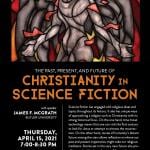
Thanks to the Michigan Center for Early Christian Studies and all those involved in making my recent public lecture possible. I have decided to share the recording of the talk that I pre-recorded to ensure that clips from television shows that I wanted to include would come through correctly. I will also be sharing the text of the talk across multiple posts in order to allow those who attended to follow up on some of the authors and stories mentioned. The text of the introduction follows below the video. Subsequent parts will appear in blog posts I will share thereafter.
There is something distinctly odd about the intersection between Christianity and science fiction. But it isn’t the pairing of the two, the suggestion that there might be an interesting connection and interaction. Rather, it is the fact that after such a long history of engagement and despite the existence of such a natural connection, to some the pairing still seems odd. C. S. Lewis is more famous for his fantasy series the Chronicles of Narnia, but his space trilogy represents a classic example of how one might express their Christian theology in and through that genre. His first book in what became a trilogy, Out of the Silent Planet, was at least in part the result of a challenge to write sci-fi that Lewis and J. R. R. Tolkien set to one another. They flipped a coin, and had it gone the other way Lewis would have written about time travel rather than space, which would have made the result even more relevant to my talk today. Deciding what to write about by a coin toss with your friend, I might add, is no odder than Christianity and science fiction intersecting (indeed, far less so, but it isn’t a competition).
We are here today to discuss and analyze, not to promote or proselytize, and that is equally true with respect to sci-fi fandom and religion. Yet my own positionality, my perspectives and preferences, my allegiances and alignments, would inevitably come through, and I have made sure deliberately that they do, since none of us talks about a topic from nowhere or from everywhere. From a religious studies perspective, the critics are as interesting as the adherents. And even from the perspective of Christian faith, the scriptures contain condemnation upon condemnation of those who fail to be open to criticisms and calls to repentance. Either way, it is not just Christian authors like Madeleine L’Engle that are relevant. As germane to the topic are authors like Arthur C. Clarke who had a great antipathy to Christianity and explores that through his stories; Ray Bradbury, Baptist of upbringing but describing himself in 2010 as a “delicatessen religionist,” whose stories feature Christian characters and even figures who might be or are mistaken for Jesus; and Margaret Atwood whose depictions of Christian nationalism and theocracy have led to her being labeled anti-religious and more specifically anti-Christian, yet she rightly insists that she is nothing of the sort. Quakers and other religious noncomformists play heroic roles in The Handmaid’s Tale. Atwood also distances herself from the label “science fiction” for a variety of reasons.
So we see that Christians writing science fiction, Christians appearing in science fiction, Christians writing about science fiction, and scholars analyzing the presence and treatment of religious themes in sci-fi are all well-established and longstanding. Yet when the two are mentioned together, one still occasionally encounters puzzled looks. That reaction of puzzlement is itself perhaps worthy of further study.
This isn’t to say that there is nothing about today’s talk that might be considered odd. For one thing, it might be said to be odd for an academic like myself to be asked to speak about the subject. Why would someone who occupies the Clarence L. Goodwin Chair in New Testament Language and Literature at Butler University be chosen to address this topic? And why for that matter would the Michigan Center for Early Christian Studies sponsor such an event? There is certainly a story I can tell, about being a New Testament scholar who became a professor of religion at a university with a small religion program. In that program there was encouragement to develop courses outside my narrow area of expertise. The push to do so opened so many new avenues of teaching and ultimately of research. Developing a course on the intersection of religion and science fiction led to me writing nonfiction treatments of the topic, and eventually even to my writing some science fiction myself.
That may be an unusual journey in many ways, but I am not the only one to travel this sort of path. And because religious studies and film criticism, theology and literature, and other interactions related to this topic are inherently interdisciplinary pairings, it is natural for someone who approaches religion in interdisciplinary ways in teaching and research to engage with popular culture in at least one form, and often in more than one. In short, I write, teach, and speak to wider audiences about this topic because I study religion in texts and in living communities, write science fiction, and have several Starfleet uniforms and a very long scarf in my wardrobe (not to mention an even more extensive collection of geeky t-shirts).
There are more oddities to mention, a seemingly endless array, just as science fiction and religion offer delightful oddities and puzzling paradoxes that sometimes frustrate us and at others open our minds. For instance, it is also odd to me that so many who speak and write about connections between faith and film, theology and television, religion and recent releases on your streaming services, seem content to address superficial similarities and connections, such as “Christ figures,” characters who in some vague way are a tiny bit like Jesus. There is so much more depth to be explored, and I am grateful to those who have chosen to join me today on this journey into and across those fascinating depths.
If you come to today’s event as a skeptic because your training in the church or in Starfleet academy has led you to believe that I am exploring intersections between two forces that are like matter and antimatter, or if you prefer, the Dark and Light sides of the Force, I hope you will find by the end of my lecture that is not the case, that you have taken your first step into a much larger universe.
To everyone else who is already ready for this journey, already buckled in and ready for launch, I thank you for your patience with these preliminaries. Our theme of focus today is not any and every intersection of Christianity and science fiction, a historical survey of the interactions, but more narrowly on the way science fiction allows us unique perspectives on the past, the present, and the possible future of Christianity. Time travel to the past. Coping with aliens and androids in the present and near future. Exploring parallel universes and alternative histories. Imagining the distant future of the church. In all these ways, science fiction provides unique angles of approach to religion in general and Christianity in particular.
For those of you who love science fiction except for time travel stories, I hear you. Whether any of them is remotely coherent is a matter of debate, but plenty of them are self-contradictory or simply don’t make any sense at all. I would suggest, however, that what makes stories involving time travel, parallel universes, and for that matter warp drive and transporters interesting is not whether the technology could work in real life, or whether the story has errors of continuity and/or logic. There are narratives with contradictions in them and between themselves and others that are nonetheless interesting for the thought experiments they allow us to explore, the symbolism they allow the storytellers to convey, and for a variety of other reasons. I’ve sometimes wondered what it would look like to invoke time travel and changes to the timeline to reconcile the contradictory geographical movements and time frames in the infancy stories in the Gospels of Matthew and Luke, or the different accounts of Judas’ death and the Field of Blood in Matthew and Acts. Introducing time travel may solve some problems, but it will also inevitably introduce new ones. That doesn’t make the exploration of possibilities along these lines something inherently unworthwhile, any more than the tensions between the Gospels means we cannot appreciate the perspective each one offers on Jesus.
If only in our imagination, science fiction allows us to get in a TARDIS and travel to the first century to see Jesus for ourselves, bypassing the constraints of both the Gospels as literature and the methods of historical inquiry. It allows us to travel to a parallel universe and see how things might be different if some moment in the history of Christianity were different, or never existed at all. It allows us to cryogenically freeze ourselves or simply be born in the distant future and see what Christianity has become, or if it has persisted at all.
Science fiction also allows us to clone Jesus and do many other things relevant to Christianity, but while the possibilities for our imaginative storytelling may be endless, our time today is not. I will thus limit myself to the theme of the past, present, and future of Christianity as viewed through some of the unique lenses that science fiction provides.
Part One of the talk will follow soon…
Previous Post
April 19, 2021
What Jesus Learned from Women: An Upcoming Conversation
Browse Our Archives
Select a Category 1 Corinthians 1 John 1 Peter 1 Samuel 1 Thessalonians 1 Timothy 2 Corinthians 2 Kings 2 Peter 2 Samuel 2 Thessalonians 2 Timothy academia Acts of the Apostles afterlife Akhaten Alcatraz American Academy of Religion Amos Anglican Arabic Aramaic archaeology art artificial intelligence astronomy atheism atonement Babylon 5 Baptists Battlestar Galactica Bible Biblical Studies Carnival biblioblogging Black Mirror Blade Runner Book of Job book review Buddhism Call for Papers China Christianity Christmas Christology Chronicles Coptic creation Daniel Deuteronomy Doctor Who Dune Easter Ecclesiastes economics education Eldad Keynan Enoch Seminar Ephesians eschatology Esther Evangelicals evolution Exodus Expanse Ezekiel Ezra fantasy Fringe fundamentalism Galatians games Ge'ez genealogy Genesis Gnosticism Gospel of Jesus' Wife Gospel of John Gospel of Judas Gospel of Luke Gospel of Mark Gospel of Matthew Gospel of Peter Gospel of Thomas Greek Harry Potter Hebrew Hebrews Hinduism historical Jesus history Hitchhiker's Guide to the Galaxy Holidays horror Hosea humor incarnation India inerrancy information literacy inspirational Intelligent Design Ireland Isaiah Islam Israel Italy James Jeremiah John the Baptist Jonah Joshua Judaism Jude Judges Judith Lamentations languages Latin Leviticus libraries literature Lord of the Rings LOST Mandaeans Mandaic memes Methodism Micah monotheism morality Mormons movies music mythicism NASSCAL Nehemiah new perspective New Testament news Numbers Orthodox paganism panentheism pantheism Patheos Paul and his letters Pentecostals Philippians Philippians 2:6-11 philosophy physics Planet of the Apes podcast politics Progressive Christianity Protestantism Proverbs Psalms pseudoscience racism religion Revelation Roman Catholicism Romania Romans Ruth scams science science fiction Secret Gospel of Mark Society of Biblical Literature Song of Songs Star Trek Star Wars Stargate Swahili Syriac Taoism technology Terminator The Handmaid's Tale The Hobbit The Matrix theodicy theology theory Timeless Titus tomb Torchwood travel TRON Uncategorized United Kingdom Westworld X-Files young-earth creationism Zechariah
Select a Month November 2026 October 2026 September 2026 August 2026 July 2026 June 2026 May 2026 April 2026 March 2026 February 2026 January 2026 December 2025 November 2025 October 2025 September 2025 July 2025 June 2025 May 2025 April 2025 March 2025 February 2025 January 2025 December 2024 November 2024 October 2024 September 2024 August 2024 July 2024 June 2024 May 2024 April 2024 March 2024 February 2024 January 2024 December 2023 November 2023 October 2023 September 2023 August 2023 July 2023 May 2023 April 2023 March 2023 February 2023 January 2023 December 2022 November 2022 October 2022 September 2022 August 2022 July 2022 June 2022 May 2022 April 2022 March 2022 February 2022 January 2022 December 2021 November 2021 October 2021 September 2021 August 2021 July 2021 June 2021 May 2021 April 2021 March 2021 February 2021 January 2021 December 2020 November 2020 October 2020 September 2020 August 2020 July 2020 June 2020 May 2020 April 2020 March 2020 February 2020 January 2020 December 2019 November 2019 October 2019 September 2019 August 2019 July 2019 June 2019 May 2019 April 2019 March 2019 February 2019 January 2019 December 2018 November 2018 October 2018 September 2018 August 2018 July 2018 June 2018 May 2018 April 2018 March 2018 February 2018 January 2018 December 2017 November 2017 October 2017 September 2017 August 2017 July 2017 June 2017 May 2017 April 2017 March 2017 February 2017 January 2017 December 2016 November 2016 October 2016 September 2016 August 2016 July 2016 June 2016 May 2016 April 2016 March 2016 February 2016 January 2016 December 2015 November 2015 October 2015 September 2015 August 2015 July 2015 June 2015 May 2015 April 2015 March 2015 February 2015 January 2015 December 2014 November 2014 October 2014 September 2014 August 2014 July 2014 June 2014 May 2014 April 2014 March 2014 February 2014 January 2014 December 2013 November 2013 October 2013 September 2013 August 2013 July 2013 June 2013 May 2013 April 2013 March 2013 February 2013 January 2013 December 2012 November 2012 October 2012 September 2012 August 2012 July 2012 June 2012 May 2012 April 2012 March 2012 February 2012 January 2012 December 2011 November 2011 October 2011 September 2011 August 2011 July 2011 June 2011 May 2011 April 2011 March 2011 February 2011 January 2011 December 2010 November 2010 October 2010 September 2010 August 2010 July 2010 June 2010 May 2010 April 2010 March 2010 February 2010 January 2010 December 2009 November 2009 October 2009 September 2009 August 2009 July 2009 June 2009 May 2009 April 2009 March 2009 February 2009 January 2009 December 2008 November 2008 October 2008 September 2008 August 2008 July 2008 June 2008 May 2008 April 2008 March 2008 February 2008 January 2008 December 2007 November 2007 October 2007 September 2007 August 2007 July 2007 June 2007 February 2007 January 2001
Follow Us!
TAKE THE
Religious Wisdom Quiz
In Revelation, how many lampstands does John see?
Select your answer to see how you score.
Twelve lampstands Seven golden lampstands Ten lampstands Four lampstands
Books by This Author Books by James F. McGrath
Related posts from Religion Prof: The Blog of James F. McGrath

The Time-Traveler’s Apprentice (A Short Story)
Religion Prof: The Blog of James F. McGrath

A Baptist's Defense of the Muslim Call to...
Religion Prof: The Blog of James F. McGrath

'Disclosure Day': The Real Revelation Isn't Aliens
Religion Prof: The Blog of James F. McGrath

Insights from Project Hail Mary
Religion Prof: The Blog of James F. McGrath
TRENDING AT PATHEOS Progressive Christian

Sunday Readings: Stay Awake and Hope
The First Sunday of Advent begins a new liturgical year, and the...

Are You a Scrooge or an Ebenezer?
A Call to Remember As the Christmas season begins, will we remember...

Noah’s Ark Archaeologists: Gopher Wood or Should We...
Ancient wood, a boat-shaped formation and dates that invite a second look:...

Smart people saying smart things (11.24.26)
Please take time to listen to Perry Bacon, Sarah Posner, Adam Serwer,...

The Contingency of Our Technology
Last week we were hit with a raft of massive technology outages....

In 1939, President Franklin D. Roosevelt moved Thanksgiving from November 30 to...
view all Progressive Christian blogs
Ad-Free & Subscriber Log-In Subscription Support
- About Us
- 2026 Calendar
- Videos
- Podcasts
- Library of World Religions
- Faith In Media Tracker
- Advertise With Us
- Write for Us
- Privacy Policy
- Terms of Service
- Do Not Sell My Data
- Contact Us
- Radiant Digital
- Manage Newsletter Subscriptions
- Unsubscribe From Notifications
- Sitemap
Copyright 2008-2026, Patheos, part of the Radiant Digital network of media brands. All rights reserved.
Subscription Support Ad-Free & Subscriber Log-In
Follow Patheos