
BuddhistCatholicContemplativeEvangelicalGeneral ChristianHinduJewishLatter-day SaintMuslimNew VisionsProgressive Christian
Beliefs
- Buddhist
- Catholic
- Contemplative
- Evangelical
- General Christian
- Hindu
- Jewish
- Latter-day Saint
- More Voices
- Muslim
- New Visions
- Pagan
- Progressive Christian
Topics
- Religion News
- Food and Religion
- Sports and Religion
- Religious Art
- Religious Music and Entertainment
- Religious Events
- History and Religion
- Style and Religion
- Politics and Religion
- Women in Religion
- Recreation Outdoors and Religion
- Business Finance and Religion
- Careers Workplace and Religion
- Education and Religion
- Family Parenting and Religion
- Health Fitness and Religion
- Home and Religion
- Relationships and Religion
- Technology and Religion
- Travel and Religion
Columnists
- Buddhist Columnists
- Business Finance and Religion Columnists
- Careers Workplace and Religion Columnists
- Catholic Columnists
- Contemplative Columnists
- Education and Religion Columnists
- Evangelists Columnists
- Family Parenting and Religion Columnists
- General Christian Columnists
- Health Fitness and Religion Columnists
- Hindu Columnists
- History and Religion Columnists
- Home and Religion Columnists
- Jewish Columnists
- More Voices Columnists
- Latter Day Columnists
- Muslim Columnists
- New Visions Columnists
- Nonreligious Columnists
- Pagan Columnists
- Politics and Religion Columnists
- Progressive Columnists
- Recreation Outdoors and Religion Columnists
- Relationships and Religion Columnists
- Religion News Columnists
- Religious Art Columnists
- Religious Events Columnists
- Religious Music and Entertainment Columnists
- Sports and Religion Columnists
- Style and Religion Columnists
- Technology and Religion Columnists
- Travel and Religion Columnists
- Women in Religion Columnists
Resource Library
- 2026 Calendar
- Library of World Religions
- The 100 Most Holy Places on Earth
- Patheos Answers
- Podcasts
- Videos
- Faith Leaders Database
- Anglican Episcopalian
- Bahai
- Baptist
- Buddhism
- Christianity
- Confucianism
- Eastern Orthodoxy
- Hinduism
- Holiness and Pentecostal
- ISKCON
- Islam
- Judaism
- Lutheran
- Methodist
- The Church of Jesus Christ of Latter-day Saints
- New Age
- Paganism
- Presbytarian and Reformed
- Protestantism
- Religion Behind the Scenes
- Roman Catholic
- Scientology
- Shia Islam
- Sikhism
- Sufism
- Sunni Islam
- Taoism
- Zen
- See all religions
Research Tools
 Ad-Free & Subscriber Log-In Subscription Support
Ad-Free & Subscriber Log-In Subscription Support
Follow Patheos 

- Trending:
- Forgiveness
- |
- Marriage
- |
- Consciousness
- |
- Death Penalty
- |
- Election
- |
- Halloween

- Home
- About Dr. James F. McGrath
- Publications
- Blogroll
- Useful Websites
- Connections
- Easy Search Posts Page
- FREE NEWSLETTER
- Home
- Progressive Christian
- Tenet
Tenet
Last updated on: January 5, 2021 at 5:01 am by James F. McGrath
Tenet 2021-01-04T18:29:14-05:00 James F. McGrath
Patheos Explore the world's faith through different perspectives on religion and spirituality! Patheos has the views of the prevalent religions and spiritualities of the world.
As soon as I saw Tenet, I knew it was a movie that I would need to see twice before I could comment on it once. Having done that, I am happy to now do so, since the movie has more than one theological aspect to it.
One of those is in the very nature of time travel. Being able to move backwards through time so that one benefits from the knowledge acquired while moving in the other direction provides something that is almost a form of omniscience. At the very least, it can be seen that it is very hard to hide one’s actions and motives from those with this ability.
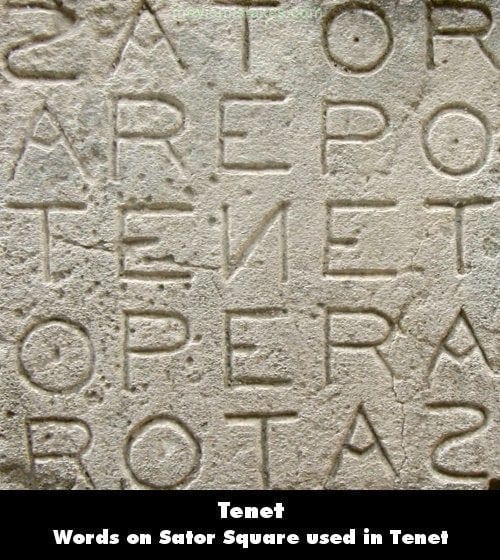
The movie’s name, however, is actually directly connected as well, and not just in the sense that I sincerely hope people as a result of the movie will stop erroneously writing about the “tenants” of their faith (as though they were landlords and someone inhabits their faith while paying rent to do so). TENET is in the center of the famous SATOR squares, an ancient puzzle which work through a series of words that are inverted horizontally and vertically:
SATOR
AREPO
TENET
OPERA
ROTAS
Those who have seen the movie will be aware that all of those words appear in some form or another, whether as names of individuals or companies or simply as words. As Alissa Wilkinson writes for Vox, this is a palindrome in four directions. The palindromic structure is symbolic as the movie moves backwards and forwards through the same events, and of course Tenet which appears in the center of the square it itself a palindrome as a word. That is one reason why everyone should see the movie at least twice. We often see the same incident from more than one person’s perspective, moving in more than one direction through time. It is helpful, and perhaps crucial, to see the same scenes again with that knowledge in mind. If nothing else, you’ll notice the brilliance of some of the filmography and attention to detail with respect to matters that no one is likely to have been paying attention to the first time they saw a particular scene (although the director does a good job of making sure we notice them, even if we do not yet know their significance). Christopher Nolan’s 2000 movie Memento also does subversive and non-linear things with time and narrative, and so this is clearly an interest of his. It isn’t clear that the squares were originally linked to Christianity, but the potential to spell out PATERNOSTER in the form of a cross in two directions at the very least led Christians to embrace this mysterious symbol. It is appropriate, given the movie’s plot, that the symbol is laden with ambiguity and uncertainty. As we watch, we are unsure until near the end who is behind certain events, just as it is revealed at much the same time that even the resolution we witness is “only halfway there.” This is called a “temporal pincer move”: as a person or team moves through an event both ways, in the end they know every detail and can act accordingly. It isn’t clear that this works either in terms of logic or physics, but as a concept and a plot for a movie it is fantastic.
The movie has lots of interesting details. On the one hand it suggests that cause preceding effect is just the way we see time. It is argued that free will is not denied since either way time and influence runs our decisions are a factor. The movie begins by introducing technology that has come back through time and is itself temporally inverted, meaning that its behavior and interaction with the world around it seems from our perspective to involve effect preceding cause.
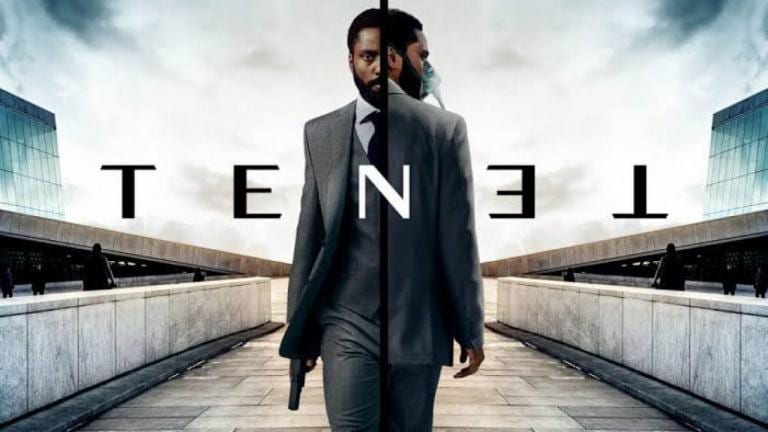
Andrei Sator is the chief villain of the movie, and his name is obviously significant. He says he has always had instincts about the future, and that is how he built this life. This hints at what we later learn, that while gathering plutonium in the ruins of his town he found a message left for him from the future, providing him with this technology to invert objects and people temporally. He sends gold through time to himself that allows him to finance this.
The central positive character we simply come to know as “the protagonist” which also makes things interesting. When time and causation can run in either direction, can we ever know whether we are the central individual or a mere pawn? If not us, can we know who is?
As the story unfolds we learn that there is more at play than just technology that inverts objects including weapons and also people. That alone would be serious. But a future technological development has discovered how to invert the entropy of the entire world. If activated that would destroy all life on the planet. The scientist who discovered this broke the algorithm for doing so into nine sections and hid them in the past in the places she thought most secure: nuclear facilities. But the end of the Cold War left those vulnerable at a moment when it became possible to find one, which is what Sator did, and from there to find ways to obtain others.
At one point the character Neil explains the grandfather paradox. Those in the future developing this technology believe they can do whatever they want to their ancestors with no consequences. He says, “We’re the people saving the world from what might have been.” There is discussion of fanaticism and belief in conversations between the protagonist and Sator. We learn that Sator is working with some forces in the future, when their seas rose and their rivers ran dry because of what we human beings did in our time and before. He says they had no choice but to seek to invert time and make our past their future as a means of surviving. The question is raised whether he is “a madman” or “a god of sorts.” Sator says at one point, “My greatest sin was bringing a son into a world I knew was ending.” There is also “an expression of faith in the mechanics of the universe.” We might want to think of Einstein’s faith that “God doesn’t play dice.” Rather than narrowing “faith” to irrational assertions by religious fanatics, which is unhelpful, I like that the movie explores both the universality of faith as something we all have, and the limits of what reason can deduce in a universe full of potential surprises.
There is also an exploration of the problem of evil. The team that the protagonist joins forces with, and later learns is responsible for assembling through actions in the future, saves the world from “what might have been,” “the bomb that didn’t go off.” We complain and question the goodness of God and/or the universe because of what happens, but how would our perspectives differ if we had a sense of what might have happened and yet did not because it was prevented?
This is definitely a movie that one must watch at least twice. We get the chance to watch the inverted scenes understanding what we are seeing, which makes them rewarding in new ways. The best movies reward us on the first viewing and yet disclose further depths and unnoticed details upon repeated viewings. Having seen it twice now, I cannot help but wonder what I’ll notice the next time I watch it.
Have you seen Tenet yet? I certainly recommend it, and am interested in hearing from those who have seen it about your impressions and thoughts after one, two, or more viewings. If you haven’t seen it yet, or are ready to see it again, you can watch it via Amazon:

Other articles of possible interest:
The Physics of Tenet is Shaky But…
Even the Gospel Coalition felt the need to comment on the movie.
https://www.thegospelcoalition.org/article/tenet-film-review/
Also relevant:
National Geographic on time travel
Previous Post

January 4, 2021
Jesus Wasn't Unique
Next Post

January 6, 2021 Epiphany: The Magi Arrive and John the Baptist Enoch Seminar Next Week!
Browse Our Archives
Select a Category 1 Corinthians 1 John 1 Peter 1 Samuel 1 Thessalonians 1 Timothy 2 Corinthians 2 Kings 2 Peter 2 Samuel 2 Thessalonians 2 Timothy academia Acts of the Apostles afterlife Akhaten Alcatraz American Academy of Religion Amos Anglican Arabic Aramaic archaeology art artificial intelligence astronomy atheism atonement Babylon 5 Baptists Battlestar Galactica Bible Biblical Studies Carnival biblioblogging Black Mirror Blade Runner Book of Job book review Buddhism Call for Papers China Christianity Christmas Christology Chronicles Coptic creation Daniel Deuteronomy Doctor Who Dune Easter Ecclesiastes economics education Eldad Keynan Enoch Seminar Ephesians eschatology Esther Evangelicals evolution Exodus Expanse Ezekiel Ezra fantasy Fringe fundamentalism Galatians games Ge'ez genealogy Genesis Gnosticism Gospel of Jesus' Wife Gospel of John Gospel of Judas Gospel of Luke Gospel of Mark Gospel of Matthew Gospel of Peter Gospel of Thomas Greek Harry Potter Hebrew Hebrews Hinduism historical Jesus history Hitchhiker's Guide to the Galaxy Holidays horror Hosea humor incarnation India inerrancy information literacy inspirational Intelligent Design Ireland Isaiah Islam Israel Italy James Jeremiah John the Baptist Jonah Joshua Judaism Jude Judges Judith Lamentations languages Latin Leviticus libraries literature Lord of the Rings LOST Mandaeans Mandaic memes Methodism Micah monotheism morality Mormons movies music mythicism NASSCAL Nehemiah new perspective New Testament news Numbers Orthodox paganism panentheism pantheism Patheos Paul and his letters Pentecostals Philippians Philippians 2:6-11 philosophy physics Planet of the Apes podcast politics Progressive Christianity Protestantism Proverbs Psalms pseudoscience racism religion Revelation Roman Catholicism Romania Romans Ruth scams science science fiction Secret Gospel of Mark Society of Biblical Literature Song of Songs Star Trek Star Wars Stargate Swahili Syriac Taoism technology Terminator The Handmaid's Tale The Hobbit The Matrix theodicy theology theory Timeless Titus tomb Torchwood travel TRON Uncategorized United Kingdom Westworld X-Files young-earth creationism Zechariah
Select a Month October 2026 September 2026 August 2026 July 2026 June 2026 May 2026 April 2026 March 2026 February 2026 January 2026 December 2025 November 2025 October 2025 September 2025 July 2025 June 2025 May 2025 April 2025 March 2025 February 2025 January 2025 December 2024 November 2024 October 2024 September 2024 August 2024 July 2024 June 2024 May 2024 April 2024 March 2024 February 2024 January 2024 December 2023 November 2023 October 2023 September 2023 August 2023 July 2023 May 2023 April 2023 March 2023 February 2023 January 2023 December 2022 November 2022 October 2022 September 2022 August 2022 July 2022 June 2022 May 2022 April 2022 March 2022 February 2022 January 2022 December 2021 November 2021 October 2021 September 2021 August 2021 July 2021 June 2021 May 2021 April 2021 March 2021 February 2021 January 2021 December 2020 November 2020 October 2020 September 2020 August 2020 July 2020 June 2020 May 2020 April 2020 March 2020 February 2020 January 2020 December 2019 November 2019 October 2019 September 2019 August 2019 July 2019 June 2019 May 2019 April 2019 March 2019 February 2019 January 2019 December 2018 November 2018 October 2018 September 2018 August 2018 July 2018 June 2018 May 2018 April 2018 March 2018 February 2018 January 2018 December 2017 November 2017 October 2017 September 2017 August 2017 July 2017 June 2017 May 2017 April 2017 March 2017 February 2017 January 2017 December 2016 November 2016 October 2016 September 2016 August 2016 July 2016 June 2016 May 2016 April 2016 March 2016 February 2016 January 2016 December 2015 November 2015 October 2015 September 2015 August 2015 July 2015 June 2015 May 2015 April 2015 March 2015 February 2015 January 2015 December 2014 November 2014 October 2014 September 2014 August 2014 July 2014 June 2014 May 2014 April 2014 March 2014 February 2014 January 2014 December 2013 November 2013 October 2013 September 2013 August 2013 July 2013 June 2013 May 2013 April 2013 March 2013 February 2013 January 2013 December 2012 November 2012 October 2012 September 2012 August 2012 July 2012 June 2012 May 2012 April 2012 March 2012 February 2012 January 2012 December 2011 November 2011 October 2011 September 2011 August 2011 July 2011 June 2011 May 2011 April 2011 March 2011 February 2011 January 2011 December 2010 November 2010 October 2010 September 2010 August 2010 July 2010 June 2010 May 2010 April 2010 March 2010 February 2010 January 2010 December 2009 November 2009 October 2009 September 2009 August 2009 July 2009 June 2009 May 2009 April 2009 March 2009 February 2009 January 2009 December 2008 November 2008 October 2008 September 2008 August 2008 July 2008 June 2008 May 2008 April 2008 March 2008 February 2008 January 2008 December 2007 November 2007 October 2007 September 2007 August 2007 July 2007 June 2007 February 2007 January 2001
Follow Us!
TAKE THE
Religious Wisdom Quiz
What was a biblical measurement of a span?
Select your answer to see how you score.
Third of a cubit Half a cubit Quarter cubit Full cubit
Books by This Author Books by James F. McGrath
Related posts from Religion Prof: The Blog of James F. McGrath

The Time-Traveler’s Apprentice (A Short Story)
Religion Prof: The Blog of James F. McGrath

Religion Prof: The Blog of James F. McGrath

'Disclosure Day': The Real Revelation Isn't Aliens
Religion Prof: The Blog of James F. McGrath

Religion Prof: The Blog of James F. McGrath
TRENDING AT PATHEOS Progressive Christian

The First Eucharistic Controversy: Christ’s Real Presence
For Catholics, the Eucharist is the source and summit of the Christian...

How to Make a Decision When You Can't...
Main point: It’s much more valuable to stay close to God so...

Archdiocese Hosts Military Marriage Retreat in Germany
RASTATT, Germany — The transient military lifestyle, with its frequent deployments and...

Nearly every morning, I make the drive to Detroit with my high-school-age...

The Real AI Story Is Adoption Without Trust
Artificial intelligence has crossed a political threshold. It is no longer a...

A new article, written by Jeff Lindsay and Gale L. Pooley,...
view all Progressive Christian blogs
Ad-Free & Subscriber Log-In Subscription Support
- About Us
- 2026 Calendar
- Videos
- Podcasts
- Library of World Religions
- Faith In Media Tracker
- Advertise With Us
- Write for Us
- Privacy Policy
- Terms of Service
- Do Not Sell My Data
- Contact Us
- Radiant Digital
- Manage Newsletter Subscriptions
- Unsubscribe From Notifications
- Sitemap
Copyright 2008-2026, Patheos. All rights reserved.
Subscription Support Ad-Free & Subscriber Log-In
Follow Patheos