
BuddhistCatholicContemplativeEvangelicalGeneral ChristianHinduJewishLatter-day SaintMuslimNew VisionsProgressive Christian
Beliefs
- Buddhist
- Catholic
- Contemplative
- Evangelical
- General Christian
- Hindu
- Jewish
- Latter-day Saint
- More Voices
- Muslim
- New Visions
- Pagan
- Progressive Christian
Topics
- Religion News
- Food and Religion
- Sports and Religion
- Religious Art
- Religious Music and Entertainment
- Religious Events
- History and Religion
- Style and Religion
- Politics and Religion
- Women in Religion
- Recreation Outdoors and Religion
- Business Finance and Religion
- Careers Workplace and Religion
- Education and Religion
- Family Parenting and Religion
- Health Fitness and Religion
- Home and Religion
- Relationships and Religion
- Technology and Religion
- Travel and Religion
Columnists
- Buddhist Columnists
- Business Finance and Religion Columnists
- Careers Workplace and Religion Columnists
- Catholic Columnists
- Contemplative Columnists
- Education and Religion Columnists
- Evangelists Columnists
- Family Parenting and Religion Columnists
- General Christian Columnists
- Health Fitness and Religion Columnists
- Hindu Columnists
- History and Religion Columnists
- Home and Religion Columnists
- Jewish Columnists
- More Voices Columnists
- Latter Day Columnists
- Muslim Columnists
- New Visions Columnists
- Nonreligious Columnists
- Pagan Columnists
- Politics and Religion Columnists
- Progressive Columnists
- Recreation Outdoors and Religion Columnists
- Relationships and Religion Columnists
- Religion News Columnists
- Religious Art Columnists
- Religious Events Columnists
- Religious Music and Entertainment Columnists
- Sports and Religion Columnists
- Style and Religion Columnists
- Technology and Religion Columnists
- Travel and Religion Columnists
- Women in Religion Columnists
Resource Library
- 2026 Calendar
- Library of World Religions
- The 100 Most Holy Places on Earth
- Patheos Answers
- Podcasts
- Videos
- Faith Leaders Database
- Anglican Episcopalian
- Bahai
- Baptist
- Buddhism
- Christianity
- Confucianism
- Eastern Orthodoxy
- Hinduism
- Holiness and Pentecostal
- ISKCON
- Islam
- Judaism
- Lutheran
- Methodist
- The Church of Jesus Christ of Latter-day Saints
- New Age
- Paganism
- Presbytarian and Reformed
- Protestantism
- Religion Behind the Scenes
- Roman Catholic
- Scientology
- Shia Islam
- Sikhism
- Sufism
- Sunni Islam
- Taoism
- Zen
- See all religions
Research Tools
 Ad-Free & Subscriber Log-In Subscription Support
Ad-Free & Subscriber Log-In Subscription Support
Follow Patheos 

- Trending:
- Forgiveness
- |
- Marriage
- |
- Consciousness
- |
- Death Penalty
- |
- Election
- |
- Halloween

- Home
- About Dr. James F. McGrath
- Publications
- Blogroll
- Useful Websites
- Connections
- Easy Search Posts Page
- FREE NEWSLETTER
- Home
- Progressive Christian
- Is John’s Christology the Lowest in the New Testament?
Is John’s Christology the Lowest in the New Testament?
Last updated on: December 5, 2020 at 7:27 am by James F. McGrath
Is John’s Christology the Lowest in the New Testament? 2020-12-05T07:27:32-05:00 James F. McGrath
Patheos Explore the world's faith through different perspectives on religion and spirituality! Patheos has the views of the prevalent religions and spiritualities of the world.
I am serious about what I suggest in the title of this blog post, even though trying to grab readers’ attention is definitely a motive for putting it this way. There are things to be said by way of clarification that couldn’t go in the title. For one thing, I find the terminology of “high Christology” and “low Christology” problematic. For another, I think the extent of development in the New Testament period is seriously overestimated. That is not, however, because I think the earliest Christology already presents a Jesus who is “fully God” as “the second person of the Trinity.” Rather, it is because I think that even the later works in the New Testament view Jesus as a human being who, on the one hand, embodies the presence and Spirit of the one God, and on the other hand, has been given authority and an exalted status by the one God. There are, to be sure, differences of nuance and expression. But there is also more consistency, I think, than is sometimes recognized.
So what do I mean by saying that John’s is the “lowest” Christology, especially when I find this terminology unhelpful? Where many earlier sources simply presuppose that Jesus is God’s authorized agent and emissary who is by definition subordinate and obedient to the one God, the Gospel of John emphasizes this. “The Son can do nothing of/by himself” (5:19). The Father is “the only true God” (17:3). Jesus is “a man who has told you the truth that I heard from God” (8:40). If Jesus bears the name of God, it is the name that God gave him, just as Paul also asserts in Philippians 2:6-11. Whether John has moved the bestowal earlier depends on whether the giving of the name “before the foundation of the world” means he had it as a possession as an already-existing person or pre-existent soul, or was destined to bear it and so it was in that sense already given to him. Either way, the one is not a “higher” Christology than the other. Both view the name as given by the one God.
Whether Paul envisaged Jesus as pre-existing as an individual, or viewed the human Jesus as the embodiment of the Wisdom of the one God, is not a debate that we need to revisit here.
A question I keep coming back to is how the descent of the Son of Man in the Gospel of John relates to the descent of the Spirit and/or the Logos. One option is to treat them as one and the same: the spirit that descends on Jesus is the Son of Man, the heavenly Doppelganger of the earthly Messiah, so that the two become one. As one sees in the New Testament as well as other early Jewish texts, there is a blurriness in the realm of spiritual beings, as God, personified attributes, the Angel of the Lord, and other terminology appear. In Revelation and in 1 Timothy 5:21 we find belief in God, Christ, and elect angels/the seven spirits of God, the latter denoting the seven principal angels (sometimes called archangels). Each human being was thought to have an angel that corresponded to them. That there was an angel of each nation as well made it natural to associate that angelic prince with the ruler of the nation. When YHWH and El came to be identified, having the king be identified with a supreme spirit in the celestial realm blurred into identification with the supreme God. In this view, Christians then share in that same spirit, share with Jesus a celestial Doppelganger who can both indwell them and serve as advocate in the spiritual realm. To be “in Christ” as Paul puts it makes a different kind of sense when some of these ancient ideas are brought into the picture.
Another option is to treat the descent as simultaneous but nevertheless have there be two that are referred to, the Son of Man being the (soul or angelic counterpart of the) Messiah who is nonetheless full of God’s Wisdom/Word/Spirit already prior to the appearance of the human Messiah on earth.
All of the New Testament works view Jesus as a human being who embodies the divine presence and action, God’s Spirit, and who is exalted to a status second only to the one God. John makes some of these elements more explicit and elaborates them in new ways in response to objections that had come up in the intervening years. Nonetheless, his portrait is not a “higher Christology” than the others, just one that is (if you will excuse the puns), at the same time more fleshed out and more spirited in its articulation. If it is “higher” then it is also “lower” because John emphasized the superiority of the Father and the submission of the Son more than others do. But as I said from the beginning, the categorization of these works as “high” and “low” is problematic.
As you can presumably tell, even after a doctorate, a second book, and decades of research spent reflecting on and exploring these matters, I still have questions. I am fine with that–I’d much rather keep puzzles unsolved and work away at them in the longer term, than declare them done while many of the pieces are still missing or are forced together.
The above is all a longer response to a question that was asked on Twitter than could be offered in tweets. The question was which work in the New Testament has the highest Christology, and that tweet suggested Revelation as the highest, and I responded by sharing the chapter on the Christology of the Book of Revelation from my book The Only True God. I also shared the following as relevant:
See also:
The Divine and the Divisive in John
The Question of Christ’s Relation to God
Ben Witherington’s mult-part series:
https://trinities.org/blog/revised-version-of-trinity-in-the-stanford-encyclopedia-of-philosophy/
Heraclitus’ Logos and our time
Did early Christians interpret Old Testament violence “through Jesus”?
Previous Post

December 4, 2020
Call for Papers: Theology and Dystopia
Next Post

December 6, 2020 Is God Love?
Browse Our Archives
Select a Category 1 Corinthians 1 John 1 Peter 1 Samuel 1 Thessalonians 1 Timothy 2 Corinthians 2 Kings 2 Peter 2 Samuel 2 Thessalonians 2 Timothy academia Acts of the Apostles afterlife Akhaten Alcatraz American Academy of Religion Amos Anglican Arabic Aramaic archaeology art artificial intelligence astronomy atheism atonement Babylon 5 Baptists Battlestar Galactica Bible Biblical Studies Carnival biblioblogging Black Mirror Blade Runner Book of Job book review Buddhism Call for Papers China Christianity Christmas Christology Chronicles Coptic creation Daniel Deuteronomy Doctor Who Dune Easter Ecclesiastes economics education Eldad Keynan Enoch Seminar Ephesians eschatology Esther Evangelicals evolution Exodus Expanse Ezekiel Ezra fantasy Fringe fundamentalism Galatians games Ge'ez genealogy Genesis Gnosticism Gospel of Jesus' Wife Gospel of John Gospel of Judas Gospel of Luke Gospel of Mark Gospel of Matthew Gospel of Peter Gospel of Thomas Greek Harry Potter Hebrew Hebrews Hinduism historical Jesus history Hitchhiker's Guide to the Galaxy Holidays horror Hosea humor incarnation India inerrancy information literacy inspirational Intelligent Design Ireland Isaiah Islam Israel Italy James Jeremiah John the Baptist Jonah Joshua Judaism Jude Judges Judith Lamentations languages Latin Leviticus libraries literature Lord of the Rings LOST Mandaeans Mandaic memes Methodism Micah monotheism morality Mormons movies music mythicism NASSCAL Nehemiah new perspective New Testament news Numbers Orthodox paganism panentheism pantheism Patheos Paul and his letters Pentecostals Philippians Philippians 2:6-11 philosophy physics Planet of the Apes podcast politics Progressive Christianity Protestantism Proverbs Psalms pseudoscience racism religion Revelation Roman Catholicism Romania Romans Ruth scams science science fiction Secret Gospel of Mark Society of Biblical Literature Song of Songs Star Trek Star Wars Stargate Swahili Syriac Taoism technology Terminator The Handmaid's Tale The Hobbit The Matrix theodicy theology theory Timeless Titus tomb Torchwood travel TRON Uncategorized United Kingdom Westworld X-Files young-earth creationism Zechariah
Select a Month October 2026 September 2026 August 2026 July 2026 June 2026 May 2026 April 2026 March 2026 February 2026 January 2026 December 2025 November 2025 October 2025 September 2025 July 2025 June 2025 May 2025 April 2025 March 2025 February 2025 January 2025 December 2024 November 2024 October 2024 September 2024 August 2024 July 2024 June 2024 May 2024 April 2024 March 2024 February 2024 January 2024 December 2023 November 2023 October 2023 September 2023 August 2023 July 2023 May 2023 April 2023 March 2023 February 2023 January 2023 December 2022 November 2022 October 2022 September 2022 August 2022 July 2022 June 2022 May 2022 April 2022 March 2022 February 2022 January 2022 December 2021 November 2021 October 2021 September 2021 August 2021 July 2021 June 2021 May 2021 April 2021 March 2021 February 2021 January 2021 December 2020 November 2020 October 2020 September 2020 August 2020 July 2020 June 2020 May 2020 April 2020 March 2020 February 2020 January 2020 December 2019 November 2019 October 2019 September 2019 August 2019 July 2019 June 2019 May 2019 April 2019 March 2019 February 2019 January 2019 December 2018 November 2018 October 2018 September 2018 August 2018 July 2018 June 2018 May 2018 April 2018 March 2018 February 2018 January 2018 December 2017 November 2017 October 2017 September 2017 August 2017 July 2017 June 2017 May 2017 April 2017 March 2017 February 2017 January 2017 December 2016 November 2016 October 2016 September 2016 August 2016 July 2016 June 2016 May 2016 April 2016 March 2016 February 2016 January 2016 December 2015 November 2015 October 2015 September 2015 August 2015 July 2015 June 2015 May 2015 April 2015 March 2015 February 2015 January 2015 December 2014 November 2014 October 2014 September 2014 August 2014 July 2014 June 2014 May 2014 April 2014 March 2014 February 2014 January 2014 December 2013 November 2013 October 2013 September 2013 August 2013 July 2013 June 2013 May 2013 April 2013 March 2013 February 2013 January 2013 December 2012 November 2012 October 2012 September 2012 August 2012 July 2012 June 2012 May 2012 April 2012 March 2012 February 2012 January 2012 December 2011 November 2011 October 2011 September 2011 August 2011 July 2011 June 2011 May 2011 April 2011 March 2011 February 2011 January 2011 December 2010 November 2010 October 2010 September 2010 August 2010 July 2010 June 2010 May 2010 April 2010 March 2010 February 2010 January 2010 December 2009 November 2009 October 2009 September 2009 August 2009 July 2009 June 2009 May 2009 April 2009 March 2009 February 2009 January 2009 December 2008 November 2008 October 2008 September 2008 August 2008 July 2008 June 2008 May 2008 April 2008 March 2008 February 2008 January 2008 December 2007 November 2007 October 2007 September 2007 August 2007 July 2007 June 2007 February 2007 January 2001
Follow Us!
TAKE THE
Religious Wisdom Quiz
Who was Jesus’ mother?
Select your answer to see how you score.
Mary Sarah Esther Ruth
Books by This Author Books by James F. McGrath
Related posts from Religion Prof: The Blog of James F. McGrath

Religion Prof: The Blog of James F. McGrath

Christology within Judaism (Enoch Seminar June 2026)
Religion Prof: The Blog of James F. McGrath
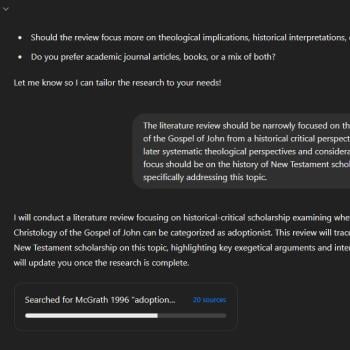
John's Adoptionist Christology? Limits of AI Lit Reviews
Religion Prof: The Blog of James F. McGrath

Religion Prof: The Blog of James F. McGrath
TRENDING AT PATHEOS Progressive Christian

In "Irreplaceable," our book on vocation and technology, Trevor Sutton and I...

I was strolling through the top floor of the brand new Parthenon...

What Does Gêvâh Mean For Kimberley Guifoyle &...
This week, a lot of the news is focused on Kimberly Guilfoyle....

INNER CIRCLE: Profound Mystery (Of Christ In All...
Ephesians 5:31-32 “For this reason, a man will leave his father and...

Do Not Rejoice When Your Enemy Falls: The...
Turning an execution into a public spectacle is a disturbing expression of...

'The Chosen' S6 Trailer: The Passion Gets Very...
Not many watching 'The Chosen' worry about spoilers, but just because they...
view all Progressive Christian blogs
Ad-Free & Subscriber Log-In Subscription Support
- About Us
- 2026 Calendar
- Videos
- Podcasts
- Library of World Religions
- Faith In Media Tracker
- Advertise With Us
- Write for Us
- Privacy Policy
- Terms of Service
- Do Not Sell My Data
- Contact Us
- Radiant Digital
- Manage Newsletter Subscriptions
- Unsubscribe From Notifications
- Sitemap
Copyright 2008-2026, Patheos. All rights reserved.
Subscription Support Ad-Free & Subscriber Log-In
Follow Patheos