
BuddhistCatholicContemplativeEvangelicalGeneral ChristianHinduJewishLatter-day SaintMuslimNew VisionsProgressive Christian
Beliefs
- Buddhist
- Catholic
- Contemplative
- Evangelical
- General Christian
- Hindu
- Jewish
- Latter-day Saint
- More Voices
- Muslim
- New Visions
- Pagan
- Progressive Christian
Topics
- Religion News
- Food and Religion
- Sports and Religion
- Religious Art
- Religious Music and Entertainment
- Religious Events
- History and Religion
- Style and Religion
- Politics and Religion
- Women in Religion
- Recreation Outdoors and Religion
- Business Finance and Religion
- Careers Workplace and Religion
- Education and Religion
- Family Parenting and Religion
- Health Fitness and Religion
- Home and Religion
- Relationships and Religion
- Technology and Religion
- Travel and Religion
Columnists
- Buddhist Columnists
- Business Finance and Religion Columnists
- Careers Workplace and Religion Columnists
- Catholic Columnists
- Contemplative Columnists
- Education and Religion Columnists
- Evangelists Columnists
- Family Parenting and Religion Columnists
- General Christian Columnists
- Health Fitness and Religion Columnists
- Hindu Columnists
- History and Religion Columnists
- Home and Religion Columnists
- Jewish Columnists
- More Voices Columnists
- Latter Day Columnists
- Muslim Columnists
- New Visions Columnists
- Nonreligious Columnists
- Pagan Columnists
- Politics and Religion Columnists
- Progressive Columnists
- Recreation Outdoors and Religion Columnists
- Relationships and Religion Columnists
- Religion News Columnists
- Religious Art Columnists
- Religious Events Columnists
- Religious Music and Entertainment Columnists
- Sports and Religion Columnists
- Style and Religion Columnists
- Technology and Religion Columnists
- Travel and Religion Columnists
- Women in Religion Columnists
Resource Library
- 2026 Calendar
- Library of World Religions
- The 100 Most Holy Places on Earth
- Patheos Answers
- Podcasts
- Videos
- Faith Leaders Database
- Anglican Episcopalian
- Bahai
- Baptist
- Buddhism
- Christianity
- Confucianism
- Eastern Orthodoxy
- Hinduism
- Holiness and Pentecostal
- ISKCON
- Islam
- Judaism
- Lutheran
- Methodist
- The Church of Jesus Christ of Latter-day Saints
- New Age
- Paganism
- Presbytarian and Reformed
- Protestantism
- Religion Behind the Scenes
- Roman Catholic
- Scientology
- Shia Islam
- Sikhism
- Sufism
- Sunni Islam
- Taoism
- Zen
- See all religions
Research Tools
 Ad-Free & Subscriber Log-In Subscription Support
Ad-Free & Subscriber Log-In Subscription Support
Follow Patheos 

- Trending:
- Forgiveness
- |
- Marriage
- |
- Consciousness
- |
- Death Penalty
- |
- Election
- |
- Halloween

- Home
- About Dr. James F. McGrath
- Publications
- Blogroll
- Useful Websites
- Connections
- Easy Search Posts Page
- FREE NEWSLETTER
- Home
- Progressive Christian
- Review of Six Impossible Things Before Breakfast
Review of Six Impossible Things Before Breakfast
Last updated on: November 29, 2020 at 5:29 am by James F. McGrath
Review of Six Impossible Things Before Breakfast 2020-11-23T22:17:53-05:00 James F. McGrath
Patheos Explore the world's faith through different perspectives on religion and spirituality! Patheos has the views of the prevalent religions and spiritualities of the world.


Once again there was an interesting convergence between my reading this book about our beliefs, and the mention on TV yesterday that con artist Peter Popoff is back. Asking what in our evolutionary history and our biological makeup leads us to draw conclusions, evaluate and accept or reject arguments and evidence, connect experiences, and so on, is not only appropriate but important and fascinating.
Wolpert introduces the subject gently, focusing on concrete examples and studies showing how evidence contrary to beliefs we already hold is often rejected, and how when presented with two pieces of evidence we instinctively focus on the evidence supporting beliefs we already hold (see e.g. pp.20-21). The way in which we incorporate new information into our belief systems and worldviews is not straightforward, by any means, and we are probably all much less open minded than we would like to believe.
When treating the topic of religious beliefs, it is important to note that Wolpert focuses on what may be called “belief that…”, i.e. assent to certain propositions. Such beliefs are indeed a part of any religious tradition and religious worldview, and when it comes to propositional beliefs, religious believers are indeed susceptible to criticism for often maintaining adherence to propositions for which there is strong evidence to the contrary. Presumably that is why Peter Popoff can make a comeback – people so badly want to believe in the miracles and healings he claims to do that his exposure as a fraud can be explained away (as can one’s own failure to experience the promised miracle even after sending him thousands of dollars).
Many religious believers understand faith/belief to mean assent to propositions without evidence, or even against the evidence, but it is also important to note that belief can also be understood in Tillichian terms as “ultimate concern”. Our propositional beliefs ought, from a purely religious perspective, be open to revision. The Book of Job tells the story of someone who shared with his contemporaries the overly-simplistic view of God and rewards/punishments that still prevails in some circles today, that the righteous prosper and the wicked suffer. The story’s resolution comes when God appears to address Job and his friends, and says that he is not pleased with the way the “friends” sought to defend traditional propositions about God, but is more pleased with Job’s willingness to question them in light of experience. If our propositional beliefs are based on a literalistic reading of Scripture and/or are not open to revision in light of new information and circumstances, then we are in a seriously problematic and perilous situation: no one, not even God, is allowed to teach us anything!
One reason why science has a hard time persuading us to change our minds about things is that science (contrary to the common misperception) does not simply accord with common sense. On the contrary, much of science’s conclusions run counter to common sense. That objects can attract one another in a vacuum (i.e. gravity), that the earth moves, that organisms adapting over time can eventually end up looking and being radically different when all we see are seemingly static organisms around us (this is comparable to the way we see languages as they are spoken today, so that it is hard to imagine that a modern, apparently static language such as French or Italian, could have evolved from the common ancestor Latin). If we bring quantum physics into the discussion, common sense gets thrown out much more radically! Science’s conclusions are often extremely counterintuitive, and it is not because of common sense that they are accepted or rejected in the scientific community. It is because of evidence.
Many religious believers have taken refuge in postmodernism, suggesting that no evidence can clearly determine a conclusion: everything is interpretation, everything is perspective. This seems unpersuasive, because it suggests that there are only two options, all or nothing. The truth is that in history, in science, in Biblical studies, in whatever field one might mention, some things will be certain, some will be probable, and some will be genuinely uncertain. But radical uncertainty is not a necessary implication of either modern science, or modern philosophy, or of anything else. Some religious believers will also take the appreciation of myths and stories in our postmodern setting as an excuse to remain immature in their faith – at the stage that Ricoeur calls the first naivite. Maturity, however, only comes with the second naivite: with having questioned and thought critically about one’s immature beliefs, and having come to appreciate them in a genuinely different and deeper way after having had their absoluteness challenged. Science is a wonderful tool in helping religious believers reach maturity, because many religious believers hold to propositional beliefs the factuality of which is at best far from certain, and in some cases evidently untrue. Science can help get us to adolescence, a necessary stage in maturing – but quite obviously not the final one, a point to which we must return shortly.
Scripture-oriented religions have a tendency to get stuck at the point in the development of human thought at which their Scriptures were completed. The Judeo-Christian tradition had got beyond the multiple gods of storm, of sea, of fertility, to the insight that all of these stem from one and the same source. This is a remarkably important insight, one that made a positive contribution to the development of science, and indeed could be said to have gotten there first! But having realized that our ideas of God developed over time, often integrating not only new spiritual and theological information but also new information about the world around us, why should we stop and be content with a concept of God that simply rolls the various deities of polytheism into a single God but leaves it at that? Aren’t we still viewing the world in the same way, treating storms and earthquakes as signs of divine favor, just now of a single God whose reason for punishing us is moral rather than merely capricious? It is a help to religion that science can show us meteorology and relieve us of the need to interpret every wind and wave that does us harm as a divine action. On the other hand, acknowledging that some things just happen appears, from Wolpert’s research, to be absolutely one of the hardest things for human beings to believe. We instinctively seek meaning in events, causal explanations, and we are apparently alone in the animal kingdom in doing so.
Wolpert’s book shows that all sorts of beliefs, but in particular religious beliefs, are expressions of perspectives that are rooted in our biology and more specifically in our brains. I found myself wondering whether and to what extent it is then possible to view the world differently. I certainly seem to have been able to get beyond looking for causes of last year’s hailstorm that are anything other than meteorological, however tempting it might be to believe that God wanted to give me a new roof, or perhaps punish the insurance company. Evolutionary biology shows that we have certain tendencies, but what impresses me most is that we can actually overcome some of our tendencies. It is here that religion is to be appreciated: our instincts regularly drive us towards self interest and self-preservation, and yet often times (because of our beliefs!) we may set aside our natural instincts of and act in ways that may even be heroic.
Religion, at least as I view it, is about transcendence. In denying the existence of the gods of the nations, we may actually have set ourselves up to ignore the realities to which such language is a symbolic pointer. Things like cultures are genuine instances of transcendence – anyone who has felt abhorrence at something in their own culture and sought to change it will know that it is not merely something that can be changed on an individual level. It is something that grabs hold of individuals and refuses to let them go, possessing them like a demon and potentially leading them to do evil that were it simply a case of individual behavior they might never have consented to. I still find helpful, whatever their shortcomings, Rudolf Bultmann’s writings about demythologization. If we simply peel away and cast aside certain beliefs on the literal/factual level, we may be taking the wrong approach. Rather, it is best to ask what insight into the human experience a story offers, and then to ask how we may re-express that insight in the context of our worldview today, which certainly will incorporate scientific information and perspectives, but need not be limited only to what science can tell us. It is to Wolpert’s credit that, even though he is certainly a skeptic of religion (and not merely of specific religious beliefs or affirmations), he gives due space to those who do not find religion and science to be fundamentally in conflict (see pp.212-216 for both perspectives).
Religion, for some, is about beliefs, and holding to them at all costs, often seeming extremely arrogant in the process. For others, religion is about almost precisely the opposite: that we do not know, that we see in a mirror darkly, that we are dependent on something and someone greater than ourselves, that our human perspective is incapable of explaining and understanding it all. For those of us of this latter perspective, science is not a threat to our faith. On the contrary, it confirms to us how much we still have to learn, and at the same time it awes us with new and deeper understandings of some of what had once been simply mysteries.
Wolpert’s conclusions are admirably balanced and fair. He states (pp.218-219) that, having seen the benefits of religious beliefs in his son’s life, he would never try to persuade him to abandon those beliefs. His one exception to a willingness to allow people to hold whatever beliefs they choose “but with a fundamental provision that those beliefs must be reliable if they lead to actions that affect the lives of other people” (p.219). I would go one step futher, and suggest that we need to find ways of helping religious believers think critically about their propositional beliefs, their doctrines and dogmas, while also understanding that disproving and changing one’s mind about such matters does not (or at least need not) represent a loss of one’s faith. Faith, in the Biblical tradition, is an attitude of trust and dependence, and not first and foremost assent to propositions, incredible or otherwise. It is the same challenge professors meet in every classroom – to help students realize that they can distinguish between their beliefs and their own selves, and that in daring to question and think critically about their beliefs and viewpoints they are not being untrue or unfaithful to their own selves, or for that matter to God.
Wolpert’s final conclusion is wonderful, and worth quoting at least in part here: “Religious and mystical beliefs will continue for the foreseeable future to be held by millions of people, not only because mysticism is in our brains, but because it gives enormous comfort and meaning to life…We have to both respect, if we can, the beliefs of others, and accept the responsibility to try and change them if the evidence for them is weak or scientifically improbable. The loss of religious beliefs could have very serious consequences, and so could the enforcement of those beliefs on others. It is the action based on beliefs that ultimately matters, and respect for the rights of others is fundamental” (p.220).
Previous Post

November 28, 2020
Warning Labels for Christianity?
Next Post

November 30, 2020 Prove It
Browse Our Archives
Select a Category 1 Corinthians 1 John 1 Peter 1 Samuel 1 Thessalonians 1 Timothy 2 Corinthians 2 Kings 2 Peter 2 Samuel 2 Thessalonians 2 Timothy academia Acts of the Apostles afterlife Akhaten Alcatraz American Academy of Religion Amos Anglican Arabic Aramaic archaeology art artificial intelligence astronomy atheism atonement Babylon 5 Baptists Battlestar Galactica Bible Biblical Studies Carnival biblioblogging Black Mirror Blade Runner Book of Job book review Buddhism Call for Papers China Christianity Christmas Christology Chronicles Coptic creation Daniel Deuteronomy Doctor Who Dune Easter Ecclesiastes economics education Eldad Keynan Enoch Seminar Ephesians eschatology Esther Evangelicals evolution Exodus Expanse Ezekiel Ezra fantasy Fringe fundamentalism Galatians games Ge'ez genealogy Genesis Gnosticism Gospel of Jesus' Wife Gospel of John Gospel of Judas Gospel of Luke Gospel of Mark Gospel of Matthew Gospel of Peter Gospel of Thomas Greek Harry Potter Hebrew Hebrews Hinduism historical Jesus history Hitchhiker's Guide to the Galaxy Holidays horror Hosea humor incarnation India inerrancy information literacy inspirational Intelligent Design Ireland Isaiah Islam Israel Italy James Jeremiah John the Baptist Jonah Joshua Judaism Jude Judges Judith Lamentations languages Latin Leviticus libraries literature Lord of the Rings LOST Mandaeans Mandaic memes Methodism Micah monotheism morality Mormons movies music mythicism NASSCAL Nehemiah new perspective New Testament news Numbers Orthodox paganism panentheism pantheism Patheos Paul and his letters Pentecostals Philippians Philippians 2:6-11 philosophy physics Planet of the Apes podcast politics Progressive Christianity Protestantism Proverbs Psalms pseudoscience racism religion Revelation Roman Catholicism Romania Romans Ruth scams science science fiction Secret Gospel of Mark Society of Biblical Literature Song of Songs Star Trek Star Wars Stargate Swahili Syriac Taoism technology Terminator The Handmaid's Tale The Hobbit The Matrix theodicy theology theory Timeless Titus tomb Torchwood travel TRON Uncategorized United Kingdom Westworld X-Files young-earth creationism Zechariah
Select a Month October 2026 September 2026 August 2026 July 2026 June 2026 May 2026 April 2026 March 2026 February 2026 January 2026 December 2025 November 2025 October 2025 September 2025 July 2025 June 2025 May 2025 April 2025 March 2025 February 2025 January 2025 December 2024 November 2024 October 2024 September 2024 August 2024 July 2024 June 2024 May 2024 April 2024 March 2024 February 2024 January 2024 December 2023 November 2023 October 2023 September 2023 August 2023 July 2023 May 2023 April 2023 March 2023 February 2023 January 2023 December 2022 November 2022 October 2022 September 2022 August 2022 July 2022 June 2022 May 2022 April 2022 March 2022 February 2022 January 2022 December 2021 November 2021 October 2021 September 2021 August 2021 July 2021 June 2021 May 2021 April 2021 March 2021 February 2021 January 2021 December 2020 November 2020 October 2020 September 2020 August 2020 July 2020 June 2020 May 2020 April 2020 March 2020 February 2020 January 2020 December 2019 November 2019 October 2019 September 2019 August 2019 July 2019 June 2019 May 2019 April 2019 March 2019 February 2019 January 2019 December 2018 November 2018 October 2018 September 2018 August 2018 July 2018 June 2018 May 2018 April 2018 March 2018 February 2018 January 2018 December 2017 November 2017 October 2017 September 2017 August 2017 July 2017 June 2017 May 2017 April 2017 March 2017 February 2017 January 2017 December 2016 November 2016 October 2016 September 2016 August 2016 July 2016 June 2016 May 2016 April 2016 March 2016 February 2016 January 2016 December 2015 November 2015 October 2015 September 2015 August 2015 July 2015 June 2015 May 2015 April 2015 March 2015 February 2015 January 2015 December 2014 November 2014 October 2014 September 2014 August 2014 July 2014 June 2014 May 2014 April 2014 March 2014 February 2014 January 2014 December 2013 November 2013 October 2013 September 2013 August 2013 July 2013 June 2013 May 2013 April 2013 March 2013 February 2013 January 2013 December 2012 November 2012 October 2012 September 2012 August 2012 July 2012 June 2012 May 2012 April 2012 March 2012 February 2012 January 2012 December 2011 November 2011 October 2011 September 2011 August 2011 July 2011 June 2011 May 2011 April 2011 March 2011 February 2011 January 2011 December 2010 November 2010 October 2010 September 2010 August 2010 July 2010 June 2010 May 2010 April 2010 March 2010 February 2010 January 2010 December 2009 November 2009 October 2009 September 2009 August 2009 July 2009 June 2009 May 2009 April 2009 March 2009 February 2009 January 2009 December 2008 November 2008 October 2008 September 2008 August 2008 July 2008 June 2008 May 2008 April 2008 March 2008 February 2008 January 2008 December 2007 November 2007 October 2007 September 2007 August 2007 July 2007 June 2007 February 2007 January 2001
Follow Us!
TAKE THE
Religious Wisdom Quiz
What does the Bible say is better than gold?
Select your answer to see how you score.
Bread Wine Strength Wisdom
Books by This Author Books by James F. McGrath
Related posts from Religion Prof: The Blog of James F. McGrath

Religion Prof: The Blog of James F. McGrath

The Obsolete Paradigm of a Purely Mythical Jesus
Religion Prof: The Blog of James F. McGrath

Insights from Project Hail Mary
Religion Prof: The Blog of James F. McGrath
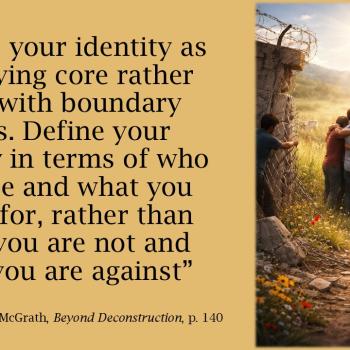
Reviews of Beyond Deconstruction (and an Easter Excerpt)
Religion Prof: The Blog of James F. McGrath
TRENDING AT PATHEOS Progressive Christian

I was strolling through the top floor of the brand new Parthenon...

What Does Gêvâh Mean For Kimberley Guifoyle &...
This week, a lot of the news is focused on Kimberly Guilfoyle....

INNER CIRCLE: Profound Mystery (Of Christ In All...
Ephesians 5:31-32 “For this reason, a man will leave his father and...

Do Not Rejoice When Your Enemy Falls: The...
Turning an execution into a public spectacle is a disturbing expression of...

'The Chosen' S6 Trailer: The Passion Gets Very...
Not many watching 'The Chosen' worry about spoilers, but just because they...

The purpose-driven labor priest
A labor activist reads Rick Warren and it gets me wondering about...
view all Progressive Christian blogs
Ad-Free & Subscriber Log-In Subscription Support
- About Us
- 2026 Calendar
- Videos
- Podcasts
- Library of World Religions
- Faith In Media Tracker
- Advertise With Us
- Write for Us
- Privacy Policy
- Terms of Service
- Do Not Sell My Data
- Contact Us
- Radiant Digital
- Manage Newsletter Subscriptions
- Unsubscribe From Notifications
- Sitemap
Copyright 2008-2026, Patheos. All rights reserved.
Subscription Support Ad-Free & Subscriber Log-In
Follow Patheos