
BuddhistCatholicContemplativeEvangelicalGeneral ChristianHinduJewishLatter-day SaintMuslimNew VisionsProgressive Christian
Beliefs
- Buddhist
- Catholic
- Contemplative
- Evangelical
- General Christian
- Hindu
- Jewish
- Latter-day Saint
- More Voices
- Muslim
- New Visions
- Pagan
- Progressive Christian
Topics
- Religion News
- Food and Religion
- Sports and Religion
- Religious Art
- Religious Music and Entertainment
- Religious Events
- History and Religion
- Style and Religion
- Politics and Religion
- Women in Religion
- Recreation Outdoors and Religion
- Business Finance and Religion
- Careers Workplace and Religion
- Education and Religion
- Family Parenting and Religion
- Health Fitness and Religion
- Home and Religion
- Relationships and Religion
- Technology and Religion
- Travel and Religion
Columnists
- Buddhist Columnists
- Business Finance and Religion Columnists
- Careers Workplace and Religion Columnists
- Catholic Columnists
- Contemplative Columnists
- Education and Religion Columnists
- Evangelists Columnists
- Family Parenting and Religion Columnists
- General Christian Columnists
- Health Fitness and Religion Columnists
- Hindu Columnists
- History and Religion Columnists
- Home and Religion Columnists
- Jewish Columnists
- More Voices Columnists
- Latter Day Columnists
- Muslim Columnists
- New Visions Columnists
- Nonreligious Columnists
- Pagan Columnists
- Politics and Religion Columnists
- Progressive Columnists
- Recreation Outdoors and Religion Columnists
- Relationships and Religion Columnists
- Religion News Columnists
- Religious Art Columnists
- Religious Events Columnists
- Religious Music and Entertainment Columnists
- Sports and Religion Columnists
- Style and Religion Columnists
- Technology and Religion Columnists
- Travel and Religion Columnists
- Women in Religion Columnists
Resource Library
- 2026 Calendar
- Library of World Religions
- The 100 Most Holy Places on Earth
- Patheos Answers
- Podcasts
- Videos
- Faith Leaders Database
- Anglican Episcopalian
- Bahai
- Baptist
- Buddhism
- Christianity
- Confucianism
- Eastern Orthodoxy
- Hinduism
- Holiness and Pentecostal
- ISKCON
- Islam
- Judaism
- Lutheran
- Methodist
- The Church of Jesus Christ of Latter-day Saints
- New Age
- Paganism
- Presbytarian and Reformed
- Protestantism
- Religion Behind the Scenes
- Roman Catholic
- Scientology
- Shia Islam
- Sikhism
- Sufism
- Sunni Islam
- Taoism
- Zen
- See all religions
Research Tools
 Ad-Free & Subscriber Log-In Subscription Support
Follow Patheos 

- Trending:
- Advent
- |
- Forgiveness
- |
- Thanksgiving
- |
- Election
- |
- Seasonal Holidays
- |
- Marriage

- Home
- About Dr. James F. McGrath
- Publications
- Blogroll
- Useful Websites
- Connections
- Easy Search Posts Page
- FREE NEWSLETTER
- Home
- Progressive Christian
- Christ in the Multiverse: An Interview with David Williams
Christ in the Multiverse: An Interview with David Williams
Last updated on: September 22, 2020 at 5:21 am by James F. McGrath
Christ in the Multiverse: An Interview with David Williams 2020-09-21T10:53:49-04:00 James F. McGrath
Patheos Explore the world's faith through different perspectives on religion and spirituality! Patheos has the views of the prevalent religions and spiritualities of the world.

C. S. Lewis is your main or at least recurring conversation partner, even as you chat with the likes of Michio Kaku, Calvin, and Job. Is multiverse theology essentially Narnia theology?
My choice to have Lewis open my chapters as I explored the impacts of this cosmology on Christian faith was more reflective of my personal journey than any other rationale. Clive Staples Lewis is an old friend, my first place of entry into the world of fantasy fiction. My mom was a linguist by training, and had me reading at an absurdly early age. I was five (five!) when I read The Lion, The Witch, and the Wardrobe alone in my room in Nairobi, and it was a peculiar experience. Perhaps it’s a factor of a child’s imagination, but my memory of it isn’t so much of sitting and reading, but of physically being in Narnia. Snow underfoot, the warmth of the fire in a beaver’s den, the hard terrible cold of a stone slab. Multiverse theology is certainly implied by storytelling that engages with both faith and the possibility of other realms of being, but it goes far deeper than the green fields of Narnia.
Other than Narnia, what other science/speculative fiction offers theologically and spiritually useful exploration of multiple universes? (I recommend Christ Crawford’s The Tuning Station, but even a TV show like Fringe has something to offer of relevance.) What are your favorites? Should we encourage more theological multiverse fiction to be written?
Multiversal narratives are just about everywhere in sci fi and fantasy, and much of what they explore is wonderful for stirring theological and spiritual conversation. My favorites? Gracious. There are so many. Star Trek, of course. I think the series finale of TNG remains one of the most satisfying multiverse/interwoven alternative timeline tales I’ve ever had the pleasure of encountering. Others? Back when I was in high school, I was very into Michael Moorcock. The cosmology underlying the Elric saga is essentially multiversal, and Moorcock’s underlying explorations of law and chaos, power and the good? Fasckinating. When it comes to harder sci fi, I’ve been influenced by the writing of Stephen Baxter, whose explorations of the dynamics of multiple spacetimes really do verge on theology at points. Reading his classic “The Time Ships” was legitimately mindblowing. And yes, more multiverse fiction with a faith spin should be written. Any sufficiently thoughtful multiverse fiction is indistinguishable from theology, to flagrantly reword Clarke’s Third Law.
I am always grateful when someone draws attention to the importance of Paul Tillich’s writings, especially on the subject of God as ultimate. (I also appreciate when an author speaks my language and does things like throwing a reference to a “saving throw,” but that’s another matter). Is it surprising how much past theologians offer that is relevant to theology as it seeks to interact with cutting-edge science? Or do human beings perennially cycle through the same (or at least very similar) issues and worldviews? Which other authors desperately need to be (re)discovered by a wider readership because of their relevance to our time and the concerns of the present?


Across the two millennia history of our faith, there are so many voices that have faded from memory or have drifted into the shadows. My own favorite lost voice is that of George MacDonald, whose fierce Scots mysticism, radical focus on the power of divine love, and willingness to challenge the cold utilitarianism of industrial Western culture still powerfully resonate with me. That he was the author of some intense, dreamlike multiverse-friendly fantasy novels really works for me, too, for some reason.
Having multiple conclusions is helpful in a book like this, but also a symbolically interesting approach. Are the parallels between the multiple worldviews we inhabit as human beings, and the multiple universes that may exist, merely a useful metaphor (just as there is a metaphorical and symbolic connection between the theory of relativity and relativism/acknowledgement that differing perspectives can both be true within their framework) or is it more than that?
I figured it’d be apropos to have a choose-your-own adventure ending, given the topic. It’s more than a metaphor, I’d say. One of the most potent challenges for ethics and morality in a multiversal cosmos is how the multiverse tests our idea of the good. Is my understanding of the good (radical compassion, agape love, and an openness to the personhood of the other) more “true” than the understanding that rises from Ayn Rand’s objectivism? If a physically identical version of me exists in another spacetime, and that David Williams somehow read, enjoyed, and treated Atlas Shrugged as life-changing literature, why am I more legitimately good than that iteration? Why do I feel I have a right to make that moral claim? That’s one thing if it’s just a thought exercise, and rather another if I understand that to be the nature of existence itself.
If there is a subject I expected more on it was the ethical and theological implications of an infinite multiverse and or parallel universes, in which everything happens, and/or in which there are countless versions of us with different morals and faiths. In a universe with Spock’s beard (as in the mirror universe in the Star Trek episode, not the band Spock’s Beard), how does or would theology need to be different in order to take seriously the existence of other versions of ourselves whose moral outlook may be different? How for that matter does a multiverse in which someplace like Narnia might really exist need to be different from one in which Narnia is just the stuff of stories? And how do we do theology from a perspective that may know that many universes are likely to exist and yet they will be beyond our reach and knowledge for the foreseeable future and perhaps forever?
The theological implications of a multiverse creation are intense. What does it do to our vision of God, if God’s creative power extends beyond our spacetime? What does it do to our understanding of the Bible narrative, and to our understanding of providence and the purpose of being? The ramifications go well beyond what a single work could sanely manage.
The ethical question also goes deeper than I think any one book could reasonably probe, which is why I made it more playful in tone. One has to know one’s limitations, eh? I do lay out what I’ve come to view as the essential dialectic of multiversal ethics. First, that if moral action can only create probable outcomes, ethics has to consider the goodness of an action in terms of most probable consequence, not certain consequence. Second and deriving from the first, that given the uncertainty of any particular outcome, an action must inherently reflect the ethical framework driving it. Decisions must be good in and of themselves. Evil cannot be justified in terms of a potential greater future good. Ultimately, that splits the difference between consequentialist and deontological ethics…or creates a necessary synthesis between the two.
As for the reality of Narnia in the multiverse, I really hope so. I haven’t yet found the ring that would take me to the Wood Between the Worlds, but I do look now and again. What other realities should force us to consider is the universality of our ethical systems and our faith. Stripping away the assumptions of national, ethnic, and other contingent identities, is the faith we proclaim still relevant? If not, we’ve just made ourselves an idol.
______________________
I am grateful to David for the chance to read his book and have this conversation about it. Here’s the panel we were both on, which you may enjoy if you’ve never seen it before (and perhaps even if you have!):
Previous Post

September 21, 2020
The Theology of Images in Shoenberg's Moses und Aron

Browse Our Archives
Select a Category 1 Corinthians 1 John 1 Peter 1 Samuel 1 Thessalonians 1 Timothy 2 Corinthians 2 Kings 2 Peter 2 Samuel 2 Thessalonians 2 Timothy academia Acts of the Apostles afterlife Akhaten Alcatraz American Academy of Religion Amos Anglican Arabic Aramaic archaeology art artificial intelligence astronomy atheism atonement Babylon 5 Baptists Battlestar Galactica Bible Biblical Studies Carnival biblioblogging Black Mirror Blade Runner Book of Job book review Buddhism Call for Papers China Christianity Christmas Christology Chronicles Coptic creation Daniel Deuteronomy Doctor Who Dune Easter Ecclesiastes economics education Eldad Keynan Enoch Seminar Ephesians eschatology Esther Evangelicals evolution Exodus Expanse Ezekiel Ezra fantasy Fringe fundamentalism Galatians games Ge'ez genealogy Genesis Gnosticism Gospel of Jesus' Wife Gospel of John Gospel of Judas Gospel of Luke Gospel of Mark Gospel of Matthew Gospel of Peter Gospel of Thomas Greek Harry Potter Hebrew Hebrews Hinduism historical Jesus history Hitchhiker's Guide to the Galaxy Holidays horror Hosea humor incarnation India inerrancy information literacy inspirational Intelligent Design Ireland Isaiah Islam Israel Italy James Jeremiah John the Baptist Jonah Joshua Judaism Jude Judges Judith Lamentations languages Latin Leviticus libraries literature Lord of the Rings LOST Mandaeans Mandaic memes Methodism Micah monotheism morality Mormons movies music mythicism NASSCAL Nehemiah new perspective New Testament news Numbers Orthodox paganism panentheism pantheism Patheos Paul and his letters Pentecostals Philippians Philippians 2:6-11 philosophy physics Planet of the Apes podcast politics Progressive Christianity Protestantism Proverbs Psalms pseudoscience racism religion Revelation Roman Catholicism Romania Romans Ruth scams science science fiction Secret Gospel of Mark Society of Biblical Literature Song of Songs Star Trek Star Wars Stargate Swahili Syriac Taoism technology Terminator The Handmaid's Tale The Hobbit The Matrix theodicy theology theory Timeless Titus tomb Torchwood travel TRON Uncategorized United Kingdom Westworld X-Files young-earth creationism Zechariah
Select a Month November 2026 October 2026 September 2026 August 2026 July 2026 June 2026 May 2026 April 2026 March 2026 February 2026 January 2026 December 2025 November 2025 October 2025 September 2025 July 2025 June 2025 May 2025 April 2025 March 2025 February 2025 January 2025 December 2024 November 2024 October 2024 September 2024 August 2024 July 2024 June 2024 May 2024 April 2024 March 2024 February 2024 January 2024 December 2023 November 2023 October 2023 September 2023 August 2023 July 2023 May 2023 April 2023 March 2023 February 2023 January 2023 December 2022 November 2022 October 2022 September 2022 August 2022 July 2022 June 2022 May 2022 April 2022 March 2022 February 2022 January 2022 December 2021 November 2021 October 2021 September 2021 August 2021 July 2021 June 2021 May 2021 April 2021 March 2021 February 2021 January 2021 December 2020 November 2020 October 2020 September 2020 August 2020 July 2020 June 2020 May 2020 April 2020 March 2020 February 2020 January 2020 December 2019 November 2019 October 2019 September 2019 August 2019 July 2019 June 2019 May 2019 April 2019 March 2019 February 2019 January 2019 December 2018 November 2018 October 2018 September 2018 August 2018 July 2018 June 2018 May 2018 April 2018 March 2018 February 2018 January 2018 December 2017 November 2017 October 2017 September 2017 August 2017 July 2017 June 2017 May 2017 April 2017 March 2017 February 2017 January 2017 December 2016 November 2016 October 2016 September 2016 August 2016 July 2016 June 2016 May 2016 April 2016 March 2016 February 2016 January 2016 December 2015 November 2015 October 2015 September 2015 August 2015 July 2015 June 2015 May 2015 April 2015 March 2015 February 2015 January 2015 December 2014 November 2014 October 2014 September 2014 August 2014 July 2014 June 2014 May 2014 April 2014 March 2014 February 2014 January 2014 December 2013 November 2013 October 2013 September 2013 August 2013 July 2013 June 2013 May 2013 April 2013 March 2013 February 2013 January 2013 December 2012 November 2012 October 2012 September 2012 August 2012 July 2012 June 2012 May 2012 April 2012 March 2012 February 2012 January 2012 December 2011 November 2011 October 2011 September 2011 August 2011 July 2011 June 2011 May 2011 April 2011 March 2011 February 2011 January 2011 December 2010 November 2010 October 2010 September 2010 August 2010 July 2010 June 2010 May 2010 April 2010 March 2010 February 2010 January 2010 December 2009 November 2009 October 2009 September 2009 August 2009 July 2009 June 2009 May 2009 April 2009 March 2009 February 2009 January 2009 December 2008 November 2008 October 2008 September 2008 August 2008 July 2008 June 2008 May 2008 April 2008 March 2008 February 2008 January 2008 December 2007 November 2007 October 2007 September 2007 August 2007 July 2007 June 2007 February 2007 January 2001
Follow Us!
TAKE THE
Religious Wisdom Quiz
Which book of the Bible is written as a song of love between a bride and groom?
Select your answer to see how you score.
Psalms Ecclesiastes Proverbs Song of Songs
Books by This Author Books by James F. McGrath
Related posts from Religion Prof: The Blog of James F. McGrath
Religion Prof: The Blog of James F. McGrath

The Obsolete Paradigm of a Purely Mythical Jesus
Religion Prof: The Blog of James F. McGrath
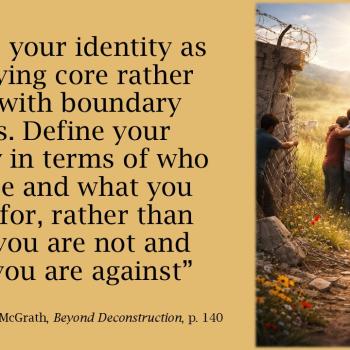
Reviews of Beyond Deconstruction (and an Easter Excerpt)
Religion Prof: The Blog of James F. McGrath
Religion Prof: The Blog of James F. McGrath
TRENDING AT PATHEOS Progressive Christian

The Wasp And I: Meditations on Repentance
How can we enter the power and joy of the repentant self...

Reflections on the Evangelical Theological Society
As I mentioned before, this year, for the first time since 2005,...

Demmed if it do and demmed if it...
"First Presidency Announces Salt Lake Temple Rededication Date" Apropos of that,...

Stop Making Thanksgiving Problematic And Just Give Thanks
“What if, today, we were grateful for everything?” –Charlie Brown I...

Sunday Readings: Stay Awake and Hope
The First Sunday of Advent begins a new liturgical year, and the...

Are You a Scrooge or an Ebenezer?
A Call to Remember As the Christmas season begins, will we remember...
view all Progressive Christian blogs
Ad-Free & Subscriber Log-In Subscription Support
- About Us
- 2026 Calendar
- Videos
- Podcasts
- Library of World Religions
- Faith In Media Tracker
- Advertise With Us
- Write for Us
- Privacy Policy
- Terms of Service
- Do Not Sell My Data
- Contact Us
- Radiant Digital
- Manage Newsletter Subscriptions
- Unsubscribe From Notifications
- Sitemap
Copyright 2008-2026, Patheos, part of the Radiant Digital network of media brands. All rights reserved.
Subscription Support Ad-Free & Subscriber Log-In
Follow Patheos