
BuddhistCatholicContemplativeEvangelicalGeneral ChristianHinduJewishLatter-day SaintMuslimNew VisionsProgressive Christian
Beliefs
- Buddhist
- Catholic
- Contemplative
- Evangelical
- General Christian
- Hindu
- Jewish
- Latter-day Saint
- More Voices
- Muslim
- New Visions
- Pagan
- Progressive Christian
Topics
- Religion News
- Food and Religion
- Sports and Religion
- Religious Art
- Religious Music and Entertainment
- Religious Events
- History and Religion
- Style and Religion
- Politics and Religion
- Women in Religion
- Recreation Outdoors and Religion
- Business Finance and Religion
- Careers Workplace and Religion
- Education and Religion
- Family Parenting and Religion
- Health Fitness and Religion
- Home and Religion
- Relationships and Religion
- Technology and Religion
- Travel and Religion
Columnists
- Buddhist Columnists
- Business Finance and Religion Columnists
- Careers Workplace and Religion Columnists
- Catholic Columnists
- Contemplative Columnists
- Education and Religion Columnists
- Evangelists Columnists
- Family Parenting and Religion Columnists
- General Christian Columnists
- Health Fitness and Religion Columnists
- Hindu Columnists
- History and Religion Columnists
- Home and Religion Columnists
- Jewish Columnists
- More Voices Columnists
- Latter Day Columnists
- Muslim Columnists
- New Visions Columnists
- Nonreligious Columnists
- Pagan Columnists
- Politics and Religion Columnists
- Progressive Columnists
- Recreation Outdoors and Religion Columnists
- Relationships and Religion Columnists
- Religion News Columnists
- Religious Art Columnists
- Religious Events Columnists
- Religious Music and Entertainment Columnists
- Sports and Religion Columnists
- Style and Religion Columnists
- Technology and Religion Columnists
- Travel and Religion Columnists
- Women in Religion Columnists
Resource Library
- 2026 Calendar
- Library of World Religions
- The 100 Most Holy Places on Earth
- Patheos Answers
- Podcasts
- Videos
- Faith Leaders Database
- Anglican Episcopalian
- Bahai
- Baptist
- Buddhism
- Christianity
- Confucianism
- Eastern Orthodoxy
- Hinduism
- Holiness and Pentecostal
- ISKCON
- Islam
- Judaism
- Lutheran
- Methodist
- The Church of Jesus Christ of Latter-day Saints
- New Age
- Paganism
- Presbytarian and Reformed
- Protestantism
- Religion Behind the Scenes
- Roman Catholic
- Scientology
- Shia Islam
- Sikhism
- Sufism
- Sunni Islam
- Taoism
- Zen
- See all religions
Research Tools
 Ad-Free & Subscriber Log-In Subscription Support
Ad-Free & Subscriber Log-In Subscription Support
Follow Patheos 

- Trending:
- Forgiveness
- |
- Marriage
- |
- Consciousness
- |
- Death Penalty
- |
- Election
- |
- Halloween

- Home
- About Dr. James F. McGrath
- Publications
- Blogroll
- Useful Websites
- Connections
- Easy Search Posts Page
- FREE NEWSLETTER
- Home
- Progressive Christian
- Vocation and Interreligious Engagement at #NetVUE2019AAR #AARSBL19 Part 3
Vocation and Interreligious Engagement at #NetVUE2019AAR #AARSBL19 Part 3
Last updated on: April 24, 2020 at 5:28 am by James F. McGrath
Vocation and Interreligious Engagement at #NetVUE2019AAR #AARSBL19 Part 3 2020-04-23T04:52:35-04:00 James F. McGrath
Patheos Explore the world's faith through different perspectives on religion and spirituality! Patheos has the views of the prevalent religions and spiritualities of the world.
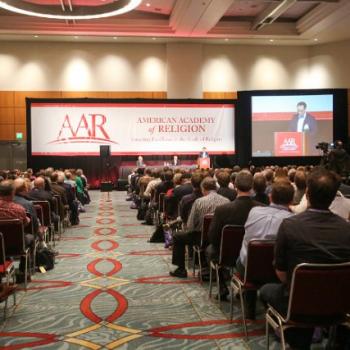
Returning after a very long break to my recap of this deeply meaningful event that took place in November 2019 in San Diego. This post covers the first part of Day Two. The day was so rich and full of helpful insights that sharing the notes I took easily fills multiple posts. I hope that sharing them benefits others even though these posts cannot do justice to the experience.
The morning began with a session on “Vocation, Interfaith, and Religious Studies in the Classroom.” It featured Marty Stortz (from Augsburg, a very diverse context), Matt Maruggi, Trina Jones from Wofford, a Methodist institution that is growing every year as the southeast experiences a boom in higher education), and Anita Houck (from a small Catholic women’s college in South Bend–famous now for Pete Buttigieg–where a religion course is required, but there is no coherent institutional approach to vocation).
Stortz said her focus is on understanding who the students are in front of her. Christians have shrunk from 64% to 38% of the student population over 10 years, while non-Christians tripled to 16%, no affiliation rose to 17%, and interestingly “not reported has dropped.” Now 13% are Muslim, and there are 3 mosques near campus where in the past there would have been 5 churches, all Lutheran. These students respond to talk of meaning and purpose, while “vocation” makes their eyes glaze over. Students consistently come in with the question “Am I in the right place?” That provides a direct link to discussing the topic of vocation, whatever terminology you may use.
Ask students to identify the roles they inhabit and the responsibilities of each. What will they do when different roles conflict, e.g. marketing major/future professional and mother.
Path as a metaphor is more prominent in the Catholic tradition than among Protestants. Perhaps this is due to the practice (however less common in our time) of pilgrimage. That custom also exists in Islam, perhaps providing a point of contact or bridge. Different images will work for different people, and some metaphors will have a detrimental impact on particular students at particular moments. Sometimes discerning the relationship between majors and minors, or even choice of courses, and vocations is challenging. The following categories can all be appropriate for vocational exploration for some students and in some contexts:
People: An example was given of a Hmong student who knew she wanted to be an activist on behalf of her people, and was not sure about her major. Focusing narrowly on what role she might or might not play would have discouraged her.
Perspective: Vocation is a lens, a vision, a way of saying “this is where I stand, what I stand for, how I see the world.” Vocation can be an identity, expressing core commitments that animate how we want to ‘show up’ in the world.
Activity: What is the noun and what are the qualifying adjectives when it comes to our sense of vocation? Are you a Christian feminist or a feminist Christian? Knowing who we are can be the centerpiece in vocational exploration.
Story: “There is a narrative arc to each life.” Help students realize they have a story to tell. Reading religious autobiography helps. An Afghani Muslim female student opined, “I never get to write like this in my major (biology) and I love it.” Stortz suggested that the Jews historically, not having a homeland, have had to live in stories, and this provides a resource.
Houck’s presentation included some amazing details. For instance, there are 37 1/2 hours of class in a typical semester in a 3-credit hour course. That means we actually have less time with students than anyone has in their job in a typical work week. To put it another way, we have insufficient time to accomplish what we want to.
Her course aims break down into two parts: fail, and fail better. Her intro to religious studies falls under the heading “Exploring the Good Life.” She has students read William Cavanaugh on why you can’t do whatever you want. There is a focus on “a life beyond ‘Do What You Love.'” She quotes Neil Gaiman on the virtue of failure. Virtue is one helpful way to approach vocation, as we focus on becoming who we are called to be. Virtue is applicable to any career path.
We need an academic journal called “It seemed like a good idea at the time,” rather like the idea of a Journal of Negative Results. “Obituaries don’t have a thesis.”
Top 10 ways to teach vocation:
- On course outcomes go bold. Purpose of course is to make the world a better place. Give that as feedback.
- Keep the Neil Gaiman quote. Refer back to it when students fail.
- Religious studies requires virtues such as humility. Did a student offer what you consider to be an ignorant comment? Express appreciation for the honest first reaction.
- Integrate ungraded self-reflection (for every assignment).
- Integrate virtue and vocation language into grading.
- Don’t write grades on essays. Grades are evil. They keep students from reading comments. Tell them they can ask for a grade if they want it.
- Apologize when you screw up. It illustrates humility.
- Contemplative pedagogy. 68.3% of students said they feel overwhelming anxiety.
- Include case studies if there’s time, and definitely integrate humor
- You can’t be everything you want as an educator.
Of related interest, the Vocation Matters blog explored a topic that was also a focus at this NetVUE workshop, namely what if anything vocation means for atheists.
Hopefully at a time when many academics are either finding they cannot go to conferences, or wondering whether future conferences will be canceled, or wondering what to make of how they perceive things to have gone this semester, sharing this now will be more useful than it might have been if I had done so in November of last year. If this is useful, please do let me know, and do also convey your appreciation to the folks at NetVUE who facilitate so much work and reflection on this topic. I don’t know what will happen with their next in-person gathering of faculty who are concerned with vocation. But I hope to be there if I can.
Stay tuned for parts 4 and 5…
Previous Post

April 23, 2020
Baby Yoda and Biblical Canon
Next Post

April 25, 2020 The Banker
Browse Our Archives
Select a Category 1 Corinthians 1 John 1 Peter 1 Samuel 1 Thessalonians 1 Timothy 2 Corinthians 2 Kings 2 Peter 2 Samuel 2 Thessalonians 2 Timothy academia Acts of the Apostles afterlife Akhaten Alcatraz American Academy of Religion Amos Anglican Arabic Aramaic archaeology art artificial intelligence astronomy atheism atonement Babylon 5 Baptists Battlestar Galactica Bible Biblical Studies Carnival biblioblogging Black Mirror Blade Runner Book of Job book review Buddhism Call for Papers China Christianity Christmas Christology Chronicles Coptic creation Daniel Deuteronomy Doctor Who Dune Easter Ecclesiastes economics education Eldad Keynan Enoch Seminar Ephesians eschatology Esther Evangelicals evolution Exodus Expanse Ezekiel Ezra fantasy Fringe fundamentalism Galatians games Ge'ez genealogy Genesis Gnosticism Gospel of Jesus' Wife Gospel of John Gospel of Judas Gospel of Luke Gospel of Mark Gospel of Matthew Gospel of Peter Gospel of Thomas Greek Harry Potter Hebrew Hebrews Hinduism historical Jesus history Hitchhiker's Guide to the Galaxy Holidays horror Hosea humor incarnation India inerrancy information literacy inspirational Intelligent Design Ireland Isaiah Islam Israel Italy James Jeremiah John the Baptist Jonah Joshua Judaism Jude Judges Judith Lamentations languages Latin Leviticus libraries literature Lord of the Rings LOST Mandaeans Mandaic memes Methodism Micah monotheism morality Mormons movies music mythicism NASSCAL Nehemiah new perspective New Testament news Numbers Orthodox paganism panentheism pantheism Patheos Paul and his letters Pentecostals Philippians Philippians 2:6-11 philosophy physics Planet of the Apes podcast politics Progressive Christianity Protestantism Proverbs Psalms pseudoscience racism religion Revelation Roman Catholicism Romania Romans Ruth scams science science fiction Secret Gospel of Mark Society of Biblical Literature Song of Songs Star Trek Star Wars Stargate Swahili Syriac Taoism technology Terminator The Handmaid's Tale The Hobbit The Matrix theodicy theology theory Timeless Titus tomb Torchwood travel TRON Uncategorized United Kingdom Westworld X-Files young-earth creationism Zechariah
Select a Month October 2026 September 2026 August 2026 July 2026 June 2026 May 2026 April 2026 March 2026 February 2026 January 2026 December 2025 November 2025 October 2025 September 2025 July 2025 June 2025 May 2025 April 2025 March 2025 February 2025 January 2025 December 2024 November 2024 October 2024 September 2024 August 2024 July 2024 June 2024 May 2024 April 2024 March 2024 February 2024 January 2024 December 2023 November 2023 October 2023 September 2023 August 2023 July 2023 May 2023 April 2023 March 2023 February 2023 January 2023 December 2022 November 2022 October 2022 September 2022 August 2022 July 2022 June 2022 May 2022 April 2022 March 2022 February 2022 January 2022 December 2021 November 2021 October 2021 September 2021 August 2021 July 2021 June 2021 May 2021 April 2021 March 2021 February 2021 January 2021 December 2020 November 2020 October 2020 September 2020 August 2020 July 2020 June 2020 May 2020 April 2020 March 2020 February 2020 January 2020 December 2019 November 2019 October 2019 September 2019 August 2019 July 2019 June 2019 May 2019 April 2019 March 2019 February 2019 January 2019 December 2018 November 2018 October 2018 September 2018 August 2018 July 2018 June 2018 May 2018 April 2018 March 2018 February 2018 January 2018 December 2017 November 2017 October 2017 September 2017 August 2017 July 2017 June 2017 May 2017 April 2017 March 2017 February 2017 January 2017 December 2016 November 2016 October 2016 September 2016 August 2016 July 2016 June 2016 May 2016 April 2016 March 2016 February 2016 January 2016 December 2015 November 2015 October 2015 September 2015 August 2015 July 2015 June 2015 May 2015 April 2015 March 2015 February 2015 January 2015 December 2014 November 2014 October 2014 September 2014 August 2014 July 2014 June 2014 May 2014 April 2014 March 2014 February 2014 January 2014 December 2013 November 2013 October 2013 September 2013 August 2013 July 2013 June 2013 May 2013 April 2013 March 2013 February 2013 January 2013 December 2012 November 2012 October 2012 September 2012 August 2012 July 2012 June 2012 May 2012 April 2012 March 2012 February 2012 January 2012 December 2011 November 2011 October 2011 September 2011 August 2011 July 2011 June 2011 May 2011 April 2011 March 2011 February 2011 January 2011 December 2010 November 2010 October 2010 September 2010 August 2010 July 2010 June 2010 May 2010 April 2010 March 2010 February 2010 January 2010 December 2009 November 2009 October 2009 September 2009 August 2009 July 2009 June 2009 May 2009 April 2009 March 2009 February 2009 January 2009 December 2008 November 2008 October 2008 September 2008 August 2008 July 2008 June 2008 May 2008 April 2008 March 2008 February 2008 January 2008 December 2007 November 2007 October 2007 September 2007 August 2007 July 2007 June 2007 February 2007 January 2001
Follow Us!
TAKE THE
Religious Wisdom Quiz
Which prophet spoke of a 'new covenant' in the Old Testament?
Select your answer to see how you score.
Jeremiah Malachi Isaiah Ezekiel
Books by This Author Books by James F. McGrath
Related posts from Religion Prof: The Blog of James F. McGrath

Where I'll Be (November 2025 Edition)
Religion Prof: The Blog of James F. McGrath

Calls for Papers and Butler University Day of...
Religion Prof: The Blog of James F. McGrath

Religion Prof: The Blog of James F. McGrath
Religion Prof: The Blog of James F. McGrath
TRENDING AT PATHEOS Progressive Christian

Nearly every morning, I make the drive to Detroit with my high-school-age...

The Real AI Story Is Adoption Without Trust
Artificial intelligence has crossed a political threshold. It is no longer a...

A new article, written by Jeff Lindsay and Gale L. Pooley,...

Swimfan: Forgotten Aughts Pleasures
This is a recovery effort. In 2002, My Big Fat Greek Wedding...

Top Three Anti-Catholic Lies About Catholicism
This is my initial transcript for the video, "THE 3 WORST...

Pope Leo Celebrates Mass for Nurses & Docs...
I don't have any idea how he did it, but Pope Leo...
view all Progressive Christian blogs
Ad-Free & Subscriber Log-In Subscription Support
- About Us
- 2026 Calendar
- Videos
- Podcasts
- Library of World Religions
- Faith In Media Tracker
- Advertise With Us
- Write for Us
- Privacy Policy
- Terms of Service
- Do Not Sell My Data
- Contact Us
- Radiant Digital
- Manage Newsletter Subscriptions
- Unsubscribe From Notifications
- Sitemap
Copyright 2008-2026, Patheos. All rights reserved.
Subscription Support Ad-Free & Subscriber Log-In
Follow Patheos