
BuddhistCatholicContemplativeEvangelicalGeneral ChristianHinduJewishLatter-day SaintMuslimNew VisionsProgressive Christian
Beliefs
- Buddhist
- Catholic
- Contemplative
- Evangelical
- General Christian
- Hindu
- Jewish
- Latter-day Saint
- More Voices
- Muslim
- New Visions
- Pagan
- Progressive Christian
Topics
- Religion News
- Food and Religion
- Sports and Religion
- Religious Art
- Religious Music and Entertainment
- Religious Events
- History and Religion
- Style and Religion
- Politics and Religion
- Women in Religion
- Recreation Outdoors and Religion
- Business Finance and Religion
- Careers Workplace and Religion
- Education and Religion
- Family Parenting and Religion
- Health Fitness and Religion
- Home and Religion
- Relationships and Religion
- Technology and Religion
- Travel and Religion
Columnists
- Buddhist Columnists
- Business Finance and Religion Columnists
- Careers Workplace and Religion Columnists
- Catholic Columnists
- Contemplative Columnists
- Education and Religion Columnists
- Evangelists Columnists
- Family Parenting and Religion Columnists
- General Christian Columnists
- Health Fitness and Religion Columnists
- Hindu Columnists
- History and Religion Columnists
- Home and Religion Columnists
- Jewish Columnists
- More Voices Columnists
- Latter Day Columnists
- Muslim Columnists
- New Visions Columnists
- Nonreligious Columnists
- Pagan Columnists
- Politics and Religion Columnists
- Progressive Columnists
- Recreation Outdoors and Religion Columnists
- Relationships and Religion Columnists
- Religion News Columnists
- Religious Art Columnists
- Religious Events Columnists
- Religious Music and Entertainment Columnists
- Sports and Religion Columnists
- Style and Religion Columnists
- Technology and Religion Columnists
- Travel and Religion Columnists
- Women in Religion Columnists
Resource Library
- 2026 Calendar
- Library of World Religions
- The 100 Most Holy Places on Earth
- Patheos Answers
- Podcasts
- Videos
- Faith Leaders Database
- Anglican Episcopalian
- Bahai
- Baptist
- Buddhism
- Christianity
- Confucianism
- Eastern Orthodoxy
- Hinduism
- Holiness and Pentecostal
- ISKCON
- Islam
- Judaism
- Lutheran
- Methodist
- The Church of Jesus Christ of Latter-day Saints
- New Age
- Paganism
- Presbytarian and Reformed
- Protestantism
- Religion Behind the Scenes
- Roman Catholic
- Scientology
- Shia Islam
- Sikhism
- Sufism
- Sunni Islam
- Taoism
- Zen
- See all religions
Research Tools
 Ad-Free & Subscriber Log-In Subscription Support
Ad-Free & Subscriber Log-In Subscription Support
Follow Patheos 

- Trending:
- Forgiveness
- |
- Marriage
- |
- Consciousness
- |
- Death Penalty
- |
- Election
- |
- Halloween

- Home
- About Dr. James F. McGrath
- Publications
- Blogroll
- Useful Websites
- Connections
- Easy Search Posts Page
- FREE NEWSLETTER
- Home
- Progressive Christian
- National Humanities Conference 2020 in Indianapolis #CFP
National Humanities Conference 2020 in Indianapolis #CFP
Last updated on: February 8, 2020 at 5:11 am by James F. McGrath
National Humanities Conference 2020 in Indianapolis #CFP 2020-02-06T14:21:50-05:00 James F. McGrath
Patheos Explore the world's faith through different perspectives on religion and spirituality! Patheos has the views of the prevalent religions and spiritualities of the world.
I want to share this call for panels and presentations at the National Humanities Conference which will be in Indianapolis this year. If you’ll be coming to Indianapolis and are a reader of my blog, plan on saying hello.
Call for Proposals
National Humanities Conference 2020 | Indianapolis, IN
November 5-8, 2020
Deadline for submitting proposals: February 21, 2020
The Federation of State Humanities Councils and the National Humanities Alliance are excited to announce the 2020 National Humanities Conference, which will be held in Indianapolis. This annual conference brings together representatives from colleges, universities, state humanities councils, cultural institutions, and other community-based organizations to explore approaches to deepening the public’s engagement with the humanities.
Indianapolis is nicknamed the “Crossroads of America” because of its historic location along the old National Road and current site where four major interstates intersect. The conference convenes days after a presidential election, which like all national elections, is a crossroads, offering the opportunity to reflect on how we have arrived at this point and where we are heading. In this spirit, we invite proposals that explore the generative, exciting possibilities of public humanities work that happens at the crossroads.
Crossroads as decision points. When and how can the humanities and humanities practitioners help communities wrestle with tough choices? What difficult decisions face our own institutions—and how do we decide which way to go? Where have we taken risks, even if we failed—and what did we learn? When we’ve found our organizations at a difficult crossroads, how did we navigate rocky terrain and what happened as a result of our choices?
Crossroads as freedom. There’s a rich tradition of expression that associates crossroads with freedom—a place where multiple opportunities open up in front of you. How can the humanities help communities discuss, even reimagine the meaning of freedom for all? In an increasingly partisan landscape, where should the humanities and humanities practitioners enter such conversations that may have unequal power dynamics?
Crossroads as uncertainty. In many cultures around the world, the crossroads is a liminal, uncertain space that is outside of normal time and space. A place that is neither here nor there, the crossroads and its uncertainty can be part of a process of becoming something new. Are there times in our own practice where we experience uncertainty and disorientation? Are there times when our programs create uncertainty and disorientation among their participants? What, if anything, is generative about doing humanities work where uncertainty is foregrounded?
Crossroads as intersections. When we reframe the crossroads as an intersection, some connotations fall away and others emerge. Interesting, good, complex work happens at the intersection of ideas, disciplines or methods. Are there outstanding models of interdisciplinary public humanities projects we can learn from? Where have unusual partnerships yielded new, urgent, meaningful public humanities work? We’re particularly interested in sessions that help us learn about public humanities initiatives or programs that address the following intersections: STEM/humanities, race/class/gender, arts/humanities, urban/rural, public/private.
We hope these questions are broad enough to spark session proposals that reflect the full range of work humanities organizations, practitioners, and scholars do: create and deliver public programs, form community partnerships, educate students, communicate with and convene publics, advocate for funding, cultivate donors, make grants, and build audiences.
In the spirit of the crossroads—places of coming together and exchange—we especially encourage session proposals that bring together humanities practitioners (state humanities council staff, museum workers, podcast producers, community historians, etc.) and scholars/academics. See examples from the 2019 conference.
DEADLINE FOR SUBMITTING PROPOSALS: February 21st, 2020
Formats
We invite proposals that model best practices in the public humanities. In other words, session leaders design lively, even fun ways of presenting information and participants are engaged as co-creators of knowledge. To that end, we encourage:
- Sessions that model public humanities program design: dynamic, inclusive, and, where possible, participatory or hands-on.
- Presentations that are concise and employ accessible language. We encourage moderators to ensure that presentations conform to predetermined limits: at least half of each session should involve audience participation.
- Actionable takeaways that others can apply to their own practice or organization.
- Sessions built around a problem, tension, or challenge in our work, with time for reflection and solutions-oriented discussion.
Indiana Humanities, the host council, is committed to creating an indelible experience that makes the most of our host city. If you have ideas or questions about opportunities to take your session off site or to identify local practitioners in order to strengthen your proposal and deepen learning and exchange, please contact Leah Nahmias, director of programs at Indiana Humanities (317-616-9804 / [email protected]). Please note in your proposal if you need more than the standard 75-minute block of time for your session.
SESSION PROPOSALS
EXPERIENTIAL HUMANITIES PROGRAM: These sessions engage conference attendees in actual humanities programming, modeled on successful programs carried out throughout the year. Sessions that draw on the city or the surrounding area and/or convey a sense of place are especially encouraged. Examples from the 2019 program can be found here.
FACILITATED DISCUSSION: One or two facilitators drive a conversation on a topic with a group of conference attendees. Conversations can broach themes of common interest, common challenges or points of tension within the humanities community. Topics for facilitated discussion should appeal to a wide range of conference participants in order to bring diverse voices into the conversation.
INTERVIEW: These sessions feature free-form dialogue between a humanities professional and an interviewer.
WORKSHOP: A hands-on session that teaches a particular skill set associated with program development, communications, collaboration, assessment, development/fundraising, cultivating new audiences or any other aspect of humanities programming.
ROUNDTABLE: Roundtables consist of a group of experts discussing a topic in front of an audience, rather than each presenting discrete remarks. A moderator leads the discussion and poses questions, but all participants speak equally about the topics. These sessions are limited to four discussants and one moderator.
PANEL: This traditional format includes a moderator and no more than three presenters. Presentations are timed so that at least half the session consists of moderator questions and discussion with the audience.
WORKING GROUPS: Working groups are seminar-like conversations of at least eight people that explore, in-depth, a subject of shared interest. Working groups will be accepted even if they do not have eight participants, but additional participants will need to be recruited after the session is accepted. The working group convenes for a session at the conference, but also converses before the conference and develops a product after. Each working group will have a facilitator, responsible for organizing the pre- and post-conference exchanges and facilitating the conversation at the conference itself. Working groups can open up for audience observers or confine participation to the members of the working group.
INDIVIDUAL PROPOSALS
We invite proposals for individual flash presentations (5 minutes) that relate to one of the key crossroads themes outlined above: 1) decision point 2) freedom 3) uncertainty 4) intersection. The program committee will curate lightning round sessions of similarly themed presentations.
To submit a proposal:
Please submit session proposals via the online form here. Please submit proposals for individual flash presentations via the online form here. The deadline for proposal submission is Friday, February 21st, 2019. For questions regarding the online submission form, please contact [email protected].
The Federation of State Humanities Councils
The Federation of State Humanities Councils, founded in 1977, is the membership association of 56 state and territorial councils. Through its conferences, collaborative projects, information services, and communications to members, legislators and others on issues of public interest, the Federation supports the state humanities councils and creates greater awareness of the humanities in public and private life.
State humanities councils are independent, nonprofit organizations that support grassroots humanities programs and community-based activities in each state and US territory. Created by Congress in the early 1970s, councils receive an annual Congressional appropriation through the National Endowment for the Humanities, which for most councils is supplemented by state and private funding. Councils are run by small staffs and governed by volunteer boards drawn from academia and the public.
The National Humanities Alliance
The National Humanities Alliance (NHA) is a nationwide coalition of organizations advocating for the humanities on campuses, in communities, and on Capitol Hill. Founded in 1981, NHA is supported by over 200 member organizations, including: colleges, universities, libraries, museums, cultural organizations, state humanities councils, and scholarly, professional, and higher education associations. It is the only organization that brings together the US humanities community as a whole.
Previous Post

February 7, 2020
A Perfect President and His Christian Supporters
Next Post
February 9, 2020 New Open Access Journal: Journal of Religious Competition in Antiquity
Browse Our Archives
Select a Category 1 Corinthians 1 John 1 Peter 1 Samuel 1 Thessalonians 1 Timothy 2 Corinthians 2 Kings 2 Peter 2 Samuel 2 Thessalonians 2 Timothy academia Acts of the Apostles afterlife Akhaten Alcatraz American Academy of Religion Amos Anglican Arabic Aramaic archaeology art artificial intelligence astronomy atheism atonement Babylon 5 Baptists Battlestar Galactica Bible Biblical Studies Carnival biblioblogging Black Mirror Blade Runner Book of Job book review Buddhism Call for Papers China Christianity Christmas Christology Chronicles Coptic creation Daniel Deuteronomy Doctor Who Dune Easter Ecclesiastes economics education Eldad Keynan Enoch Seminar Ephesians eschatology Esther Evangelicals evolution Exodus Expanse Ezekiel Ezra fantasy Fringe fundamentalism Galatians games Ge'ez genealogy Genesis Gnosticism Gospel of Jesus' Wife Gospel of John Gospel of Judas Gospel of Luke Gospel of Mark Gospel of Matthew Gospel of Peter Gospel of Thomas Greek Harry Potter Hebrew Hebrews Hinduism historical Jesus history Hitchhiker's Guide to the Galaxy Holidays horror Hosea humor incarnation India inerrancy information literacy inspirational Intelligent Design Ireland Isaiah Islam Israel Italy James Jeremiah John the Baptist Jonah Joshua Judaism Jude Judges Judith Lamentations languages Latin Leviticus libraries literature Lord of the Rings LOST Mandaeans Mandaic memes Methodism Micah monotheism morality Mormons movies music mythicism NASSCAL Nehemiah new perspective New Testament news Numbers Orthodox paganism panentheism pantheism Patheos Paul and his letters Pentecostals Philippians Philippians 2:6-11 philosophy physics Planet of the Apes podcast politics Progressive Christianity Protestantism Proverbs Psalms pseudoscience racism religion Revelation Roman Catholicism Romania Romans Ruth scams science science fiction Secret Gospel of Mark Society of Biblical Literature Song of Songs Star Trek Star Wars Stargate Swahili Syriac Taoism technology Terminator The Handmaid's Tale The Hobbit The Matrix theodicy theology theory Timeless Titus tomb Torchwood travel TRON Uncategorized United Kingdom Westworld X-Files young-earth creationism Zechariah
Select a Month October 2026 September 2026 August 2026 July 2026 June 2026 May 2026 April 2026 March 2026 February 2026 January 2026 December 2025 November 2025 October 2025 September 2025 July 2025 June 2025 May 2025 April 2025 March 2025 February 2025 January 2025 December 2024 November 2024 October 2024 September 2024 August 2024 July 2024 June 2024 May 2024 April 2024 March 2024 February 2024 January 2024 December 2023 November 2023 October 2023 September 2023 August 2023 July 2023 May 2023 April 2023 March 2023 February 2023 January 2023 December 2022 November 2022 October 2022 September 2022 August 2022 July 2022 June 2022 May 2022 April 2022 March 2022 February 2022 January 2022 December 2021 November 2021 October 2021 September 2021 August 2021 July 2021 June 2021 May 2021 April 2021 March 2021 February 2021 January 2021 December 2020 November 2020 October 2020 September 2020 August 2020 July 2020 June 2020 May 2020 April 2020 March 2020 February 2020 January 2020 December 2019 November 2019 October 2019 September 2019 August 2019 July 2019 June 2019 May 2019 April 2019 March 2019 February 2019 January 2019 December 2018 November 2018 October 2018 September 2018 August 2018 July 2018 June 2018 May 2018 April 2018 March 2018 February 2018 January 2018 December 2017 November 2017 October 2017 September 2017 August 2017 July 2017 June 2017 May 2017 April 2017 March 2017 February 2017 January 2017 December 2016 November 2016 October 2016 September 2016 August 2016 July 2016 June 2016 May 2016 April 2016 March 2016 February 2016 January 2016 December 2015 November 2015 October 2015 September 2015 August 2015 July 2015 June 2015 May 2015 April 2015 March 2015 February 2015 January 2015 December 2014 November 2014 October 2014 September 2014 August 2014 July 2014 June 2014 May 2014 April 2014 March 2014 February 2014 January 2014 December 2013 November 2013 October 2013 September 2013 August 2013 July 2013 June 2013 May 2013 April 2013 March 2013 February 2013 January 2013 December 2012 November 2012 October 2012 September 2012 August 2012 July 2012 June 2012 May 2012 April 2012 March 2012 February 2012 January 2012 December 2011 November 2011 October 2011 September 2011 August 2011 July 2011 June 2011 May 2011 April 2011 March 2011 February 2011 January 2011 December 2010 November 2010 October 2010 September 2010 August 2010 July 2010 June 2010 May 2010 April 2010 March 2010 February 2010 January 2010 December 2009 November 2009 October 2009 September 2009 August 2009 July 2009 June 2009 May 2009 April 2009 March 2009 February 2009 January 2009 December 2008 November 2008 October 2008 September 2008 August 2008 July 2008 June 2008 May 2008 April 2008 March 2008 February 2008 January 2008 December 2007 November 2007 October 2007 September 2007 August 2007 July 2007 June 2007 February 2007 January 2001
Follow Us!
TAKE THE
Religious Wisdom Quiz
What did God create on the first day?
Select your answer to see how you score.
Plants Animals Water Light
Books by This Author Books by James F. McGrath
Related posts from Religion Prof: The Blog of James F. McGrath

AGI Has Not Arrived, and No Tech Company...
Religion Prof: The Blog of James F. McGrath

From Close Encounters to Disclosure: Call for Papers
Religion Prof: The Blog of James F. McGrath
#CFP Interpreting the Hunger Games Prequels
Religion Prof: The Blog of James F. McGrath
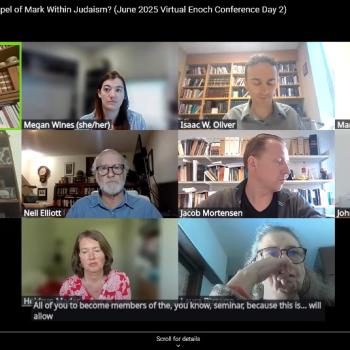
Paul, Mark, and Revelation Within Judaism (Enoch Seminar)
Religion Prof: The Blog of James F. McGrath
TRENDING AT PATHEOS Progressive Christian

Janie Learns the Way of the Cross: A...
Teaching children about Jesus' Passion can be challenging. Many parents and educators...

Looking For Good Catholic Writing - October 2026
He alone extends the heavens, and he walks upon the waves of...

In "Irreplaceable," our book on vocation and technology, Trevor Sutton and I...

I was strolling through the top floor of the brand new Parthenon...

What Does Gêvâh Mean For Kimberley Guifoyle &...
This week, a lot of the news is focused on Kimberly Guilfoyle....

INNER CIRCLE: Profound Mystery (Of Christ In All...
Ephesians 5:31-32 “For this reason, a man will leave his father and...
view all Progressive Christian blogs
Ad-Free & Subscriber Log-In Subscription Support
- About Us
- 2026 Calendar
- Videos
- Podcasts
- Library of World Religions
- Faith In Media Tracker
- Advertise With Us
- Write for Us
- Privacy Policy
- Terms of Service
- Do Not Sell My Data
- Contact Us
- Radiant Digital
- Manage Newsletter Subscriptions
- Unsubscribe From Notifications
- Sitemap
Copyright 2008-2026, Patheos. All rights reserved.
Subscription Support Ad-Free & Subscriber Log-In
Follow Patheos