
BuddhistCatholicContemplativeEvangelicalGeneral ChristianHinduJewishLatter-day SaintMuslimNew VisionsProgressive Christian
Beliefs
- Buddhist
- Catholic
- Contemplative
- Evangelical
- General Christian
- Hindu
- Jewish
- Latter-day Saint
- More Voices
- Muslim
- New Visions
- Pagan
- Progressive Christian
Topics
- Religion News
- Food and Religion
- Sports and Religion
- Religious Art
- Religious Music and Entertainment
- Religious Events
- History and Religion
- Style and Religion
- Politics and Religion
- Women in Religion
- Recreation Outdoors and Religion
- Business Finance and Religion
- Careers Workplace and Religion
- Education and Religion
- Family Parenting and Religion
- Health Fitness and Religion
- Home and Religion
- Relationships and Religion
- Technology and Religion
- Travel and Religion
Columnists
- Buddhist Columnists
- Business Finance and Religion Columnists
- Careers Workplace and Religion Columnists
- Catholic Columnists
- Contemplative Columnists
- Education and Religion Columnists
- Evangelists Columnists
- Family Parenting and Religion Columnists
- General Christian Columnists
- Health Fitness and Religion Columnists
- Hindu Columnists
- History and Religion Columnists
- Home and Religion Columnists
- Jewish Columnists
- More Voices Columnists
- Latter Day Columnists
- Muslim Columnists
- New Visions Columnists
- Nonreligious Columnists
- Pagan Columnists
- Politics and Religion Columnists
- Progressive Columnists
- Recreation Outdoors and Religion Columnists
- Relationships and Religion Columnists
- Religion News Columnists
- Religious Art Columnists
- Religious Events Columnists
- Religious Music and Entertainment Columnists
- Sports and Religion Columnists
- Style and Religion Columnists
- Technology and Religion Columnists
- Travel and Religion Columnists
- Women in Religion Columnists
Resource Library
- 2026 Calendar
- Library of World Religions
- The 100 Most Holy Places on Earth
- Patheos Answers
- Podcasts
- Videos
- Faith Leaders Database
- Anglican Episcopalian
- Bahai
- Baptist
- Buddhism
- Christianity
- Confucianism
- Eastern Orthodoxy
- Hinduism
- Holiness and Pentecostal
- ISKCON
- Islam
- Judaism
- Lutheran
- Methodist
- The Church of Jesus Christ of Latter-day Saints
- New Age
- Paganism
- Presbytarian and Reformed
- Protestantism
- Religion Behind the Scenes
- Roman Catholic
- Scientology
- Shia Islam
- Sikhism
- Sufism
- Sunni Islam
- Taoism
- Zen
- See all religions
Research Tools
 Ad-Free & Subscriber Log-In Subscription Support
Ad-Free & Subscriber Log-In Subscription Support
Follow Patheos 

- Trending:
- Forgiveness
- |
- Marriage
- |
- Consciousness
- |
- Death Penalty
- |
- Election
- |
- Halloween

- Home
- About Dr. James F. McGrath
- Publications
- Blogroll
- Useful Websites
- Connections
- Easy Search Posts Page
- FREE NEWSLETTER
- Home
- Progressive Christian
- Vocation and Interreligious Engagement at #NetVUE2019AAR #AARSBL19 Part 1
Vocation and Interreligious Engagement at #NetVUE2019AAR #AARSBL19 Part 1
Last updated on: December 8, 2019 at 5:06 am by James F. McGrath
Vocation and Interreligious Engagement at #NetVUE2019AAR #AARSBL19 Part 1 2019-12-07T16:18:47-05:00 James F. McGrath
Patheos Explore the world's faith through different perspectives on religion and spirituality! Patheos has the views of the prevalent religions and spiritualities of the world.
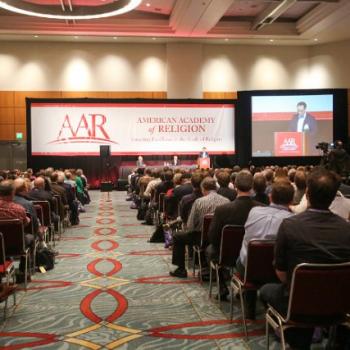
I was delighted to attend the NetVUE (Network for Vocation in Undergraduate Education) pre-conference workshop in San Diego last month. The Religion program at Butler University has been exploring the possibility of offering a minor in interreligious engagement ever since I read an article by Eboo Patel proposing an interfaith curriculum, and I realized that we already offered almost every class listed there (or something very close that could become what was listed with minor tweaking). In the context of Butler University, it would have room for interfaith in the strict sense, but would focus more on interreligious engagement, not presuming that students and faculty connected with the program would be coming from a faith perspective, but also helping those whose interest is to navigate religious diversity in the workplace, whether as educators in a K-12 classroom, healthcare professionals, or anything else. The workshop in San Diego focused on the relationship between vocational exploration and interreligious studies as well as religious diversity. It emerged out of a recognition that the language of “calling” still resonates with students, and yet not always in the same way, while “vocation” ranges from being meaningless to being perceived as referring explicitly to going into the priesthood.
The various panelists and speakers were fantastic. C. Hannah Schell started things off by sharing that in the past she would have said no, vocation doesn’t have a place in religious studies classrooms. Colleagues in small liberal arts college may not understand what Religious Studies is about, assuming it is teaching from a religious perspective in a way that advocates it. As faculty who want our field to be recognized as rigorous and secular, we can be defensive and try to appear objective. After sharing some details about her own institutional context, she mentioned a key influence that has shaped and changed her thinking: Barbara Walvoord’s work on what has been called “The Great Divide”: students take our classes for quite personal reasons, while faculty focus on critical thinking, history, etc. There is not only a disconnect; the aims can be viewed as at odds with one another. Yet Schell discovered these are not mutually exclusive goals. Getting students to write reflections at the beginning, middle, and end of a course, she learned so much about students as a result. Students came to see her during office hours just because she asked why they were taking the class, and what they got out of it. An upper-level course that explored vocation also proved very popular. Getting tenure helped, as did getting comfortable in own skin as scholar-teacher-mentor. On this see also Emily Gravett’s article about the great divide and student motivation in the Wabash Journal of Teaching and Learning.
Matthew Sayers offered his perspective working in a Religion Department rather than Theology. They wanted (as we sought to a while back at Butler) to get rid of the problematic terminology “Western” and “Eastern” religious traditions. As an atheist and an ex-Catholic, he was very aware of the baggage associated with the word vocation. He said at one point, “My religion is being a professor.” He also drew a helpful comparison with the baggage the word “myth” has for students, and the fact that academics cannot just eliminate students’ assumptions and prior knowledge in such instances. Students are hungry for purpose and meaning. His initial response was “hell no, that’s not my job.” But academics not only can but do teach values, and what we teach and how we teach it embodies values. When he teaches a First Year Experience class, “Faith and Doubt in the 21st Century,” he provides armbands that say FAITH and DOUBT. They take 5 minutes and focus on the words and concepts. He asks them to wear the one they are feeling more strongly on their dominant arm in subsequent classes. His aim is not to tell them what to believe but help them reflect on why they believe what they do. Some do sterile papers. But some really engage, and wrestling with readings that challenge their religious assumptions, students’ minds are blown when they learn that all but two of the authors they read are Christians. They thus learn about diversity within their own tradition as well as more generally. Sayers brought the IFYC (Interfaith Youth Core) Teaching Interfaith Understanding workshop into the picture. He asked whether we are worried about atheist students losing their unfaith, the way we sometimes worry about Christians losing their faith. He suggested that if students realize the power of critical thinking, they will want it too. How can we encourage individual reflection while avoiding narcissism? How do we not only acknowledge but respond to power dynamics in classroom? What lenses get between you and the thing you’re studying? “You as the professor” is one of the answers – you assign the readings, etc. Mention was made of
“Body Ritual Among the Nacirema” which you should acquaint yourself with if you’re not familiar with it. It is an attempt to describe American culture from an outsider anthropologist’s perspective. It helps to raise questions of outsider/insider vantage points, as well as issues of subjectivity and objectivity. Sayers was quite astonished that students – including religious students – assumed he was more objective because he is atheist!
John Barton offered a straightforward affirmative to the question, seeking to “lift the hood” on a matter that many assume functions in a particular way but do not look closely at. As a Christian professor, matters of vocation interweave with a lot of what he does. He told us quite a bit about his university context. Pepperdine is “robustly Christian,” with clear public faith affirmations, and a low church Protestant campus culture. In some ways it is similar to Biola or Wheaton, but in other ways it is far more diverse, and it is non-creedal when it comes to faculty hiring (with one major exception). They have diverse students and faculty but a Christian majority nonetheless. Interestingly, they are not eligible to be members of CCCU. They are deemed not to be religious enough, and some pieces are not in place that are requirements of membership. Conversely, declined by Phi Beta Kappa because they are too religious. “Welcome to the Pepperdine Experiment.”
Vocation and religion, understood broadly, seek to get at ultimate concern and human fullness. Barton takes a Wittgensteinian approach, feeling hesitation and resistance when talking about vocation – or religion for that matter, even though he teaches World Religions. Considering the prospect of changing a course title usually settles the matter for him just because of the paperwork involved. Is a course title misleading right from the beginning, and if so, is that OK? Both religion and vocation are framed by a Protestant Christian (Lutheran) heritage. He is not complaining about it, merely acknowledging it. His perspective might be termed “soft resistance,” and that may be because he is an insider. He is not sure what to do with that, precisely because he cannot see the matter precisely as others do from other vantage points. But at any rate, students have a sense of what “world religions” is, and he invites them in. Changing the name would simply lead to most of them not finding it in the catalog.
Barton rejects any notion of a sharp division between theology and religious studies. He prefers to talk of situated objectivity, and of comparative theology rather than comparative religion. He mentioned the hermeneutical trends of continental philosophy, acknowledging that any analysis of historical realities itself comes out of a place of historical situatedness. His perspective vacillates or perhaps better cycles between analytical, historical, and autobiographical perspectives, and invites students to do the same. These perspectives are distinct but interdependent. There is no neutrality, yet he also wants to avoid purely subjective spin. Trying to walk that tightrope is a worthwhile endeavor.
In seeking to maintain that tightrope walk or dance between analytical experiments and vocational reflectiveness, Barton invites students to assess him: that is the point of declaring his own standpoint, rather than it representing a place that students are expected to simply try to arrive. Some Christian parents don’t like this, they want religion professors to provide clearer assertions rather than exploration. Barton acknowledged that the end of semester assignment to assess him hasn’t gone well. There is no such thing as non-local neutrality, but can one achieve of aim for “pedagogical neutrality”? Barton pursued this, not telling students where he is coming from in order to avoid short-circuiting their exploration. But ultimately he chooses to err on side of transparency when push comes to shove. The choice to approach things this way is itself a kind of situatedness and reflects his stance and identity. He is a white male Christian, and aware of the fact. He himself offsets assumptions about the normativity of his viewpoint and thinking. He tends to think that in religious studies, the better mistake to make is on the side of location, identifying ourselves, in conversation with others. If students detect where he is coming from too early, it shuts down conversation.
During the Q&A there were fascinating questions and mentions of specific readings and how they’ve worked in classes. For instance, William Jones’ “Is God a White Racist?” One of the panelists emphasized that they don’t assign anything just for one reason. They emphasized that processors can use our privilege to our own advantage or to the advantage of students. When students speculate on the motivation for assigning particular readings, the motive they miss most is that the professor is a PhD assigning an academic as reading. A key question is “How do you pull back the curtain when you’re the one behind the curtain?” Can we effectively be both the Wizard of Oz and Toto? At Pepperdine religion is the one exception where there is a hiring requirement (statement of faith). They thus cannot pretend to be neutral. Barton shared that there is tension within his division because of how he postures himself. We asked whether it possible to avoid marginalizing anyone. Barton said he reaches out to any students who shares their identity when touching on their tradition. Like math, this is simply “showing one’s work.” Tillich was brought into the picture as it was suggested that our inability to talk about politics civilly shows that it has become our ultimate concern. Someone else suggested the reason we cannot talk about religion and politics is that people think they know about these topics when they don’t. Critical thinking is about finding the balance between locatedness and truth.
More than once the loaded Christian language of hospitality came up – welcoming others suggests you have ownership and others are your guests. On the other hand, ultimately we cannot divest ourselves of privilege. We can share power. One example is male colleagues having students call them by their first name. This hides rather than eliminates power difference, and may negatively impact female faculty who do not have the privilege of doing likewise while maintaining student respect. Barton was asked how much the invitation to students to assess him as professor depends on a certain situatedness and homogeneity of the student body? Someone else asked about female students whose fathers say they cannot pursue a certain vocational path. Do we respect the family’s tradition, or the student’s autonomy? Either choice reflects certain values rather than some value-neutral, supposedly objective stance. We may try to help students who think they can do anything see their own limits and situatedness, and be at cross purposes with first generation college students who are aware of their own situatedness and need encouragement to believe they can achieve great things and need to learn to dare to take risks. Different professors have different experiences, as do different students. Think about the immigrant experience and the struggle and sacrifice some undertake to come to US and send their child to university. In some contexts this makes open-ended exploration of vocation anathema. Their family values say they should become doctors or lawyers, enter the middle class, and provide for their parents. Religious studies can help us with this since it intersects with culture at points like this: and at the same time, precisely in the act of honoring father and mother, majoring in Religion may not be natural for children who are being pushed towards high-earning professions. Even so, honoring parents and becoming a doctor can still be a focus of vocational reflection and work in harmony as students become aware of some of these values that may simply be implicit and taken for granted.
I will continue the recap in another post. In the meantime see also the post below related to this topic:
Lessons from Humanism: Mentoring that Fosters Vocational Discernment
Previous Post

December 7, 2019
A Beautiful Day in the Neighborhood
Next Post

December 9, 2019 Vocation and Interreligious Engagement at #NetVUE2019AAR #AARSBL19 Part 2
Browse Our Archives
Select a Category 1 Corinthians 1 John 1 Peter 1 Samuel 1 Thessalonians 1 Timothy 2 Corinthians 2 Kings 2 Peter 2 Samuel 2 Thessalonians 2 Timothy academia Acts of the Apostles afterlife Akhaten Alcatraz American Academy of Religion Amos Anglican Arabic Aramaic archaeology art artificial intelligence astronomy atheism atonement Babylon 5 Baptists Battlestar Galactica Bible Biblical Studies Carnival biblioblogging Black Mirror Blade Runner Book of Job book review Buddhism Call for Papers China Christianity Christmas Christology Chronicles Coptic creation Daniel Deuteronomy Doctor Who Dune Easter Ecclesiastes economics education Eldad Keynan Enoch Seminar Ephesians eschatology Esther Evangelicals evolution Exodus Expanse Ezekiel Ezra fantasy Fringe fundamentalism Galatians games Ge'ez genealogy Genesis Gnosticism Gospel of Jesus' Wife Gospel of John Gospel of Judas Gospel of Luke Gospel of Mark Gospel of Matthew Gospel of Peter Gospel of Thomas Greek Harry Potter Hebrew Hebrews Hinduism historical Jesus history Hitchhiker's Guide to the Galaxy Holidays horror Hosea humor incarnation India inerrancy information literacy inspirational Intelligent Design Ireland Isaiah Islam Israel Italy James Jeremiah John the Baptist Jonah Joshua Judaism Jude Judges Judith Lamentations languages Latin Leviticus libraries literature Lord of the Rings LOST Mandaeans Mandaic memes Methodism Micah monotheism morality Mormons movies music mythicism NASSCAL Nehemiah new perspective New Testament news Numbers Orthodox paganism panentheism pantheism Patheos Paul and his letters Pentecostals Philippians Philippians 2:6-11 philosophy physics Planet of the Apes podcast politics Progressive Christianity Protestantism Proverbs Psalms pseudoscience racism religion Revelation Roman Catholicism Romania Romans Ruth scams science science fiction Secret Gospel of Mark Society of Biblical Literature Song of Songs Star Trek Star Wars Stargate Swahili Syriac Taoism technology Terminator The Handmaid's Tale The Hobbit The Matrix theodicy theology theory Timeless Titus tomb Torchwood travel TRON Uncategorized United Kingdom Westworld X-Files young-earth creationism Zechariah
Select a Month October 2026 September 2026 August 2026 July 2026 June 2026 May 2026 April 2026 March 2026 February 2026 January 2026 December 2025 November 2025 October 2025 September 2025 July 2025 June 2025 May 2025 April 2025 March 2025 February 2025 January 2025 December 2024 November 2024 October 2024 September 2024 August 2024 July 2024 June 2024 May 2024 April 2024 March 2024 February 2024 January 2024 December 2023 November 2023 October 2023 September 2023 August 2023 July 2023 May 2023 April 2023 March 2023 February 2023 January 2023 December 2022 November 2022 October 2022 September 2022 August 2022 July 2022 June 2022 May 2022 April 2022 March 2022 February 2022 January 2022 December 2021 November 2021 October 2021 September 2021 August 2021 July 2021 June 2021 May 2021 April 2021 March 2021 February 2021 January 2021 December 2020 November 2020 October 2020 September 2020 August 2020 July 2020 June 2020 May 2020 April 2020 March 2020 February 2020 January 2020 December 2019 November 2019 October 2019 September 2019 August 2019 July 2019 June 2019 May 2019 April 2019 March 2019 February 2019 January 2019 December 2018 November 2018 October 2018 September 2018 August 2018 July 2018 June 2018 May 2018 April 2018 March 2018 February 2018 January 2018 December 2017 November 2017 October 2017 September 2017 August 2017 July 2017 June 2017 May 2017 April 2017 March 2017 February 2017 January 2017 December 2016 November 2016 October 2016 September 2016 August 2016 July 2016 June 2016 May 2016 April 2016 March 2016 February 2016 January 2016 December 2015 November 2015 October 2015 September 2015 August 2015 July 2015 June 2015 May 2015 April 2015 March 2015 February 2015 January 2015 December 2014 November 2014 October 2014 September 2014 August 2014 July 2014 June 2014 May 2014 April 2014 March 2014 February 2014 January 2014 December 2013 November 2013 October 2013 September 2013 August 2013 July 2013 June 2013 May 2013 April 2013 March 2013 February 2013 January 2013 December 2012 November 2012 October 2012 September 2012 August 2012 July 2012 June 2012 May 2012 April 2012 March 2012 February 2012 January 2012 December 2011 November 2011 October 2011 September 2011 August 2011 July 2011 June 2011 May 2011 April 2011 March 2011 February 2011 January 2011 December 2010 November 2010 October 2010 September 2010 August 2010 July 2010 June 2010 May 2010 April 2010 March 2010 February 2010 January 2010 December 2009 November 2009 October 2009 September 2009 August 2009 July 2009 June 2009 May 2009 April 2009 March 2009 February 2009 January 2009 December 2008 November 2008 October 2008 September 2008 August 2008 July 2008 June 2008 May 2008 April 2008 March 2008 February 2008 January 2008 December 2007 November 2007 October 2007 September 2007 August 2007 July 2007 June 2007 February 2007 January 2001
Follow Us!
TAKE THE
Religious Wisdom Quiz
What does Proverbs compare wisdom to?
Select your answer to see how you score.
A city A mountain A woman A river
Books by This Author Books by James F. McGrath
Related posts from Religion Prof: The Blog of James F. McGrath

Where I'll Be (November 2025 Edition)
Religion Prof: The Blog of James F. McGrath

Calls for Papers and Butler University Day of...
Religion Prof: The Blog of James F. McGrath

Religion Prof: The Blog of James F. McGrath
Religion Prof: The Blog of James F. McGrath
TRENDING AT PATHEOS Progressive Christian

'Super Scam Me' Exposes AI Jon Bon Jovi...
Leslie Pickett believed she was in a relationship with Jon Bon Jovi....

The Brazilian Remake of Kendricks' 'Flywheel' Opens in...
“Flywheel,” the story that launched the Kendrick Brothers’ filmmaking career is getting...

The Dangers of Gradual Accommodation (Winking at Sin)
Recently, the “law of gradualness” resurfaced during the opening of a weeklong,...

The Iron Gates and the Lion of the...
Yesterday, I didn't finish my report about, well, yesterday. So I'll...

The Image: On the Horror of Capitalism and...
The Image Then went the Pharisees, and took counsel how they might...

We are approaching the date of our new American national holiday: October...
view all Progressive Christian blogs
Ad-Free & Subscriber Log-In Subscription Support
- About Us
- 2026 Calendar
- Videos
- Podcasts
- Library of World Religions
- Faith In Media Tracker
- Advertise With Us
- Write for Us
- Privacy Policy
- Terms of Service
- Do Not Sell My Data
- Contact Us
- Radiant Digital
- Manage Newsletter Subscriptions
- Unsubscribe From Notifications
- Sitemap
Copyright 2008-2026, Patheos. All rights reserved.
Subscription Support Ad-Free & Subscriber Log-In
Follow Patheos