
BuddhistCatholicContemplativeEvangelicalGeneral ChristianHinduJewishLatter-day SaintMuslimNew VisionsProgressive Christian
Beliefs
- Buddhist
- Catholic
- Contemplative
- Evangelical
- General Christian
- Hindu
- Jewish
- Latter-day Saint
- More Voices
- Muslim
- New Visions
- Pagan
- Progressive Christian
Topics
- Religion News
- Food and Religion
- Sports and Religion
- Religious Art
- Religious Music and Entertainment
- Religious Events
- History and Religion
- Style and Religion
- Politics and Religion
- Women in Religion
- Recreation Outdoors and Religion
- Business Finance and Religion
- Careers Workplace and Religion
- Education and Religion
- Family Parenting and Religion
- Health Fitness and Religion
- Home and Religion
- Relationships and Religion
- Technology and Religion
- Travel and Religion
Columnists
- Buddhist Columnists
- Business Finance and Religion Columnists
- Careers Workplace and Religion Columnists
- Catholic Columnists
- Contemplative Columnists
- Education and Religion Columnists
- Evangelists Columnists
- Family Parenting and Religion Columnists
- General Christian Columnists
- Health Fitness and Religion Columnists
- Hindu Columnists
- History and Religion Columnists
- Home and Religion Columnists
- Jewish Columnists
- More Voices Columnists
- Latter Day Columnists
- Muslim Columnists
- New Visions Columnists
- Nonreligious Columnists
- Pagan Columnists
- Politics and Religion Columnists
- Progressive Columnists
- Recreation Outdoors and Religion Columnists
- Relationships and Religion Columnists
- Religion News Columnists
- Religious Art Columnists
- Religious Events Columnists
- Religious Music and Entertainment Columnists
- Sports and Religion Columnists
- Style and Religion Columnists
- Technology and Religion Columnists
- Travel and Religion Columnists
- Women in Religion Columnists
Resource Library
- 2026 Calendar
- Library of World Religions
- The 100 Most Holy Places on Earth
- Patheos Answers
- Podcasts
- Videos
- Faith Leaders Database
- Anglican Episcopalian
- Bahai
- Baptist
- Buddhism
- Christianity
- Confucianism
- Eastern Orthodoxy
- Hinduism
- Holiness and Pentecostal
- ISKCON
- Islam
- Judaism
- Lutheran
- Methodist
- The Church of Jesus Christ of Latter-day Saints
- New Age
- Paganism
- Presbytarian and Reformed
- Protestantism
- Religion Behind the Scenes
- Roman Catholic
- Scientology
- Shia Islam
- Sikhism
- Sufism
- Sunni Islam
- Taoism
- Zen
- See all religions
Research Tools
 Ad-Free & Subscriber Log-In Subscription Support
Ad-Free & Subscriber Log-In Subscription Support
Follow Patheos 

- Trending:
- Forgiveness
- |
- Marriage
- |
- Consciousness
- |
- Death Penalty
- |
- Election
- |
- Halloween

- Home
- About Dr. James F. McGrath
- Publications
- Blogroll
- Useful Websites
- Connections
- Easy Search Posts Page
- FREE NEWSLETTER
- Home
- Progressive Christian
- Good Omens and the Bible #CFP
Good Omens and the Bible #CFP
Last updated on: July 10, 2019 at 5:17 am by James F. McGrath
Good Omens and the Bible #CFP 2019-07-09T19:45:27-04:00 James F. McGrath
Patheos Explore the world's faith through different perspectives on religion and spirituality! Patheos has the views of the prevalent religions and spiritualities of the world.

If you’re not sure what the connection is between Good Omens and eating, take a look at this article exploring the significance of food and angelic eating in the show:
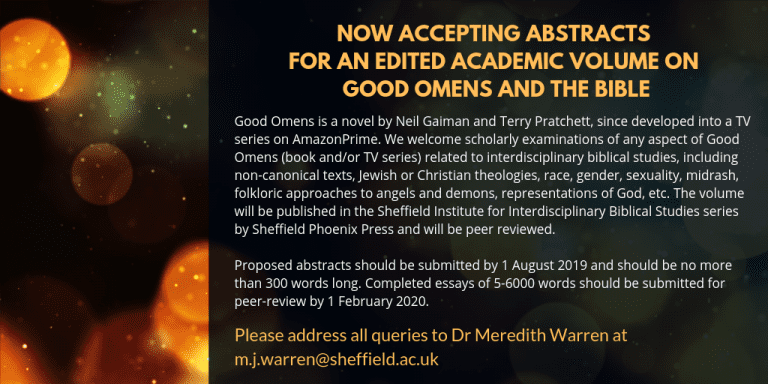
And now, here’s the call for papers for the volume:
Good Omens is a novel by Neil Gaiman and Terry Pratchett, since developed into a TV series on AmazonPrime. We welcome scholarly examinations of any aspect of Good Omens (book and/or TV series) related to interdisciplinary biblical studies, including non-canonical texts, Jewish or Christian theologies, race, gender, sexuality, midrash, folkloric approaches to angels and demons, representations of God, etc.
The volume will be published in the Sheffield Institute for Interdisciplinary Biblical Studies series by Sheffield Phoenix Press and will be peer reviewed. Proposed abstracts should be submitted by 1 August and should be no more than 300 words long. Completed essays of 5-6000 words should be submitted for peer-review by 1 February 2020.
Please address all queries to Dr Meredith Warren at [email protected]
Also related to this topic:
The Omen, Good Omens, and Why Neil Gaiman is Not the Antichrist
Good Omens: Fast Friends at the End Times
And in case you missed it, there was hilariously a petition to Netflix to cancel the show – which was never on Netflix, and was already over by that point!
I haven’t read the novel, but the TV show Good Omens begins with narration by God, who explains how Archbishop Usher was almost exactly right about the date of creation. Hopefully that is enough to clue most viewers in to the fact that the story is satire. But I think it nonetheless has some profound theological insights to offer.
From the very first episode there is mention of a “Great Plan” which is said to be ineffable. That proves to be a central point later on. We also have discussion between an angel and demon who become best friends over the course of the story. The angel gave away his flaming sword to Adam and Eve. The demon, who was the tempting snake in the garden (played hilariously by David Tennant with reptilian eyes), says that it would be funny if the angel did wrong thing and the demon the right thing. “A demon can get into a lot of trouble for doing the right thing,” he remarks.
Another major feature in the story is the book The Nice and Accurate Prophecies of Agnes Nutter, Witch. Hers is the only completely accurate collection of prophecies ever to be written, but they are often vague and only intelligible with hindsight. But she foresaw that the time in which the main story is set would be the time in which the Antichrist would appear. The Antichrist turns out in many ways to be as crucial a character as Aziraphale and Crowwley, the angel and demon, and the story explores the interesting perennial question of nature vs. nurture. The arrival of the Antichrist requires that he be substituted for a baby that has just been born, without the parents’ knowledge. The aim is that he grow up as the son of an American diplomat. But in the hospital run by satanic nuns where all this is organized to take place, a mix-up occurs.
In connection with the theme of Meredith Warren’s book and the podcast we recorded, Aziraphale eats sushi, while Gabriel says he wouldn’t sully his temple with that base matter. This accurately reflects the perspective of many ancient authors about what angels should and shouldn’t do, although I’m not sure whether Neil Gaiman knew this.
For those interested in music, there is also a moment in the first episode when Crowwley asks how many first-class composers they have in heaven. He mentions that Mozart, Beethoven, and all the Bachs are in hell. Once again one wonders whether this reflects a lack of knowledge of Johann Sebastian Bach’s faith, or is pronouncing it inadequate based on an awareness of his life.
In episode 2, Crowley mentions (not for the last time) that he didn’t mean to fall, he just hung out with the wrong crowd. More satire is offered, as War (one of the four horsemen of the apocalypse) arrives and oversees an incident in which human political leaders kill one another over the question of which of them gets to sign a peace agreement first. There are potentially profound remarks, such as “Evil always contains the seeds of its own destruction,” and thought-provoking ones such as “Angels aren’t occult. We’re ethereal.” Aziraphale owns a used bookshop, and in it he has copy of John of Patmos’ scroll. Looking at it again, he discovers that 666 is a phone number, leading him to the misplaced Antichrist.
Episode 3 focuses much of its attention on flashbacks to earlier moments in history. Noah’s flood is just aimed at locals, we are told, as the Almighty is not upset with the Chinese, native Americans, or Australians. When Crowley observes that killing kids seems more like the sort of thing that his lot should do, Aziraphale insists that “You can’t judge the Almighty.” With a wink and a nod to a young-earth creationist conundrum, one of the unicorns runs away before the rain begins. If there is a scene that seems anticlimactic, it is the crucifixion scene. It is not long before eating features prominently again: oysters, crepes, brioche, and pears. There is also reference to a picnic and then dining at the Ritz. We also learn that holy water destroys demons completely, which will be significant later on.
In episode 4 Aziraphale is told to “lose the gut” (he has gone soft eating human food). There is also an appearance of the Megiddo archaeological site (Armageddon) and reference to the Metatron. In episode 5 the flaming sword returns, suggesting that Aziraphale’s kindness and generosity was a good thing in the long term.
Episode 6 brings the story to its climax, and returns to the idea that the Great Plan is ineffable. The problem is that both angels and demons are sure they know what that plan is nonetheless, and are working towards the final battle based on that assumption. Adam, the young Antichrist, had been getting carried away with his power and a desire to reboot the Earth, but has a change of heart. He is told that he is better than heaven or hell incarnate: he is “human incarnate.” Ultimately Satan shows up, and rather strikingly refers to Adam as his rebellious son. This is perhaps one of the most profound moments in the show, since rebelliousness on the part of the “angelically inclined” features regularly in Christian literature, whereas the possibility of demons or the Antichrist rebelling against their tendency and preferring to do something good is rarely considered in a similar way. Adam tells Satan, “You’re not my dad, you never were.” The angelic and demonic best friends muse, “What if the Almighty planned it all along? Wouldn’t put it past her.” One of them also tells the other, “You don’t have a side anymore. Neither of us do.” That is perhaps the most crucial theme of the show, the idea that an angel and a demon forging a friendship can save the world when polarized opposition leads to conflict, war, and destruction.
The final scene with Adam the Antichrist sees him disobeying his (human) mother and leaving the garden where he has been grounded, eating an apple after he does so. There is a nice fake-out that Aziraphel and Crowley engage in. And there is the suggestion that the big conflict will not be heaven vs. hell, but heaven and hell against humanity will be the big one.
At the end, it is time to leave the garden. A perfectly apt question closes the exploration of the theme: “Tempt you to a bit of lunch?” But the show leaves us with an overall question to ponder: isn’t hope and ultimately salvation dependent on those of us who might be inclined to be enemies instead forging friendships that cross whatever category boundaries might otherwise separate us? Angel and demon, antichrist and kid, witchhunter and witch, etc.
Being willing to eat together is often crucial to that process.
Have you read or watched Good Omens? What are your thoughts on its theological vision?


Previous Post

July 9, 2019
Dragons #CFP
Next Post
July 11, 2019 Can Fundamentalists Understand the Bible?
Browse Our Archives
Select a Category 1 Corinthians 1 John 1 Peter 1 Samuel 1 Thessalonians 1 Timothy 2 Corinthians 2 Kings 2 Peter 2 Samuel 2 Thessalonians 2 Timothy academia Acts of the Apostles afterlife Akhaten Alcatraz American Academy of Religion Amos Anglican Arabic Aramaic archaeology art artificial intelligence astronomy atheism atonement Babylon 5 Baptists Battlestar Galactica Bible Biblical Studies Carnival biblioblogging Black Mirror Blade Runner Book of Job book review Buddhism Call for Papers China Christianity Christmas Christology Chronicles Coptic creation Daniel Deuteronomy Doctor Who Dune Easter Ecclesiastes economics education Eldad Keynan Enoch Seminar Ephesians eschatology Esther Evangelicals evolution Exodus Expanse Ezekiel Ezra fantasy Fringe fundamentalism Galatians games Ge'ez genealogy Genesis Gnosticism Gospel of Jesus' Wife Gospel of John Gospel of Judas Gospel of Luke Gospel of Mark Gospel of Matthew Gospel of Peter Gospel of Thomas Greek Harry Potter Hebrew Hebrews Hinduism historical Jesus history Hitchhiker's Guide to the Galaxy Holidays horror Hosea humor incarnation India inerrancy information literacy inspirational Intelligent Design Ireland Isaiah Islam Israel Italy James Jeremiah John the Baptist Jonah Joshua Judaism Jude Judges Judith Lamentations languages Latin Leviticus libraries literature Lord of the Rings LOST Mandaeans Mandaic memes Methodism Micah monotheism morality Mormons movies music mythicism NASSCAL Nehemiah new perspective New Testament news Numbers Orthodox paganism panentheism pantheism Patheos Paul and his letters Pentecostals Philippians Philippians 2:6-11 philosophy physics Planet of the Apes podcast politics Progressive Christianity Protestantism Proverbs Psalms pseudoscience racism religion Revelation Roman Catholicism Romania Romans Ruth scams science science fiction Secret Gospel of Mark Society of Biblical Literature Song of Songs Star Trek Star Wars Stargate Swahili Syriac Taoism technology Terminator The Handmaid's Tale The Hobbit The Matrix theodicy theology theory Timeless Titus tomb Torchwood travel TRON Uncategorized United Kingdom Westworld X-Files young-earth creationism Zechariah
Select a Month October 2026 September 2026 August 2026 July 2026 June 2026 May 2026 April 2026 March 2026 February 2026 January 2026 December 2025 November 2025 October 2025 September 2025 July 2025 June 2025 May 2025 April 2025 March 2025 February 2025 January 2025 December 2024 November 2024 October 2024 September 2024 August 2024 July 2024 June 2024 May 2024 April 2024 March 2024 February 2024 January 2024 December 2023 November 2023 October 2023 September 2023 August 2023 July 2023 May 2023 April 2023 March 2023 February 2023 January 2023 December 2022 November 2022 October 2022 September 2022 August 2022 July 2022 June 2022 May 2022 April 2022 March 2022 February 2022 January 2022 December 2021 November 2021 October 2021 September 2021 August 2021 July 2021 June 2021 May 2021 April 2021 March 2021 February 2021 January 2021 December 2020 November 2020 October 2020 September 2020 August 2020 July 2020 June 2020 May 2020 April 2020 March 2020 February 2020 January 2020 December 2019 November 2019 October 2019 September 2019 August 2019 July 2019 June 2019 May 2019 April 2019 March 2019 February 2019 January 2019 December 2018 November 2018 October 2018 September 2018 August 2018 July 2018 June 2018 May 2018 April 2018 March 2018 February 2018 January 2018 December 2017 November 2017 October 2017 September 2017 August 2017 July 2017 June 2017 May 2017 April 2017 March 2017 February 2017 January 2017 December 2016 November 2016 October 2016 September 2016 August 2016 July 2016 June 2016 May 2016 April 2016 March 2016 February 2016 January 2016 December 2015 November 2015 October 2015 September 2015 August 2015 July 2015 June 2015 May 2015 April 2015 March 2015 February 2015 January 2015 December 2014 November 2014 October 2014 September 2014 August 2014 July 2014 June 2014 May 2014 April 2014 March 2014 February 2014 January 2014 December 2013 November 2013 October 2013 September 2013 August 2013 July 2013 June 2013 May 2013 April 2013 March 2013 February 2013 January 2013 December 2012 November 2012 October 2012 September 2012 August 2012 July 2012 June 2012 May 2012 April 2012 March 2012 February 2012 January 2012 December 2011 November 2011 October 2011 September 2011 August 2011 July 2011 June 2011 May 2011 April 2011 March 2011 February 2011 January 2011 December 2010 November 2010 October 2010 September 2010 August 2010 July 2010 June 2010 May 2010 April 2010 March 2010 February 2010 January 2010 December 2009 November 2009 October 2009 September 2009 August 2009 July 2009 June 2009 May 2009 April 2009 March 2009 February 2009 January 2009 December 2008 November 2008 October 2008 September 2008 August 2008 July 2008 June 2008 May 2008 April 2008 March 2008 February 2008 January 2008 December 2007 November 2007 October 2007 September 2007 August 2007 July 2007 June 2007 February 2007 January 2001
Follow Us!
TAKE THE
Religious Wisdom Quiz
Who said: "See to it that no one takes you captive through hollow and deceptive philosophy"?
Select your answer to see how you score.
Peter James Paul John
Books by This Author Books by James F. McGrath
Related posts from Religion Prof: The Blog of James F. McGrath

Venezuela, Greenland, and the Apocalypse
Religion Prof: The Blog of James F. McGrath

How Evangelicals View God as Like Donald Trump
Religion Prof: The Blog of James F. McGrath
Religion Prof: The Blog of James F. McGrath

The Ongoing Impact of Hal Lindsey's End Times...
Religion Prof: The Blog of James F. McGrath
TRENDING AT PATHEOS Progressive Christian

Pope Leo Celebrates Mass for Nurses & Docs...
I don't have any idea how he did it, but Pope Leo...

The Sermon on the Mount, Part I: Matthew...
The Sermon on the Mount, Part I (Matthew 4:12-5:12) St. Matthew moves...

What's up from Crossway: Reviewing some of their latest A few weeks...

Janie Learns the Way of the Cross: A...
Teaching children about Jesus' Passion can be challenging. Many parents and educators...

Looking For Good Catholic Writing - October 2026
He alone extends the heavens, and he walks upon the waves of...

In "Irreplaceable," our book on vocation and technology, Trevor Sutton and I...
view all Progressive Christian blogs
Ad-Free & Subscriber Log-In Subscription Support
- About Us
- 2026 Calendar
- Videos
- Podcasts
- Library of World Religions
- Faith In Media Tracker
- Advertise With Us
- Write for Us
- Privacy Policy
- Terms of Service
- Do Not Sell My Data
- Contact Us
- Radiant Digital
- Manage Newsletter Subscriptions
- Unsubscribe From Notifications
- Sitemap
Copyright 2008-2026, Patheos. All rights reserved.
Subscription Support Ad-Free & Subscriber Log-In
Follow Patheos