
BuddhistCatholicContemplativeEvangelicalGeneral ChristianHinduJewishLatter-day SaintMuslimNew VisionsProgressive Christian
Beliefs
- Buddhist
- Catholic
- Contemplative
- Evangelical
- General Christian
- Hindu
- Jewish
- Latter-day Saint
- More Voices
- Muslim
- New Visions
- Pagan
- Progressive Christian
Topics
- Religion News
- Food and Religion
- Sports and Religion
- Religious Art
- Religious Music and Entertainment
- Religious Events
- History and Religion
- Style and Religion
- Politics and Religion
- Women in Religion
- Recreation Outdoors and Religion
- Business Finance and Religion
- Careers Workplace and Religion
- Education and Religion
- Family Parenting and Religion
- Health Fitness and Religion
- Home and Religion
- Relationships and Religion
- Technology and Religion
- Travel and Religion
Columnists
- Buddhist Columnists
- Business Finance and Religion Columnists
- Careers Workplace and Religion Columnists
- Catholic Columnists
- Contemplative Columnists
- Education and Religion Columnists
- Evangelists Columnists
- Family Parenting and Religion Columnists
- General Christian Columnists
- Health Fitness and Religion Columnists
- Hindu Columnists
- History and Religion Columnists
- Home and Religion Columnists
- Jewish Columnists
- More Voices Columnists
- Latter Day Columnists
- Muslim Columnists
- New Visions Columnists
- Nonreligious Columnists
- Pagan Columnists
- Politics and Religion Columnists
- Progressive Columnists
- Recreation Outdoors and Religion Columnists
- Relationships and Religion Columnists
- Religion News Columnists
- Religious Art Columnists
- Religious Events Columnists
- Religious Music and Entertainment Columnists
- Sports and Religion Columnists
- Style and Religion Columnists
- Technology and Religion Columnists
- Travel and Religion Columnists
- Women in Religion Columnists
Resource Library
- 2026 Calendar
- Library of World Religions
- The 100 Most Holy Places on Earth
- Patheos Answers
- Podcasts
- Videos
- Faith Leaders Database
- Anglican Episcopalian
- Bahai
- Baptist
- Buddhism
- Christianity
- Confucianism
- Eastern Orthodoxy
- Hinduism
- Holiness and Pentecostal
- ISKCON
- Islam
- Judaism
- Lutheran
- Methodist
- The Church of Jesus Christ of Latter-day Saints
- New Age
- Paganism
- Presbytarian and Reformed
- Protestantism
- Religion Behind the Scenes
- Roman Catholic
- Scientology
- Shia Islam
- Sikhism
- Sufism
- Sunni Islam
- Taoism
- Zen
- See all religions
Research Tools
 Ad-Free & Subscriber Log-In Subscription Support
Ad-Free & Subscriber Log-In Subscription Support
Follow Patheos 

- Trending:
- Forgiveness
- |
- Marriage
- |
- Consciousness
- |
- Death Penalty
- |
- Election
- |
- Halloween

- Home
- About Dr. James F. McGrath
- Publications
- Blogroll
- Useful Websites
- Connections
- Easy Search Posts Page
- FREE NEWSLETTER
- Home
- Progressive Christian
- Doctor Who: Demons of the Punjab
Doctor Who: Demons of the Punjab
Last updated on: November 12, 2018 at 12:03 am by James F. McGrath
Doctor Who: Demons of the Punjab 2018-11-11T22:37:57-05:00 James F. McGrath
Patheos Explore the world's faith through different perspectives on religion and spirituality! Patheos has the views of the prevalent religions and spiritualities of the world.
The episode “Demons of the Punjab” was incredibly moving. I’ve visited India but not Pakistan. For some years, I taught a course on South Asian Civilizations, in which we read the novel Train to Pakistan. I had a lump in my throat at many points during this emotionally powerful story set against the backdrop of real events.
The story begins in the present day at Yaz’s grandmother’s birthday party. We learn that Umbreen, her grandmother, was the first woman to get married in Pakistan after its creation, and then later, the first Muslim to work in a textile mill in South Yorkshire. She gives Yaz a watch which has cracked glass, telling her that it must never be fixed, for reasons Yaz would not understand. The grandmother adds, “I have such stories I could tell you.” Yaz is eager to know more, and says, “Your life’s our heritage.” Yaz then turns to the Doctor to try to find out more, asking, “What’s the point of having a friend with a time machine if you can’t nip back and see your grandmother when she was young?” The Doctor, however, is initially very cautious because of the risks involved in crossing paths with one’s own ancestors. As she puts it later, “You could interfere yourself out of existence…Tread softly, you’re treading on your own history.”
The story seems to presuppose viewers have some familiarity with the historical events that are taking place in 1947, but provides at least just enough for those who may not. There are radio snippets such as Lord Mountbatten announcing the creation of Pakistan. The Doctor mentions that tens of millions will be displaced and over a million killed. But much more is provided through the story’s characters themselves. The tensions between Muslims and Hindus, which Yaz finds run through her family and her grandmother’s story, if not perhaps her own ancestry. It turns out that her grandmother married right after the creation of Pakistan was announced, even before the official map had been released. And her new husband, a Hindu, was killed by other Hindus for protecting his Muslim wife and mother in law.
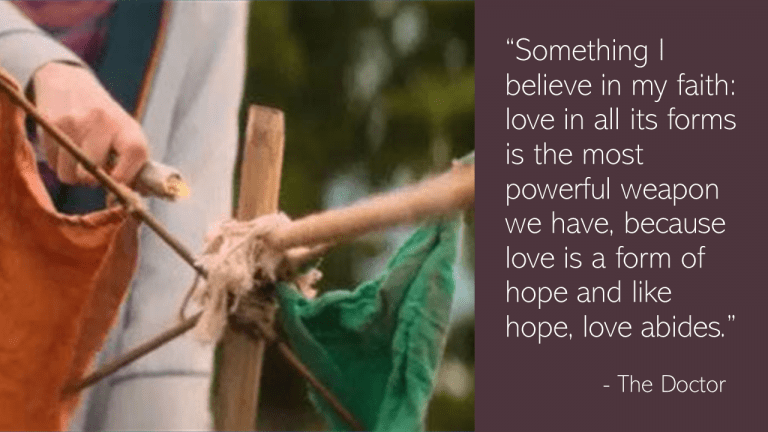
An important character (even though he is in the background and then killed) is the sadhu, a Hindu holy man, whose name is said to be Bhakti, which is a term for devotional poetry. He comments on how young people are always in such a rush (taking a cart instead of walking). Bhakti was the only person willing to marry the couple from mixed religious backgrounds. He is killed by Manush, the brother of Prem (the groom), in an effort to try to prevent the marriage. But the Doctor steps in and performs the ceremony, in what is one of the coolest things in all of Doctor Who history, for someone with my interests at least. Here’s part of what the Doctor says:
Something I believe in my faith: love in all its forms is the most powerful weapon we have, because love is a form of hope and like hope, love abides.
They do a Hindu ritual using rope, then a Muslim one in which Prem gives his bride Umbreen a watch. He drops it and it breaks. But while I appreciate the exploration of religious diversity in India and the way colonial powers turned longtime neighbors into enemies – but not all of them – my attention was obviously drawn to the Doctor’s talk of her faith. It isn’t the first time this has come up – see the episode The Curse of Fenric for more on that topic. But it is rare. There is a bit of comedy – the Doctor says she hasn’t officiated a wedding since Einstein’s. But on a more serious note, she says that the ceremony will be “non-denominational,” which is a striking word choice.
 In the midst of all the interpersonal and historical drama, some “demons” show up, who are of course aliens. When they get into their ship, the humans comment that it is beautiful, which prompts the Doctor to reply, “They can surprise you…demons.” She eventually recognizes them as from the Vajarian Hive, a race of assassins. The Doctor says they are an ancient species, which evolved themselves into deadliest assassins in the known universe. Prem had seen them before, as a soldier in Singapore. They had been standing over his older brother’s dead body. Prem took a pendant of Hanuman from around his brother’s neck, but in his fear, he left the body there. When the aliens return to their ship and find the intruders, they say, “You have desecrated the hive. The hive is sacred.”
Later in the episode, the Vajarians explain themselves to the Doctor. “We are not assassins…We have changed…We are witnesses.” After their homeworld was destroyed, they underwent a reformation of their ways. The dust they carry with them is all that remains of their people, their genetic material, remnants of a war in which they died unsaved, and unwitnessed. The remaining Vajarians now they seek out the unacknowledged dead, those who otherwise would die alone. Their mission is to honor life as it passes. When the Doctor suggests that they not merely watch what is doomed to happen – Prem will die – the Vajarians say, “We are not gods. Events sit as they will. They can only be witnessed…The fixed force of time cannot be stopped.” The Doctor says to that last statement, “I know.”
There are other details that are of interest for those who want to explore religion on Doctor Who. The statement that “Bakhti taught me the scriptures,” and that he was the only one who would agree to marry a Muslim and a Hindu. The tendency to explain misfortune and the surprising in terms of curses.
As the violence that results from partition is getting closer, the observation is made that “There’s nothing worse than when ordinary people lose their minds” – when Hindu, Muslim, Sikh become persuaded that what divides them is greater than what unites them. “Our families have worked the land alongside each other for generations.” On the other hand, Manush is said to spend too much time reading pamphlets, and listening to angry men on the radio. That last point hits home particularly powerfully in relation to our own time.
But the most powerful line in the whole episode is when Prem goes out to face down his own brother and other Hindus who are bent on killing Muslims. When the Doctor offers to go with him, Prem says, “No. These are demons I have to face alone.”
And so that’s the powerful message of this episode, one that has been a recurring theme on Doctor Who, but rarely presented as compellingly. The demons, the monsters, are as often us humans as aliens.
 There are other thought-provoking lines, beyond the ones I noted above. The focus on family history of course connected with me. But it also highlighted the difference between lived history and what a grandchild (for instance) doing research might discover. Graham sagely remarks that “A woman’s allowed to have secrets even from her granddaughter.” And he also insightfully asks, “Do any of us know the truth of our own lives, while living them from the inside?”
Near the end of the episode, we see that the inside of the Vajarian spaceship is like a cathedral to those who die alone, their holograms floating above their heads beneath the domed ceiling.
Different music played over the end credits. This is not the first time that has been done on Doctor Who. But it is rare. So much in this episode was rare, and yet so much of it felt like classic Doctor Who, with the historical focus that was so much more characteristic of the earliest seasons than much later ones.
For me, the episode was a compelling and deeply moving combination of everything I love most about Doctor Who. Interesting material about both human and Gallifreyan religion. Serious commentary about individual lives, history, morality, and the value of life. And so I truly loved it, and expect it to be one that I’ll continue to talk about often among my favorite episodes.
What are your thoughts about “Demons of the Punjab”?
Previous Post

November 11, 2018
3D Virtual Temple
Next Post
November 13, 2018 Poor In Spirit and Poor in America
Browse Our Archives
Select a Category 1 Corinthians 1 John 1 Peter 1 Samuel 1 Thessalonians 1 Timothy 2 Corinthians 2 Kings 2 Peter 2 Samuel 2 Thessalonians 2 Timothy academia Acts of the Apostles afterlife Akhaten Alcatraz American Academy of Religion Amos Anglican Arabic Aramaic archaeology art artificial intelligence astronomy atheism atonement Babylon 5 Baptists Battlestar Galactica Bible Biblical Studies Carnival biblioblogging Black Mirror Blade Runner Book of Job book review Buddhism Call for Papers China Christianity Christmas Christology Chronicles Coptic creation Daniel Deuteronomy Doctor Who Dune Easter Ecclesiastes economics education Eldad Keynan Enoch Seminar Ephesians eschatology Esther Evangelicals evolution Exodus Expanse Ezekiel Ezra fantasy Fringe fundamentalism Galatians games Ge'ez genealogy Genesis Gnosticism Gospel of Jesus' Wife Gospel of John Gospel of Judas Gospel of Luke Gospel of Mark Gospel of Matthew Gospel of Peter Gospel of Thomas Greek Harry Potter Hebrew Hebrews Hinduism historical Jesus history Hitchhiker's Guide to the Galaxy Holidays horror Hosea humor incarnation India inerrancy information literacy inspirational Intelligent Design Ireland Isaiah Islam Israel Italy James Jeremiah John the Baptist Jonah Joshua Judaism Jude Judges Judith Lamentations languages Latin Leviticus libraries literature Lord of the Rings LOST Mandaeans Mandaic memes Methodism Micah monotheism morality Mormons movies music mythicism NASSCAL Nehemiah new perspective New Testament news Numbers Orthodox paganism panentheism pantheism Patheos Paul and his letters Pentecostals Philippians Philippians 2:6-11 philosophy physics Planet of the Apes podcast politics Progressive Christianity Protestantism Proverbs Psalms pseudoscience racism religion Revelation Roman Catholicism Romania Romans Ruth scams science science fiction Secret Gospel of Mark Society of Biblical Literature Song of Songs Star Trek Star Wars Stargate Swahili Syriac Taoism technology Terminator The Handmaid's Tale The Hobbit The Matrix theodicy theology theory Timeless Titus tomb Torchwood travel TRON Uncategorized United Kingdom Westworld X-Files young-earth creationism Zechariah
Select a Month October 2026 September 2026 August 2026 July 2026 June 2026 May 2026 April 2026 March 2026 February 2026 January 2026 December 2025 November 2025 October 2025 September 2025 July 2025 June 2025 May 2025 April 2025 March 2025 February 2025 January 2025 December 2024 November 2024 October 2024 September 2024 August 2024 July 2024 June 2024 May 2024 April 2024 March 2024 February 2024 January 2024 December 2023 November 2023 October 2023 September 2023 August 2023 July 2023 May 2023 April 2023 March 2023 February 2023 January 2023 December 2022 November 2022 October 2022 September 2022 August 2022 July 2022 June 2022 May 2022 April 2022 March 2022 February 2022 January 2022 December 2021 November 2021 October 2021 September 2021 August 2021 July 2021 June 2021 May 2021 April 2021 March 2021 February 2021 January 2021 December 2020 November 2020 October 2020 September 2020 August 2020 July 2020 June 2020 May 2020 April 2020 March 2020 February 2020 January 2020 December 2019 November 2019 October 2019 September 2019 August 2019 July 2019 June 2019 May 2019 April 2019 March 2019 February 2019 January 2019 December 2018 November 2018 October 2018 September 2018 August 2018 July 2018 June 2018 May 2018 April 2018 March 2018 February 2018 January 2018 December 2017 November 2017 October 2017 September 2017 August 2017 July 2017 June 2017 May 2017 April 2017 March 2017 February 2017 January 2017 December 2016 November 2016 October 2016 September 2016 August 2016 July 2016 June 2016 May 2016 April 2016 March 2016 February 2016 January 2016 December 2015 November 2015 October 2015 September 2015 August 2015 July 2015 June 2015 May 2015 April 2015 March 2015 February 2015 January 2015 December 2014 November 2014 October 2014 September 2014 August 2014 July 2014 June 2014 May 2014 April 2014 March 2014 February 2014 January 2014 December 2013 November 2013 October 2013 September 2013 August 2013 July 2013 June 2013 May 2013 April 2013 March 2013 February 2013 January 2013 December 2012 November 2012 October 2012 September 2012 August 2012 July 2012 June 2012 May 2012 April 2012 March 2012 February 2012 January 2012 December 2011 November 2011 October 2011 September 2011 August 2011 July 2011 June 2011 May 2011 April 2011 March 2011 February 2011 January 2011 December 2010 November 2010 October 2010 September 2010 August 2010 July 2010 June 2010 May 2010 April 2010 March 2010 February 2010 January 2010 December 2009 November 2009 October 2009 September 2009 August 2009 July 2009 June 2009 May 2009 April 2009 March 2009 February 2009 January 2009 December 2008 November 2008 October 2008 September 2008 August 2008 July 2008 June 2008 May 2008 April 2008 March 2008 February 2008 January 2008 December 2007 November 2007 October 2007 September 2007 August 2007 July 2007 June 2007 February 2007 January 2001
Follow Us!
TAKE THE
Religious Wisdom Quiz
Which Christian principle is shown by the story of the widow's mite?
Select your answer to see how you score.
Generosity from the heart Give to be seen Give only if rich Never give
Books by This Author Books by James F. McGrath
Related posts from Religion Prof: The Blog of James F. McGrath

Doctor Who: Introducing Billie Piper
Religion Prof: The Blog of James F. McGrath

Doctor Who: The Story and the Engine
Religion Prof: The Blog of James F. McGrath

Well Well Well, Doctor Who Returns to Midnight...
Religion Prof: The Blog of James F. McGrath

Doctor Who’s 'Lux' Explores Light, Faith, and Fiction
Religion Prof: The Blog of James F. McGrath
TRENDING AT PATHEOS Progressive Christian

Janie Learns the Way of the Cross: A...
Teaching children about Jesus' Passion can be challenging. Many parents and educators...

Looking For Good Catholic Writing - October 2026
He alone extends the heavens, and he walks upon the waves of...

In "Irreplaceable," our book on vocation and technology, Trevor Sutton and I...

I was strolling through the top floor of the brand new Parthenon...

What Does Gêvâh Mean For Kimberley Guifoyle &...
This week, a lot of the news is focused on Kimberly Guilfoyle....

INNER CIRCLE: Profound Mystery (Of Christ In All...
Ephesians 5:31-32 “For this reason, a man will leave his father and...
view all Progressive Christian blogs
Ad-Free & Subscriber Log-In Subscription Support
- About Us
- 2026 Calendar
- Videos
- Podcasts
- Library of World Religions
- Faith In Media Tracker
- Advertise With Us
- Write for Us
- Privacy Policy
- Terms of Service
- Do Not Sell My Data
- Contact Us
- Radiant Digital
- Manage Newsletter Subscriptions
- Unsubscribe From Notifications
- Sitemap
Copyright 2008-2026, Patheos. All rights reserved.
Subscription Support Ad-Free & Subscriber Log-In
Follow Patheos