
BuddhistCatholicContemplativeEvangelicalGeneral ChristianHinduJewishLatter-day SaintMuslimNew VisionsProgressive Christian
Beliefs
- Buddhist
- Catholic
- Contemplative
- Evangelical
- General Christian
- Hindu
- Jewish
- Latter-day Saint
- More Voices
- Muslim
- New Visions
- Pagan
- Progressive Christian
Topics
- Religion News
- Food and Religion
- Sports and Religion
- Religious Art
- Religious Music and Entertainment
- Religious Events
- History and Religion
- Style and Religion
- Politics and Religion
- Women in Religion
- Recreation Outdoors and Religion
- Business Finance and Religion
- Careers Workplace and Religion
- Education and Religion
- Family Parenting and Religion
- Health Fitness and Religion
- Home and Religion
- Relationships and Religion
- Technology and Religion
- Travel and Religion
Columnists
- Buddhist Columnists
- Business Finance and Religion Columnists
- Careers Workplace and Religion Columnists
- Catholic Columnists
- Contemplative Columnists
- Education and Religion Columnists
- Evangelists Columnists
- Family Parenting and Religion Columnists
- General Christian Columnists
- Health Fitness and Religion Columnists
- Hindu Columnists
- History and Religion Columnists
- Home and Religion Columnists
- Jewish Columnists
- More Voices Columnists
- Latter Day Columnists
- Muslim Columnists
- New Visions Columnists
- Nonreligious Columnists
- Pagan Columnists
- Politics and Religion Columnists
- Progressive Columnists
- Recreation Outdoors and Religion Columnists
- Relationships and Religion Columnists
- Religion News Columnists
- Religious Art Columnists
- Religious Events Columnists
- Religious Music and Entertainment Columnists
- Sports and Religion Columnists
- Style and Religion Columnists
- Technology and Religion Columnists
- Travel and Religion Columnists
- Women in Religion Columnists
Resource Library
- 2026 Calendar
- Library of World Religions
- The 100 Most Holy Places on Earth
- Patheos Answers
- Podcasts
- Videos
- Faith Leaders Database
- Anglican Episcopalian
- Bahai
- Baptist
- Buddhism
- Christianity
- Confucianism
- Eastern Orthodoxy
- Hinduism
- Holiness and Pentecostal
- ISKCON
- Islam
- Judaism
- Lutheran
- Methodist
- The Church of Jesus Christ of Latter-day Saints
- New Age
- Paganism
- Presbytarian and Reformed
- Protestantism
- Religion Behind the Scenes
- Roman Catholic
- Scientology
- Shia Islam
- Sikhism
- Sufism
- Sunni Islam
- Taoism
- Zen
- See all religions
Research Tools
 Ad-Free & Subscriber Log-In Subscription Support
Ad-Free & Subscriber Log-In Subscription Support
Follow Patheos 

- Trending:
- Forgiveness
- |
- Marriage
- |
- Consciousness
- |
- Death Penalty
- |
- Election
- |
- Halloween

- Home
- About Dr. James F. McGrath
- Publications
- Blogroll
- Useful Websites
- Connections
- Easy Search Posts Page
- FREE NEWSLETTER
- Home
- Progressive Christian
- Cards, Dice, and Other Game Consoles
Cards, Dice, and Other Game Consoles
Last updated on: August 1, 2018 at 5:13 am by James F. McGrath
Cards, Dice, and Other Game Consoles 2018-07-31T13:20:54-04:00 James F. McGrath
Patheos Explore the world's faith through different perspectives on religion and spirituality! Patheos has the views of the prevalent religions and spiritualities of the world.
I was really struck by a post on the blog Only a Game, coming as it did right when I was preparing to speak at Gen Con about gamification and the arts in higher education together with a couple of other Butler University colleagues. In it Chris Bateman writes:
If a game console is a device designed for the express purpose of executing arbitrary programmatic systems for entertainment, then the deck of cards was the world’s first game console. All previous games except dice had components specific to their design, but this was not the case for the first cards (quite possibly Chinese ‘money cards’, although the history of the deck of cards is rather hard to trace owing to the poor survivability of actual cards). By creating a set of components that were coded into both numerical values and suits (usually four), human-deck cyborgs had a means to create myriad different games – and have indeed exactly this over the millennia that followed.
Now the question of the cybervirtue of a deck of cards is an interesting one precisely because for much of their history card games were expressly gambling games, and therefore seen as a quintessential expression of vice. Yet anyone who carries a deck of cards with them has the capacity to wile away spare time with engaging solitaire games that cultivate attentiveness (if not patience, per se), and an ability to create a convivial play experience for an arbitrary number of other humans who can be easily incorporated into the same cyborg network more or less at will. The deck of cards experience can be cyber-hospitable, cyber-disciplined, cyber-prudent, cyber-cunning, cyber-creative… the number of positive qualities that can be instilled by playing cards with other humans is far more than I suspect anyone else has ever thought about…I know most people in videogame development are more impressed by the latest computer specifications for high powered digital games consoles, but I can’t help myself: the deck of cards trumps all other multi-role game technology for its flexibility, its simplicity, and its potential to encourage virtue.
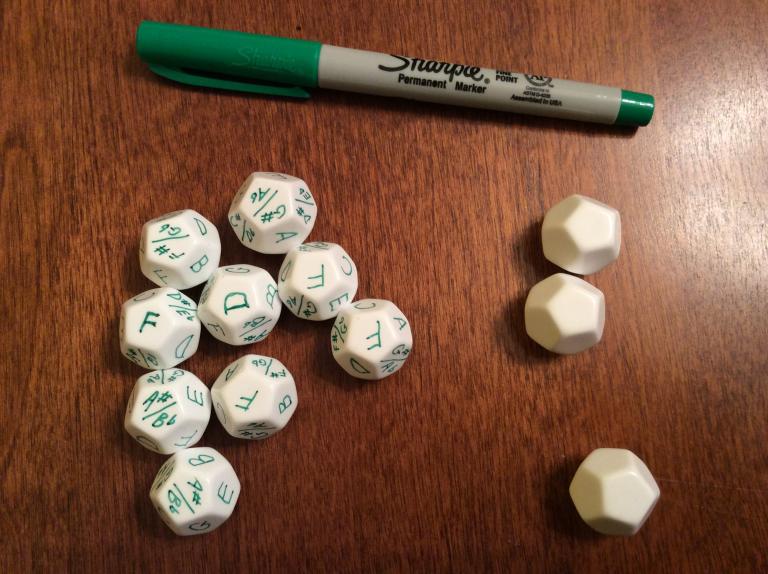
I was struck by this not just because of my general interest in gaming and gamification. I have been working on developing a game that can be used to teach and/or test music theory knowledge, and it began first as a deck of Playing Chords (a double pun, so I couldn’t resist) before transitioning into a set of twelve twelve-sided dice.
Below are the basic game rules that I have come up with. I am still trying to think of a good name for the game. If it were not for the intellectual property violation that would result, I might have called it “Do Re Mi Fa So Yahtzee! Do”!
Dodecaphonic Dodecahedrons
A Game of Musical Dice
Roll twelve twelve sided dice. Keep some as they are, reroll the rest. Do that one more time, then score.
You get the points listed if you roll something the first attempt; half that if it takes a second roll; a quarter if it happens on the third roll.
Each player does that, then you see who wins that round.
The first player to win the number of rounds you have decided on wins.
Simple!
Scoring:
Chromatic scale (every die is different): 1000 points
Black keys (every die has sharps/flats): 800 points
White keys (no accidentals on any of the twelve dice, no sharps or flats, only letters): 600 points
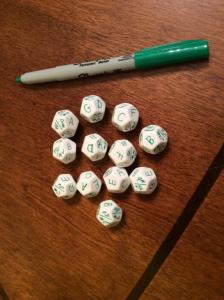 Chords: dice with alternating letter names (see additional rules below for important details)
13 chord (7 alternating letters): 300 points
11 chord (6 alternating letters): 220 points
9 chord (5 alternating letters): 100 points
7 chord (4 alternating letters): 40 points
Triad (3 alternating letters): 16 points
Unison: # of identical dice x 10 points (not counting one of them)
Hexachords: 10 points for any series of six different notes
Tetrachords: 6 points for any series of four different notes
Intervals: 1 point per two dice with any different notes on them (count as many pairs as there are, as long as no die is counted twice)
Additional rules:
When determining alternating letters, after G you return to A. You cannot combine letters marked with sharp # and letters marked with flat b in the same chord.
You are allowed to set aside dice from a roll and then reroll the others, cutting your final score for the turn in half each time you do so. Once a die has been set aside, it cannot be rerolled on that turn, even if other dice from the first roll set have been repurposed after subsequent rolls to form part of a different scoring combination than you originally planned. Your score for your turn will be based on whatever one scoring combination you choose from among your dice rolls.
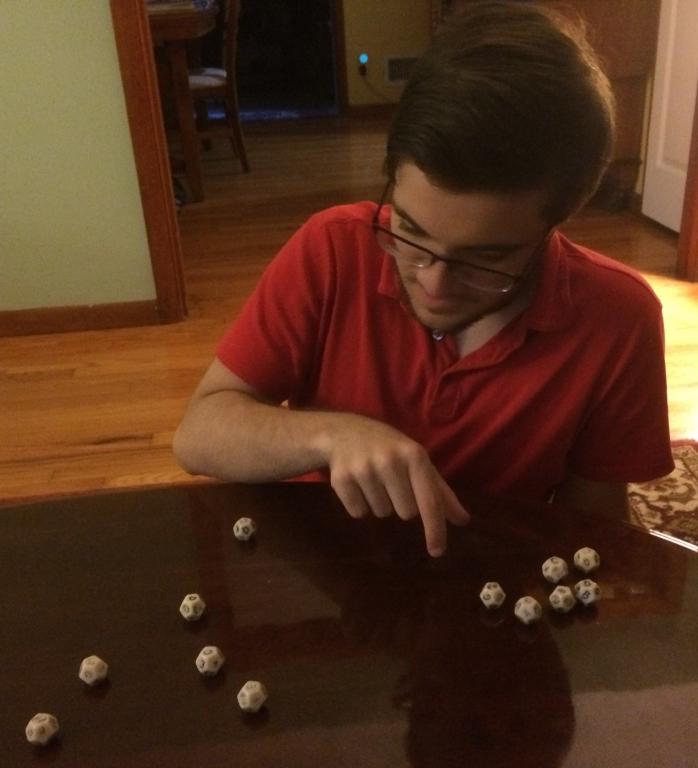 You can also add in scales for advanced players. The game as it is will let someone learn some basics of music theory without even knowing that that is what they are doing, just by learning the game rules as something arbitrary, much as is done with a game like poker. But it can also be used to test and build on existing knowledge, as happened when I played the game with my son and we found ourselves Googling to try to figure out whether certain combinations might exist as exotic non-western scales!
For those who may be interested in exploring musical games further, you can purchase your own deck of Playing Chords from The Game Crafter, the same company that makes Canon: The Card Game. I have yet to find a way to make musical dice other than by hand, but if and when I do, I will make that available online. If you try playing the dice game or use the cards, let me know how your experience is!
Previous Post

July 31, 2018
Jonah and the Ancient Aliens’ Submarine
Next Post
August 2, 2018 History, Education, and Gaming
Browse Our Archives
Select a Category 1 Corinthians 1 John 1 Peter 1 Samuel 1 Thessalonians 1 Timothy 2 Corinthians 2 Kings 2 Peter 2 Samuel 2 Thessalonians 2 Timothy academia Acts of the Apostles afterlife Akhaten Alcatraz American Academy of Religion Amos Anglican Arabic Aramaic archaeology art artificial intelligence astronomy atheism atonement Babylon 5 Baptists Battlestar Galactica Bible Biblical Studies Carnival biblioblogging Black Mirror Blade Runner Book of Job book review Buddhism Call for Papers China Christianity Christmas Christology Chronicles Coptic creation Daniel Deuteronomy Doctor Who Dune Easter Ecclesiastes economics education Eldad Keynan Enoch Seminar Ephesians eschatology Esther Evangelicals evolution Exodus Expanse Ezekiel Ezra fantasy Fringe fundamentalism Galatians games Ge'ez genealogy Genesis Gnosticism Gospel of Jesus' Wife Gospel of John Gospel of Judas Gospel of Luke Gospel of Mark Gospel of Matthew Gospel of Peter Gospel of Thomas Greek Harry Potter Hebrew Hebrews Hinduism historical Jesus history Hitchhiker's Guide to the Galaxy Holidays horror Hosea humor incarnation India inerrancy information literacy inspirational Intelligent Design Ireland Isaiah Islam Israel Italy James Jeremiah John the Baptist Jonah Joshua Judaism Jude Judges Judith Lamentations languages Latin Leviticus libraries literature Lord of the Rings LOST Mandaeans Mandaic memes Methodism Micah monotheism morality Mormons movies music mythicism NASSCAL Nehemiah new perspective New Testament news Numbers Orthodox paganism panentheism pantheism Patheos Paul and his letters Pentecostals Philippians Philippians 2:6-11 philosophy physics Planet of the Apes podcast politics Progressive Christianity Protestantism Proverbs Psalms pseudoscience racism religion Revelation Roman Catholicism Romania Romans Ruth scams science science fiction Secret Gospel of Mark Society of Biblical Literature Song of Songs Star Trek Star Wars Stargate Swahili Syriac Taoism technology Terminator The Handmaid's Tale The Hobbit The Matrix theodicy theology theory Timeless Titus tomb Torchwood travel TRON Uncategorized United Kingdom Westworld X-Files young-earth creationism Zechariah
Select a Month October 2026 September 2026 August 2026 July 2026 June 2026 May 2026 April 2026 March 2026 February 2026 January 2026 December 2025 November 2025 October 2025 September 2025 July 2025 June 2025 May 2025 April 2025 March 2025 February 2025 January 2025 December 2024 November 2024 October 2024 September 2024 August 2024 July 2024 June 2024 May 2024 April 2024 March 2024 February 2024 January 2024 December 2023 November 2023 October 2023 September 2023 August 2023 July 2023 May 2023 April 2023 March 2023 February 2023 January 2023 December 2022 November 2022 October 2022 September 2022 August 2022 July 2022 June 2022 May 2022 April 2022 March 2022 February 2022 January 2022 December 2021 November 2021 October 2021 September 2021 August 2021 July 2021 June 2021 May 2021 April 2021 March 2021 February 2021 January 2021 December 2020 November 2020 October 2020 September 2020 August 2020 July 2020 June 2020 May 2020 April 2020 March 2020 February 2020 January 2020 December 2019 November 2019 October 2019 September 2019 August 2019 July 2019 June 2019 May 2019 April 2019 March 2019 February 2019 January 2019 December 2018 November 2018 October 2018 September 2018 August 2018 July 2018 June 2018 May 2018 April 2018 March 2018 February 2018 January 2018 December 2017 November 2017 October 2017 September 2017 August 2017 July 2017 June 2017 May 2017 April 2017 March 2017 February 2017 January 2017 December 2016 November 2016 October 2016 September 2016 August 2016 July 2016 June 2016 May 2016 April 2016 March 2016 February 2016 January 2016 December 2015 November 2015 October 2015 September 2015 August 2015 July 2015 June 2015 May 2015 April 2015 March 2015 February 2015 January 2015 December 2014 November 2014 October 2014 September 2014 August 2014 July 2014 June 2014 May 2014 April 2014 March 2014 February 2014 January 2014 December 2013 November 2013 October 2013 September 2013 August 2013 July 2013 June 2013 May 2013 April 2013 March 2013 February 2013 January 2013 December 2012 November 2012 October 2012 September 2012 August 2012 July 2012 June 2012 May 2012 April 2012 March 2012 February 2012 January 2012 December 2011 November 2011 October 2011 September 2011 August 2011 July 2011 June 2011 May 2011 April 2011 March 2011 February 2011 January 2011 December 2010 November 2010 October 2010 September 2010 August 2010 July 2010 June 2010 May 2010 April 2010 March 2010 February 2010 January 2010 December 2009 November 2009 October 2009 September 2009 August 2009 July 2009 June 2009 May 2009 April 2009 March 2009 February 2009 January 2009 December 2008 November 2008 October 2008 September 2008 August 2008 July 2008 June 2008 May 2008 April 2008 March 2008 February 2008 January 2008 December 2007 November 2007 October 2007 September 2007 August 2007 July 2007 June 2007 February 2007 January 2001
Follow Us!
TAKE THE
Religious Wisdom Quiz
Who taught Apollos about the gospel of Jesus Christ.
Select your answer to see how you score.
Timothy Paul Aquila and Priscilla Barnabas
Books by This Author Books by James F. McGrath
Related posts from Religion Prof: The Blog of James F. McGrath
Religion Prof: The Blog of James F. McGrath

Religion Prof: The Blog of James F. McGrath
Religion Prof: The Blog of James F. McGrath

Ready Reader One: The Stories We Tell About,...
Religion Prof: The Blog of James F. McGrath
TRENDING AT PATHEOS Progressive Christian

Pope Leo Celebrates Mass for Nurses & Docs...
I don't have any idea how he did it, but Pope Leo...

The Sermon on the Mount, Part I: Matthew...
The Sermon on the Mount, Part I (Matthew 4:12-5:12) St. Matthew moves...

What's up from Crossway: Reviewing some of their latest A few weeks...

Janie Learns the Way of the Cross: A...
Teaching children about Jesus' Passion can be challenging. Many parents and educators...

Looking For Good Catholic Writing - October 2026
He alone extends the heavens, and he walks upon the waves of...

In "Irreplaceable," our book on vocation and technology, Trevor Sutton and I...
view all Progressive Christian blogs
Ad-Free & Subscriber Log-In Subscription Support
- About Us
- 2026 Calendar
- Videos
- Podcasts
- Library of World Religions
- Faith In Media Tracker
- Advertise With Us
- Write for Us
- Privacy Policy
- Terms of Service
- Do Not Sell My Data
- Contact Us
- Radiant Digital
- Manage Newsletter Subscriptions
- Unsubscribe From Notifications
- Sitemap
Copyright 2008-2026, Patheos. All rights reserved.
Subscription Support Ad-Free & Subscriber Log-In
Follow Patheos