
BuddhistCatholicContemplativeEvangelicalGeneral ChristianHinduJewishLatter-day SaintMuslimNew VisionsProgressive Christian
Beliefs
- Buddhist
- Catholic
- Contemplative
- Evangelical
- General Christian
- Hindu
- Jewish
- Latter-day Saint
- More Voices
- Muslim
- New Visions
- Pagan
- Progressive Christian
Topics
- Religion News
- Food and Religion
- Sports and Religion
- Religious Art
- Religious Music and Entertainment
- Religious Events
- History and Religion
- Style and Religion
- Politics and Religion
- Women in Religion
- Recreation Outdoors and Religion
- Business Finance and Religion
- Careers Workplace and Religion
- Education and Religion
- Family Parenting and Religion
- Health Fitness and Religion
- Home and Religion
- Relationships and Religion
- Technology and Religion
- Travel and Religion
Columnists
- Buddhist Columnists
- Business Finance and Religion Columnists
- Careers Workplace and Religion Columnists
- Catholic Columnists
- Contemplative Columnists
- Education and Religion Columnists
- Evangelists Columnists
- Family Parenting and Religion Columnists
- General Christian Columnists
- Health Fitness and Religion Columnists
- Hindu Columnists
- History and Religion Columnists
- Home and Religion Columnists
- Jewish Columnists
- More Voices Columnists
- Latter Day Columnists
- Muslim Columnists
- New Visions Columnists
- Nonreligious Columnists
- Pagan Columnists
- Politics and Religion Columnists
- Progressive Columnists
- Recreation Outdoors and Religion Columnists
- Relationships and Religion Columnists
- Religion News Columnists
- Religious Art Columnists
- Religious Events Columnists
- Religious Music and Entertainment Columnists
- Sports and Religion Columnists
- Style and Religion Columnists
- Technology and Religion Columnists
- Travel and Religion Columnists
- Women in Religion Columnists
Resource Library
- 2026 Calendar
- Library of World Religions
- The 100 Most Holy Places on Earth
- Patheos Answers
- Podcasts
- Videos
- Faith Leaders Database
- Anglican Episcopalian
- Bahai
- Baptist
- Buddhism
- Christianity
- Confucianism
- Eastern Orthodoxy
- Hinduism
- Holiness and Pentecostal
- ISKCON
- Islam
- Judaism
- Lutheran
- Methodist
- The Church of Jesus Christ of Latter-day Saints
- New Age
- Paganism
- Presbytarian and Reformed
- Protestantism
- Religion Behind the Scenes
- Roman Catholic
- Scientology
- Shia Islam
- Sikhism
- Sufism
- Sunni Islam
- Taoism
- Zen
- See all religions
Research Tools
 Ad-Free & Subscriber Log-In Subscription Support
Ad-Free & Subscriber Log-In Subscription Support
Follow Patheos 

- Trending:
- Forgiveness
- |
- Marriage
- |
- Consciousness
- |
- Death Penalty
- |
- Election
- |
- Halloween

- Home
- About Dr. James F. McGrath
- Publications
- Blogroll
- Useful Websites
- Connections
- Easy Search Posts Page
- FREE NEWSLETTER
- Home
- Progressive Christian
- Conscience and the Bible
Conscience and the Bible
Last updated on: July 13, 2018 at 5:44 am by James F. McGrath
Conscience and the Bible 2018-07-12T12:39:34-04:00 James F. McGrath
Patheos Explore the world's faith through different perspectives on religion and spirituality! Patheos has the views of the prevalent religions and spiritualities of the world.
Yesterday I shared some things that came up in my Sunday school class, and since there has been a lot more written on this topic on blogs that I read, I want to share links to and excerpts from those other posts.
So, what’s the big picture of Jesus’ ethical vision?
- Followers of Jesus serve rather than dominate (Mark 10:42-45).
- Followers of Jesus forgive rather than retaliate (Matt 5:43-45; Col 3:13)
- Followers of Jesus suffer harm rather than inflict it (1 Pet 2:21; Mark 8:34-35).
- Followers of Jesus Repay Evil with Good rather than More Evil (Luke 6:27-28; Rom 12:14, 17-21).
- Followers of Jesus love rather than hate: “By this everyone will know that you are my disciples, if you have love for one another” (John 13:35).
How, then, do the so-called violent actions of Jesus — his use of whip in the temple courts, his far from clear statement about taking up a sword, and even his strong words for the Pharisees in Matt 23 — fit into this pattern of ethics? If you choose one you have chosen on the basis of which you prefer. If you mesh them, the preponderance of the former outweighs by far the latter.
Randal Rauser emphasized the importance to begin with our conscience when reading the Bible:
The Bible includes some descriptions of divine action which are fundamentally at odds with the moral perceptions of properly functioning human beings. In some cases, God is presented as performing actions that appear to be wicked. In other cases, he is presented as commanding humans to perform actions that appear to be wicked. Of the latter, the single most disturbing passage is arguably found in 1 Samuel 15:3 in which God commands Saul to kill all the Amalekite people as well as their domesticated animals…The moral offense of this passage should be obvious to everyone. But if it isn’t, consider how you would react upon reading those directives in the Qur’an or any other extra-biblical source. In all those cases, the Christian’s moral indictment of the directive would be immediate and unqualified. Thus, at the very least, the Christian must concede that 1 Samuel 15:3 appears to present God as commanding wicked actions.
This leaves the Christian with two basic options.
Option 1: deny that the action in question is necessarily wicked.
Option 2: deny that God ever commanded the action in question.
..no Christian should believe Christian discipleship requires them to deny the most fundamental dictates of their own conscience.
See also his post about a recent book trying to make sense of genocidal texts in the Bible, in which he writes:
Likening a particular ethnic or religious or cultural group to cancer? It’s a horrifying analogue, particularly as it calls to mind countless other instances of dehumanizing genocidal rhetoric from the Nazis labeling of Jews as cockroaches to the Hutus calling Tutsis cockroaches. You can talk all you like about the herem of sinful impulses as you follow Christ, but that doesn’t change the fact that the text on which those spiritualized appropriations are based dehumanizes an entire population.
The example that I turned to, in my Sunday school class, since we had been talking about welcoming immigrants, was to set Nehemiah 13 alongside the laws about treating the foreigner in our midst as we would treat one of our own. But as the above shows, examples can be found in abundance.
Richard Beck wrote about this issue of the conscience and the Bible for Protestants. Here is an excerpt:
In short, in 1521 the monopoly on truth was busted up. The individual conscience–your conscience–was now able to decide and declare truth for itself. And while this has been a very good thing in many ways, it also comes with some consequences. Specifically, Protestants live with a perpetual crisis of authority. Yes, we have a Bible, but there is no way to adjudicate between two Protestants when they disagree about the Bible.
There is a paradox at the heart of many attempts to articulate a Christian systematic theology, and I’m thinking of making it a focus when I write a book (hopefully in the near future) about progressive Christianity as a natural expression of Christianity and as something that emerges naturally from the Bible. Theologically, the focus should be God, and then Jesus, in a Christian systematic theology. And yet how do we start with God? Systematic theologies may have “God” as their first chapter, but then they immediately start citing scripture, even though the doctrine of scripture is left for a later chapter. Even within frameworks that leave God as mysterious and turn first to Jesus, the historical figure of Jesus is not accessible to us without once again turning to our written sources. And so the Bible inevitably ends up inserted prematurely into the process of theological reflection, in ways that can easily lead to bibliolatry.
Keith Giles recently summed up nicely the motivation behind the attempt at biblicism:
The Bible is not a perfect book. It was not written by God, it was written by men, many of whom did not share the same perspectives about who God was and what God was like.
For Evangelical Protestants in America, this fact is very uncomfortable. Most Jewish scholars freely admit that their Hebrew Bible is a collection of varied opinions and perspectives on God and His nature. They are comfortable with the dialog, and the mystery, that these varied voices bring to the table for us to consider.
American Christians are most certainly NOT comfortable with mystery. We don’t want mystery, we want facts. We demand answers. We insist upon having the most exact and accurate information about God possible. Everything is either Black or White, when it comes to God and the Bible. There is no room for any shade of gray.
But as Rachel Held Evans emphasizes in her new book, Inspired, “The gospel is like a mosaic of stories, each one part of a larger story, yet beautiful and truthful on its own. There’s no formula, no blueprint.” See the helpful longer excerpt on her blog, in which she writes:
This is the deleterious snare of fundamentalism: It claims that the heart is so corrupted by sin, it simply cannot be trusted to sort right from wrong, good from evil, divine from depraved. Instinct, intuition, conscience, critical thinking—these impulses must be set aside whenever they appear to contradict the biblical text, because the good Christian never questions the “clear teachings of Scripture”; the good Christian listens to God, not her gut.
I’ve watched people get so entangled in this snare they contort into shapes unrecognizable. When you can’t trust your own God- given conscience to tell you what’s right, or your own God-given mind to tell you what’s true, you lose the capacity to engage the world in any meaningful, authentic way, and you become an easy target for authoritarian movements eager to exploit that vacuity for their gain. I tried reading Scripture with my conscience and curiosity suspended, and I felt, quite literally, disintegrated. I felt fractured and fake.
There’s another briefer excerpt on the Internet Monk blog, also related to this theme. I’m eagerly looking forward to reading the whole book!
For those who’ve been raised indoctrinated by biblicism, it can feel sinful to acknowledge that the Bible can be wrong. But the truth is that elevating these human writings to a level of perfection and infallibility that humans do not have is what is sinful – from the perspective of the Bible’s own teachings, no less!
See too Sabio Lantz’s introduction to the Bible for non-believers in which he writes:
Religion is complicated. Christianity and Islam will tell you that correct belief is central to true religion. But the most important thing to know about a religion is not it’s beliefs (though you will need those), but how those beliefs are used by its believers.
Most Westerners, exposed culturally to Christianity, even if nonbelievers, are subconsciously hypnotized by this idea that a religion is its beliefs. Most folks feel they will understand a religion if they just read a list of their beliefs and maybe some of their history. But religions use their beliefs like tools to pursue social and personal goals. Mind you, believers themselves may tell you that it is all about correct beliefs, but they are wrong…

Previous Post
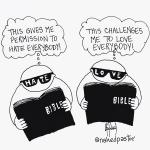
July 12, 2018
The Bible is What We Make It
Next Post
July 14, 2018 Conflict among Fallible Humans
Browse Our Archives
Select a Category 1 Corinthians 1 John 1 Peter 1 Samuel 1 Thessalonians 1 Timothy 2 Corinthians 2 Kings 2 Peter 2 Samuel 2 Thessalonians 2 Timothy academia Acts of the Apostles afterlife Akhaten Alcatraz American Academy of Religion Amos Anglican Arabic Aramaic archaeology art artificial intelligence astronomy atheism atonement Babylon 5 Baptists Battlestar Galactica Bible Biblical Studies Carnival biblioblogging Black Mirror Blade Runner Book of Job book review Buddhism Call for Papers China Christianity Christmas Christology Chronicles Coptic creation Daniel Deuteronomy Doctor Who Dune Easter Ecclesiastes economics education Eldad Keynan Enoch Seminar Ephesians eschatology Esther Evangelicals evolution Exodus Expanse Ezekiel Ezra fantasy Fringe fundamentalism Galatians games Ge'ez genealogy Genesis Gnosticism Gospel of Jesus' Wife Gospel of John Gospel of Judas Gospel of Luke Gospel of Mark Gospel of Matthew Gospel of Peter Gospel of Thomas Greek Harry Potter Hebrew Hebrews Hinduism historical Jesus history Hitchhiker's Guide to the Galaxy Holidays horror Hosea humor incarnation India inerrancy information literacy inspirational Intelligent Design Ireland Isaiah Islam Israel Italy James Jeremiah John the Baptist Jonah Joshua Judaism Jude Judges Judith Lamentations languages Latin Leviticus libraries literature Lord of the Rings LOST Mandaeans Mandaic memes Methodism Micah monotheism morality Mormons movies music mythicism NASSCAL Nehemiah new perspective New Testament news Numbers Orthodox paganism panentheism pantheism Patheos Paul and his letters Pentecostals Philippians Philippians 2:6-11 philosophy physics Planet of the Apes podcast politics Progressive Christianity Protestantism Proverbs Psalms pseudoscience racism religion Revelation Roman Catholicism Romania Romans Ruth scams science science fiction Secret Gospel of Mark Society of Biblical Literature Song of Songs Star Trek Star Wars Stargate Swahili Syriac Taoism technology Terminator The Handmaid's Tale The Hobbit The Matrix theodicy theology theory Timeless Titus tomb Torchwood travel TRON Uncategorized United Kingdom Westworld X-Files young-earth creationism Zechariah
Select a Month October 2026 September 2026 August 2026 July 2026 June 2026 May 2026 April 2026 March 2026 February 2026 January 2026 December 2025 November 2025 October 2025 September 2025 July 2025 June 2025 May 2025 April 2025 March 2025 February 2025 January 2025 December 2024 November 2024 October 2024 September 2024 August 2024 July 2024 June 2024 May 2024 April 2024 March 2024 February 2024 January 2024 December 2023 November 2023 October 2023 September 2023 August 2023 July 2023 May 2023 April 2023 March 2023 February 2023 January 2023 December 2022 November 2022 October 2022 September 2022 August 2022 July 2022 June 2022 May 2022 April 2022 March 2022 February 2022 January 2022 December 2021 November 2021 October 2021 September 2021 August 2021 July 2021 June 2021 May 2021 April 2021 March 2021 February 2021 January 2021 December 2020 November 2020 October 2020 September 2020 August 2020 July 2020 June 2020 May 2020 April 2020 March 2020 February 2020 January 2020 December 2019 November 2019 October 2019 September 2019 August 2019 July 2019 June 2019 May 2019 April 2019 March 2019 February 2019 January 2019 December 2018 November 2018 October 2018 September 2018 August 2018 July 2018 June 2018 May 2018 April 2018 March 2018 February 2018 January 2018 December 2017 November 2017 October 2017 September 2017 August 2017 July 2017 June 2017 May 2017 April 2017 March 2017 February 2017 January 2017 December 2016 November 2016 October 2016 September 2016 August 2016 July 2016 June 2016 May 2016 April 2016 March 2016 February 2016 January 2016 December 2015 November 2015 October 2015 September 2015 August 2015 July 2015 June 2015 May 2015 April 2015 March 2015 February 2015 January 2015 December 2014 November 2014 October 2014 September 2014 August 2014 July 2014 June 2014 May 2014 April 2014 March 2014 February 2014 January 2014 December 2013 November 2013 October 2013 September 2013 August 2013 July 2013 June 2013 May 2013 April 2013 March 2013 February 2013 January 2013 December 2012 November 2012 October 2012 September 2012 August 2012 July 2012 June 2012 May 2012 April 2012 March 2012 February 2012 January 2012 December 2011 November 2011 October 2011 September 2011 August 2011 July 2011 June 2011 May 2011 April 2011 March 2011 February 2011 January 2011 December 2010 November 2010 October 2010 September 2010 August 2010 July 2010 June 2010 May 2010 April 2010 March 2010 February 2010 January 2010 December 2009 November 2009 October 2009 September 2009 August 2009 July 2009 June 2009 May 2009 April 2009 March 2009 February 2009 January 2009 December 2008 November 2008 October 2008 September 2008 August 2008 July 2008 June 2008 May 2008 April 2008 March 2008 February 2008 January 2008 December 2007 November 2007 October 2007 September 2007 August 2007 July 2007 June 2007 February 2007 January 2001
Follow Us!
TAKE THE
Religious Wisdom Quiz
True or False: The first plague in Egypt turned the Nile River into blood.
Select your answer to see how you score.
TRUE FALSE
Books by This Author Books by James F. McGrath
Related posts from Religion Prof: The Blog of James F. McGrath

Religion Prof: The Blog of James F. McGrath
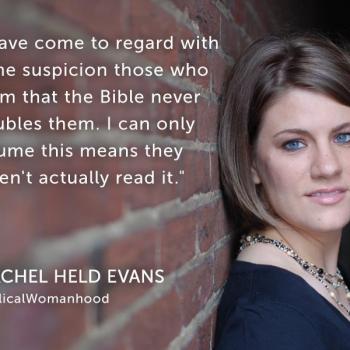
Why Rachel Held Evans Still Reads Like a...
Religion Prof: The Blog of James F. McGrath
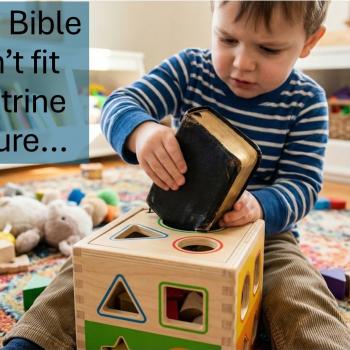
Unscriptural Doctrines of Scripture
Religion Prof: The Blog of James F. McGrath
Interview with Garrick Allen about Words Are Not...
Religion Prof: The Blog of James F. McGrath
TRENDING AT PATHEOS Progressive Christian

The First Eucharistic Controversy: Christ’s Real Presence
For Catholics, the Eucharist is the source and summit of the Christian...

What a Stop Sign Can Teach Us About...
How to Make a Decision When You Can't Hear God Main point:...

Archdiocese Hosts Military Marriage Retreat in Germany
RASTATT, Germany — The transient military lifestyle, with its frequent deployments and...

Nearly every morning, I make the drive to Detroit with my high-school-age...

The Real AI Story Is Adoption Without Trust
Artificial intelligence has crossed a political threshold. It is no longer a...

A new article, written by Jeff Lindsay and Gale L. Pooley,...
view all Progressive Christian blogs
Ad-Free & Subscriber Log-In Subscription Support
- About Us
- 2026 Calendar
- Videos
- Podcasts
- Library of World Religions
- Faith In Media Tracker
- Advertise With Us
- Write for Us
- Privacy Policy
- Terms of Service
- Do Not Sell My Data
- Contact Us
- Radiant Digital
- Manage Newsletter Subscriptions
- Unsubscribe From Notifications
- Sitemap
Copyright 2008-2026, Patheos. All rights reserved.
Subscription Support Ad-Free & Subscriber Log-In
Follow Patheos