
BuddhistCatholicContemplativeEvangelicalGeneral ChristianHinduJewishLatter-day SaintMuslimNew VisionsProgressive Christian
Beliefs
- Buddhist
- Catholic
- Contemplative
- Evangelical
- General Christian
- Hindu
- Jewish
- Latter-day Saint
- More Voices
- Muslim
- New Visions
- Pagan
- Progressive Christian
Topics
- Religion News
- Food and Religion
- Sports and Religion
- Religious Art
- Religious Music and Entertainment
- Religious Events
- History and Religion
- Style and Religion
- Politics and Religion
- Women in Religion
- Recreation Outdoors and Religion
- Business Finance and Religion
- Careers Workplace and Religion
- Education and Religion
- Family Parenting and Religion
- Health Fitness and Religion
- Home and Religion
- Relationships and Religion
- Technology and Religion
- Travel and Religion
Columnists
- Buddhist Columnists
- Business Finance and Religion Columnists
- Careers Workplace and Religion Columnists
- Catholic Columnists
- Contemplative Columnists
- Education and Religion Columnists
- Evangelists Columnists
- Family Parenting and Religion Columnists
- General Christian Columnists
- Health Fitness and Religion Columnists
- Hindu Columnists
- History and Religion Columnists
- Home and Religion Columnists
- Jewish Columnists
- More Voices Columnists
- Latter Day Columnists
- Muslim Columnists
- New Visions Columnists
- Nonreligious Columnists
- Pagan Columnists
- Politics and Religion Columnists
- Progressive Columnists
- Recreation Outdoors and Religion Columnists
- Relationships and Religion Columnists
- Religion News Columnists
- Religious Art Columnists
- Religious Events Columnists
- Religious Music and Entertainment Columnists
- Sports and Religion Columnists
- Style and Religion Columnists
- Technology and Religion Columnists
- Travel and Religion Columnists
- Women in Religion Columnists
Resource Library
- 2026 Calendar
- Library of World Religions
- The 100 Most Holy Places on Earth
- Patheos Answers
- Podcasts
- Videos
- Faith Leaders Database
- Anglican Episcopalian
- Bahai
- Baptist
- Buddhism
- Christianity
- Confucianism
- Eastern Orthodoxy
- Hinduism
- Holiness and Pentecostal
- ISKCON
- Islam
- Judaism
- Lutheran
- Methodist
- The Church of Jesus Christ of Latter-day Saints
- New Age
- Paganism
- Presbytarian and Reformed
- Protestantism
- Religion Behind the Scenes
- Roman Catholic
- Scientology
- Shia Islam
- Sikhism
- Sufism
- Sunni Islam
- Taoism
- Zen
- See all religions
Research Tools
 Ad-Free & Subscriber Log-In Subscription Support
Ad-Free & Subscriber Log-In Subscription Support
Follow Patheos 

- Trending:
- Forgiveness
- |
- Marriage
- |
- Consciousness
- |
- Death Penalty
- |
- Election
- |
- Halloween

- Home
- About Dr. James F. McGrath
- Publications
- Blogroll
- Useful Websites
- Connections
- Easy Search Posts Page
- FREE NEWSLETTER
- Home
- Progressive Christian
- Darkest Hour
Darkest Hour
Last updated on: December 7, 2017 at 7:41 am by James F. McGrath
Darkest Hour 2017-12-07T07:41:44-05:00 James F. McGrath
Patheos Explore the world's faith through different perspectives on religion and spirituality! Patheos has the views of the prevalent religions and spiritualities of the world.
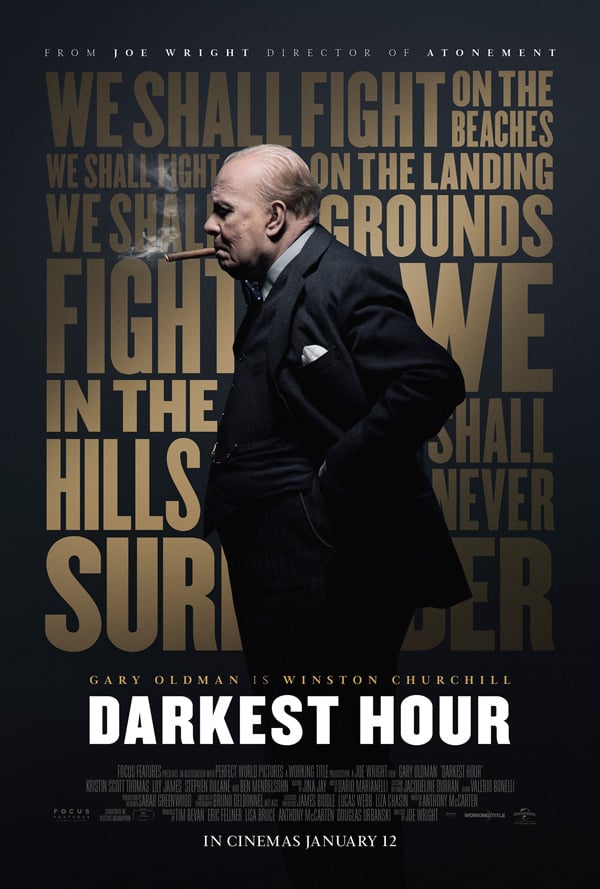 I was delighted to have the opportunity to see the new movie Darkest Hour before it opens in theaters tonight. I had been looking forward to seeing it, ever since I first saw publicity about it showing Gary Oldman, with prosthetics and makeup to turn him into Winston Churchill.
The movie focuses on a relatively short period in May 1940, starting with the British parliament’s loss of faith in prime minister Neville Chamberlain. After some discussion and much reluctance from both his own party and the king, Winston Churchill is appointed as prime minister and invited to create a government, because he is the only person that the opposition will support. More than in other films (or television shows like The Crown), Darkest Hour emphasizes Churchill’s command of the written word and delivery thereof in speech, in contrast with his regular inability to find the right word while speaking. Words and communication seem to me to be at the heart of the message of the film, and this is reinforced by the minimalist soundtrack by Dario Marianelli – and by the powerful use of silence in moments when other filmmakers and film score composers would have chosen to interject music to create emotion. The absence of sound effectively reinforces the power of things like the human voice, as well as of eye contact and other forms of non-verbal communication.
The movie is very much focused on Winston Churchill, trying to give us a perspective that allows us to see him as human and not merely as myth and memory. Within that framework, the movie highlights his gifts as a speechwriter but contrasts this with his weaknesses and shortcomings, and the sacrifices his family had to make for him to have the (up until that time relatively unremarkable) political career that he had had. Early in the film, while his wife (who clearly loves him dearly but is also able to push back against some of his tendencies) says “he is a man like any other,” Winston himself asks while in the process of choosing a hat from his collection of many, “Which self should I be today?”
The bulk of the film focuses in on his difficult decisions and on his brilliant communication through certain media and in certain contexts, often in marked contrast with others. Although I took notes while watching the movie, there were quotes which stuck in my mind without need to look at what I had written to recall them. Phrases such as “How many more dictators must be wooed, appeased…You cannot bargain with a tiger while your head is in its mouth,” “Lost causes are the only ones worth fighting for,” or “those who never change their mind never change anything.” It is easy to disagree with the literal meaning of these statements – and yet to recognize the power and perhaps even validity of their point to at least some degree. It is a question that people will always face: is it better to sacrifice our lives than to sacrifice or abandon our values?
The power of political rhetoric, its relation to truth and information, and matters of hope, values, and tyranny are given particular attention, in ways that both reflect and speak to our current age. Indeed, the question of reflecting vs. influencing the voice of the people is itself a major matter of focus, as Churchill rides the Underground and asks ordinary people a variety of questions, and then tells this story to his Outer Cabinet and eventually to Parliament with similar effect. Has the voice of the people influenced him, he them, or both? Earlier in the movie, Churchill had said that he wants to inspire in the people a feeling that they don’t know they have, which highlights the fact that any answer we might try to give to the question that the movie poses – who influences whom, or do both equally influence each other – gets lost to our view in the human subconscious and the less visible elements of sociocultural values.
Other things that are highlighted include the machinations of members of Churchill’s own party, and his decision (somewhat forced by circumstances, but in marked contrast to the tendency of many today) to surround himself with rivals rather than a potential echo chamber. The issue of receiving little or no information, partial information, and the bigger picture view is highlighted as Churchill’s typist breaks into tears after typing his dictated telegram to the commander of troops at Calais letting them know that rescue would not be coming. As we the viewers know, and as she gets the chance to learn, the sacrifice of the battalion in Calais is part of an effort to save almost 10 times as many from Dunkirk. Having been told that it would take a miracle to save even 10% of them, the question of what course of action to take when the ideal – save everyone – is not available; who gets to decide; who should know about what is being debated and eventually decided; and whether we can and should trust in leaders is highlighted. For ultimately Churchill persuaded his nation to stand up to a tyrant, but in a context in which there was no rational basis for thinking they would win. And were it not for Pearl Harbor getting the United States into the war, things might well have turned out differently – in which case we might also remember Churchill very differently.
For those interested in religion, there are moments in the movie that deserve attention, in addition to the central themes of faith, conviction, trust, and truth. The rhetoric that will state that “our policy is to wage war with all the strength that God can give us” raises very serious questions about the relationship between religion, state, tyranny, and violent struggle. And there is a very specific view of God that is brought into the picture when Churchill says (while talking to the king about his parents) “My father was like God – busy elsewhere.” More subtle, but still relevant to this theme, are statements such as that of Churchill’s wife when she says that “with such power you must try to be more kind.” The relationship between power and kindness is not a given, but reflects particular values. But perhaps the most powerful moment is when Churchill’s wife tells him that his inner struggles have prepared him for that moment. She tells him that he is strong precisely because he is imperfect, and wise precisely because of his doubts.
Other elements in the movie are also important to note in our present context. The places where women could not go in the war effort, and the places (such as the pool of typists) staffed entirely by ladies. The 7 million refugees in France, in view of current refugee crises. And in the midst of a film with so much serious subject matter, there is still humor – for instance, when Churchill gets the “V for Victory” sign backwards and gives a cameraman a gesture that in the UK means “up your bum”; or when he says in response to a woman who says her baby looks like him, “Madam, all babies look like me.” The cinematography is also impressive, with a striking number of shots that allow substantial parts of the screen to be blacked out, as though Churchill (whether riding in a lift/elevator, or in an underground room talking to the president of the United States) is boxed in. The frequent scenes in tunnels seem to foreshadow the movement of many into shelters in the years that follow.
At the very end of the movie, after a powerful speech that wins support even from the most determined detractors in Churchill’s own party, one of them asks “What just happened?” The answer that is given is this: “He mobilized the English language and sent it into battle.” In an era of echo chambers and partisan politics, of tyranny and refugee crises, of accusations of fake news and uncertainty or overconfidence about whom to trust, Darkest Hour provides insight, challenges, and inspiration. Because its message is ultimately about hope and trust. The figure of Winston Churchill is one that, with hindsight, we look back on as providing crucial, positive leadership in a moment of profound crisis. But in that moment, the question of whether his inspirational rhetoric (which did not initially inform the public of what the king referred to at one point as the “unvarnished truth”) was something dangerous to be feared or something uplifting to be supported and trusted, was as yet unanswered. Darkest Hour thus both challenges us to stand courageously against tyranny, and to dare to trust from a standpoint that admittedly does not have all the information nor all the answers, and often lacks as well any rational or evidentiary basis for holding out strong hope for better things in the future.
In case you couldn’t tell, I highly recommend this movie, which my family also found to be powerful, historically engaging, and of great contemporary relevance.

Previous Post
December 6, 2017
The Real St. Nicholas
Next Post

December 8, 2017 Haggling for Peace
Browse Our Archives
Select a Category 1 Corinthians 1 John 1 Peter 1 Samuel 1 Thessalonians 1 Timothy 2 Corinthians 2 Kings 2 Peter 2 Samuel 2 Thessalonians 2 Timothy academia Acts of the Apostles afterlife Akhaten Alcatraz American Academy of Religion Amos Anglican Arabic Aramaic archaeology art artificial intelligence astronomy atheism atonement Babylon 5 Baptists Battlestar Galactica Bible Biblical Studies Carnival biblioblogging Black Mirror Blade Runner Book of Job book review Buddhism Call for Papers China Christianity Christmas Christology Chronicles Coptic creation Daniel Deuteronomy Doctor Who Dune Easter Ecclesiastes economics education Eldad Keynan Enoch Seminar Ephesians eschatology Esther Evangelicals evolution Exodus Expanse Ezekiel Ezra fantasy Fringe fundamentalism Galatians games Ge'ez genealogy Genesis Gnosticism Gospel of Jesus' Wife Gospel of John Gospel of Judas Gospel of Luke Gospel of Mark Gospel of Matthew Gospel of Peter Gospel of Thomas Greek Harry Potter Hebrew Hebrews Hinduism historical Jesus history Hitchhiker's Guide to the Galaxy Holidays horror Hosea humor incarnation India inerrancy information literacy inspirational Intelligent Design Ireland Isaiah Islam Israel Italy James Jeremiah John the Baptist Jonah Joshua Judaism Jude Judges Judith Lamentations languages Latin Leviticus libraries literature Lord of the Rings LOST Mandaeans Mandaic memes Methodism Micah monotheism morality Mormons movies music mythicism NASSCAL Nehemiah new perspective New Testament news Numbers Orthodox paganism panentheism pantheism Patheos Paul and his letters Pentecostals Philippians Philippians 2:6-11 philosophy physics Planet of the Apes podcast politics Progressive Christianity Protestantism Proverbs Psalms pseudoscience racism religion Revelation Roman Catholicism Romania Romans Ruth scams science science fiction Secret Gospel of Mark Society of Biblical Literature Song of Songs Star Trek Star Wars Stargate Swahili Syriac Taoism technology Terminator The Handmaid's Tale The Hobbit The Matrix theodicy theology theory Timeless Titus tomb Torchwood travel TRON Uncategorized United Kingdom Westworld X-Files young-earth creationism Zechariah
Select a Month October 2026 September 2026 August 2026 July 2026 June 2026 May 2026 April 2026 March 2026 February 2026 January 2026 December 2025 November 2025 October 2025 September 2025 July 2025 June 2025 May 2025 April 2025 March 2025 February 2025 January 2025 December 2024 November 2024 October 2024 September 2024 August 2024 July 2024 June 2024 May 2024 April 2024 March 2024 February 2024 January 2024 December 2023 November 2023 October 2023 September 2023 August 2023 July 2023 May 2023 April 2023 March 2023 February 2023 January 2023 December 2022 November 2022 October 2022 September 2022 August 2022 July 2022 June 2022 May 2022 April 2022 March 2022 February 2022 January 2022 December 2021 November 2021 October 2021 September 2021 August 2021 July 2021 June 2021 May 2021 April 2021 March 2021 February 2021 January 2021 December 2020 November 2020 October 2020 September 2020 August 2020 July 2020 June 2020 May 2020 April 2020 March 2020 February 2020 January 2020 December 2019 November 2019 October 2019 September 2019 August 2019 July 2019 June 2019 May 2019 April 2019 March 2019 February 2019 January 2019 December 2018 November 2018 October 2018 September 2018 August 2018 July 2018 June 2018 May 2018 April 2018 March 2018 February 2018 January 2018 December 2017 November 2017 October 2017 September 2017 August 2017 July 2017 June 2017 May 2017 April 2017 March 2017 February 2017 January 2017 December 2016 November 2016 October 2016 September 2016 August 2016 July 2016 June 2016 May 2016 April 2016 March 2016 February 2016 January 2016 December 2015 November 2015 October 2015 September 2015 August 2015 July 2015 June 2015 May 2015 April 2015 March 2015 February 2015 January 2015 December 2014 November 2014 October 2014 September 2014 August 2014 July 2014 June 2014 May 2014 April 2014 March 2014 February 2014 January 2014 December 2013 November 2013 October 2013 September 2013 August 2013 July 2013 June 2013 May 2013 April 2013 March 2013 February 2013 January 2013 December 2012 November 2012 October 2012 September 2012 August 2012 July 2012 June 2012 May 2012 April 2012 March 2012 February 2012 January 2012 December 2011 November 2011 October 2011 September 2011 August 2011 July 2011 June 2011 May 2011 April 2011 March 2011 February 2011 January 2011 December 2010 November 2010 October 2010 September 2010 August 2010 July 2010 June 2010 May 2010 April 2010 March 2010 February 2010 January 2010 December 2009 November 2009 October 2009 September 2009 August 2009 July 2009 June 2009 May 2009 April 2009 March 2009 February 2009 January 2009 December 2008 November 2008 October 2008 September 2008 August 2008 July 2008 June 2008 May 2008 April 2008 March 2008 February 2008 January 2008 December 2007 November 2007 October 2007 September 2007 August 2007 July 2007 June 2007 February 2007 January 2001
Follow Us!
TAKE THE
Religious Wisdom Quiz
What does "Apocalypse" mean in Greek?
Select your answer to see how you score.
Revelation Destruction Judgment Victory
Books by This Author Books by James F. McGrath
Related posts from Religion Prof: The Blog of James F. McGrath

The Time-Traveler’s Apprentice (A Short Story)
Religion Prof: The Blog of James F. McGrath

Religion Prof: The Blog of James F. McGrath
'Disclosure Day': The Real Revelation Isn't Aliens
Religion Prof: The Blog of James F. McGrath

Religion Prof: The Blog of James F. McGrath
TRENDING AT PATHEOS Progressive Christian

The Sermon on the Mount, Part I: Matthew...
The Sermon on the Mount, Part I (Matthew 4:12-5:12) St. Matthew moves...

What's up from Crossway: Reviewing some of their latest A few weeks...

Janie Learns the Way of the Cross: A...
Teaching children about Jesus' Passion can be challenging. Many parents and educators...

Looking For Good Catholic Writing - October 2026
He alone extends the heavens, and he walks upon the waves of...

In "Irreplaceable," our book on vocation and technology, Trevor Sutton and I...

I was strolling through the top floor of the brand new Parthenon...
view all Progressive Christian blogs
Ad-Free & Subscriber Log-In Subscription Support
- About Us
- 2026 Calendar
- Videos
- Podcasts
- Library of World Religions
- Faith In Media Tracker
- Advertise With Us
- Write for Us
- Privacy Policy
- Terms of Service
- Do Not Sell My Data
- Contact Us
- Radiant Digital
- Manage Newsletter Subscriptions
- Unsubscribe From Notifications
- Sitemap
Copyright 2008-2026, Patheos. All rights reserved.
Subscription Support Ad-Free & Subscriber Log-In
Follow Patheos