
BuddhistCatholicContemplativeEvangelicalGeneral ChristianHinduJewishLatter-day SaintMuslimNew VisionsProgressive Christian
Beliefs
- Buddhist
- Catholic
- Contemplative
- Evangelical
- General Christian
- Hindu
- Jewish
- Latter-day Saint
- More Voices
- Muslim
- New Visions
- Pagan
- Progressive Christian
Topics
- Religion News
- Food and Religion
- Sports and Religion
- Religious Art
- Religious Music and Entertainment
- Religious Events
- History and Religion
- Style and Religion
- Politics and Religion
- Women in Religion
- Recreation Outdoors and Religion
- Business Finance and Religion
- Careers Workplace and Religion
- Education and Religion
- Family Parenting and Religion
- Health Fitness and Religion
- Home and Religion
- Relationships and Religion
- Technology and Religion
- Travel and Religion
Columnists
- Buddhist Columnists
- Business Finance and Religion Columnists
- Careers Workplace and Religion Columnists
- Catholic Columnists
- Contemplative Columnists
- Education and Religion Columnists
- Evangelists Columnists
- Family Parenting and Religion Columnists
- General Christian Columnists
- Health Fitness and Religion Columnists
- Hindu Columnists
- History and Religion Columnists
- Home and Religion Columnists
- Jewish Columnists
- More Voices Columnists
- Latter Day Columnists
- Muslim Columnists
- New Visions Columnists
- Nonreligious Columnists
- Pagan Columnists
- Politics and Religion Columnists
- Progressive Columnists
- Recreation Outdoors and Religion Columnists
- Relationships and Religion Columnists
- Religion News Columnists
- Religious Art Columnists
- Religious Events Columnists
- Religious Music and Entertainment Columnists
- Sports and Religion Columnists
- Style and Religion Columnists
- Technology and Religion Columnists
- Travel and Religion Columnists
- Women in Religion Columnists
Resource Library
- 2026 Calendar
- Library of World Religions
- The 100 Most Holy Places on Earth
- Patheos Answers
- Podcasts
- Videos
- Faith Leaders Database
- Anglican Episcopalian
- Bahai
- Baptist
- Buddhism
- Christianity
- Confucianism
- Eastern Orthodoxy
- Hinduism
- Holiness and Pentecostal
- ISKCON
- Islam
- Judaism
- Lutheran
- Methodist
- The Church of Jesus Christ of Latter-day Saints
- New Age
- Paganism
- Presbytarian and Reformed
- Protestantism
- Religion Behind the Scenes
- Roman Catholic
- Scientology
- Shia Islam
- Sikhism
- Sufism
- Sunni Islam
- Taoism
- Zen
- See all religions
Research Tools
 Ad-Free & Subscriber Log-In Subscription Support
Ad-Free & Subscriber Log-In Subscription Support
Follow Patheos 

- Trending:
- Forgiveness
- |
- Marriage
- |
- Consciousness
- |
- Death Penalty
- |
- Election
- |
- Halloween

- Home
- About Dr. James F. McGrath
- Publications
- Blogroll
- Useful Websites
- Connections
- Easy Search Posts Page
- FREE NEWSLETTER
- Home
- Progressive Christian
- Digital Humanities, Games, and Forgeries at #AARSBL17
Digital Humanities, Games, and Forgeries at #AARSBL17
Last updated on: November 21, 2017 at 11:16 am by James F. McGrath
Digital Humanities, Games, and Forgeries at #AARSBL17 2017-11-21T11:16:49-05:00 James F. McGrath
Patheos Explore the world's faith through different perspectives on religion and spirituality! Patheos has the views of the prevalent religions and spiritualities of the world.
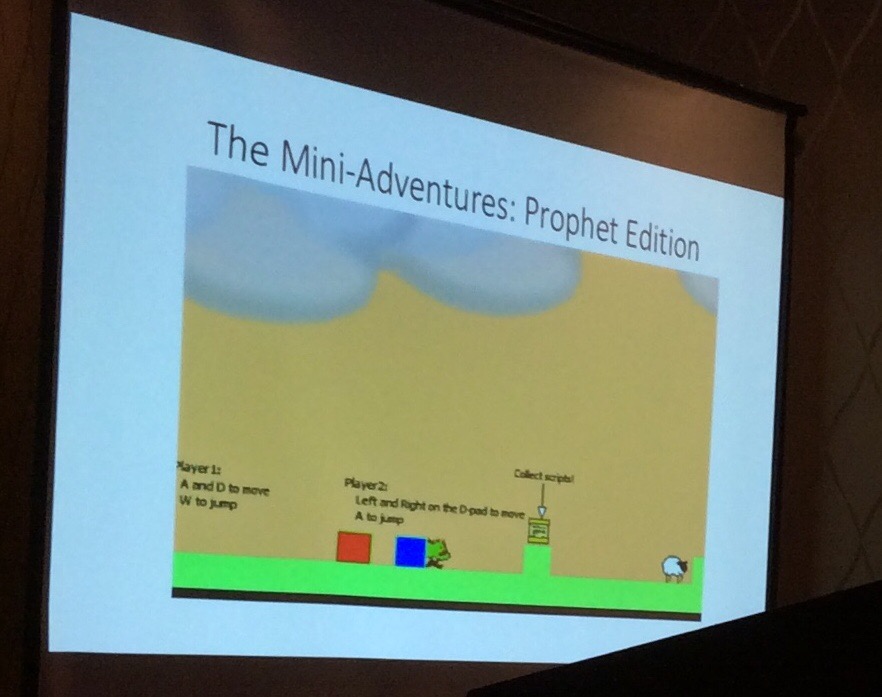
Richard Bautch presented first, and was the first of two papers related to games – the second of which is by me, and I did not take notes during that, obviously, nor will I try the patience of my blog readers by talking about my game again in what is already a long blog post. Bautch teaches a senior seminar on prophets, and has students build a video game, The Mini Adventures: Prophets Edition. The four modules of the course need to become four levels, and the values of the prophets have to play out on the screen in original ways. The aim is to get at what drives and motivates prophets like Amos or Jeremiah. The game play moves from rural to urban. A character eats scrolls in a homage to both Ezekiel and Pac Man. All the elements were created by students. The look is retro, but that is intentional. The focus is to be kept on ideas. Bautch then moved to discuss the background of the project, quoting video game design theorists who (in the book Slay the Dragon) have called this the golden age of narrative-based video gaming. His focus is not on having them retell a biblical story, but to dig deeper into motivations of characters and such. The course involved collaboration between students in the biblical studies class and in the game studies program. The project was not in the end completed during the time of the course, but can still be considered a success. The students had to submit a GCD (Game Concept Document) for a grade. Bautch said that without the game studies major (which is in the school of humanities at St. Edwards) this might not have been possible, and that the collaboration benefitted them students as well as those in religious studies. Afterwards, an audience member suggested making the games available online. The focus on process as well as product was also noted. Game Maker Pro is the platform that was used to make the games.
After my paper, which I thought was very well received, we shifted away from focusing on games. Katherine Jones presented on statistics and the detection of forgeries. She is working in data science, but took a course from Christopher Rollston which got her interested in this topic. Jones noted the penchant for the public to assume that artifacts which come to light are authentic, and so a means of weighing characteristics as potential pointers to authenticity or forgery. She highlighted the Gospel of Jesus’ Wife as an example, and the need for the media as well as scholars to have better means of evaluating artifacts using an objective statistical model. Scientific tests are rarely as accurate as we assume they are, but they are important within their margin of error. Jones’ project involved flagging artifacts known to be authentic or inauthentic with a binary marker related to eight different criteria: C14 date, linguistic inconsistency, authenticity of script, provenience, location of purchase, monetary motives, social motives, and far-fetched or sensationalist content. Jones also noted the odds against a very small fragment of a lost work happening to mention Jesus’ wife. Next Jones turned to the Moussaieff Ostracon, before sharing the mathematical form of the model, and how various criteria are weighted. The model predicted correctly in 81% of the cases, with some false positives and negatives. Jones then turned to potential issues and practical applications. I wondered what the method would make of the Gospel of Philip, and whether an initial red flag might negatively impact subsequent scholarship on it. Perhaps the solution is to simply not apply it to works whose provenience and date are authenticated. Jones concluded with the placards in the Museum of the Bible raising awareness of questions about the authenticity of Dead Sea Scrolls fragments on display. Further considerations such as patina on inscriptions and impact of ink on what it is written on also need to be taken into account. One of her final recommendations was that we all learn to program in R!
Claire Clivaz presented next on a partnership approach to open access publishing, starting with the aim of oa2020.org, which declares the intention to link all those involved in various stages of knowledge production and publication within an open access framework. Clivaz noted that publishers are typically not participants in digital humanities projects and discussions about them in the production phase. She then highlighted humarec.org, a project that she has been involved in. This offers a manuscript viewer showing a unique manuscript featuring the letters of Paul in three languages: Greek, Latin, and Arabic. All the encoded materials are on GitHub. The images of the manuscript itself are property of the Marciana Library, and they did not give permission to include the manuscript images on other websites within other NT DH projects such as the INTGP ECM, however. Many institutions have moved from speaking of publications to speaking of outputs. Clivaz highlighted the various collaborators in the project, including E. J. Brill, and also quoted Henri Meschonnic. She shared statistics about where from and how long the HumaRec site is visited. The INTGP announced yesterday that they have removed restrictions previously placed on its use. Clivaz mentioned that some of these sites are starting to be included in library catalogues. She also highlighted Sara Schulthess’ webbook, a peer-reviewed monograph for a VRE, and also De Gruyter’s move towards open peer review. In a webbook, each paragraph has a URL to facilitate reference.
John Dyer presented last on digital reading habits in relation to the Bible, starting with photos of the pope reading the Bible on a computer, and someone using the light from their phone to read their print Bible. Dyer focused his research on American Evangelical Bible readers, since Evangelicals have been responsible for producing all the major Bible software and websites. Researchers have found that scrolling impedes reading, that hyperlinks cause distraction, and that interface components such as menus and sidebars also influence and distract. A team of researchers in Beijing found that ereaders used by people who are familiar and comfortable with them. They also found that readers tend to skim when reading ebooks, but giving a time limit tricked them into reading more slowly and thus skimming less. Digital Bibles regularly miss details, such as brackets and notes that flag the status of John 7-8 and the ending of Mark. YouVersion produces infographics with statistics, but they do not provide data to researchers (Dyer asked). A 2015 article by Richardson and Pardun found that people felt that the sense of sacredness was reduced when reading the Bible on a device. Dyer took 150 participants from among regular churchgoers in three churches in the Dallas area. He surveyed their media engagement by type, divided them into two groups (digital and print), then asked them to read the Epistle of Jude, and then the Gospel of John following a longer term reading plan. In his presentation, Dyer shared some of the results of his survey in a nice 3D format. Interesting finds were the penchant of parents to read with children using print Bibles, and for people to prefer print reading except at work. Some parents also added that their children, because of using devices, had increased biblical literacy. Another interesting find was that men comprehended less when reading on their phones. Affective differences were also interesting: readers of Jude in print said they felt encouraged, while digital readers said they felt confused. One participant said that reading the Bible digitally felt more like skimming an email and less like studying God’s Word. Dyer made an amusing reference to the new favorite version, the NAB: “nearest available Bible.” Evangelicals clearly have a lot of flexibility in their pragmatic approach. I wondered whether affect was being reported as comprehension – in other words, is the sense of a sacred experience when reading a print Bible being reported as comprehension, and if so, is it important to test their comprehension rather than merely asking for their perception of it. During the question time, Naomi Koltun-Fromm emphasized that Bible reading (especially in an orthodox Jewish context) is often using the text to remind of passages that are already familiar, rather than reading for the first time. Another commented mentioned that orthodox Jews will not read on devices on Saturdays. Dyer also shared that he considered distributing all new iPads and print Bibles rather than having them use their own.
Previous Post

November 21, 2017
More Digital Humanities at #AARSBL17
Next Post

November 22, 2017 First Ever Fan Studies North America Conference!
Browse Our Archives
Select a Category 1 Corinthians 1 John 1 Peter 1 Samuel 1 Thessalonians 1 Timothy 2 Corinthians 2 Kings 2 Peter 2 Samuel 2 Thessalonians 2 Timothy academia Acts of the Apostles afterlife Akhaten Alcatraz American Academy of Religion Amos Anglican Arabic Aramaic archaeology art artificial intelligence astronomy atheism atonement Babylon 5 Baptists Battlestar Galactica Bible Biblical Studies Carnival biblioblogging Black Mirror Blade Runner Book of Job book review Buddhism Call for Papers China Christianity Christmas Christology Chronicles Coptic creation Daniel Deuteronomy Doctor Who Dune Easter Ecclesiastes economics education Eldad Keynan Enoch Seminar Ephesians eschatology Esther Evangelicals evolution Exodus Expanse Ezekiel Ezra fantasy Fringe fundamentalism Galatians games Ge'ez genealogy Genesis Gnosticism Gospel of Jesus' Wife Gospel of John Gospel of Judas Gospel of Luke Gospel of Mark Gospel of Matthew Gospel of Peter Gospel of Thomas Greek Harry Potter Hebrew Hebrews Hinduism historical Jesus history Hitchhiker's Guide to the Galaxy Holidays horror Hosea humor incarnation India inerrancy information literacy inspirational Intelligent Design Ireland Isaiah Islam Israel Italy James Jeremiah John the Baptist Jonah Joshua Judaism Jude Judges Judith Lamentations languages Latin Leviticus libraries literature Lord of the Rings LOST Mandaeans Mandaic memes Methodism Micah monotheism morality Mormons movies music mythicism NASSCAL Nehemiah new perspective New Testament news Numbers Orthodox paganism panentheism pantheism Patheos Paul and his letters Pentecostals Philippians Philippians 2:6-11 philosophy physics Planet of the Apes podcast politics Progressive Christianity Protestantism Proverbs Psalms pseudoscience racism religion Revelation Roman Catholicism Romania Romans Ruth scams science science fiction Secret Gospel of Mark Society of Biblical Literature Song of Songs Star Trek Star Wars Stargate Swahili Syriac Taoism technology Terminator The Handmaid's Tale The Hobbit The Matrix theodicy theology theory Timeless Titus tomb Torchwood travel TRON Uncategorized United Kingdom Westworld X-Files young-earth creationism Zechariah
Select a Month October 2026 September 2026 August 2026 July 2026 June 2026 May 2026 April 2026 March 2026 February 2026 January 2026 December 2025 November 2025 October 2025 September 2025 July 2025 June 2025 May 2025 April 2025 March 2025 February 2025 January 2025 December 2024 November 2024 October 2024 September 2024 August 2024 July 2024 June 2024 May 2024 April 2024 March 2024 February 2024 January 2024 December 2023 November 2023 October 2023 September 2023 August 2023 July 2023 May 2023 April 2023 March 2023 February 2023 January 2023 December 2022 November 2022 October 2022 September 2022 August 2022 July 2022 June 2022 May 2022 April 2022 March 2022 February 2022 January 2022 December 2021 November 2021 October 2021 September 2021 August 2021 July 2021 June 2021 May 2021 April 2021 March 2021 February 2021 January 2021 December 2020 November 2020 October 2020 September 2020 August 2020 July 2020 June 2020 May 2020 April 2020 March 2020 February 2020 January 2020 December 2019 November 2019 October 2019 September 2019 August 2019 July 2019 June 2019 May 2019 April 2019 March 2019 February 2019 January 2019 December 2018 November 2018 October 2018 September 2018 August 2018 July 2018 June 2018 May 2018 April 2018 March 2018 February 2018 January 2018 December 2017 November 2017 October 2017 September 2017 August 2017 July 2017 June 2017 May 2017 April 2017 March 2017 February 2017 January 2017 December 2016 November 2016 October 2016 September 2016 August 2016 July 2016 June 2016 May 2016 April 2016 March 2016 February 2016 January 2016 December 2015 November 2015 October 2015 September 2015 August 2015 July 2015 June 2015 May 2015 April 2015 March 2015 February 2015 January 2015 December 2014 November 2014 October 2014 September 2014 August 2014 July 2014 June 2014 May 2014 April 2014 March 2014 February 2014 January 2014 December 2013 November 2013 October 2013 September 2013 August 2013 July 2013 June 2013 May 2013 April 2013 March 2013 February 2013 January 2013 December 2012 November 2012 October 2012 September 2012 August 2012 July 2012 June 2012 May 2012 April 2012 March 2012 February 2012 January 2012 December 2011 November 2011 October 2011 September 2011 August 2011 July 2011 June 2011 May 2011 April 2011 March 2011 February 2011 January 2011 December 2010 November 2010 October 2010 September 2010 August 2010 July 2010 June 2010 May 2010 April 2010 March 2010 February 2010 January 2010 December 2009 November 2009 October 2009 September 2009 August 2009 July 2009 June 2009 May 2009 April 2009 March 2009 February 2009 January 2009 December 2008 November 2008 October 2008 September 2008 August 2008 July 2008 June 2008 May 2008 April 2008 March 2008 February 2008 January 2008 December 2007 November 2007 October 2007 September 2007 August 2007 July 2007 June 2007 February 2007 January 2001
Follow Us!
TAKE THE
Religious Wisdom Quiz
True or False: According to 1 John, God is love, and whoever abides in love abides in God.
Select your answer to see how you score.
FALSE TRUE
Books by This Author Books by James F. McGrath
Related posts from Religion Prof: The Blog of James F. McGrath

Religion Prof: The Blog of James F. McGrath

Unscriptural Doctrines of Scripture
Religion Prof: The Blog of James F. McGrath
Interview with Garrick Allen about Words Are Not...
Religion Prof: The Blog of James F. McGrath

Religion Prof: The Blog of James F. McGrath
TRENDING AT PATHEOS Progressive Christian

The First Eucharistic Controversy: Christ’s Real Presence
For Catholics, the Eucharist is the source and summit of the Christian...

What a Stop Sign Can Teach Us About...
How to Make a Decision When You Can't Hear God Main point:...

Archdiocese Hosts Military Marriage Retreat in Germany
RASTATT, Germany — The transient military lifestyle, with its frequent deployments and...

Nearly every morning, I make the drive to Detroit with my high-school-age...

The Real AI Story Is Adoption Without Trust
Artificial intelligence has crossed a political threshold. It is no longer a...

A new article, written by Jeff Lindsay and Gale L. Pooley,...
view all Progressive Christian blogs
Ad-Free & Subscriber Log-In Subscription Support
- About Us
- 2026 Calendar
- Videos
- Podcasts
- Library of World Religions
- Faith In Media Tracker
- Advertise With Us
- Write for Us
- Privacy Policy
- Terms of Service
- Do Not Sell My Data
- Contact Us
- Radiant Digital
- Manage Newsletter Subscriptions
- Unsubscribe From Notifications
- Sitemap
Copyright 2008-2026, Patheos. All rights reserved.
Subscription Support Ad-Free & Subscriber Log-In
Follow Patheos