
BuddhistCatholicContemplativeEvangelicalGeneral ChristianHinduJewishLatter-day SaintMuslimNew VisionsProgressive Christian
Beliefs
- Buddhist
- Catholic
- Contemplative
- Evangelical
- General Christian
- Hindu
- Jewish
- Latter-day Saint
- More Voices
- Muslim
- New Visions
- Pagan
- Progressive Christian
Topics
- Religion News
- Food and Religion
- Sports and Religion
- Religious Art
- Religious Music and Entertainment
- Religious Events
- History and Religion
- Style and Religion
- Politics and Religion
- Women in Religion
- Recreation Outdoors and Religion
- Business Finance and Religion
- Careers Workplace and Religion
- Education and Religion
- Family Parenting and Religion
- Health Fitness and Religion
- Home and Religion
- Relationships and Religion
- Technology and Religion
- Travel and Religion
Columnists
- Buddhist Columnists
- Business Finance and Religion Columnists
- Careers Workplace and Religion Columnists
- Catholic Columnists
- Contemplative Columnists
- Education and Religion Columnists
- Evangelists Columnists
- Family Parenting and Religion Columnists
- General Christian Columnists
- Health Fitness and Religion Columnists
- Hindu Columnists
- History and Religion Columnists
- Home and Religion Columnists
- Jewish Columnists
- More Voices Columnists
- Latter Day Columnists
- Muslim Columnists
- New Visions Columnists
- Nonreligious Columnists
- Pagan Columnists
- Politics and Religion Columnists
- Progressive Columnists
- Recreation Outdoors and Religion Columnists
- Relationships and Religion Columnists
- Religion News Columnists
- Religious Art Columnists
- Religious Events Columnists
- Religious Music and Entertainment Columnists
- Sports and Religion Columnists
- Style and Religion Columnists
- Technology and Religion Columnists
- Travel and Religion Columnists
- Women in Religion Columnists
Resource Library
- 2026 Calendar
- Library of World Religions
- The 100 Most Holy Places on Earth
- Patheos Answers
- Podcasts
- Videos
- Faith Leaders Database
- Anglican Episcopalian
- Bahai
- Baptist
- Buddhism
- Christianity
- Confucianism
- Eastern Orthodoxy
- Hinduism
- Holiness and Pentecostal
- ISKCON
- Islam
- Judaism
- Lutheran
- Methodist
- The Church of Jesus Christ of Latter-day Saints
- New Age
- Paganism
- Presbytarian and Reformed
- Protestantism
- Religion Behind the Scenes
- Roman Catholic
- Scientology
- Shia Islam
- Sikhism
- Sufism
- Sunni Islam
- Taoism
- Zen
- See all religions
Research Tools
 Ad-Free & Subscriber Log-In Subscription Support
Ad-Free & Subscriber Log-In Subscription Support
Follow Patheos 

- Trending:
- Forgiveness
- |
- Marriage
- |
- Consciousness
- |
- Death Penalty
- |
- Election
- |
- Halloween

- Home
- About Dr. James F. McGrath
- Publications
- Blogroll
- Useful Websites
- Connections
- Easy Search Posts Page
- FREE NEWSLETTER
- Home
- Progressive Christian
- Mr. g
Mr. g
Last updated on: April 18, 2017 at 6:46 am by James F. McGrath
Mr. g 2017-04-18T06:46:37-04:00 James F. McGrath
Patheos Explore the world's faith through different perspectives on religion and spirituality! Patheos has the views of the prevalent religions and spiritualities of the world.
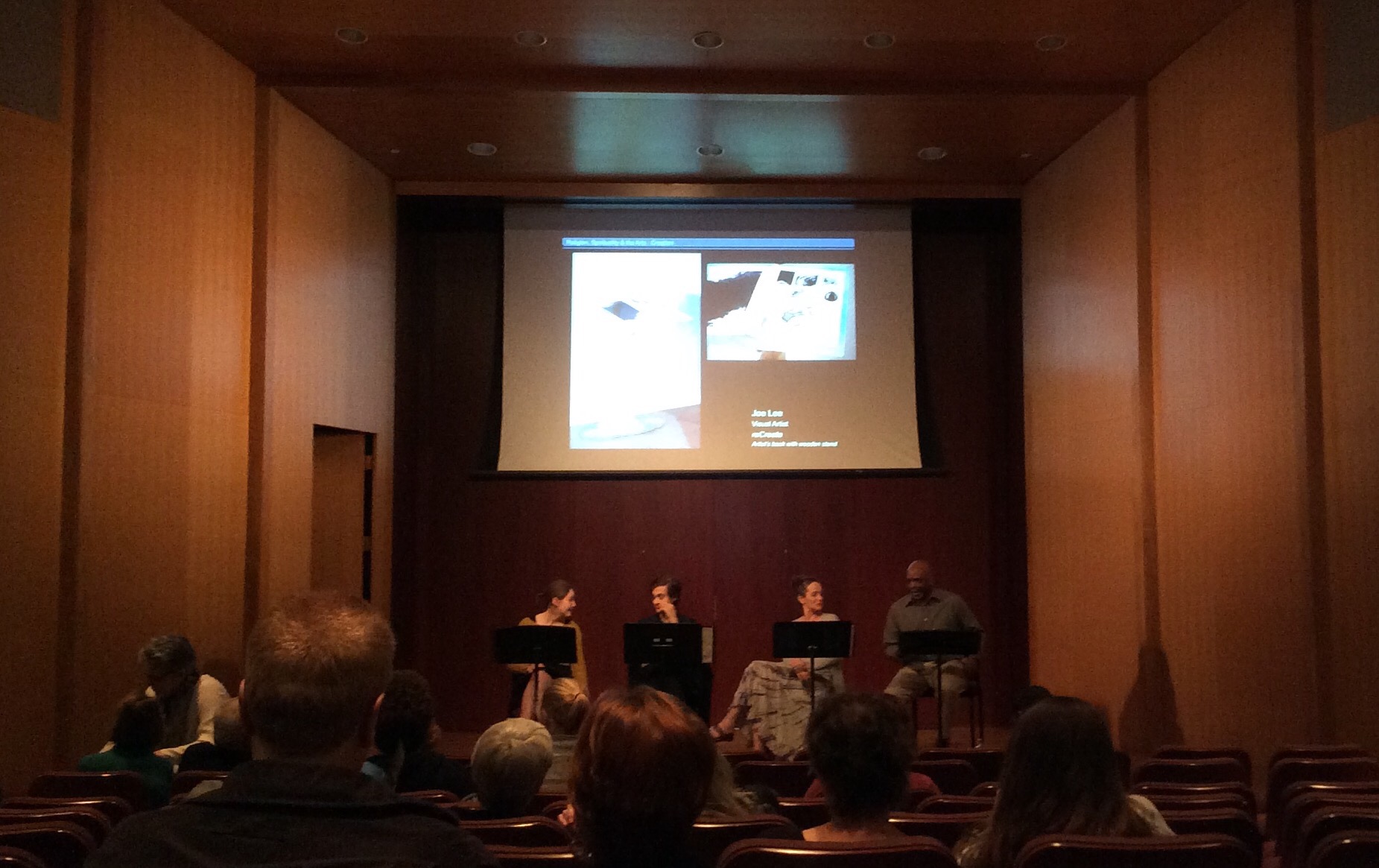
Last night I had the opportunity to attend a dramatic reading of the play “Mr. g,” by Wesley Savick, adapted from a novel by Alan Lightman. The performance was part of ArtsFest, and sponsored by the Religion, Spirituality, and the Arts program. Two of the performers were Butler students, and two were from the Indiana Repertory Theater.
The story is about Mr. g, a teenage boy. He contemplates how to tell his story, and whether it should start with “in the beginning,” “a long time ago in…” or something else. He had just woken up from a nap, and decided to create the universe. He reflects on how infinite possibilities result in infinite indecision, and the decision to replace nothingness with something. His aunt Penelope brings him his lunch (a sandwich, plate of cookies, and glass of milk), as he tells of creating time. She tells him off for bringing before and after, past and future, into existence – indeed, she complains about the tenses that she now has to use to complain about this new state of affairs. He then turned to space, including the creation of ambiguity by bringing quantum physics into existence – or did quantum physics create itself?
His neighbor stops by and asks him whether he thinks that a thing and its opposite can both be true. Mr. g says no. She points out that the universe he made will end in tragedy, thanks to free creatures that he is bringing into existence. But his uncle and aunt insist that if he wants to make animate beings, he will do so and make them just as he pleases. They encourage him to take his time and focus on one universe; they also talk about naming the universe, and instilling it with spirit, harmony, feeling, and beauty. He decides to call his universe Aalam 104729. Mr. g’s first law ends up being that the past is sharper than the future. His second is that there are no absolutes. The third is that every event must have a cause. He likes its spirituality and rationality. He notes that a very intelligent creature – should he ever make one – would be able to ponder it, but not penetrate beyond the first event. He decides those three laws are sufficient.
Uncle Deva suggests making everything connected to everything else, and to Mr. g, giving the universe a soul. But Deva reacts with disgust at how boring it would be if the universe contained nothing animate. Mr. g insists that he will not make anything immortal in his universe, because it would be against his law.
The neighbor girl comes over and questions the idea that physical laws will determine every thought of animate beings. She asks if he is afraid they will embarrass him. He says he just wants consistency and elegance.
Deva and Penelope “ooh” at stars coming into existence. They refer to him as an artist, a physicist, and a genius. He shows off the way the rotation of planets changes the light on the mountains. He continues to comment on how “it was good.”
But eventually he contemplates creating another universe with more organizing principles. Penelope suggests that he should finish the universe that he has already made, and accuses him of being greedy. At first, he is indignant, but eventually he recognizes how much pleasure he takes from creation, and how it could lead him to get carried away. And so he focuses on this universe and makes water. He is impressed by how some molecules have started replicating themselves, simply following the laws he made. He says he hadn’t fully taken into account the possibility of accidents. The neighbor girl asks whether life merely seems out of control, or in fact is out of his control. She is excited by the prospect of the highly complex brains of organisms producing effects that cannot be foreseen. She encourages him to let the living things unfold as they may. They pick up two petrie dishes and clink them, saying, “To Life!”
In the second act, uncle Deva asks about intelligent life as though he were asking about grandchildren. Deva suggests that the beauty of his glorious universe would make it even better, since more minds would appreciate that beauty. Mr. g asks what will happen if something goes wrong and animate life suffers. Deva tells him to have faith, since his goodness will ensure that suffering doesn’t happen. Mr. g wears a lab coat and goggles in these scenes. He is excited as a group of 200 million cells generate electrical activity unnecessary to their survival. He pokes the blob of cells with a stick, and expresses excitement at the blob’s awareness of being a “me” touched by something else. He feels sympathy towards it. Then he considers the possibility that thinking things could perform their own experience and discover the laws that he made. They will feel imagination and mystery. The neighbor girl imagines them crying out to God for rain, longing for immortality – the greater the mind, the worse the suffering. She notes that they enjoy harming each other, and must like it some how. Mr. g says he cannot accept that, and she remarks that perhaps all things cannot be contained. He asks why they fear death, and she suggests that perhaps they abhor the void and non-existence as much as he did. The scene concludes with Mr. g and the neighbor girl speaking as though they are two orphan sisters in a war.
At the start of the next scene, Mr. g asks Penelope whether she was happier back before he made time and suffering. She cries. Deva emphasizes that they have other things besides suffering – emphasizing music. Penelope says that creation has changed them, and asks why they should be immortal while those suffering creatures do not. She also asks whether the creatures know he is their creator, and he says they have ideas about him – “religion.” They discuss whether mystery inspires the creatures, and whether it would be better for him to reveal himself to them. Mr. g comments on their sense of the void even though they cannot grasp it. Deva suggests giving the creatures a tiny glimpse of the void at the moment of death, so that they sense they are part of something immortal.
Mr. g takes delight in the observation of two complete strangers exchanging pleasantries, suggesting that the creatures finding meaning may be what matters, rather than their meaning to immortals. The neighbor girl observes that Mr. g is as susceptible to mystery as they are – and he remains a mystery to her. Mr. g revisits the sisters, and gives one of them a glimpse of the void before she dies. He comments on the way her molecules will become part of millions of other people as time passes. The neighbor girl takes Mr. g to see where she lives – a barren place as his laws lead to the heat death of the universe. She asks if he would do it again, knowing what he knows now. He says he regrets that there was suffering. But she asks the question again. Penelope asks her nephew what he will do next. Mr. g says he misses it, but his aunt and uncle say there will be another, and another, and another after that. The play ends with Mr. g saying, “Yes.”
The performance was followed by a conversation between my colleague Brent Hege and Mark Kesling from The Da Vinci Pursuit. Hege talked about myth, and Kesling suggested that Lightman uses story to help people understand science. Hege noted how the play begins with Mr. g and others stumbling over language, and how the limitations of language and the need for myths and models and stories connect science and religion. The audience was then invited to join in the conversation. Hege commented on the neigbor girl as a Satan character (or better, Mephistopheles in Goethe’s Faust), representing indeterminacy, over against God who represents law. Rabbi Dennis Sasso offered the comment that “the enemy of wonder is fundamentalism.” Rabbi Sandy Sasso shared that Lightman is of the view that physics is best done by the young, and novel writing by the older, and this reflects his own shift from the one to the other. Hege commented on the shift of Mr. g from focusing on power to focusing on love as his character develops. Kesling remarked on the way the body recycles itself, so that we are only ever 16 years old. Alexander Borrello (who performed Mr. g’s part) shared Lightman’s comments on why Mr. g and the neighbor are depicted as teenagers – their impetuousness, their impulse to create, their naïveté, contrasted with the stability preferred by the older characters, in particular the aunt. Lacy Weixel (the neighbor girl) noted that her character is introduced with the question of whether a thing and its opposite can both be true. I found this to have a Taoist slant, as order and chaos, law and chance, male and female interact creatively to bring about life and everything else about the universe as we know it.
On this Thursday at 6:30pm, Alan Lightman will be on campus in the same venue, Butler University’s Eidson Duckwall Recital Hall.
I am so happy that scientists and artists and educators explore the multifaceted nature of human existence, and the limits of our human understanding from all vantage points, in creative ways that invite a wider audience into the conversation and prompts us to reflect and explore for ourselves.
Previous Post
April 17, 2017
United Ark-Lines
Next Post

April 19, 2017 Applying the Baloney-Detection Kit
Browse Our Archives
Select a Category 1 Corinthians 1 John 1 Peter 1 Samuel 1 Thessalonians 1 Timothy 2 Corinthians 2 Kings 2 Peter 2 Samuel 2 Thessalonians 2 Timothy academia Acts of the Apostles afterlife Akhaten Alcatraz American Academy of Religion Amos Anglican Arabic Aramaic archaeology art artificial intelligence astronomy atheism atonement Babylon 5 Baptists Battlestar Galactica Bible Biblical Studies Carnival biblioblogging Black Mirror Blade Runner Book of Job book review Buddhism Call for Papers China Christianity Christmas Christology Chronicles Coptic creation Daniel Deuteronomy Doctor Who Dune Easter Ecclesiastes economics education Eldad Keynan Enoch Seminar Ephesians eschatology Esther Evangelicals evolution Exodus Expanse Ezekiel Ezra fantasy Fringe fundamentalism Galatians games Ge'ez genealogy Genesis Gnosticism Gospel of Jesus' Wife Gospel of John Gospel of Judas Gospel of Luke Gospel of Mark Gospel of Matthew Gospel of Peter Gospel of Thomas Greek Harry Potter Hebrew Hebrews Hinduism historical Jesus history Hitchhiker's Guide to the Galaxy Holidays horror Hosea humor incarnation India inerrancy information literacy inspirational Intelligent Design Ireland Isaiah Islam Israel Italy James Jeremiah John the Baptist Jonah Joshua Judaism Jude Judges Judith Lamentations languages Latin Leviticus libraries literature Lord of the Rings LOST Mandaeans Mandaic memes Methodism Micah monotheism morality Mormons movies music mythicism NASSCAL Nehemiah new perspective New Testament news Numbers Orthodox paganism panentheism pantheism Patheos Paul and his letters Pentecostals Philippians Philippians 2:6-11 philosophy physics Planet of the Apes podcast politics Progressive Christianity Protestantism Proverbs Psalms pseudoscience racism religion Revelation Roman Catholicism Romania Romans Ruth scams science science fiction Secret Gospel of Mark Society of Biblical Literature Song of Songs Star Trek Star Wars Stargate Swahili Syriac Taoism technology Terminator The Handmaid's Tale The Hobbit The Matrix theodicy theology theory Timeless Titus tomb Torchwood travel TRON Uncategorized United Kingdom Westworld X-Files young-earth creationism Zechariah
Select a Month October 2026 September 2026 August 2026 July 2026 June 2026 May 2026 April 2026 March 2026 February 2026 January 2026 December 2025 November 2025 October 2025 September 2025 July 2025 June 2025 May 2025 April 2025 March 2025 February 2025 January 2025 December 2024 November 2024 October 2024 September 2024 August 2024 July 2024 June 2024 May 2024 April 2024 March 2024 February 2024 January 2024 December 2023 November 2023 October 2023 September 2023 August 2023 July 2023 May 2023 April 2023 March 2023 February 2023 January 2023 December 2022 November 2022 October 2022 September 2022 August 2022 July 2022 June 2022 May 2022 April 2022 March 2022 February 2022 January 2022 December 2021 November 2021 October 2021 September 2021 August 2021 July 2021 June 2021 May 2021 April 2021 March 2021 February 2021 January 2021 December 2020 November 2020 October 2020 September 2020 August 2020 July 2020 June 2020 May 2020 April 2020 March 2020 February 2020 January 2020 December 2019 November 2019 October 2019 September 2019 August 2019 July 2019 June 2019 May 2019 April 2019 March 2019 February 2019 January 2019 December 2018 November 2018 October 2018 September 2018 August 2018 July 2018 June 2018 May 2018 April 2018 March 2018 February 2018 January 2018 December 2017 November 2017 October 2017 September 2017 August 2017 July 2017 June 2017 May 2017 April 2017 March 2017 February 2017 January 2017 December 2016 November 2016 October 2016 September 2016 August 2016 July 2016 June 2016 May 2016 April 2016 March 2016 February 2016 January 2016 December 2015 November 2015 October 2015 September 2015 August 2015 July 2015 June 2015 May 2015 April 2015 March 2015 February 2015 January 2015 December 2014 November 2014 October 2014 September 2014 August 2014 July 2014 June 2014 May 2014 April 2014 March 2014 February 2014 January 2014 December 2013 November 2013 October 2013 September 2013 August 2013 July 2013 June 2013 May 2013 April 2013 March 2013 February 2013 January 2013 December 2012 November 2012 October 2012 September 2012 August 2012 July 2012 June 2012 May 2012 April 2012 March 2012 February 2012 January 2012 December 2011 November 2011 October 2011 September 2011 August 2011 July 2011 June 2011 May 2011 April 2011 March 2011 February 2011 January 2011 December 2010 November 2010 October 2010 September 2010 August 2010 July 2010 June 2010 May 2010 April 2010 March 2010 February 2010 January 2010 December 2009 November 2009 October 2009 September 2009 August 2009 July 2009 June 2009 May 2009 April 2009 March 2009 February 2009 January 2009 December 2008 November 2008 October 2008 September 2008 August 2008 July 2008 June 2008 May 2008 April 2008 March 2008 February 2008 January 2008 December 2007 November 2007 October 2007 September 2007 August 2007 July 2007 June 2007 February 2007 January 2001
Follow Us!
TAKE THE
Religious Wisdom Quiz
Who baptized Jesus?
Select your answer to see how you score.
John the Baptist Peter James Paul
Books by This Author Books by James F. McGrath
Related posts from Religion Prof: The Blog of James F. McGrath

Calls for Papers and Butler University Day of...
Religion Prof: The Blog of James F. McGrath

Religion Prof: The Blog of James F. McGrath
Why Study Religious Studies at Butler University?
Religion Prof: The Blog of James F. McGrath

Religion Prof: The Blog of James F. McGrath
TRENDING AT PATHEOS Progressive Christian

The First Eucharistic Controversy: Christ’s Real Presence
For Catholics, the Eucharist is the source and summit of the Christian...

How to Make a Decision When You Can't...
Main point: It’s much more valuable to stay close to God so...

Archdiocese Hosts Military Marriage Retreat in Germany
RASTATT, Germany — The transient military lifestyle, with its frequent deployments and...

Nearly every morning, I make the drive to Detroit with my high-school-age...

The Real AI Story Is Adoption Without Trust
Artificial intelligence has crossed a political threshold. It is no longer a...

A new article, written by Jeff Lindsay and Gale L. Pooley,...
view all Progressive Christian blogs
Ad-Free & Subscriber Log-In Subscription Support
- About Us
- 2026 Calendar
- Videos
- Podcasts
- Library of World Religions
- Faith In Media Tracker
- Advertise With Us
- Write for Us
- Privacy Policy
- Terms of Service
- Do Not Sell My Data
- Contact Us
- Radiant Digital
- Manage Newsletter Subscriptions
- Unsubscribe From Notifications
- Sitemap
Copyright 2008-2026, Patheos. All rights reserved.
Subscription Support Ad-Free & Subscriber Log-In
Follow Patheos